
As the autumn foliage turns the street trees red and yellow, the familiar cityscapes we walk through every day take on a striking new beauty. When choosing a place to live, beyond commuting convenience and access to shopping, this is perhaps the time of year when we find ourselves rethinking how having lush greenery and waterside spaces just a short walk away impacts both our quality of life and the value of our home.
This installment marks the final chapter of our series on "Large-Scale Urban Green Spaces and Residential Property Value." For this concluding article, we focus on the area surrounding Ohori Park (大濠公園), which boasts vast water features and greenery right next to Chuo Ward, Fukuoka City (福岡市中央区)—the largest commercial and business hub in Kyushu.
Looking not only from a real estate investment perspective but also through the lens of families and singles seeking a place to actually live, we will objectively organize official land price trends, ongoing redevelopment plans, living environment characteristics, and essential pre-purchase checks such as disaster risk and sunlight conditions.
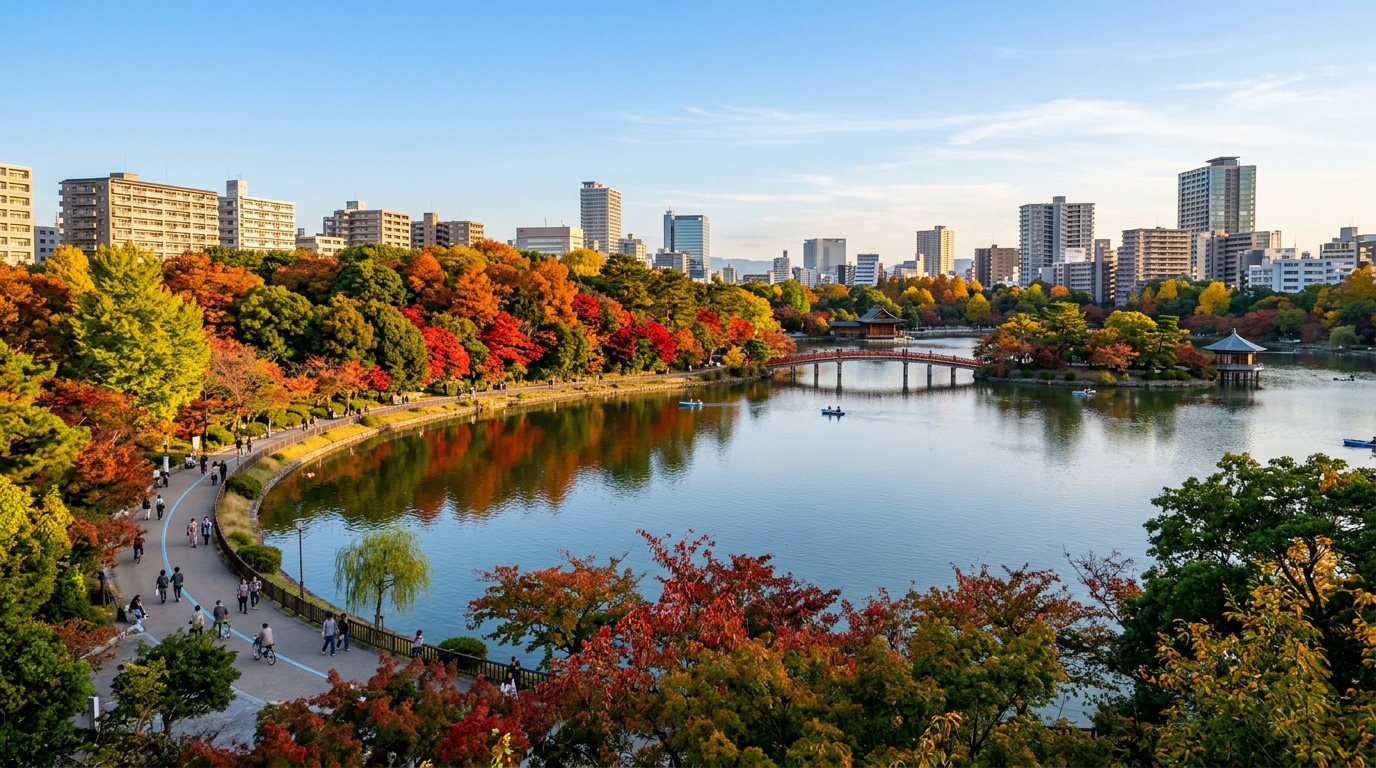
First, to provide an overview of the current state of Chuo Ward, Fukuoka City, and the Ohori Park area, the table below summarizes land price and transaction trends alongside major ongoing urban planning schedules.
| Item / Indicator | Trends & Schedules in Chuo Ward, Fukuoka City & Around Ohori Park (as of 2026) |
|---|---|
| Official Residential Land Price Trends | While residential land across Fukuoka City continues to rise, the citywide rate of increase shows signs of moderating. The standard benchmark site in Ohori 1-chome (大濠1丁目) maintains the highest level in the prefecture at around ¥1.49 million/m² as of 2026, roughly 2.4 to 2.5 times its level 10 years ago. |
| Pre-owned Condo Transaction Price Trends | Across Chuo Ward as a whole, recent pre-owned condo transaction unit prices trend around ¥600,000/m² (approx. double the level 10 years ago). Around Ohori, depending on location and building age, some properties trade at ¥700,000–¥800,000+/m². |
| Tenjin Big Bang (City Center Redevelopment) | 85 buildings completed as of the end of March 2026, with approx. 90 scheduled by the end of 2026 and approx. 120 by the 2030s. Following ONE FUKUOKA BLDG. and others, redevelopment of the Tenjin 2-chome South Block Ekimae East District is underway. |
| Central Park Concept | An integrated utilization project for Ohori Park and Maizuru Park (舞鶴公園) (totaling approx. 80 ha), scheduled for completion in 2030. Restoration and public opening of Maizuru Park's "Shiomi Yagura" (潮見櫓) completed in March 2025. |
| New Fukuoka Prefectural Museum of Art & Related Facilities | Fukuoka Budokan (福岡武道館) relocated and opened in Higashi Park (東公園) in January 2026. Construction of the New Fukuoka Prefectural Museum of Art (新福岡県立美術館) on the south side of Ohori Park began in May 2026 (scheduled to open in FY2029; the Japanese Garden will temporarily close from the end of March 2027). |
| Surrounding Park Redevelopment (Nishi Park) | Redevelopment via Park-PFI is underway at the adjacent prefectural Nishi Park (西公園) to the north (construction started March 2026; a new hub with an observation terrace and dining facilities is scheduled to open in May 2027). |
1. The Value Large-Scale Urban Green Spaces Bring to Residential Areas (Series Finale)
In conclusion, residential areas surrounding large urban parks close to the city center possess a structure where demand is easily supported over the long term by three factors: "scarcity of supply," "preservation of the living environment," and "synergy with surrounding redevelopment."
In urban areas, as office buildings, commercial facilities, and condominiums are constructed, it becomes increasingly difficult to secure new, contiguous expanses of natural space. Consequently, a location bordering an already established, large-scale park becomes a rare condition that cannot be replicated later.
Furthermore, from the perspective of living in a home, having a park next door prevents dense building crowding, making it easier to maintain open sightlines, good ventilation, and seasonal scenery in daily life. Moreover, as high-rise development and business concentration advance in the city center—such as in Fukuoka's Tenjin (天神) area—attention increasingly turns to residential areas that offer quietness and greenery while remaining close to workplaces, creating a virtuous cycle where overall urban growth enhances the living environment around the park.
2. Basic Data and Neighborhood Characteristics of Chuo Ward & Ohori Park
The Ohori Park area features a distinctive urban structure even within Japan, where roughly 80 hectares of green and waterside space sit directly adjacent to the transit convenience of being just minutes from downtown Tenjin.
Ohori Park is a prefectural park with a total area of approx. 39.8 ha (of which approx. 22.6 ha is the pond), built utilizing the outer moat of Fukuoka Castle, and it will celebrate its 100th anniversary in 2029. Combined with the adjacent Maizuru Park (Fukuoka Castle Ruins) to the east, the area reaches approx. 80 ha (roughly 17 times the size of Tokyo Dome), situated close to the city center and surrounded by Fukuoka City Subway Airport Line's Ohori Koen Station (大濠公園駅) and Tojinmachi Station (唐人町駅), as well as Nanakuma Line's Ropponmatsu Station (六本松駅).
Currently, two major movements shaping the future of this area are progressing simultaneously. The first is the central redevelopment project "Tenjin Big Bang." With 85 buildings completed as of the end of March 2026 and approx. 120 buildings scheduled for reconstruction into the 2030s, Tenjin's business concentration and employment opportunities are expanding significantly.
The second is the "Central Park Concept" (scheduled for completion in 2030) promoted by Fukuoka Prefecture and Fukuoka City. This plan aims to develop Ohori Park and Maizuru Park into an integrated "vast museum space," and in March 2025, the "Shiomi Yagura" in Maizuru Park was restored and opened to the public for the first time in 117 years. Additionally, the Fukuoka Budokan on the south side of Ohori Park relocated and opened in Higashi Park in January 2026; on the southern site including its former grounds, the "New Fukuoka Prefectural Museum of Art," designed by Kengo Kuma (隈研吾), held its groundbreaking ceremony in May 2026 and is under construction toward a FY2029 opening. At Nishi Park to the north, a new hub facility featuring a cafe and observation deck is also being developed for a May 2027 opening, gradually updating the appeal of the entire park cultural zone.
3. Transaction Unit Price Trends and Price Ranges Around Ohori Park
Although the pace of land price increases across Fukuoka City as a whole has begun to show signs of calming, residential land and condominium transaction unit prices around Ohori Park continue to trend at an exceptionally high level even within the city.
Looking at the Ministry of Land, Infrastructure, Transport and Tourism's Official Land Prices (2026), while residential land in Fukuoka City has risen for 14 consecutive years, the citywide year-on-year rate of change narrowed slightly from around 9.0% in 2025 to around 7.0% in 2026. Behind this is the fact that, in addition to rising construction costs and property prices, higher mortgage interest rates are beginning to create a sense of a ceiling on budgets for general buyers.
However, the area facing Ohori Park shows a resilience somewhat distinct from these citywide movements. The residential standard site in Ohori 1-chome recorded an official land price of around ¥1.49 million/m² in 2026 (up over 13% year-on-year), representing roughly 2.4 to 2.5 times its level 10 years ago in 2016 (in the ¥600,000/m² range).
| Area / Target Category | Unit Price & Price Trends as of 2026 (from Official Statistics & Market Trends) | Characteristics & Background of Price Formation |
|---|---|---|
| Ohori 1-chome (Residential Land, Official Land Price) | Approx. ¥1.49 million/m² (approx. 2.4–2.5x vs. 10 years ago) | Long-term maintenance of the highest residential land price in the prefecture. Quiet living environment and rare location tend to be highly valued. |
| Chuo Ward, Fukuoka City (Residential Land, Official Land Price) | Around ¥560,000/m² (approx. 2.1x vs. 10 years ago) | Surpassed 1991 levels, supported by the largest urban residential demand in Kyushu. |
| Chuo Ward, Fukuoka City (Pre-owned Condo Transactions) | Around ¥600,000/m² (approx. 2x vs. 10 years ago) | Both studio and 3LDK units circulate, trending at an annual 5%+ increase over the past 5 years. |
| Around Ohori (Pre-owned Condo Market) | ¥700,000–¥800,000+/m² (some cases around ¥70–¥80 million+ for 70 m²) | Unit price differences tend to emerge based not only on distance to the station, but also "proximity to the park, unobstructed views, and management condition." |
Looking closely at actual transactions, even within the Ohori area, characteristics differ by district and site conditions. Ohori 1-chome, stretching to the west and south of the park, has a strong impression of a low-rise, calm upscale residential neighborhood, whereas Arato (荒戸) and Ohori 2-chome to the north offer easy daily access to Tojinmachi Station and shopping streets. Furthermore, even among "properties close to the park," whether one can actually see the park's greenery depends on the height of buildings in front and the orientation of windows, so it is important to note that significant differences in price per square meter can arise even for properties of the same age and size.
4. Livability and Living Environment Insights Unique to Green-Adjacent Areas
The livability of the Ohori Park area lies in being able to incorporate seasonal nature into daily routines while enjoying urban living infrastructure—medical, commercial, and cultural—within walking distance or a short trip.
Inside the park, where ginkgo and maple trees turn vibrant colors during the November autumn foliage season, a roughly 2 km loop course is maintained, making morning and evening walks, jogging, and dog walking an established part of residents' daily lives. The park is dotted with "Ohori Terrace" (大濠テラス)—opened utilizing the Park-PFI system—cafes, and the Fukuoka Art Museum (福岡市美術館). Once the New Fukuoka Prefectural Museum of Art opens in FY2029, the strolling routes integrating Japanese gardens and art spaces will become even richer.
In terms of daily convenience, Tojinmachi Shopping Street, supermarkets along the subway line, and commercial facilities in the Ropponmatsu area (such as Ropponmatsu 421) are close by, making everyday shopping effortless. Additionally, Chuo Ward offers good access to general hospitals including Hamanomachi Hospital (浜の町病院) and Fukuoka Chuo Hospital (福岡中央病院), which opened in Yakuin (薬院) in January 2026—a reassuring factor for all generations from child-rearing families to seniors.
Looking at public support for home acquisition, for moves from April 2026 onward, the "FY2026 Fukuoka City Child-Rearing Household Intra-City Moving Support Project" (令和8年度 福岡市子育て世帯市内引越し応援事業) is in place. If an intra-city move meets the requirements (such as new earthquake-resistance standards, floor area criteria, and designated school district conditions), it may be possible to combine subsidies for home acquisition, rent, and moving expenses. Checking available programs in advance—including the "Three-Generation Co-residence / Near-residence Moving Support Project" (三世代同居・近居住替え支援事業) for living with or near parents, and the national "Mirai Eco Housing 2026 Project" (みらいエコ住宅2026事業) for energy-efficient new builds and insulation renovations—makes financial planning much easier.
5. Livability and Points to Watch: Family vs. Single Perspectives
For families, the appeal lies in "educational environment and quality of living," though balancing space and price can be a challenge. For singles, "proximity to work and a refreshing environment" is attractive, while careful scrutiny of site conditions is essential.
Family Perspective
Surrounding school districts such as Tonin Elementary School (当仁小学校), Maizuru Elementary and Junior High School (舞鶴小中学校), and Akasaka Elementary School (赤坂小学校), along with the academic atmosphere created by university-affiliated junior and senior high schools, garner strong support from child-rearing households. An environment where children can experience nature and cultural facilities without traveling far on weekends enriches family time. On the other hand, 3LDK condos over 70 m² and detached houses with land have limited market circulation and tend to be priced high, making budget balancing strict. For condominiums, calculating monthly housing costs including management fees, repair reserve funds, and parking fees, and comparing options such as buying a pre-owned condo and performing insulation or other renovations, can lead to a sustainable plan.
Single / DINKS Perspective
Using the Subway Airport Line, Tenjin is just minutes away, and Hakata Station (博多駅) and Fukuoka Airport (福岡空港) are accessible without transfers, offering high time efficiency for frequent business travelers and singles working downtown. Even for those working primarily remotely, having an environment where you can take a walk in the park between work tasks helps refresh both mind and body. However, along arterial roads such as Meiji-dori (明治通り) and Kokutai-doro (国体道路), traffic volume and emergency vehicle sirens can be noticeable, so it is important to visit the site at different times of day to check the sound environment. Also, if you anticipate moving or renting out the property in the future, checking the management association's repair plan and the brightness of nighttime walking routes from the station provides peace of mind.
6. Key Pre-Purchase Checks: Disaster Risk, Sunlight, and Surrounding Environment
Even in a prime area adjacent to green space, carefully conducting "flood and earthquake risk checks" and "site-specific sunlight and view verification" directly leads to a regret-free home choice.
The three practical checkpoints you should always verify before purchasing are as follows:
- Checking Flood and Landslide Risk: Because the Ohori Park area has topographical characteristics close to Hakata Bay (博多湾), rivers, and a large pond, it is necessary to check the designated inundation areas and expected flood depths for "river flooding," "inland flooding," "storm surge," and "tsunami" on a block-by-block basis using the Fukuoka City Comprehensive Hazard Map. Note that while Ohori Park itself is a designated evacuation site for earthquakes and tsunamis, parts of the southern side of Maizuru Park and the hilly areas toward Sakurazaka (桜坂) are designated as steep slope areas (landslide warning zones), making terrain-specific checks essential.
- Preparing for the Kego Fault Zone and Checking Ground Conditions: Given the presence of the "Kego Fault Zone" (警固断層帯) running through central Fukuoka City, it is important to factor into your budget compliance with new earthquake-resistance standards and seismic diagnosis results for pre-owned condos, or seismic resistance grades, liquefaction prediction maps, and potential ground improvement needs for detached houses.
- Seasonal Sunlight and Future Building Potential: Even in locations close to the park, sunlight—especially around the winter solstice—varies greatly depending on whether the zoning of adjacent southern plots allows tall buildings to be constructed.
During the property consideration stage, checking and saving transaction unit price trends and hazard information for addresses of interest using "Mekiki Research" area surveys makes comparison smooth. Additionally, when considering building or rebuilding a detached house in the area, using the Pro plan's AI Architecture Simulator allows you to visualize detached house floor plans, 3D models, summer/winter solstice sunlight simulations, and approximate total budgets tailored to the area's conditions in advance.
7. Summary of the 5-City Comparison on Urban Green Spaces and Residential Property Value
Comparing large-scale green space areas across five major Japanese cities reveals a common pattern: areas that combine "scarcity of green space," "proximity to central business districts," and "continuous investment in parks and culture" tend to maintain stability in both living environment and asset value.
To conclude the series, we have compared and organized the structure of representative large-scale urban green spaces and their surrounding residential areas in five major cities: Tokyo, Osaka, Nagoya, Sapporo, and Fukuoka.
| City (Representative Example) | Green Space & Location Characteristics | Residential Price & Demand Trends | Synergy with Redevelopment & Urban Structure |
|---|---|---|---|
| Tokyo (Around Yoyogi Park, Shinjuku Gyoen, etc.) | Vast forests spreading right next to central business and commercial hubs. Multiple rail lines converge. | Highest price tier in Japan. Tends to remain at high levels driven by domestic/overseas affluent buyers and urban end-user demand. | As large-scale redevelopment in Shibuya and Shinjuku progresses, the scarcity of quiet green-adjacent housing stands out. |
| Osaka (Around Utsubo Park, Nakanoshima Park, etc.) | Urban park type where business districts sit adjacent to waterside and greenery. Strong work-life proximity. | Steady condo demand in Chuo, Nishi, and Kita wards. Broad buyer base from singles to families. | Umeda area development and new rail lines (such as the Naniwasuji Line) improve walkability around waterside and parks. |
| Nagoya (Around Meijo Park) | Vast historic park centered on Nagoya Castle harmonizing with a spacious road network. | While citywide growth has moderated in phases, areas balancing convenience and environment tend to be chosen. | Introduction of private facilities in the park and castle perimeter improvements enhance daily vibrancy and residential appeal. |
| Sapporo (Around Maruyama Park, Nakajima Park) | Fusion of pioneering history and natural terrain, directly connected to downtown (Odori, Sapporo Station) via subway. | Chuo Ward, Sapporo shows strong population retention, and green-adjacent residential areas maintain stable valuations. | Even amid downtown redevelopment, seasonal nature and snow-country subway convenience support residential value. |
| Fukuoka (Around Ohori Park, Maizuru Park) | Approx. 80 ha of greenery integrating water features and castle ruins, adjacent to Tenjin and airport access. | Even as citywide price growth adjusts, Ohori 1-chome and similar areas show extremely strong resilience. | Unique synergy from the simultaneous progress of "Tenjin Big Bang" and the "Central Park Concept (2030)." |
What emerges across all five cities is that places that continue to be chosen—even amid changing eras and interest rate environments—are not simply those with "a big park," but those close to downtown workplaces and transit hubs where the public and private sectors collaborate to continuously update park spaces for the times. The area around Ohori Park in Fukuoka is one of the few areas continuing to evolve toward the FY2029 opening of the New Fukuoka Prefectural Museum of Art and the 2030 completion of the Central Park Concept, making it an urban model poised to attract attention for both "richness of life" and "asset stability."
8. Conclusion
Shining in the autumn foliage season, the area around Ohori Park is a residential district distinctive even nationwide, where high transit convenience to the city center harmonizes with roughly 80 hectares of waterside, greenery, and cultural space as part of daily life. While recent transaction unit prices and official land prices remain at high levels, when actually choosing a home, it is important not to judge solely by the "Ohori" name or image, but to calmly verify the atmosphere of each block, station access routes, views and sunlight, as well as hazard information including flood risks and the Kego Fault Zone.
Furthermore, across Fukuoka City as a whole, rising property prices and interest rate trends are driving greater differentiation by price range and area. We encourage you to proceed with your evaluation by accumulating objective facts based on official data, while keeping your own lifestyle and total budget in mind.
By registering as a free member, you can directly pull the Ministry of Land, Infrastructure, Transport and Tourism data used in this blog from your Claude or ChatGPT (via MCP integration). Please use it to compare and organize price trends and hazard information for addresses of interest within your own AI environment to make a well-informed home choice.