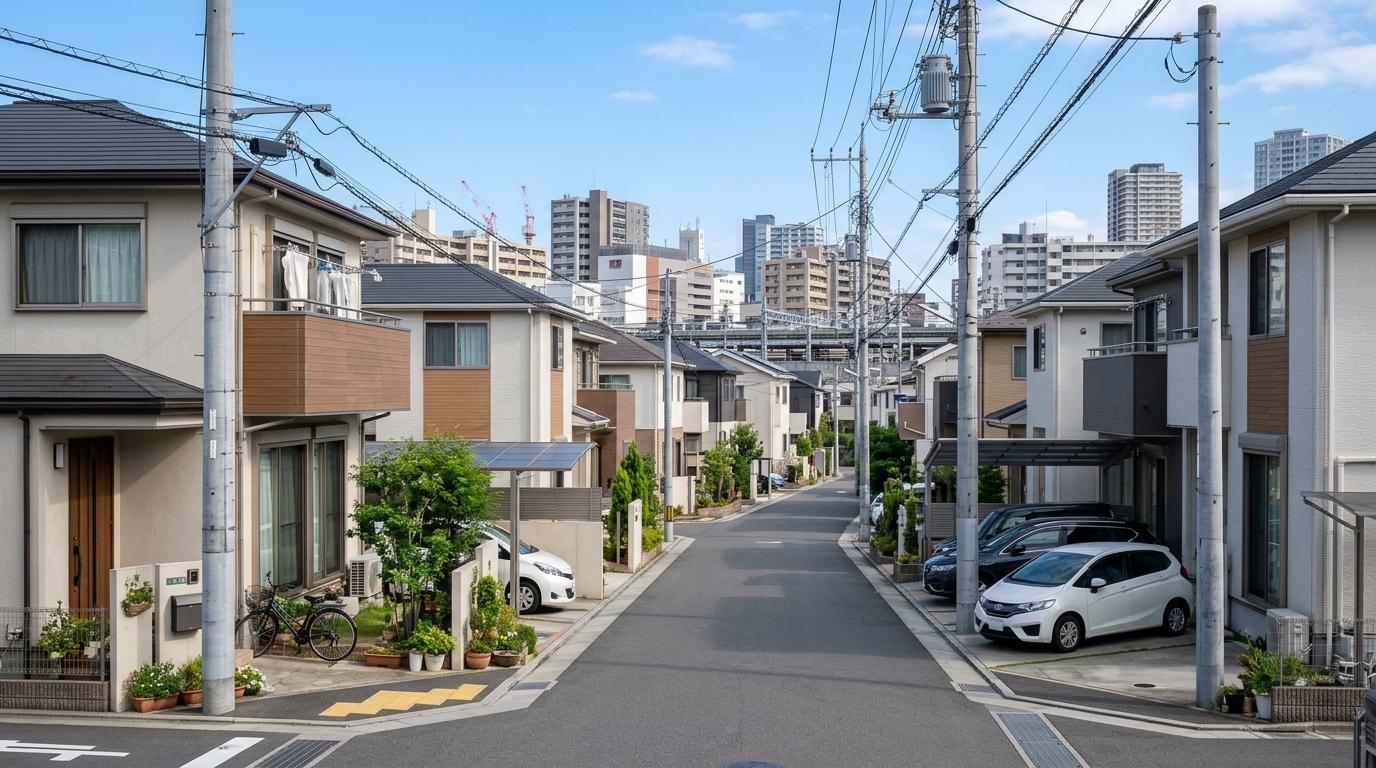
Located at the eastern tip of Kanagawa Prefecture (神奈川県), facing Ota Ward, Tokyo (東京都大田区) across Tokyo Bay (東京湾) and the Tama River (多摩川), Kawasaki Ward, Kawasaki City (川崎市川崎区) is home to the major transit hubs of JR Kawasaki Station (JR川崎駅) and Keikyu Kawasaki Station (京急川崎駅). Yet, it offers a distinct price range and urban character compared to neighboring Saiwai Ward (幸区) and Nakahara Ward (中原区)—home to the Musashi-Kosugi area. In addition to its exceptional transit convenience with direct access to central Tokyo and Haneda Airport, large-scale station-front redevelopments and waterfront land-use conversions are gaining momentum toward 2030, drawing renewed attention from buyers considering land or detached homes.
However, choosing a home in Kawasaki Ward based solely on "distance from the station or lot size" can lead to overlooking critical underlying conditions. Located on low-lying land at the mouth of the Tama River and along Tokyo Bay, the area carries specific flood hazard and ground characteristics, as well as a mixed residential-industrial streetscape shaped by its history as an Edo-period post town and part of the Keihin Industrial Area (京浜工業地帯). Factoring in these realities behind the pricing is essential.
Using official data—including real estate transaction records from the Ministry of Land, Infrastructure, Transport and Tourism (MLIT / 国土交通省), 2026 official land prices (公示地価), and Kawasaki City's hazard maps and municipal policies—this article examines why real estate in Kawasaki Ward is priced as it is today, and outlines both the "advantages" and "trade-offs" to help you make an informed decision when building a detached house or selecting land.
| Indicator / Item | Kawasaki Ward, Kawasaki City (and JR Kawasaki Station Area) | Supplementary / Comparative Data (as of 2026) |
|---|---|---|
| Official Land Price (Residential Avg.) | ¥1.11M / tsubo (+4.7% YoY) | Saiwai Ward: ¥1.28M/tsubo; Nakahara Ward: ¥1.55M/tsubo; Tsurumi Ward: ¥1.02M/tsubo |
| Official Land Price (All Uses Avg.) | ¥742,900 / ㎡ (+7.8% YoY) | +72.45% compared to 10 years ago |
| Pre-owned Condo Median Contract Price | Kawasaki Ward: ¥38.0M (approx. ¥628,000/㎡) | Kawasaki City overall: ¥46.0M (approx. ¥671,000/㎡) |
| Actual Transactions near JR Kawasaki Station | Station area (Saiwai Ward side): approx. ¥530,000/㎡ (Median: ¥48.0M) | 2021–2026, 3,499 transactions (MLIT API) |
| Major Redevelopments (through 2030) | Kawasaki Arena-City / Keikyu Kawasaki Station West Exit Redevelopment | Arena construction scheduled for 2027; opening/completion scheduled for 2030 |
| New Childcare & Housing Policies | Child Medical Expense Subsidy expanded to high school age (from Sept. 2026) | Mandatory Solar Power System Installation Program (from Apr. 2025) |
1. Transaction Trends and Contract Price Movements in Kawasaki Ward: Why Is It Valued at This Level?
In short, the Kawasaki Ward real estate market is characterized by a coexistence of "high valuations in commercial, high-density areas near the station" and "price differentials driven by residential environment and hazard conditions within the ward." Compared to neighboring Saiwai and Nakahara Wards, it remains at a level where buyers can more realistically consider land and detached homes within their budgets.
When querying actual transaction data from MLIT's Real Estate Information Library (不動産情報ライブラリ) at the JR Kawasaki Station coordinates (35.5313° N, 139.6969° E), the JR rail line running north-south/east-west forms the ward boundary: the East Exit side is Kawasaki Ward, while the West Exit side is Saiwai Ward. Consequently, alongside local facility data on the Kawasaki Ward side (such as Miyamae Elementary School, Fujimi Junior High School, and Ota General Hospital), municipal-level transaction statistics for the station area are aggregated on the neighboring Saiwai Ward side (3,499 transactions from 2021 to 2026). Looking at the broader JR Kawasaki Station commercial area including the Saiwai Ward side, the average transaction price is approximately ¥53.19 million, the median is ¥48.0 million (ranging from ¥2.0 million to ¥1.3 billion), and the average unit price reaches approximately ¥530,000/㎡.
Our quarterly aggregation of MLIT Real Estate Information Library transaction data for the JR Kawasaki Station area (Saiwai Ward side) shows the following recent trends by property type:
| Property Type (JR Kawasaki Station Area, Saiwai Ward Side) | 2025 Q1 Median Unit Price | 2026 Q1 Median Unit Price | YoY Change | 2026 Q1 Transactions / Median Price |
|---|---|---|---|---|
| Pre-owned Condos, etc. | Approx. ¥810,000/㎡ | Approx. ¥830,000/㎡ | +1.5% | 116 / ¥54.0M |
| Residential Land (Land & Building) | Approx. ¥730,000/㎡ | Approx. ¥860,000/㎡ | +17.9% | 47 / ¥55.0M |
| Residential Land (Land Only) | ¥350,000/㎡ | ¥430,000/㎡ | +22.9% | 3 / ¥58.0M |
Source: Quarterly aggregation by our company based on MLIT Real Estate Information Library transaction data (2024 Q2 – 2026 Q1). The chart above shows the trend in median unit price per square meter for pre-owned condos, etc.
Two key insights emerge from this data. First, while commercial districts directly connected to or near the station maintain high price levels (in Omiya-cho, a 3LDK, 75㎡ unit built in 1999 traded for ¥84.0 million in 2026 Q1; by district, median condo unit prices are ¥1.20M/㎡ in Omiya-cho and approx. ¥1.04M/㎡ in Minamisaiwai-cho), prices step down in residential areas slightly farther from the station (Tsukagoshi at approx. ¥730,000/㎡, Ogura at approx. ¥630,000/㎡, and detached homes in Minamikase at approx. ¥620,000/㎡), and even further across Kawasaki Ward as a whole. In fact, Kawasaki Ward's 2026 official residential land price averages ¥1.11M/tsubo (+4.7% YoY), showing a clear gap compared to Saiwai Ward (¥1.28M/tsubo) and Nakahara Ward (¥1.55M/tsubo). The median contract price for pre-owned condos (2025 Q3 – 2026 Q2) in Kawasaki Ward is also ¥38.0 million (approx. ¥628,000/㎡, 378 transactions), lower than the citywide median of ¥46.0 million. This price gap is precisely what creates room for buyers to consider land and detached homes in Kawasaki Ward.
Second, the quarterly transaction volume for "Residential Land (Land Only)" is extremely thin—just 4 transactions in 2025 Q3 and only 3 in 2026 Q1. Because the supply of vacant land is limited, median unit prices fluctuate widely from quarter to quarter, ranging from ¥280,000/㎡ to ¥610,000/㎡. When searching for land, it is essential not only to look at "land-only" market prices, but also to reference actual transactions for "land with old buildings" (for example, in Endo-machi in 2026 Q1, a 1978 wooden 5LDK+S house of 140㎡ traded for ¥93.0 million) and compare options with demolition costs factored in.
2. Urban History and Background: Waterfront Industrial Clusters and Municipal Finances Supporting Daily Convenience
To properly understand Kawasaki Ward's value, one must look at its evolution from "Tokaido Kawasaki-juku" (東海道川崎宿) to the "Keihin Industrial Area," and now to a hub for cutting-edge research and entertainment—backed by strong municipal finances.
The area from the current Kawasaki Station East Exit along the Old Tokaido Road flourished during the Edo period as "Kawasaki-juku," a post town on the Tokaido Fifty-Three Stations. Since the Meiji era, land reclamation and factory construction progressed from the mouth of the Tama River along Tokyo Bay, forming one of Japan's leading heavy and chemical industrial zones. The robust economic base generated by these industrial clusters has supported Kawasaki City's tax revenues for decades.
In the FY2024 settlement, Kawasaki City's financial capability index (財政力指数) stood at 1.06, ranking 1st among all government-designated cities (average: 0.83), making it a "non-subsidy municipality" (不交付団体) that does not rely on ordinary local allocation tax grants from the national government. In the FY2025 general account settlement, the city recorded a real surplus of ¥7.6 billion, and municipal tax revenue for the FY2026 budget is projected to reach a record-high ¥427.2 billion. These abundant financial resources translate directly into resident services: starting September 1, 2026, the Child Medical Expense Subsidy (小児医療費助成制度) was expanded to cover high school-aged youth (up to the first March 31 after turning 18), and the ¥500 per-visit copayment for outpatient care for 4th graders and older was abolished (with no income restrictions).
Furthermore, the waterfront area is undergoing a large-scale land-use transformation often described as "once in a century." In the Tonomachi district, "KING SKYFRONT" (キングスカイフロント) has grown into a life sciences hub directly connected to Haneda Airport via the Tama River Sky Bridge (opened March 2022). Meanwhile, across roughly 400 hectares including the Ogishima district—freed up by the suspension of blast furnaces at JFE Steel's East Japan Works (Keihin)—agreements were signed in August 2026 to develop an advanced logistics hub on approximately 18 hectares of Ogishima, signaling an ongoing renewal of the industrial structure.
3. Advantages of Building a Detached Home in Kawasaki Ward: Direct Urban Access and Dense Living Infrastructure
For those considering a home or detached house in Kawasaki Ward, the primary appeal lies in its everyday mobility and the density of urban amenities.
- Unmatched Multi-Access to Central Tokyo, Yokohama, and Haneda Airport
From JR Kawasaki Station, residents can use the Tokaido, Keihin-Tohoku, and Nambu lines for direct access to Shinagawa, Tokyo, and Yokohama. (Note: Passenger counts for JR Kawasaki Station were unavailable/null in the current API dataset, though it is one of Kanagawa Prefecture's premier terminal stations.) Additionally, Keikyu Kawasaki Station serves the Keikyu Main Line and Daishi Line, offering direct access to Haneda Airport—a major time-saving advantage for dual-income households and frequent business travelers. - Concentration of Medical, Commercial, and Daily Living Infrastructure
API data for the radius around JR Kawasaki Station identified 108 medical institutions. Major general hospitals are close at hand, including Ota General Hospital (太田総合病院, Nisshin-cho, Kawasaki Ward), Koshunkai Majima Hospital (恒春会 馬嶋病院, Nisshin-cho), and Kawasaki Saiwai Hospital (川崎幸病院, Omiya-cho, Saiwai Ward) on the West Exit side. On the commercial front, Lazona Kawasaki Plaza on the West Exit is undergoing a major renewal starting in autumn 2026, complemented by the Azalea underground shopping mall on the East Exit, local shopping streets, and supermarkets along the Keikyu Daishi Line. - Station-Front Renewal Toward 2030
Projects enhancing pedestrian flow and vibrancy around the station are underway, including the "Kawasaki Arena-City Project" adjacent to Keikyu Kawasaki Station (featuring an arena seating up to 15,000 and a rooftop park open to the public; construction starts in 2027, opening scheduled for October 2030) and the "Keikyu Kawasaki Station West Exit District Redevelopment" (preliminary A-2 district approved in March 2026; completion scheduled for FY2030). - Land Price Range Offering More Space for the Same Budget
With 2026 official residential land prices (¥1.11M/tsubo) lower than Nakahara Ward (¥1.55M/tsubo) and Saiwai Ward (¥1.28M/tsubo), buyers with the same overall budget have greater room on the Kawasaki Ward side (especially around Hatchonawate, Oda-Sakae, and Kawasaki-Daishi) to consider detached homes with parking or larger floor plans.
4. Trade-Offs to Factor In (Part 1): Tama River & Tokyo Bay Hazards, Ground Conditions, and Construction Costs
Despite its many attractions, anyone purchasing land or building a detached home in Kawasaki Ward must factor in the natural disaster risks and additional construction costs that underlie its price differential.
Hazard data for the JR Kawasaki Station area (Commercial Zone, building coverage ratio 80%, floor-area ratio 500%) indicates "no" landslide risk, but "yes" for flood risk, with a maximum inundation depth Rank 5 (10–20 m) based on assumed maximum-scale rainfall. Because Kawasaki Ward consists entirely of flat alluvial lowlands and reclaimed land, it is crucial before purchasing to check all four hazard maps published by Kawasaki City at the exact street-address level: the Flood Hazard Map (Tama River / Tsurumi River), Inland Flood Hazard Map (assuming 153 mm/hour rainfall), Storm Surge Hazard Map (revised edition distributed from January 2026), and Tsunami Hazard Map.
Additionally, Kawasaki City's "Seismic Shaking Susceptibility Map" (揺れやすさマップ) classifies the coastal and low-lying areas of Kawasaki and Saiwai Wards as relatively prone to shaking during earthquakes. When building a detached home, it is wise to budget for the following additional costs and design measures:
- Securing Funds for Ground Surveys and Ground Improvement: In soft-ground areas, ground improvement work such as columnar improvement or steel pipe piles is often required, adding several hundred thousand to over a million yen in extra costs.
- Flood-Resilient Building Specifications: Effective floor-plan and structural measures include adopting a high foundation, elevating the installation height of distribution boards and water heaters (such as EcoCute units), using water-resistant materials on the first floor, or considering a second-floor living room.
- Compliance with the Mandatory Solar Power System Installation Program (Effective April 2025): Kawasaki City enforces a program requiring builders supplying above a certain annual volume (5,000㎡ or more per year of buildings under 2,000㎡ floor area) to meet solar power installation standards, and homeowners receive explanations from architects regarding installation. This requires checking roof shape and pitch, sunlight conditions affected by neighboring buildings' shadows, and impacts on seismic load.
When organizing these topographical and cost conditions, you can use Mekiki Research's "Area Research" feature (free membership) to save and compare transaction unit prices and hazard information for target addresses. When moving to the concrete planning stage for a detached home, the Pro plan's "AI Architecture Simulator" allows you to run summer/winter solstice sunlight simulations, 2D/3D floor plans, and rough total budget estimates in advance, giving you concrete criteria for land selection.
5. Trade-Offs to Factor In (Part 2): Station-Front Scenery, Traffic Volume, and Area Differences
Another factor to understand beforehand is that the living environment and neighborhood atmosphere vary significantly across different parts of Kawasaki Ward.
- Boundary Between Station-Front Entertainment Districts and Residential Areas
The East Exit area around JR and Keikyu Kawasaki Stations (Ekimae-honcho, Isago, Ogawacho, Higashidacho, etc.) has a high concentration of commercial, business, and entertainment facilities. Impressions of nighttime foot traffic, noise, and public safety vary by block. If you seek a quiet residential environment, it is essential to walk the neighborhoods both day and night—comparing areas around the Miyamae Elementary and Fujimi Junior High school districts with residential pockets farther south in Watarida, Kyomachi, and Oda, or along the Keikyu Daishi Line (Minatocho, Suzukicho, Kawasaki-Daishi). - Arterial Roads, Logistics Traffic, and Rail Crossings
Along major arterial roads such as National Route 15 (Daiichi Keihin), Sangyo Dori (Prefectural Route 6), and National Route 132, as well as near the waterfront, heavy truck and logistics traffic is frequent, which can raise concerns about noise, vibration, dust, and school-route safety. Additionally, rail crossings are scattered along the JR Nambu Branch Line and Keikyu Daishi Line, causing wait times during certain hours for cars and bicycles. - Mixed Zoning and Changes in Sunlight/Scenery
Kawasaki Ward features a mosaic of Quasi-Industrial, Neighborhood Commercial, and Category 2 Residential zones. Because mid-to-high-rise condos, warehouses, or workshops can be built next to low-rise homes, it is important before buying land to check not only the zoning but also the building coverage and floor-area ratios (for example, the Endo-machi detached house transaction mentioned earlier was in a Category 2 Residential Zone with 60%/200% ratios) as well as the development potential of adjacent lots to anticipate future changes in sunlight.
6. Ease of Selling and Liquidity: An Exit Strategy Perspective Based on Transaction Volume and Contract Trends
Even for a primary residence, "future ease of selling (liquidity)" due to job transfers or life-stage changes cannot be ignored.
Looking at the latest Tokyo metropolitan area market, monthly reports for September and October 2026 published by East Japan REINS (東日本レインズ) show that due to caution over rising prices and interest rate trends, pre-owned condo contract counts across the Tokyo metropolitan area fell by roughly 20% year-on-year (in Kawasaki City, October 2026 pre-owned condo contracts were down 22.6% YoY), entering a phase of accumulating inventory. Meanwhile, although pre-owned detached home contract prices have remained firm overall, October 2026 contract counts dipped 5.8% YoY, reflecting more selective buyers.
In Kawasaki Ward's newly built detached home market as well, persistently high construction costs and a gap with sellers' land price expectations led to a decrease in the number of units listed between autumn 2025 and spring 2026, while completed properties have increasingly required price adjustments (discounts) before reaching a contract.
In this market environment, land and detached homes in Kawasaki Ward that maintain liquidity share clear common traits:
- Locations within a 10–15 minute walk of a station, or with convenient bus access to multiple rail lines
- Buildings with clearly documented hazard preparedness (records of ground improvement and flood countermeasures)
- Regular-shaped lots that are not overly narrow or irregular, with adequate front-road width and parking space
Conversely, for areas well over a 20-minute walk from a station or lots with narrow front roads and rebuilding restrictions, buyers should budget with the expectation that the sales period could be prolonged.
7. Choosing Land or a Detached Home in Kawasaki Ward: Who It Suits vs. Who Should Consider Carefully
Based on the official data and trade-offs above, choosing land or a detached home in Kawasaki Ward can be summarized as follows.
Who Kawasaki Ward Suits:
- Families prioritizing access to central Tokyo, Yokohama, and Haneda Airport while allocating budget to the building and space: Ideal for households looking to balance commuting convenience and living area by taking advantage of land unit prices that are lower than near stations in Nakahara or Saiwai Wards.
- Those who value municipal childcare and medical infrastructure: Well-suited for buyers who appreciate the robust living infrastructure, including over 100 medical institutions near the station and the Child Medical Expense Subsidy expanded to high school age from September 2026.
- Those excited by urban transformation through 2030: A good match for buyers who view the Arena-City, West Exit redevelopment, and waterfront innovation hubs as positive updates to the city.
Who Should Consider Carefully:
- Those who want to minimize flood risk and liquefaction concerns as much as possible: If you prefer to avoid designated flood hazard areas entirely, comparing inland areas of Kawasaki City—such as the hilly and plateau terrain of Takatsu, Miyamae, or Asao Wards—may provide greater peace of mind.
- Those who prioritize a quiet, uniform low-rise residential streetscape: If you seek the consistent, tranquil atmosphere of a Category 1 Low-Rise Exclusive Residential Zone, you will need to narrow your search considerably within central Kawasaki Ward, where commercial and industrial uses frequently mix.
8. Summary
Kawasaki Ward, Kawasaki City, Kanagawa Prefecture is a high-performing area combining JR and Keikyu terminal functions, over 100 medical and commercial facilities, and public services backed by top-tier municipal fiscal strength. While high-priced transactions of ¥800,000–¥1.20M/㎡ are seen around the station on the neighboring Saiwai Ward side, Kawasaki Ward maintains a relatively accessible 2026 official residential land price average of ¥1.11M/tsubo, making it an attractive option for end-users seeking a balance between land and building.
On the other hand, flood, storm surge, and inland flood hazards from the Tama River and Tokyo Bay, ground improvement costs, sunlight checks under the solar power installation program, and neighborhood-by-neighborhood differences in living environments are trade-offs that must be verified with both data and on-site visits before purchasing. Start by grasping the market prices and hazard conditions of your target area using objective data, and build a financial and architectural plan you can feel confident about.
By registering for a free Mekiki Research account, you can pull the exact MLIT data used in this blog directly into your Claude or ChatGPT environment (via MCP integration). When you find a promising candidate site, you can seamlessly deepen your research within your own AI workflow.