
Around JR Kagoshima-Chuo Station (JR鹿児島中央駅), the overland gateway to southern Kyushu, large-scale developments on both the east and west exits have been advancing in succession since the start of the 2020s. With move-ins beginning at new station-front condominiums in spring 2027, the area is approaching a major milestone. Since the full opening of the Kyushu Shinkansen (九州新幹線), the city's center of gravity—once concentrated almost exclusively in the Tenmonkan (天文館) entertainment district—has steadily expanded toward the station area, reshaping how residents choose homes in surrounding neighborhoods.
In this article, we organize the redevelopment trends on the west exit of JR Kagoshima-Chuo Station and the city's evolution toward 2030, then analyze Kagoshima City's market structure using actual transaction data. We also objectively examine the trade-offs—such as hazard risks and maintenance costs—that come with station-front convenience, providing practical insights for both homebuyers and investors.
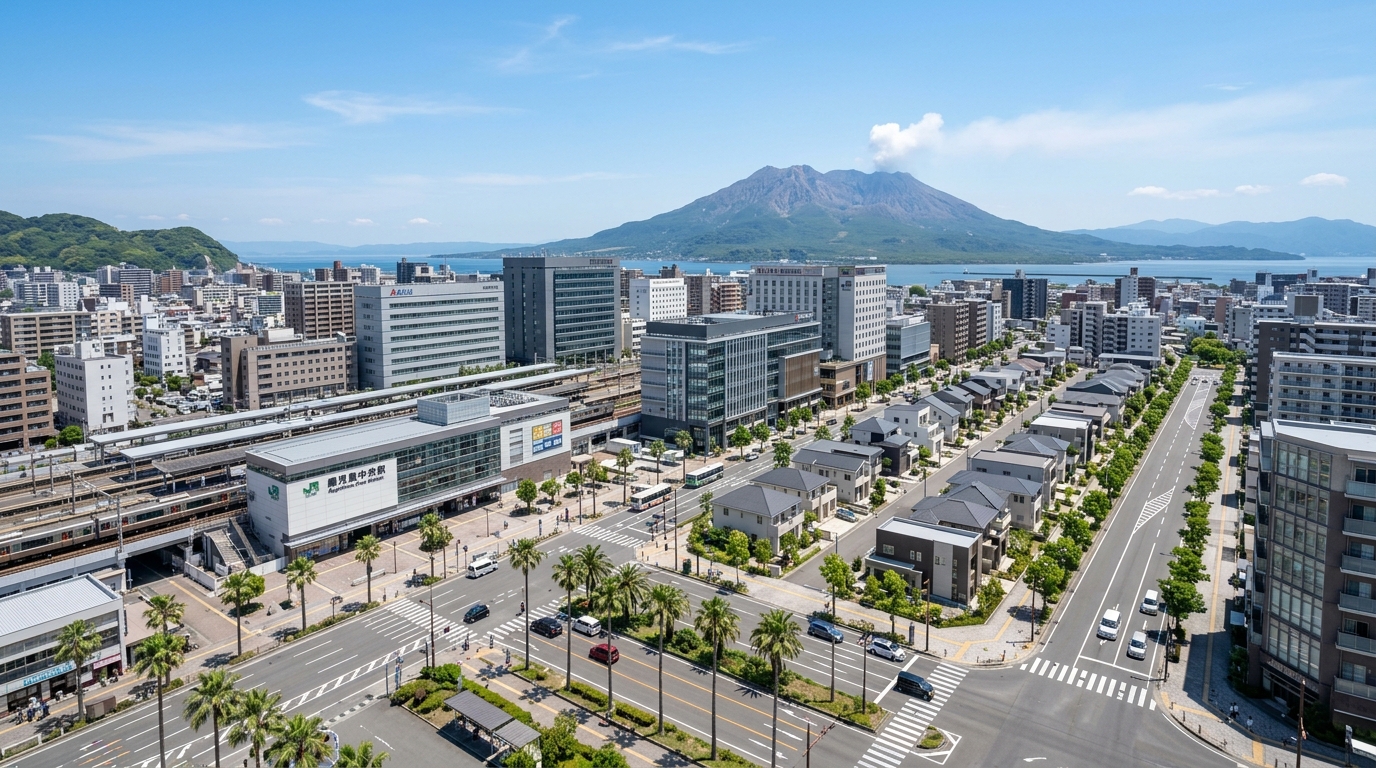
1. JR Kagoshima-Chuo Station West Exit Redevelopment Schedule and Changing Urban Flows
To summarize the redevelopment around JR Kagoshima-Chuo Station: the area has shifted from a 2021–2023 phase of concentrating commercial and office functions to a 2026–2027 phase of attracting permanent residents to blocks directly connected to the station, and is now moving toward 2030 with plans to utilize prefectural land and improve walkability to the central downtown area. Compared to the east exit—home to Amu Plaza Kagoshima (アミュプラザ鹿児島) and Kagoshima Chuo Tower / LiKa1920 (鹿児島中央タワー / LiKa1920)—the west exit previously had many parking lots and low-rise buildings, but it has now been dramatically transformed.
The timeline and outlook for the major redevelopment projects are as follows:
| Period | Area / Project Name | Main Development Details & Trends |
|---|---|---|
| 2021 | East Exit: Kagoshima Chuo Tower (Chuo-cho Blocks 19 & 20) | Opening of a 24-story above-ground, 1-story underground mixed-use building featuring the commercial facility "LiKa1920," offices, and condominiums. |
| 2022 | Tenmonkan: CenTerrace Tenmonkan (センテラス天文館) | Opening of a mixed-use complex in Sennichi-cho (千日町) housing retail, a hotel, a library, and more. |
| April 2023 | West Exit Phase I: JR Kagoshima Chuo Building (JR鹿児島中央ビル) | Opening of an 11-story commercial and office complex with a total floor area of approx. 31,616 sqm. Houses "AMU WE" (including Yamakataya Store) on floors 1–3, and offices of approx. 600 tsubo (approx. 1,983 sqm) per floor on floors 4–10. |
| January 2026 | West Exit: MJR Kagoshima-Chuo Ekimae The Garden (MJR鹿児島中央駅前ザ・ガーデン) | A 156-unit condominium scheduled for completion on the former site of the JR Kyushu Kagoshima Branch. |
| March 2027 (Planned) | West Exit: MJR Kagoshima-Chuo Ekimae The Residence (MJR鹿児島中央駅前ザ・レジデンス) | A 14-story, 260-unit condominium by JR Kyushu and Japan Post Real Estate scheduled for move-in on the former site of the Japan Post Kyushu Branch Kagoshima Office (Take 1-chome / 武1丁目). |
| 2025–2030 and beyond | West Exit: Former Prefectural Industrial Technology Center Site (approx. 9,600 sqm) | A review committee submitted recommendations in September 2025. The direction is to keep the land publicly owned while utilizing private funds to develop multi-purpose open spaces (such as bus parking and greenery) and functions supporting future growth. |
| FY2025–FY2044 | Tenmonkan to Honko-ku: Izuro Intersection Area (いづろ交差点周辺地区) | A long-term redevelopment concept covering approx. 7 ha formulated by Kagoshima City. Planned in coordination with the redevelopment of the Honko-ku (本港区) waterfront area to enhance pedestrian flow from Chuo Station toward the sea. |
A notable aspect of the west exit's transformation is how "work, commerce, and living" have been condensed within walking distance. With the opening of the JR Kagoshima Chuo Building, a pedestrian route directly connected to the Shinkansen ticket gate floor was established, and the arrival of AMU WE—bringing together a supermarket, clinics, and cafes—transformed the west exit from a mere station-back parking zone into an everyday living hub. Furthermore, the adjacent approx. 9,600 sqm former Prefectural Industrial Technology Center site is being discussed as a valuable open space and transit hub amid growing condominium supply, making it a key factor in shaping the west exit's openness and cityscape toward 2030.
2. Surrounding Land and Detached House Prices and the Drivers of Price Gaps
The concentration of urban functions through redevelopment is clearly reflected in surrounding real estate prices. According to the 2026 Official Land Prices (公示地価) published by the Ministry of Land, Infrastructure, Transport and Tourism (MLIT / 国土交通省), while the average residential land price across Kagoshima Prefecture continued to decline at -0.4%, Kagoshima City posted solid gains of +0.8% for residential land and +1.4% for commercial land.
Organizing transaction data from MLIT's "Real Estate Information Library" (不動産情報ライブラリ) for 2021–2026 across Kagoshima City—retrieved by Mekiki Research using the area near JR Kagoshima-Chuo Station West Exit (lat 31.5838, lng 130.5419) as a reference point—reveals the overall market picture:
| Metric / Item | Mekiki Research Data (Kagoshima City / Station Reference) | Notes & Background |
|---|---|---|
| Number of Transactions (2021–2026) | 7,684 | Sufficient transaction volume across the entire city |
| Average / Median Transaction Price | Approx. 29.6 million yen (29,565,968 yen) / 20.0 million yen | High-value deals such as whole-building sales tend to pull up the average |
| Average Unit Price | Approx. 95,000 yen/sqm (94,530 yen/sqm) | Reflects the price gap between the city center and suburban residential areas |
| Reference Point Zoning & FAR | Commercial Zone (Building Coverage Ratio 80%, FAR 400%) | Immediate station area allows high-density commercial and mid-to-high-rise use |
| Reference Point School District & Medical Facilities | Nishida Elementary School (西田小学校), Take Junior High School (武中学校) / 71 medical facilities | Numerous hospitals within walking distance (Maeda Hospital, Shirasaka Hospital, Shinmura Hospital, etc.) |
| Reference Point Hazard Info | Flood inundation risk present (Estimated max depth Rank 4: 5–10 m) | No landslide risk (due to flat terrain around the station) |
| Nearest Station Ridership | System data: Unregistered (null) | *JR Kyushu's FY2025 "average daily boardings" is 19,700 passengers |
*Note: Although the station ridership field in Mekiki Research is unregistered (null), according to JR Kyushu's FY2025 data, Kagoshima-Chuo Station's average daily boardings reached 19,700 (3rd highest in JR Kyushu's network), and total daily passengers (boardings and alightings) in 2024 stood at 40,164, making it the largest terminal in the prefecture.
Next, let's look at quarterly trends by property type through Q1 2026 (2026Q1) based on the same dataset (aggregated quarterly by Mekiki Research using BigQuery):
- Pre-owned Condominiums: Moved from a median of approx. 360,000 yen/sqm in 2024Q2 (69 transactions, 26.0 million yen) to 325,000 yen/sqm in 2026Q1 (58 transactions, 26.0 million yen), showing resilience with a +3.4% year-on-year increase compared to 2025Q1 (approx. 310,000 yen/sqm).
- Residential Land (Land only): Compared to 74,000 yen/sqm in 2024Q2 (114 transactions, 18.0 million yen), 2026Q1 stood at 80,000 yen/sqm (46 transactions, 14.0 million yen), remaining roughly flat at -2.4% year-on-year (2025Q1: 82,000 yen/sqm).
- Residential Land (Land & Building): Compared to 125,000 yen/sqm in 2024Q2 (172 transactions, 26.0 million yen) and 137,000 yen/sqm in 2025Q1 (160 transactions, 26.0 million yen), 2026Q1 dropped to 92,000 yen/sqm (117 transactions, 22.0 million yen), a -32.8% year-on-year decline.
The wide fluctuation in unit prices for detached houses (land and building) stems from quarterly shifts in the mix of central-city versus suburban and older-property transactions across Kagoshima City. In fact, looking at individual 2026Q1 transactions, a commercial-zone lot in Izumi-cho (泉町, 190 sqm) closed at 98.0 million yen (approx. 510,000 yen/sqm), whereas in Inari-cho (稲荷町, Category 2 Medium-to-High-Rise Residential Zone), a 2023-built 4LDK (180 sqm) sold for 30.0 million yen, a 2002-built 4LDK on a 625 sqm lot sold for 37.0 million yen, and a 1968-built wooden house (220 sqm) sold for 300,000 yen—illustrating vast price dispersion depending on location, age, and lot conditions.
Looking at the top districts by transaction volume in the latest aggregation, the popular southern residential area of Murasakibaru (紫原) maintained high levels at 120,000 yen/sqm for land (23 transactions) and approx. 178,000 yen/sqm for land & building (20 transactions). Meanwhile, Yoshino-cho (吉野町) in the north (36 land & building transactions, approx. 45,000 yen/sqm) and Sakanoue (坂之上) in the south (18 transactions, 45,000 yen/sqm) were dominated by larger lots with lower unit prices. Pre-owned condominiums in Taniyama-Chuo (谷山中央, 24 transactions, approx. 282,000 yen/sqm) also maintained steady transaction volume.
Comparing 2026 average Official Land Prices and Prefectural Land Price Survey (基準地価) figures, while Chuo-cho (中央町) on the east exit (approx. 657,000 yen/sqm) and Tenmonkan (approx. 514,000 yen/sqm) command high prices, Nishida (西田, 368,000 yen/sqm) and Take (武, 214,000 yen/sqm; 153,000 yen/sqm at a residential survey point in Take 3-chome) on the west exit remain relatively accessible while enjoying central convenience—a price gap that continues to attract end-user homebuyers.
3. How West Exit Redevelopment Impacts Surrounding Residential & Detached House Searches
The opening of the station-connected JR Kagoshima Chuo Building (AMU WE) and large-scale condominium construction on the west exit are creating clear ripple effects for those searching for detached houses or land nearby.
First, living infrastructure on the west exit has been strengthened, raising the livability of nearby residential areas. Previously, residents in Take, Nishida, Tokiwa (常盤), and Josei (城西) had to cross through the station, level crossings, or underpasses to reach the east exit or Tenmonkan. Now, with Yamakataya Store, medical clinics, and cafes gathered in AMU WE, daily shopping and medical visits can easily be completed on the west side alone.
Second, rising prices for station-connected condominiums are prompting buyers to consider detached houses or land. "MJR Kagoshima-Chuo Ekimae The Residence," currently on sale at the west exit, is priced between 42.4 million yen and 91.8 million yen (62.70 sqm–97.96 sqm), placing it in the upper price tier for Kagoshima City. Compared to the citywide median transaction price of around 20.0 million yen for homes and land, families working with a budget of 35 to 45 million yen are increasingly weighing realistic alternatives—such as "searching for a pre-owned detached house or compact lot in Take or Nishida," or "extending their search to Murasakibaru, Taniyama, or Yoshino to build a spacious custom home."
When considering a home purchase, municipal and national support programs are also worth noting. In April 2025, Kagoshima City expanded its "Child Medical Expense Subsidy System" (こども医療費助成制度), making out-of-pocket medical costs at prefectural institutions free up to the 3rd year of junior high school with no income limit. Additionally, the city offers the "Child-Rearing Household Relocation Support Project" (子育て世帯住替支援事業) for families purchasing existing homes within designated residential induction zones (in FY2026/Reiwa 8, subsidies for new builds ended, leaving only existing home purchases eligible for up to 100,000 yen, plus up to 50,000 yen if living with or near parents). For new detached builds, national programs such as the "Mirai Eco Housing 2026 Project" (みらいエコ住宅2026事業, covering GX-oriented homes and Long-Life Quality Housing for child-rearing households) directly impact financial planning.
If you want to check and save surrounding transaction price trends, hazard information, and living environments for a specific address, you can use the area research feature available with a free membership. Furthermore, if you want to simulate floor plans (2D), 3D models, summer/winter solstice sunlight, and rough total budgets for a detached house, the AI Architecture Simulator in the Pro plan is also helpful.
4. Strengths Seen Through Urban History: Transit Hub and Everyday Comfort
The high evaluation of the Kagoshima-Chuo Station West Exit area as a residential district goes beyond mere "convenience near the station"—it is backed by history and geography.
In terms of transit, it is the prefecture's largest hub, bringing together the Kyushu Shinkansen, three JR conventional lines (Kagoshima Main Line, Ibusuki Makurazaki Line, and Nippo Main Line), the Kagoshima City Tram (鹿児島市電), local buses, and airport limousine buses. The city tram operates at a flat fare of 200 yen for adults, connecting to Tenmonkan, City Hall, and Taniyama, making it a rare area where a car-light lifestyle is realistic. Mekiki Research's surrounding environment data also confirms 71 medical facilities, underscoring strong healthcare access alongside established school districts like Nishida Elementary and Take Junior High.
Looking at the city's formation reveals the contrast between Kagoshima City's characteristic "Shirasu Plateau" (シラス台地) and the flat alluvial lowland formed by the Kotsuki River (甲突川). Formed by the massive eruption of the Aira Caldera (Ito pyroclastic flow) roughly 30,000 years ago, the Shirasu Plateau created elevated residential districts surrounding the city center, such as Murasakibaru, Takeoka (武岡), and Sakuragaoka (桜ヶ丘). In contrast, the Take and Nishida areas on the west exit sit on flat land developed through sediment carried by the Kotsuki River and domain-era land reclamation via the Ishiide Irrigation Canal (石井手用水, begun in 1806). It is also a historic district where the Five Stone Bridges of the Kotsuki River—including Nishida Bridge (西田橋), built by master Higo stonemason Iwanaga Sangoro (岩永三五郎) during the Tenpo fiscal reforms—supported the feudal sankin-kotai (alternate attendance) routes.
While hillside estates like Murasakibaru and Takeoka involve steep slopes, the plain stretching from Take and Nishida toward Arata (荒田) and Kamiarata (上荒田) remains flat and easy to navigate by bicycle or on foot. Yet average land unit prices remain lower than in Chuo-cho on the east exit or Tenmonkan, offering a "balance of urban convenience and living space" where buyers can more easily secure a detached house lot and parking within the same budget.
5. Potential Regrets to Watch Out For (1): Terrain, Hazards, and Sakurajima Ash
On the other hand, to avoid regrets after moving in, there are natural environment factors that must be factored in before purchasing.
First is checking flood hazards (inundation risk) and ground characteristics. Mekiki Research's point data (lat=31.5838, lng=130.5419) indicates that the area around JR Kagoshima-Chuo Station falls within an estimated flood inundation zone, rated Rank 4 (maximum estimated depth of 5–10 m). This is due to the topography of the Kotsuki River, a Class B river flowing through the city center. During the "August 6 Heavy Rain Disaster" of 1993, the Kotsuki River overflowed, flooding roughly 12,000 to 13,000 homes in central Kagoshima. Although subsequent river improvements (special emergency projects) have significantly increased flow capacity, anyone considering land or a detached house on the flat west exit must check past flood records and the latest hazard maps (such as "Kagoshima i-Map"), and incorporate countermeasures such as raised foundations, placing electrical equipment on the second floor or higher, first-floor flood protection, and fire insurance with flood coverage.
While the flat area immediately around the station is rated "none" for landslide risk, the elevated areas slightly west of the west exit—such as Tokiwa, Tagami (田上), Takeoka, and Josei—feature steep slopes characteristic of the Shirasu Plateau's edge. Because Shirasu soil is vulnerable to water and prone to collapse, it is essential to verify landslide warning zone designations and the condition of retaining walls when considering properties near cliffs.
Second is the daily lifestyle impact and maintenance costs of volcanic ash from Sakurajima (桜島). Because Sakurajima's volcanic ash consists of fine glassy particles, it easily adheres to exterior walls when mixed with rain, leading to clogged rain gutters, paint deterioration, and strain on equipment such as air conditioner outdoor units. Even in summer, wind direction can make it difficult to open windows or dry laundry outside. When building or choosing a detached house, failing to incorporate ash-resistant ("kokuhai" / 克灰) features—such as an indoor laundry/drying room, easy-to-clean exterior paving and parking slopes, and high-performance air intake filters—into the initial plan can lead to post-move-in stress and higher repair costs.
6. Potential Regrets to Watch Out For (2): Car Dependency, Maintenance Costs, and Resale Liquidity
There are also two trade-offs regarding living costs and future exit strategies (ease of resale) that should be assessed in advance.
First is car dependency and hidden transportation costs. Kagoshima City has a high reliance on automobiles even among regional cities, with prefectural surveys showing private car ownership exceeding 80%. Living near the Kagoshima-Chuo Station West Exit or along the city tram line makes a car-free or one-car-per-couple lifestyle feasible, but for areas more than a 15-minute walk from the station, hillside neighborhoods, or weekend trips to large shopping malls and leisure spots, many households find a car indispensable.
If you own a car in central-adjacent areas like Take or Nishida, monthly parking fees or the land cost of securing on-site parking will add to your budget. Conversely, looking at public transit, all 21 routes operated by Kagoshima City Bus were operating at a deficit (operating ratio over 100, with some exceeding 300) as of FY2024 (Reiwa 6), and routes have been reviewed or transferred to private operators in the past. Choosing a location far from the city tram or JR stations that relies solely on buses carries the risk of future service reductions or fare hikes.
Second is resale liquidity and price polarization. While the citywide transaction volume of 7,684 deals from 2021 to 2026 provides solid market depth, a closer look shows a clear divide in buyer profiles between the Chuo Station / Taniyama-Chuo areas (where condominiums are concentrated) and Yoshino-cho, Murasakibaru, and Sakanoue (where detached houses on large lots trade actively).
Because land prices per tsubo near the station are trending upward, securing a large lot can push total costs into the 50 to 70 million yen range—far above Kagoshima City's median transaction price (20.0 million yen)—which risks narrowing the pool of future buyers. Conversely, extremely small lots near the station or detached houses on narrow front roads with space for only one car may not match family demand (such as two-car parking needs) and can take longer to sell. It is important to calmly evaluate the balance between lot shape, road frontage, and parking capacity.
7. Who the Kagoshima-Chuo Station Area Suits—and Who Should Think Twice
Based on the data and regional characteristics above, here is a summary of who is best suited for JR Kagoshima-Chuo Station West Exit and its surrounding neighborhoods.
Best suited for:
- Dual-income and child-rearing households prioritizing "time efficiency": With the Shinkansen, JR lines, city tram, supermarkets, and medical facilities all within walking distance, it is ideal for households looking to minimize commuting, school, and shopping travel times.
- Those looking to reduce car ownership or planning for senior years: The flat terrain and robust medical infrastructure (71 facilities) provide a strong foundation for living independently even after giving up a driver's license.
- Investors and end-users prioritizing long-term asset liquidity: Even as the city's overall population declines, the station area—as a major transit hub—remains the most likely location to attract both rental demand (singles, DINKs, corporate transferees) and end-user buyers.
Those who should consider carefully:
- Those who want to avoid flood risk as much as possible: Because the flatlands around the station fall within the Kotsuki River's estimated inundation zone, buyers uncomfortable with hazard map risks may feel more secure comparing elevated Shirasu Plateau areas like Murasakibaru, Takeoka, or Ishikidai (伊敷台).
- Those prioritizing a large garden, flat parking for 2+ cars, and a quiet environment on a limited budget: With rising land prices and dense condominium development in Take and Nishida, buyers seeking spaciousness and budget efficiency may find better matches by expanding their search to Taniyama, Usuki (宇宿), Yoshino, or Sakanoue.
- Those who dislike maintenance from volcanic ash and sea breeze: Dealing with Sakurajima's ash is a baseline reality of living in Kagoshima City, so it is worth confirming upfront whether you are willing to invest in indoor drying facilities and ash-resistant exterior specifications.
8. Summary: Checkpoints for Choosing Land or a Detached House Toward 2030
Following the opening of the JR Kagoshima Chuo Building (AMU WE) in 2023 and the completion of station-connected condominiums in 2026–2027, the redevelopment of JR Kagoshima-Chuo Station West Exit is entering a phase where the utilization of the former Prefectural Industrial Technology Center site and stronger ties with the central downtown area will take shape toward 2030. While improved convenience enhances the livability of surrounding neighborhoods like Take and Nishida, accurately factoring in local conditions—such as Kotsuki River flood hazards, Sakurajima ashfall, and car-society maintenance costs—is key to a satisfying home purchase.
Finally, here are the key checkpoints for your property search:
- Check the latest hazard maps: Verify "flood inundation depth" in flat areas and "landslide warning zones" in elevated or cliffside areas on a site-by-site basis.
- Calculate total costs including parking and transit: Compare not just land and building prices, but also parking expenses and future public transit sustainability.
- Leverage ash-resistant specs and subsidies: Alongside ash countermeasures like indoor drying and ventilation, check eligibility for Kagoshima City's "Child-Rearing Household Relocation Support Project" and national energy-saving subsidies.
When narrowing down specific candidate sites, it is important to overlay actual transaction data and hazard information on a map rather than relying solely on impressions. By registering for a free membership, you can pull the MLIT data used in this blog directly into your Claude or ChatGPT (via MCP integration). Use your own AI to continue researching areas of interest and make an informed home or real estate decision.