
As autumn deepens and maple and ginkgo trees paint the city in vibrant colors, the presence of expansive urban green spaces stands out more than ever. Iconic Kyoto autumn destinations like Okazaki Park (岡崎公園) and the Kyoto Imperial Palace Park (京都御苑 / Kyoto Gyoen) are not only beloved tourist spots, but also vital everyday infrastructure for local residents—serving as venues for daily walks and raising children.
At the same time, many prospective homebuyers and real estate investors wonder: "A green neighborhood sounds pleasant, but how are actual home prices and property values trending?" or "Is it really possible to enjoy a quiet daily life near major tourist attractions?" In Kyoto City, strict regulations designed to protect historic landscapes and the natural environment limit the supply of land and housing, meaning that the living environment of each specific area tends to be directly reflected in property prices.
Based on official transaction data and hazard information for Sakyo Ward, Kyoto City, Kyoto Prefecture (around 35.0497° N, 135.7765° E, as well as the ward as a whole), this article objectively examines price trends, everyday convenience, and key points to check when choosing a home in residential areas near major green spaces like Okazaki Park and Kyoto Gyoen.
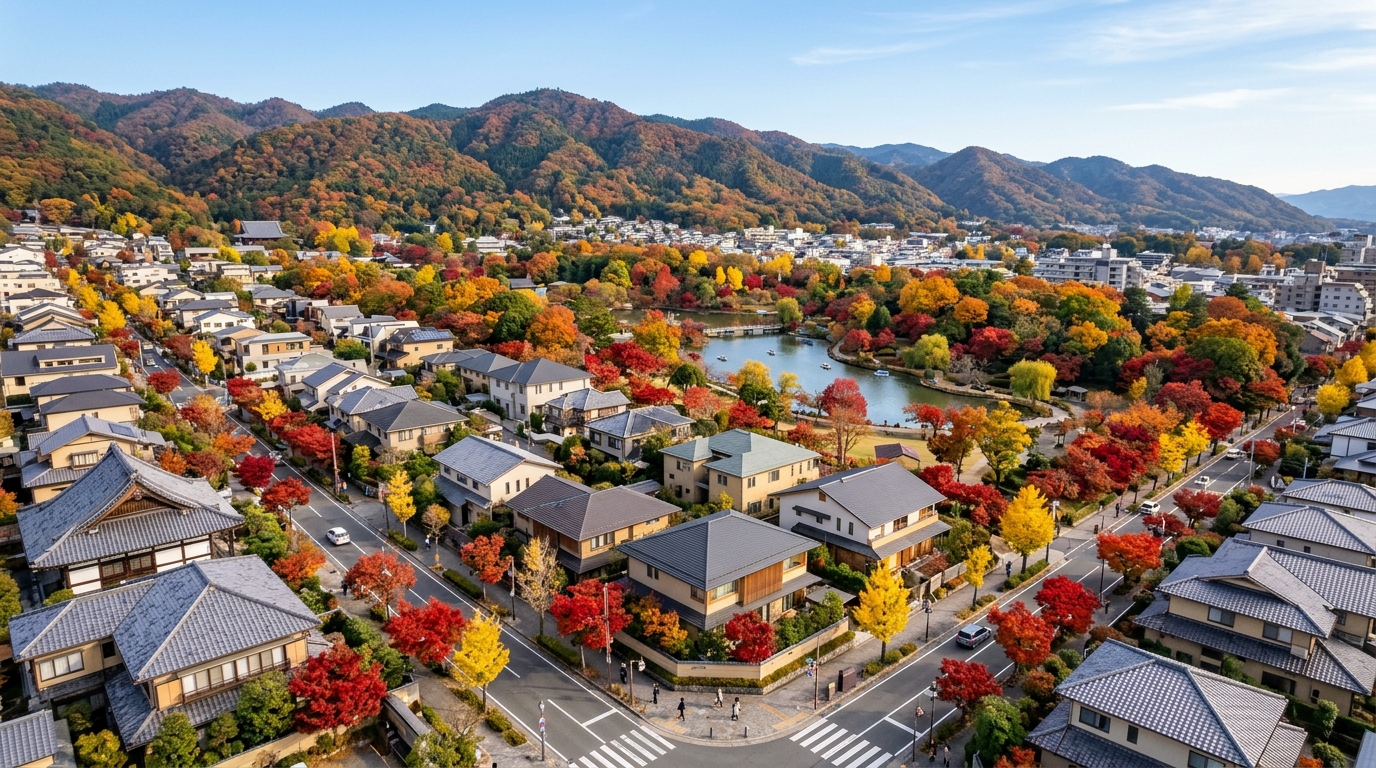
First, let's review the transaction data, local development trends, and key living indicators for Sakyo Ward in the summary table below.
| Item | Data Overview & Latest Trends (as of 2026) |
|---|---|
| Target Area | Sakyo Ward, Kyoto City, Kyoto Prefecture (Near Okazaki Park & Kyoto Gyoen to Matsugasaki & Ichijoji) |
| Total Transaction Trends (2021–2026) | 3,340 transactions / Average: approx. ¥47.73 million / Median: ¥34.00 million / Avg. unit price: approx. ¥300,000/㎡ |
| Latest Market Prices by Type (Q1 2026) | Land & Building: approx. ¥320,000/㎡ (+2.0% YoY)<br>Pre-owned Condos, etc.: approx. ¥470,000/㎡ (-7.8% YoY)<br>Land Only: ¥380,000/㎡ (-9.5% YoY) |
| Recent Local Facilities & Developments | "Re.Nova Kitayama" (Opened Oct 2025; dining & more added Apr 2026)<br>"Rakuhoku Hankyu Square" major renewal (Jan–Summer 2026)<br>"Life" supermarket planned near Kokusaikaikan Subway Station (Opening scheduled Mar 2027) |
| Green Conservation & Family Housing Support | Ongoing green maintenance & AR walking guides at Okazaki Park & Kyoto Gyoen<br>"Kyoto Anshin Sumai Support Grant" up to ¥2.0 million (FY2026 applications open) |
| Hazards & Regulations to Note | Areas designated for flood risk (0.5–3m) and landslide (debris flow) warning zones<br>Category 1 Low-Rise Exclusive Residential Zone (50% building coverage / 80% FAR) & Kyoto City landscape/height regulations |
1. The Relationship Between Large Urban Green Spaces and Residential Areas During Autumn Foliage Season
Having large parks and green spaces nearby in an urban area is a key factor supporting both the living environment and real estate market valuation. Beyond offering seasonal scenery, areas with substantial greenery are unlikely to be redeveloped into high-rise buildings or large factories in the future, meaning sunlight, ventilation, and a calm streetscape are easily preserved over the long term.
Kyoto, in particular, is a basin surrounded by mountains on three sides. Alongside waterfronts like the Kamo River (鴨川) and Takano River (高野川), the city features large, historically and culturally significant green spaces scattered throughout the urban area—such as Okazaki Park in Sakyo Ward, Kyoto Gyoen in neighboring Kamigyo Ward, and the Kyoto Botanical Gardens (京都府立植物園) and Takaragaike Park (宝が池公園) in northern Sakyo Ward. In autumn, maple and ginkgo trees color the cityscape, drawing many visitors on weekends, while local residents enjoy the major advantage of experiencing the changing seasons daily within walking or cycling distance.
For owner-occupier homebuyers, living near green spaces directly enhances daily quality of life—allowing children to play outdoors without traveling far on weekends, or making morning walks and pet strolls a regular habit. Furthermore, when considering future resale or moving, proximity to irreplaceable large green spaces tends to attract steady demand, helping property prices remain resilient even during market fluctuations.
2. Area Overview and Livability of Okazaki Park, Kyoto Gyoen, and Sakyo Ward
Sakyo Ward, located close to Okazaki Park and Kyoto Gyoen, is an area where cultural facilities, academic institutions, and quiet residential neighborhoods coexist in harmony.
The area around Okazaki Park (Okazaki, Sakyo Ward) was developed from the Meiji era onward alongside the Lake Biwa Canal (琵琶湖疏水) and the National Industrial Exhibition. Today, it remains one of Kyoto's premier cultural and exchange zones, home to Heian Jingu Shrine (平安神宮), the Kyoto City KYOCERA Museum of Art (京都市京セラ美術館), ROHM Theatre Kyoto (ロームシアター京都), and the Kyoto City Zoo (京都市動物園). Based on Kyoto City's "Okazaki Area Revitalization Vision," efforts are made to balance landscape and environmental preservation with vibrancy, including ongoing tree and park maintenance in FY2026.
Meanwhile, Kyoto Gyoen (Kamigyo Ward), bordering the west side of Sakyo Ward across the Kamo River, is a vast 65-hectare national park managed by the Ministry of the Environment. It maintains a rich ecosystem where over 100 species of wild birds can be observed. Across FY2025–2026, initiatives are underway to balance historic landscape preservation with everyday use, including natural path renovations, tree management, monitoring of old trees, and AR-based historical walking guides.
Looking north from this southern cultural and historic green belt along the Kamo and Takano rivers, residential areas such as the surroundings of Matsugasaki Station (松ヶ崎駅) on the Kyoto Municipal Subway Karasuma Line, Ichijoji (一乗寺), and Takano (高野) unfold. Much of this area is designated as a "Category 1 Low-Rise Exclusive Residential Zone" (50% building coverage ratio / 80% floor area ratio), which prohibits tall buildings and large commercial facilities, preserving wide open skies and a quiet living environment.
3. Price Trends and Characteristics of Sakyo Ward and the Okazaki Area from Transaction Data
In Sakyo Ward's real estate market, detached house transactions have remained firm recently, while clear price differences exist depending on property type and specific neighborhood.
According to an independent aggregation by Mekiki Research of transaction data from the Ministry of Land, Infrastructure, Transport and Tourism (MLIT) "Real Estate Information Library" (2021–2026), total transactions in Sakyo Ward reached 3,340 cases. The average transaction price is approximately ¥47.73 million, while the median—which better reflects typical market conditions by excluding extreme high-end outliers—is ¥34.00 million (ranging from approx. ¥20,000 to ¥2.0 billion), with an average unit price of roughly ¥300,000/㎡.
To grasp recent market movements, let's examine the Q1 2026 quarterly data by property type, aggregated from the MLIT Real Estate Information Library.
As shown in the chart above, the median unit price for "Residential Land (Land & Building)"—the core of owner-occupier demand—moved gradually from Q2 2024 (¥300,000/㎡) to Q4 2025 (approx. ¥340,000/㎡). In Q1 2026, across 77 transactions, the median unit price stood at approx. ¥320,000/㎡ (median transaction price ¥34.00 million), maintaining solid growth at +2.0% year-over-year.
Meanwhile, "Pre-owned Condos, etc." recorded 45 transactions in Q1 2026, with a median unit price of approx. ¥470,000/㎡ (median transaction price ¥29.00 million), down 7.8% YoY. Although prices briefly spiked to approx. ¥690,000/㎡ (median ¥43.00 million) in Q2 2025, they have settled back in 2026 to levels reflecting building age and location. "Residential Land (Land Only)" saw 13 transactions with a median unit price of ¥380,000/㎡ (median ¥62.00 million, -9.5% YoY), showing a tendency for larger quarterly fluctuations due to the limited number of transactions and specific site conditions.
Let's also look at which districts within Sakyo Ward are most active. Organizing the top districts by transaction volume reveals clear price differences by area.
| District | Main Transaction Type | Count | Median Unit Price | Area Characteristics |
|---|---|---|---|---|
| Takano Higashihiraki-cho | Pre-owned Condos, etc. | 20 | approx. ¥330,000/㎡ | Convenient condo cluster near commercial facilities and the Takano River |
| Shizuichi Ichihara-cho | Residential Land (Land & Building) | 16 | ¥150,000/㎡ | Nature-rich northern suburban residential area; larger lots at relatively affordable prices |
| Okazaki Nishifukunokawa-cho | Residential Land (Land & Building) | 15 | ¥320,000/㎡ | Residential area near Okazaki Park & Shirakawa-dori; unit prices above the ward average |
| Iwakura Hataeda-cho | Residential Land (Land & Building) | 10 | approx. ¥290,000/㎡ | Calm suburban residential area including the Kokusaikaikan Station vicinity |
| Takano Nishihiraki-cho | Pre-owned Condos, etc. | 9 | approx. ¥510,000/㎡ | Area adjacent to commercial facilities; relatively high condo unit prices |
Notably, "Okazaki Nishifukunokawa-cho," located on the east-to-north side of Okazaki Park, recorded 15 transactions for residential land (land and building) with a high median unit price of ¥320,000/㎡. Furthermore, looking at specific Q1 2026 transaction samples in the Ichijoji area near our survey point, prices vary significantly depending on property size and zoning:
- Ichijoji Kinomoto-cho (Land & Building, 5LDK+S, 360㎡, built 1997, RC, Category 1 Low-Rise Exclusive Residential Zone, 50% coverage / 80% FAR): ¥110.00 million
- Ichijoji Anno-cho (Land & Building, 3LDK, 115㎡, built 2004, Wood, Category 1 Low-Rise Exclusive Residential Zone, 40% coverage / 80% FAR): ¥31.00 million
- Ichijoji Satononishi-cho (Land & Building, 4LDK, 85㎡, built 1999, Wood, Category 1 Low-Rise Exclusive Residential Zone, 50% coverage / 80% FAR): ¥29.00 million
- Ichijoji Kawarada-cho (Pre-owned Condo, 4LDK, 95㎡, built 2009, RC, Category 1 Residential Zone): ¥58.00 million
- Ichijoji Oharada-cho (Pre-owned Condo, 2DK, 50㎡, built 1985, RC, Category 1 Residential Zone): ¥22.00 million
- Ichijoji Satonomae-cho (Land & Building, 55㎡, Wood, Neighborhood Commercial Zone, 80% coverage / 200% FAR): ¥5.70 million
Thus, Sakyo Ward offers a diverse mix of options tailored to different budgets and lifestyles—from estate-style properties on expansive lots (around ¥110 million), to detached homes around ¥30 million ideal for families, and pre-owned condos in the ¥20 million range suited for singles or couples.
4. Living Environment Benefits Near Green Spaces: Childcare, Healthcare, and Upgraded Infrastructure
Residential areas near green spaces offer more than just "abundant nature and nice views." Combined with recent upgrades to daily infrastructure and generous municipal support, they form a highly livable environment for generations ranging from families to seniors.
In terms of daily convenience, commercial and park facilities in Sakyo Ward have seen a series of updates over the past one to two years. In the Takano area—which ranked high in transaction volume—"Rakuhoku Hankyu Square" (Takano Nishihiraki-cho) underwent its first major renewal since its 2019 rebranding from January to summer 2026. Roughly 20% of its tenants were refreshed, welcoming new stores such as MUJI, Ainz & Tulpe, Seria, and Showa Nishikawa, further enhancing everyday shopping convenience.
Additionally, just a 1-minute walk from Kitayama Subway Station (北山駅) on the east side of the Kyoto Botanical Gardens, the park-style complex "Re.Nova Kitayama" opened on October 4, 2025. The grounds feature a BørneLund outdoor fitness area, large children's play equipment, a housing exhibition, and disaster-preparedness facilities like emergency storage and bench-stoves. With dining options and a covered outdoor dog run scheduled to open in April 2026, it has become a vibrant hub for all generations. Further north in Kamitakano (near Kokusaikaikan Station), major supermarket "Life" is planning to open a new store by March 1, 2027, making it even easier to balance green surroundings with convenient shopping.
For everyday peace of mind regarding healthcare, 19 medical institutions—primarily clinics—were confirmed around our survey point, including pediatric and dermatology clinics familiar to families raising children, such as Shigemariko Dermatology Clinic, Shimogamo Nishio Clinic, and Tateishi Pediatric Clinic.
Moreover, families considering buying a home in Kyoto City should not overlook public housing and childcare support programs. Kyoto City offers the "Kyoto Anshin Sumai Support Grant" (for families with children acquiring pre-owned housing). Households with preschool-aged children (including expectant mothers) who purchase a pre-owned home in the city and renovate it using a local contractor receive a base grant of ¥1.0 million, and up to ¥2.0 million if they meet additional criteria (such as multi-child households, moving from outside the city, or purchasing a Kyo-machiya or certified-management condo). Applications for FY2026 are open until March 31, 2027, and many buyers combine this with national energy-saving subsidies for insulation renovations. Furthermore, Kyoto City's "Child Medical Expense Subsidy System" covers outpatient and inpatient care up to junior high school (3rd year) with no income limit, capping outpatient co-payments for infants through elementary schoolers at ¥200 per month per medical institution.
5. Checkpoints When Considering Land, Detached Houses, or Pre-owned Homes (Hazards, Building Restrictions, Sunlight)
Even in an ideal living environment near green spaces, pre-purchase risk checks based on Kyoto's topography and unique urban planning rules are essential. Before moving forward with a purchase or construction plan, be sure to check these three points: hazard information, building restrictions, and the balance between sunlight and floor plan.
-
Checking Hazard Information (Floods & Landslides) Reviewing hazard data around our survey point (Matsugasaki to Ichijoji in Sakyo Ward) reveals areas subject to both flood risk (maximum inundation depth Rank 2: 0.5–3m) and landslide risk (debris flow). Because the eastern and northern parts of the Kyoto Basin sit near the foothills of Higashiyama and Mt. Hiei—and are crossed by rivers and canals like the Takano River, Shirakawa River, and Lake Biwa Canal—risk levels can vary significantly even within the same neighborhood depending on whether a lot is riverside or on higher ground. A 0.5–3m flood projection means the first floor of a house could be inundated, so it is crucial to check the exact location on Kyoto City's hazard map before buying, and consider raised foundations, placing main living spaces on the second floor or higher, and appropriate flood insurance.
-
Kyoto-Specific Building Restrictions (Zoning & New Landscape Policy) Much of Sakyo Ward's residential land is designated as a "Category 1 Low-Rise Exclusive Residential Zone," with generous standards of 50% building coverage and 80% floor area ratio at our surveyed location. A 50% coverage ratio means the building's footprint cannot exceed half the lot size—making it easy to secure a garden or parking, though it can be challenging to fit the desired number of rooms on a small lot. Additionally, Kyoto City enforces strict height limits (such as 10m, 12m, or 15m depending on the height district) and landscape standards for roof shapes and exterior colors under its "New Landscape Policy," so you should verify early on whether your desired building volume is legally permitted.
-
Sunlight Conditions and Practical Living Simulations In areas rich in autumn foliage and greenery, or in low-rise residential zones with strict north-side setback and height rules, the placement of neighboring houses and surrounding trees can greatly affect winter solstice sunlight and room brightness. Rather than looking only at price and square footage on a listing sheet, understanding how large a house can be built on the lot and how much sunlight it will receive each season is key to a satisfying home choice.
With Mekiki Research's free membership, you can check and save transaction unit price trends and hazard information on a map for any address of interest. Our paid Pro plan also offers an AI architecture simulator that generates 2D floor plans, 3D models, summer/winter solstice sunlight simulations, and rough total budget estimates from your desired conditions.
6. Choosing an Area That Balances Peak Tourist Crowds with a "Quiet Daily Life"
When choosing a home near Okazaki Park or Kyoto Gyoen, it is important to calmly assess the distance between tourist congestion—especially during autumn foliage and spring cherry blossom seasons—and your daily commuting routes.
Kyoto City recorded a record-high 62.79 million tourists in 2025, and during peak seasons, traffic congestion and crowded city buses are common around central areas and major sights. For example, Okazaki Park's main thoroughfares, Jingu-michi and Niomon-dori, bustle with visitors on weekends and during events. Therefore, if you rely on cars or buses daily, your comfort will vary greatly depending on whether you choose a residential street one block off tour bus routes and major intersections, or a location within walking/cycling distance of the Kyoto Municipal Subway (such as Higashiyama Station on the Tozai Line, or Marutamachi and Matsugasaki Stations on the Karasuma Line) to avoid bus congestion.
When researching an area, it is also necessary to distinguish between what can be grasped from public data and what should be verified on-site or through municipal offices. While our backend data confirmed that the nearest station is Matsugasaki Station on the Kyoto Municipal Subway, station passenger counts and school district (elementary/junior high) boundaries were unavailable (null) via public APIs. For families in particular, traffic volume along school routes, sidewalk conditions, and the actual atmosphere of schools cannot be measured by numbers alone. Checking the Kyoto City Board of Education's official school district maps and walking the area during both weekend tourist hours and weekday school commute times will provide peace of mind.
7. Future Outlook and Asset Value from Both Owner-Occupier and Investment Perspectives
Two key perspectives shape the future asset value of Sakyo Ward and the Okazaki/Gyoen area: "scarcity of supply" and "steady owner-occupier demand."
On the supply side, Kyoto City's strict landscape regulations and extensive low-rise residential zones make large-scale condo developments and high-rises structurally difficult. While Kyoto City has been discussing relaxing height limits in southern areas (such as south of Kyoto Station) since 2023 to counter population outflow, preserving calm streetscapes remains a priority in core historic and cultural landscape areas like Okazaki Park, Kyoto Gyoen, Kitayama, and Matsugasaki. This limited supply helps maintain the scarcity value of existing quality residential land and condos.
On the demand side, the concentration of educational and research institutions led by Kyoto University is a major strength. With Kyoto University's designation as a "University for International Research Excellence" by the Ministry of Education, Culture, Sports, Science and Technology, the area continuously attracts researchers, students, and education-conscious families from Japan and abroad. Combined with pre-owned home acquisition/renovation grants like the "Kyoto Anshin Sumai Support Grant" and upgraded daily facilities like "Re.Nova Kitayama" and "Rakuhoku Hankyu Square," these factors support long-term settlement by owner-occupiers rather than just temporary tourist demand.
On the other hand, from an investment or future resale perspective, it is important to note that persistently high construction costs, interest rate trends, and differences in building age, earthquake resistance, and hazard risks are being evaluated strictly. Even within Sakyo Ward, while Q1 2026 median unit prices for residential land (land & building) remained firm at +2.0% YoY, pre-owned condos fell 7.8% YoY, showing growing selectivity by building and age. Rather than buying simply because a property is "near a famous park," cross-referencing station distance, management condition, hazard risk, and surrounding transaction prices with objective data is the soundest approach to protecting future asset value.
8. Summary: Combining Objective Area Data with Your Ideal Lifestyle
Autumn, when foliage colors the city, is a season when it is easy to appreciate how large urban green spaces—like Okazaki Park, Kyoto Gyoen, and the Kamo and Takano riverbanks—support both the city's charm and the richness of daily life.
Looking back at actual data for Sakyo Ward, Kyoto City, the 2021–2026 median transaction price was ¥34.00 million, and the Q1 2026 median unit price for detached houses (land & building) was approx. ¥320,000/㎡ (+2.0% YoY), backed by stable owner-occupier demand. While areas like Okazaki Nishifukunokawa-cho (¥320,000/㎡) and Takano Nishihiraki-cho (approx. ¥510,000/㎡) maintain high demand, diverse options suited to different budgets and lot sizes exist in Ichijoji, Iwakura, and Shizuichi Ichihara-cho. Tailwinds such as commercial facility renewals, new park complexes, and housing grants of up to ¥2.0 million are also aligned.
However, even within the same ward, flood (0.5–3m) and landslide risk zones, building coverage/FAR limits, landscape ordinances, and tourist congestion vary greatly by exact location. To achieve both beautiful greenery and comfortable urban living, it is essential to go beyond emotional appeal and objectively verify official transaction data and hazard information for your target site.
If you have a specific address or area in mind, start by checking the latest transaction data and hazard maps for yourself. By registering for a free membership, you can also pull the MLIT data used in this blog directly into your Claude or ChatGPT (via MCP integration). We encourage you to compare areas that fit your lifestyle and find a home you can truly feel confident about.
Check the latest land prices and hazard information for Sakyo Ward, Kyoto City on Mekiki Research 👉