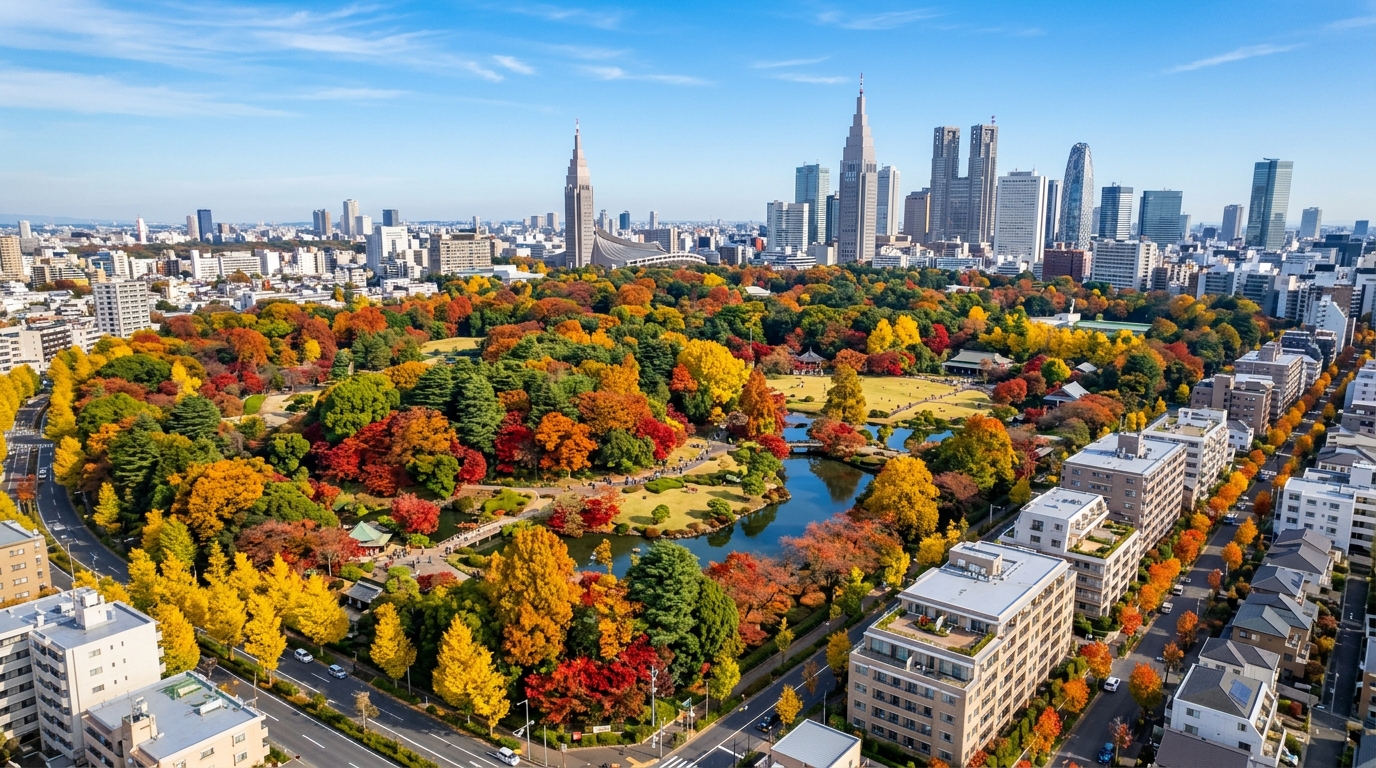
Past mid-November, the autumn foliage season has arrived in central Tokyo, painting street trees and gardens in vivid shades of red and gold. The area around Shinjuku Gyoen (新宿御苑), stretching east of Shinjuku Station (新宿駅)—one of Japan's largest terminal stations—is a rare location where residents can enjoy plane tree avenues, ginkgo, and Japanese maple leaves along their daily walking routes. Consequently, it attracts strong interest not only from real estate investors, but also from families and singles looking for urban living.
At the same time, areas adjacent to major green spaces in the heart of the city often raise practical questions: "The convenience and natural environment are appealing, but how have transaction prices been trending?" or "Are there concerns about noise during peak tourist seasons, sunlight, or disaster preparedness?" When actually searching for a home or land, it is essential to look beyond emotional appeal and objectively analyze official transaction data, urban planning regulations, and hazard information.
In this article, we objectively examine the asset value and livability of Shinjuku Ward (新宿区) and the Shinjuku Gyoen area based on real estate transaction price data from the Ministry of Land, Infrastructure, Transport and Tourism (MLIT, 国土交通省), municipal urban planning and hazard data, and the latest trends in redevelopment and support programs underway as of 2026.
First, here is an overview of the latest transaction indicators for Shinjuku Ward as a whole, major ongoing redevelopment schedules, and key living environment data.
| Item | Latest Data & Schedule Overview (as of 2026) | Source / Notes |
|---|---|---|
| Overall Transaction Trend (2021–2026) | 10,953 transactions / Median price ¥53,000,000 (Avg. approx. ¥86,410,000) | MLIT API aggregation (Avg. price per sqm: approx. ¥1,200,000/㎡) |
| Pre-owned Condo Price per sqm (2026 Q1) | ¥1,320,000/㎡ (+1.5% YoY, Median ¥63,000,000) | MLIT Real Estate Information Library quarterly aggregation |
| Detached House (Land & Building) Price per sqm (2026 Q1) | Approx. ¥1,710,000/㎡ (+18.7% YoY, Median ¥110,000,000) | Same as above (Residential land only: 2 cases in 2026 Q1 at ¥1,700,000/㎡) |
| Major Redevelopment (Nishi-Shinjuku 1-chome) | Former Meiji Yasuda Life Shinjuku Building site, 23-story mixed-use building (Completed August 2026) | Includes childcare support facilities, retail, and a hall |
| Major Redevelopment (Shinjuku Station West Exit District) | Former Odakyu Department Store site, 48 stories (Scheduled completion FY2029–March 2030) | Above-ground steel frame construction in full swing as of October 2026 |
| Living Environment & Surrounding Indicators (Survey Point) | Nearest station: Shinjuku-sanchome / Medical facilities: 68 / Projected flood depth: 0.5–3m | Zoning: Commercial District (Building coverage ratio 80%, Floor area ratio 600%) |
1. The Appeal of Shinjuku Gyoen and Central Urban Green Spaces During Autumn Foliage Season
In conclusion, large-scale urban green spaces like Shinjuku Gyoen possess a scarcity that is difficult to replicate through new development, serving as a major pillar supporting both the living environment and asset values of surrounding residential areas.
Shinjuku Gyoen is a national garden spanning approximately 58.3 hectares with a perimeter of about 3.5 kilometers, straddling Shinjuku Ward and Shibuya Ward (渋谷区). Originally the site of the Naito family's residence during the Edo period, it was developed as an imperial garden in the Meiji era and opened to the public in 1949 after World War II. The park is home to around 10,000 trees, offering diverse seasonal scenery: roughly 900 cherry trees of about 70 varieties in spring, and from mid-November to early December, a rich autumn palette featuring the plane tree avenue in the Formal Garden, ginkgo trees in front of the greenhouse, and maples in the Japanese Garden and around the Lower Pond.
The contrast of open sky and greenery against the backdrop of central Tokyo's skyscrapers is far more than a mere tourist attraction. For nearby residents, it serves as an everyday "backyard" that elevates quality of life—whether for morning runs, weekend strolls with children, or refreshing breaks between remote work sessions. Because it is extremely difficult to carve out a new large-scale park in a dense urban core packed with commercial facilities and offices, a location within walking distance of an established, lush green space holds timeless appeal that is resilient to changing trends.
2. Transaction Price Trends in Shinjuku Ward and the Latest Market Around Shinjuku Gyoen
In conclusion, residential transaction unit prices in Shinjuku Ward have remained firm from 2024 through 2026, with pre-owned condominiums in particular maintaining a high level of ¥1,320,000/㎡ (+1.5% YoY) as of Q1 2026.
According to our aggregation of Shinjuku Ward transaction statistics (2021–2026) based on MLIT's Real Estate Information Library, across all 10,953 transactions, the average unit price is approximately ¥1,200,000/㎡ and the median transaction price is ¥53,000,000 (the average transaction price, which includes large commercial buildings, is approximately ¥86,410,000, ranging from a minimum of ¥1,000,000 to a maximum of ¥8.6 billion).
Next, let us examine the quarterly trend in median price per square meter by property type over the past two years (Q2 2024 to Q1 2026), based on our quarterly aggregation of MLIT Real Estate Information Library data.
Looking closely at the quarterly data by property type (number of transactions, median price per sqm, and median transaction price) reveals distinct characteristics for each housing category.
| Quarter | Pre-owned Condos (Unit Price / Median Price) | Residential Land Only (Unit Price / Median Price) | Land & Building (Unit Price / Median Price) |
|---|---|---|---|
| 2024 Q2 | Approx. ¥1.26M/㎡ / ¥50M (472 cases) | ¥1.10M/㎡ / ¥87M (22 cases) | Approx. ¥1.14M/㎡ / ¥94M (65 cases) |
| 2024 Q3 | ¥1.25M/㎡ / ¥47M (438 cases) | ¥1.00M/㎡ / ¥110M (29 cases) | ¥1.50M/㎡ / ¥130M (50 cases) |
| 2024 Q4 | Approx. ¥1.27M/㎡ / ¥48M (447 cases) | ¥1.10M/㎡ / ¥110M (15 cases) | ¥1.46M/㎡ / ¥110M (59 cases) |
| 2025 Q1 | ¥1.30M/㎡ / ¥51M (530 cases) | ¥1.20M/㎡ / ¥100M (25 cases) | Approx. ¥1.44M/㎡ / ¥110M (80 cases) |
| 2025 Q2 | ¥1.30M/㎡ / ¥51M (505 cases) | ¥1.20M/㎡ / ¥160M (15 cases) | Approx. ¥1.37M/㎡ / ¥110M (61 cases) |
| 2025 Q3 | Approx. ¥1.31M/㎡ / ¥52M (569 cases) | ¥1.00M/㎡ / ¥130M (14 cases) | Approx. ¥1.47M/㎡ / ¥140M (67 cases) |
| 2025 Q4 | ¥1.35M/㎡ / ¥55M (530 cases) | ¥1.40M/㎡ / ¥120M (22 cases) | Approx. ¥1.47M/㎡ / ¥150M (65 cases) |
| 2026 Q1 | ¥1.32M/㎡ / ¥63M (397 cases) | ¥1.70M/㎡ / ¥120M (2 cases) | Approx. ¥1.71M/㎡ / ¥110M (27 cases) |
Pre-owned condominiums see abundant transaction volume of around 400 to 500 cases every quarter. The median unit price rose steadily from approximately ¥1,260,000/㎡ in Q2 2024 to ¥1,350,000/㎡ in Q4 2025, and stood at ¥1,320,000/㎡ (+1.5% YoY) in Q1 2026. The rise in the median transaction price to ¥63,000,000 in Q1 2026 reflects not only higher unit prices, but also an increasing share of transactions by end-users—such as families—seeking larger floor plans.
On the other hand, residential land (land only) showed a sharp +41.7% YoY increase (¥1,700,000/㎡) in Q1 2026; however, because there were only 2 disclosed transactions in that quarter, the figure is easily skewed by specific high-value deals. Land and building transactions were also relatively few in Q1 2026 at 27 cases, up +18.7% YoY (approx. ¥1,710,000/㎡).
Looking at the top districts by pre-owned condo transaction volume, Nishi-Shinjuku (西新宿) leads with 250 cases (median ¥1,600,000/㎡), followed by Shinjuku (新宿, 179 cases / ¥1,200,000/㎡), Kita-Shinjuku (北新宿, 135 cases / approx. ¥1,150,000/㎡), Shimo-Ochiai (下落合, 97 cases / ¥1,360,000/㎡), and Nishi-Waseda (西早稲田, 91 cases / approx. ¥1,170,000/㎡). Examining individual Q1 2026 transactions adjacent or close to Shinjuku Gyoen—specifically in the Yotsuya (四谷) and northeast Gyoen areas—a 2LDK (75㎡, built 2013) in Aizumicho (愛住町) sold for ¥170,000,000, a 2LDK (75㎡, built 2018) in Arakicho (荒木町) sold for ¥220,000,000, and a 70㎡ unit (built 2018) in the same district sold for ¥210,000,000. Meanwhile, depending on building age and size, a 1LDK+S (60㎡, built 1999) in Arakicho traded for ¥90,000,000, a 1LDK (50㎡, built 2020) in Akagishitamachi (赤城下町) for ¥120,000,000, and a 1LDK (65㎡, built 2014) in Ichigaya-Kagacho (市谷加賀町) for ¥130,000,000—demonstrating a wide price range depending on the specific neighborhood, age, and floor area.
3. Redevelopment Around Shinjuku Station and Living Infrastructure as of 2026
In conclusion, large-scale urban renewal is progressing around Shinjuku Station under the "Shinjuku Grand Terminal" concept, and its spillover effects—such as improved commercial convenience and pedestrian flow—are beginning to benefit daily life around Shinjuku Gyoen.
As of 2026, the Shinjuku Station area is in the midst of the "Shinjuku Grand Terminal" (新宿グランドターミナル) initiative, based on the city's core redevelopment policy. Under the Tokyo Metropolitan Government's Shinjuku Station Immediate Vicinity Land Readjustment Project, work is underway to build a new deck spanning over the railway tracks to connect the east and west sides of the station, alongside a reorganization of the station plaza into a pedestrian-centered space.
As concrete milestones, the 23-story mixed-use "Meiji Yasuda Shinjuku Building" (Nishi-Shinjuku 1-chome District Project) on the former Meiji Yasuda Life Shinjuku Building site was completed in August 2026, introducing retail, a hall, and childcare support facilities to create spaces where people can gather and linger in front of the station. Furthermore, at the "Shinjuku Station West Exit District Development Plan" on the former Odakyu Department Store site (48 stories, approx. 258m tall, scheduled for completion between FY2029 and March 2030), above-ground steel frame construction is in full swing as of October 2026. In the Nishi-Shinjuku 3-chome West District, a major neighborhood development featuring roughly 3,200 residential units, a park, and a disaster prevention hub (construction starting 2026, scheduled completion 2033) is also moving forward.
Changes are also visible on the Shinjuku Gyoen side. In Shinjuku 1-chome, the mixed-use "(Tentative) Shinjuku Gyoen-mae Project" (construction started July 2026, scheduled completion late 2029) is underway, and residential supply continues in the Shinjuku Tomihisacho (新宿富久町) area with the new condominium "The Parkhouse Shinjuku Tomihisacho" scheduled for handover in November 2026. Additionally, near Isetan Shinjuku Main Store in Shinjuku 5-chome, Isetan Mitsukoshi Holdings announced a hotel development plan in November 2026 to jointly redevelop five of its own buildings (scheduled to open in 2032).
From a resident's perspective, everyday supermarkets and municipal support programs are also noteworthy. In the Tomihisacho area, large supermarkets such as "York Foods with The Garden Jiyugaoka Shinjuku Tomihisa" provide convenient access to fresh groceries despite the central location. Furthermore, Shinjuku Ward offers robust housing and living support programs, including the "Next-Generation Childcare Relocation Subsidy" (covering up to ¥35,000/month in rent difference for up to two years, plus up to ¥100,000 in moving expenses for households with children under compulsory education age moving into private rental housing within the ward), the "Private Rental Housing Rent Subsidy for Child-Rearing Families," Tokyo's "Tokyo Kodomo Sukusuku Housing Certification System" (recently expanded to detached houses and linked with Japan Housing Finance Agency's Flat 35 regional-linked interest rate reductions), the national "Mirai Eco Housing 2026 Project," and Shinjuku Ward's subsidies for residential solar power, storage batteries, and insulated windows.
4. Why Families and Singles Choose This Area: Transit Convenience and Living Environment Insights
In conclusion, the Shinjuku Gyoen area is popular across generations because it combines overwhelming transit access—led by Shinjuku-sanchome Station—with a quiet residential atmosphere just one street off the main thoroughfares.
Environmental data from our survey point (around Shinjuku-sanchome Station (新宿三丁目駅) in Shinjuku Ward) highlights the depth of local living infrastructure:
- Transit Access: The nearest station is Shinjuku-sanchome Station, served by the Tokyo Metro Marunouchi and Fukutoshin lines as well as the Toei Shinjuku Line (note: daily passenger counts for Shinjuku-sanchome Station are not recorded/null in the current API dataset). JR Shinjuku Station, Shinjuku-gyoemmae Station (新宿御苑前駅), and Yotsuya-sanchome Station (四谷三丁目駅) are also within walking distance, and the Marunouchi Line provides direct access to Tokyo and Otemachi without transfers.
- Abundant Medical Facilities: There are 68 medical facilities around the survey point, with neighborhood clinics such as "Mizue Clinic" scattered within walking distance. Easy access to evening or after-work medical care provides significant peace of mind for families with young children and busy singles alike.
- Education & Child-Rearing Environment: The designated public school district for the survey point is Toyama Elementary School (戸山小学校) and Yotsuya Junior High School (四谷中学校). While Shinjuku Ward as a whole has a high proportion of single-person households, the corridor from Yotsuya and Shinjuku Gyoen to Tomihisacho has a concentration of local parks like Hanazono Park (花園公園), daycare centers, and supermarkets within walking distance, making it an established area for dual-income families seeking a short commute.
Residents often note that while department stores like Isetan and numerous restaurants are close at hand, the area maintains a calmer atmosphere distinct from Shinjuku's West Exit or Kabukicho. However, even within a 5-minute walk, nighttime quietness and foot traffic differ significantly between properties facing major arteries like Shinjuku-dori, Yasukuni-dori, or Meiji-dori and residential pockets tucked one street back, such as Aizumicho, Arakicho, or Naitomachi (内藤町). When considering a property, it is important to walk the area yourself not only on weekday afternoons, but also at night and on weekends.
5. Pros and Cons of Residential Areas Near Large-Scale Green Spaces (Sunlight, Foot Traffic, etc.)
In conclusion, while living near a large green space offers major benefits such as openness and mitigation of the urban heat island effect, buyers must pay attention to seasonal tourist crowds and changes in sunlight conditions caused by differing building height regulations.
The greatest advantage of living near a vast green space like Shinjuku Gyoen is the sense of openness and wide sky. In a dense urban center where buildings are packed closely together, lots facing the park enjoy favorable natural light and ventilation, allowing residents to experience the changing seasons from their windows or along their daily walks.
At the same time, there are specific caveats to keep in mind when considering the area as a primary residence:
- Seasonal Crowds & Traffic During Cherry Blossom and Autumn Foliage Seasons: Annual visitors to Shinjuku Gyoen reached approximately 2.82 million in 2025. During cherry blossom season (late March to April) and peak autumn foliage (late November to early December), sidewalks, cafes, and subway stations near Shinjuku Gate, Okido Gate, and Sendagaya Gate become crowded with domestic and international visitors. It is wise to check whether your daily commute or stroller routes overlap with tourist foot traffic.
- Zoning and Sunlight Gaps: The survey point is zoned as a "Commercial District" (商業地域, building coverage ratio 80.0%, floor area ratio 600.0%). In commercial zones with high coverage and floor area ratios, mid- to high-rise condominiums and office buildings can be built right next to one another. If a new building is planned nearby, sunlight conditions can change dramatically depending on the season and time of day.
- Insects and Fallen Leaves: For lower-floor units or detached houses adjacent to the garden, the rich greenery also means factoring summer insects and autumn/winter fallen leaves into daily maintenance.
6. Hazard Information and Disaster Risks in Shinjuku Ward
In conclusion, the Shinjuku Gyoen area and Shinjuku Ward feature complex topography mixing uplands (plateaus) and lowlands, and our data indicates risks of both flooding (projected depth 0.5–3m) and landslides (debris flow), making site-specific verification essential before purchase.
Being in central Tokyo does not make an area immune to natural disasters. Shinjuku Ward's terrain is divided into uplands around 30 meters in elevation—known as the Toshima Plateau (豊島台地) and Yodobashi Plateau (淀橋台地)—and lowlands along the Kanda River (神田川) and former riverbeds and valleys.
In fact, Geospatial Information Authority of Japan (GSI) hazard data for our survey point (near Shinjuku-sanchome to the northwest side of Shinjuku Gyoen) confirms the following risks:
- Flood Risk: Risk present (Projected maximum flood depth Rank 2: 0.5–3m)
- Landslide Risk: Risk present (Phenomenon: Debris flow)
Some may be surprised to hear of flood or landslide risks in the middle of Shinjuku, but even central Tokyo has many areas designated for pluvial flooding (inundation when heavy rain exceeds drainage capacity) or landslide warning zones along steep slopes and valley edges bordering the plateaus. In particular, a projected flood depth of 0.5–3m is enough to affect the ground floor or basement of a detached house, as well as underground parking and electrical equipment in a condominium.
When evaluating a property, it is essential to check the hazard map's flood depth, building foundation height, location of electrical rooms, and evacuation routes for the exact address and lot under consideration, rather than relying on broad ward-level generalizations.
7. Checklist for Considering a Detached House or Home Near Urban Green Spaces
In conclusion, when considering a detached house, land, or condominium around Shinjuku Gyoen, cross-checking three points at the specific address level—urban planning restrictions (sunlight and building volume), actual daily living routes, and hazards/ground conditions—is key to avoiding regrets.
As we have seen, the Shinjuku Gyoen area is dominated by condominium supply, and the number of land and detached house transactions is limited. For example, our data shows that areas like Aizumicho and Ichigaya-Kagacho, designated as "Category 1 Residential Districts" (第1種住居地域) where the living environment is more protected, sit right next to Commercial Districts like Arakicho and Shinjuku-sanchome where taller buildings are permitted.
If you are considering purchasing land or building/rebuilding a custom home, organizing the following checklist will help streamline your decision:
- Urban Planning & Neighboring Environment: Beyond zoning, check road setback regulations and height districts to see how tall and large a house can actually be built, and whether it will be shaded by neighboring houses or condos to the south during winter when the sun is low.
- Road Frontage & Parking Space: Historic urban neighborhoods still have lots fronting narrow roads, so check whether heavy construction machinery can enter during building work and how easily you can maneuver a car if you own one.
- Security, Energy Efficiency & Subsidies: Check whether the home's specifications qualify for Shinjuku Ward's "Security Equipment Purchase Subsidy" or subsidies for insulation, solar panels, and storage batteries.
When you find a promising plot or neighborhood, you can use Mekiki Research's free membership features to look up, save, and compare transaction price trends, hazard data, and nearby facilities for that exact address. Once you are ready to visualize a concrete plan for building a detached house, you can also use the Pro plan's "AI Architecture Simulator" to generate 2D floor plans, 3D models, summer/winter solstice sunlight simulations, and rough total budget estimates tailored to the lot's conditions. Combining official data with concrete spatial visualization helps you make a confident housing choice even on a compact urban lot.
8. Summary: Evaluating Your Ideal Living Environment Through Both Data and On-Site Experience
The Shinjuku Gyoen area—whose value shines especially bright during the autumn foliage season—is a rare neighborhood where you can simultaneously enjoy a vast 58.3-hectare green space, urban evolution driven by the Shinjuku Grand Terminal concept, and rich transit, medical, and shopping infrastructure.
MLIT transaction data shows that the median unit price for pre-owned condominiums in Shinjuku Ward remains stable at ¥1,320,000/㎡ (+1.5% YoY) as of Q1 2026, while detached houses and land maintain high price levels amid limited supply. However, quietness depending on distance from main roads, sunlight conditions between commercial and residential zones, and hazard risks such as flooding (0.5–3m) and landslides can vary significantly within just a few blocks.
To make "living near central Tokyo's greenery" a reality, take an autumn stroll to experience the streetscape and foot traffic at different times of day firsthand, while calmly cross-referencing pinpoint official data.
By registering for a free account, you can also pull the MLIT data used in this article directly into your Claude or ChatGPT via MCP integration—making it easy to compare land price trends and hazard information for any address you are considering using your everyday AI tools.
Check the latest land prices and hazard information for Shinjuku Ward, Tokyo on Mekiki Research 👉