
As autumn deepens, crowds flock to Fujikawaguchiko Town, Minamitsuru District, Yamanashi Prefecture (山梨県南都留郡富士河口湖町), seeking the striking contrast between Mount Fuji and vibrant fall foliage. Ever since its designation as a UNESCO World Heritage site, the area has solidified its international status as a premier tourist destination. In recent years, luxury resort hotels—including those backed by foreign investment—have been opening in rapid succession. This momentum extends far beyond a seasonal tourism boom, driving significant shifts in surrounding land prices, the local real estate market, and practical demand from families considering relocation.
In this article, set against the backdrop of Fujikawaguchiko during its peak foliage season, we thoroughly examine how high-end resort developments and increasingly strict landscape regulations are shaping local land values and residential environments. Drawing on official data from Japan's Ministry of Land, Infrastructure, Transport and Tourism (MLIT), a veteran real estate analyst decodes transaction price trends by district and assesses the current state of local living infrastructure.
Whether you are looking for investment land or exploring a dual-habitation lifestyle or primary residence amidst rich natural surroundings, this guide offers practical insights for smart land selection and environmental assessment.
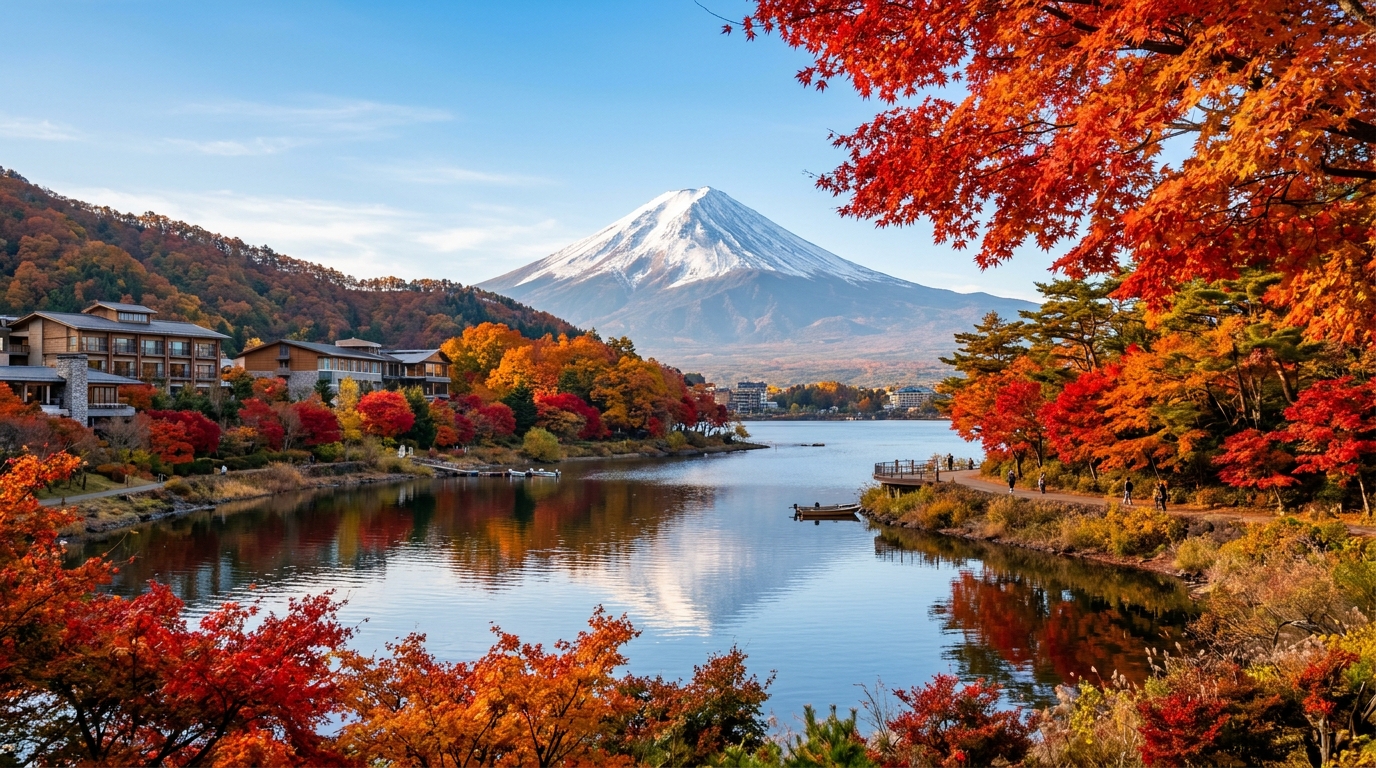
1. Autumn Foliage Appeal and the Current Real Estate Market in Fujikawaguchiko
Boasting the longest shoreline among the Fuji Five Lakes (富士五湖), Fujikawaguchiko Town is renowned for seasonal natural beauty, highlighted by famous autumn spots such as the Momiji Corridor (もみじ回廊, Momiji Kairō). In recent years, ongoing tourist infrastructure upgrades and new experience-based facilities have expanded options for visitors and prospective residents alike. For instance, July 2025 saw the opening of Expression KAWAGUCHIKO TERRACE, a modern cafe terrace centered around local ingredients.
This enhanced regional appeal directly influences the local real estate market. According to actual transaction data gathered via the MLIT API from 2021 through 2026 (sample size: 415 cases), the average property transaction price in Fujikawaguchiko Town stands at approximately ¥20 million (median: ¥10 million), with an average unit price of around ¥25,000 per square meter. The price spectrum is exceptionally wide, ranging from nominal deals as low as ¥1,000 to major commercial transactions reaching ¥450 million.
This wide price disparity stems from a mix of primary residential/vacation home land purchases and large-scale site acquisitions for luxury resort developments targeting wealthy buyers. To accurately interpret the real estate market in Fujikawaguchiko Town, looking beyond overall averages to evaluate specific land use and location-based purchasing patterns is essential.
2. Land Price Appreciation Driven by Luxury Foreign Resort Influx and Its Local Impact
In recent years, Fujikawaguchiko Town has experienced a noticeable surge in small luxury resort developments targeting affluent buyers. Leading this trend is FUFU Kawaguchiko (ふふ 河口湖), which maintained its Two Michelin Key status in the Michelin Guide 2026. Other developments include QUUGA, an exclusive private resort accommodating just five groups per day opening in 2026, and Kasumigaseki Capital's (霞ヶ関キャピタル) acquisition of a roughly 3,200 m² site for its new Fujikawaguchiko Hotel Project. Competition for land among domestic and international developers continues to intensify.
The entry of these high-end resorts serves as a powerful catalyst driving up land prices across adjacent areas. Real transaction records show that in Q1 2026, a 9,999 m² residential plot (land only) in the Kodachi (小立) district sold for ¥350 million (roughly ¥77,000/m²). Far exceeding typical residential lot sizes, this land was almost certainly acquired for a new resort facility or a luxury estate development.
In the same district, another 1,200 m² lot transacted at ¥49 million (roughly ¥39,000/m²), underscoring robust demand for expansive properties. As resort developments elevate the regional brand, appreciation spills over into surrounding residential and vacation home zones—a clear signal of rising property value that real estate investors cannot afford to overlook.
3. Landscape Regulations Protecting Mt. Fuji Views and Key Considerations for Single-Family Homes
Anyone purchasing or building real estate in Fujikawaguchiko Town must navigate the area's strict landscape regulations. Because the entire municipality lies within Fuji-Hakone-Izu National Park (富士箱根伊豆国立公園) and includes designated World Heritage views of Mount Fuji, the Fujikawaguchiko Town Landscape Ordinance (富士河口湖町景観条例) and associated landscape plans are strictly enforced.
The dataset reveals that most target areas are designated as "Urban Planning Areas outside Urbanization Promotion and Restriction Areas" (市街化区域及び市街化調整区域外の都市計画区域), with standard building coverage ratios (BCR) set at 70% and floor area ratios (FAR) between 200% and 400%. Other parcels fall into Category 1 Residential Zones (第1種住居地域), with a BCR of 60% and FAR of 200%. However, building volume cannot be determined by these standard Building Standards Act metrics alone.
Under guidelines tied to the Landscape Ordinance and the Natural Parks Act, building heights are often capped at 15 meters, and strict color saturation and lightness parameters apply to roofs and exterior walls. Compliance with exterior color standards that harmonize with surrounding nature is rigorously enforced—even for repainting classic hot spring ryokan. Whether building a primary residence or a vacation home—such as the single-family wooden home traded in the Oishi (大石) district for ¥24 million (890 m² site)—owners must pay careful attention to roof shapes, exterior wall colors, and site greening ratios to preserve indigenous vegetation and views of Mount Fuji.
4. Living Convenience and Residential Environment for Families and Prospective Relocators
For practical home buyers, daily livability matters just as much as scenic surroundings. Fujikawaguchiko Town actively encourages young families and relocators through initiatives like the Fujikawaguchiko Town Relocation and Settlement Promotion Scholarship Repayment Support Grant (富士河口湖町移住・定住促進奨学金返還支援補助金), launched in FY2024. As of 2026, this program continues to offer up to ¥240,000 annually (up to ¥1.2 million over five years for eligible applicants under age 35).
In terms of transportation, Kawaguchiko Station (河口湖駅) on the Fujikyu Railway (富士山麓電気鉄道, Fujisan Roku Denki Tetsudō) serves as the primary transit hub, averaging 1,456 daily passengers. Local public schools include Kawaguchiko Elementary School (河口小学校) and Kawaguchiko Kita Junior High School (河口湖北中学校), making the area appealing to families seeking a wholesome environment for child-rearing amidst nature.
However, specific data points warrant attention. The API query results indicate 0 healthcare facilities in the immediate vicinity of the surveyed points. While this partly reflects limited public data coverage in specific rural pockets, it highlights that pediatric or internal medicine clinics may not be within walking distance. Those planning relocation or dual-habitation should verify actual transit times to medical centers and neighboring hubs like Fujiyoshida City (富士吉田市).
5. Price Trends and Neighborhood Breakdown Around Lake Kawaguchi
To gain an objective view of the local market, let us examine recent transaction trends in Fujikawaguchiko Town. The chart below illustrates the quarterly trend for median land prices per square meter (residential land only), aggregated from the MLIT Real Estate Information Library.
From roughly ¥30,000/m² in Q1 2025, raw land prices climbed to approximately ¥39,000/m² by Q1 2026 despite minor quarterly fluctuations. This represents a substantial year-over-year increase of 30%, reflecting renewed interest in resort locations across the area.
In contrast, properties categorized as "Land and Building" (宅地(土地と建物)) showed a median unit price of around ¥27,000/m² in Q1 2026, marking a slight decline of 3.2% year-over-year. This reflects building depreciation on pre-owned homes. For instance, while a residential property in the Katsuyama (勝山) district sold for ¥46 million (250 m²), another property in the same district traded at ¥5.5 million (430 m²), likely representing a teardown lot valuation. Meanwhile, the second-hand condominium market remains minimal, with only one transaction recorded in Q1 2026 (¥1.8 million, approx. ¥26,000/m²), confirming that local demand centers almost entirely on detached homes and land.
Below are the top districts by transaction volume:
| District Name | Property Type | Transaction Count | Median Price / m² |
|---|---|---|---|
| Kodachi (小立) | Residential Land (Land only) | 20 | Approx. ¥35,000/m² |
| Funatsu (船津) | Residential Land (Land only) | 19 | Approx. ¥33,000/m² |
| Funatsu (船津) | Residential Land (Land & Building) | 8 | Approx. ¥65,000/m² |
| Katsuyama (勝山) | Residential Land (Land only) | 6 | Approx. ¥24,000/m² |
| Kawaguchi (河口) | Residential Land (Land only) | 6 | Approx. ¥24,000/m² |
Districts like Kodachi and Funatsu offer convenient access to the lakeside, leading transaction activity and serving as price drivers for the region.
6. Sunlight and Hazard Checks: Essential Steps for Dual-Home Seekers and Homebuilders
When purchasing land and building a home or vacation property in Fujikawaguchiko Town, evaluating local climate and disaster risks is paramount.
Regarding climate, the region's high elevation places it in "Zone 4" under national energy efficiency standards, denoting cold winters. Constructing a home with high insulation performance is vital to withstand winter freezes. Taking advantage of financial support—such as the Yamanashi KAITEKI Housing Promotion Grant (やまなしKAITEKI住宅普及促進事業費補助金) or the national Mirai Eco-Housing 2026 Program (みらいエコ住宅2026事業)—can play an important role in sound financial planning. Ensuring adequate sunlight exposure during winter months is equally critical for thermal comfort.
Hazard evaluations are another essential step. While sample data indicates no flood risk at queried points (no maximum inundation depth listed), landslide risks are categorized as "Present," specifically under the "Debris Flow" (土石流) classification. Scenic plots situated near mountain slopes carry a higher risk of debris flow during heavy rains or typhoons. Reviewing updated hazard maps prior to land acquisition is critical to choosing a safe plot.
7. Key Tips for Regret-Free Land Selection and Home Design in Fujikawaguchiko
Finding land in Fujikawaguchiko Town involves balancing multiple variables—ranging from landscape ordinance compliance and winter sunlight capture to avoiding landslide risk zones. Conducting thorough pre-construction simulations helps prospective buyers avoid costly oversights.
To streamline this process, consider using the "AI Architectural Simulator" included in the Mekiki Research Pro Plan. By inputting Fujikawaguchiko town data alongside your specific preferences, the AI automatically generates 2D floor plans and 3D architectural models customized for detached single-family homes.
Particularly useful for mountain resorts is the 3D summer and winter solstice "Sunlight Simulation" feature. By viewing how neighboring topography or structures affect natural light during winter months in 3D, you can optimize building orientation and layout to maximize warmth. The tool also creates exterior visual renderings styled to comply with local landscape guidelines and provides preliminary cost estimates. Users can even upload existing 2D floor plan images to convert them into 3D models. (Note: This simulation tool is designed exclusively for single-family homes. It does not support multi-family apartment planning, yield projections, or cash-flow estimates, nor does it replace formal architectural quotes or structural engineering calculations.)
8. Conclusion
Set against the scenic backdrop of autumn foliage, Fujikawaguchiko Town continues to draw attention from real estate investors and prospective residents alike, buoyed by upscale resort developments and relocation support programs. Yet alongside rising land values lie complex local considerations—including landscape regulations, landslide hazards, and medical infrastructure availability.
In a dynamic market like this, making decisions based on objective data is more important than ever. By signing up for a free membership, you can connect official MLIT data directly to your Claude or ChatGPT setup via MCP integration. This feature allows you to continue conducting detailed, AI-powered real estate research independently.
Whether you are seeking a primary residence, a second home, or an investment property, exploring the latest data directly is a great first step toward evaluating real estate opportunities in Fujikawaguchiko Town.