
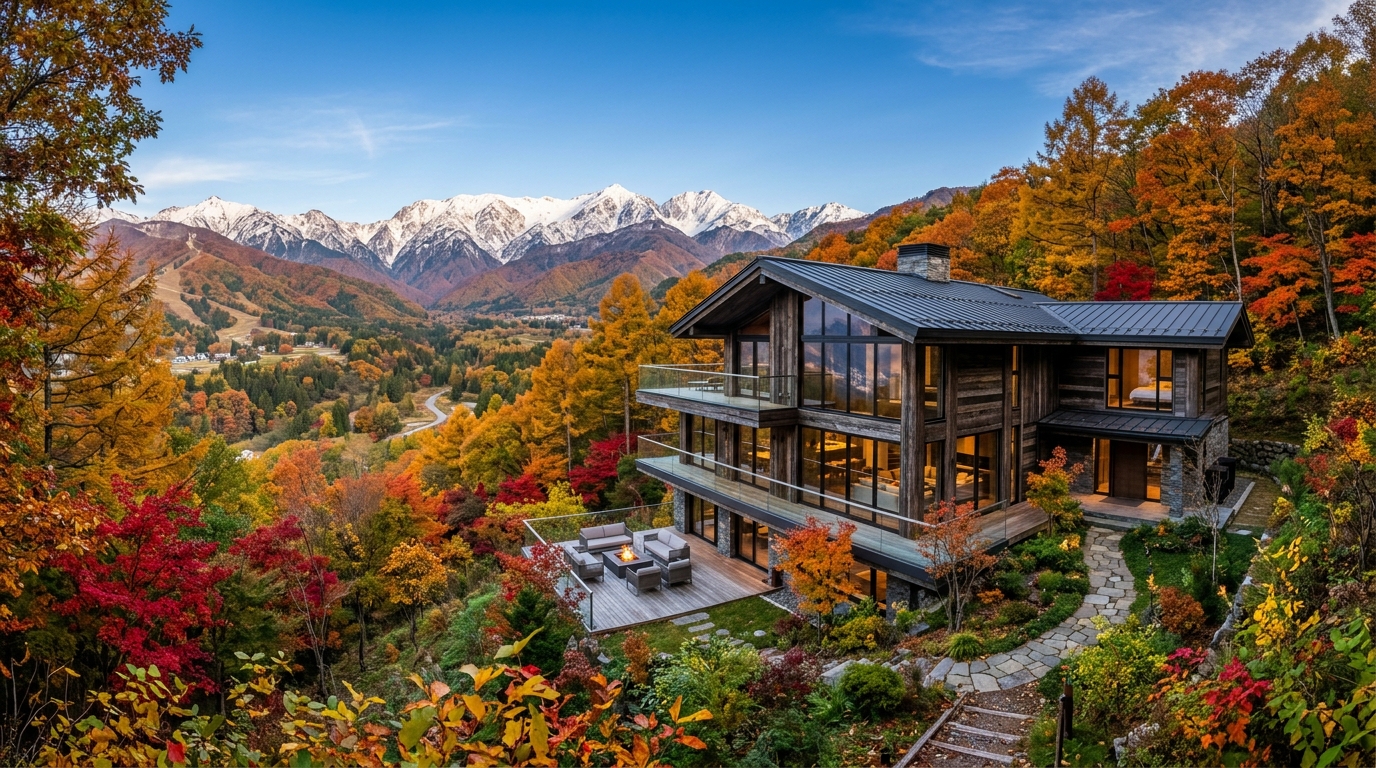
In the autumn of 2026, vibrant fall foliage paints the mountainsides of Hakuba Village, Nagano Prefecture (長野県北安曇郡白馬村). Once a single-season tourist destination bustling primarily with winter skiers, Hakuba has transformed into a "world-class all-season mountain resort" in recent years, attracting intense interest in the real estate market. In particular, international luxury resort developments proceeding in harmony with strict landscape conservation rules are powerfully driving demand for high-net-worth relocations and dual-life (two-home living) lifestyles.
This article provides an in-depth explanation of Hakuba Village's real estate trends as of 2026, aimed not only at real estate investors but also at prospective residents, home buyers, and vacation home builders. Backed by real data from the Ministry of Land, Infrastructure, Transport and Tourism (MLIT), we unravel the asset value of the Hakuba area from multiple perspectives—ranging from land price trends and transaction market rates to winter livability and family-rearing environments.
1. Hakuba Village in Autumn 2026: The Charm of a Mountain Resort Backed by Spectacular Foliage and Land Price Trends
Driven by robust domestic and international demand, the real estate market in Hakuba Village is showing dynamic movement. According to recent MLIT transaction data obtained by our company (covering the period 2021–2026 with a sample size of 315 properties), the average transaction price across all of Hakuba Village stands at approximately 27 million yen, with a median of 8 million yen, and an average unit price of about 20,000 yen/m².
A notable feature of this dataset is that the maximum transaction price reached 700 million yen. This indicates that the market includes not only standard residential sales but also large-scale luxury resort developments and premium vacation home plot transactions involving vast land areas. Conversely, the minimum transaction price was 5,700 yen for forest land (rinchi). Such extreme price disparities based on property attributes and locations are a defining characteristic of mountain resort areas.
During the autumn foliage season, countless visitors arrive seeking breathtaking views of the Northern Alps. This beautiful scenery serves as the primary underlying asset supporting Hakuba's property values. What captures the hearts of relocators and dual-life residents is the ability to enjoy this breathtaking environment not just as a temporary tourist, but as a part of their daily living routine.
2. Real Estate Rarity Driven by Landscape Conservation Ordinances and International Brand Developments
One key reason Hakuba Village maintains high asset values is its strict architectural regulations designed to protect natural scenery. Looking at the data, many areas in Hakuba are classified under the City Planning Act as non-designated zones (areas outside designated urban planning boundaries or urbanization promotion/adjustment zones), yet strict limits are imposed on Building Coverage Ratio (BCR / 建蔽率) and Floor Area Ratio (FAR / 容積率).
Actual transaction records reveal that while some areas allow a 60% BCR and 200% FAR, other areas heavily restrict development—such as a light-gauge steel frame residence sale in Oaza Hokujo restricted to a 30% BCR and 50% FAR for environmental conservation. These regulations prevent chaotic sprawl and guarantee generous spacing between properties, ultimately safeguarding the privacy and asset value of individual single-family homes and villas.
Furthermore, as of 2026, Hakuba Village is seeing a wave of high-profile international brand developments and redevelopments aligned with local aesthetics. For example, in front of Hakuba Station, a redevelopment project led by Sakura Real Estate (さくら不動産) is underway for a mixed-use complex featuring a world-class snowboard company, Burton, and a 24-hour Seven-Eleven, scheduled for completion in winter 2026. At Hakuba Iwatake Mountain Resort, a new center house opened for the 2025–2026 winter season, alongside ongoing efforts involving Mitsubishi Estate and Shimizu Corporation to attract high-grade international hotels.
Capital inflows continue to accelerate elsewhere in the village: Banyan Group's "Cassia Hakuba" broke ground in the Echoland district (scheduled to open in 2028), while Alpico Holdings is advancing the 4.3 billion yen "Hakuba Village Hokujo Project (tentative name)" near Happo-One, featuring a major bus terminal and hotel complex. In October 2026, an affiliate of the Oriental Land Group announced its first investment in Hakuba's tourism sector, further solidifying Hakuba’s reputation as a next-generation year-round destination rather than a mere ski hub.
3. International Environment and Nature: The Reality of Family Relocation
Retirees and ultra-high-net-worth individuals are no longer the only demographics moving to Hakuba. The number of young families relocating and building primary residences has grown rapidly, drawn by the pristine natural surroundings and a multicultural educational environment.
For public schooling, Hakuba Kita Elementary School (白馬北小学校) and Hakuba Junior High School (白馬中学校) serve as central hubs, supported by a unique community where diverse cultures intersect. The local municipality is heavily invested in family welfare; according to the "Hakuba Village Child-Rearing Guidebook 2026," economic support programs are well-funded, including multi-child household grants and "Alps Pay" regional currency vouchers for new births. Additionally, in April 2026, the childcare ICT service "CoDMON" was introduced across public nurseries and childcare support facilities, streamlining communication between parents and educators.
Generous subsidies are also available to lower the barriers to entry for essential workers. Programs such as the "Hakuba Village Nursery Teacher Relocation Support Grant" (600,000 yen) and the "Long-Term Care Staff Relocation Support Grant" (launched in July 2026, offering up to 600,000 yen toward moving expenses and rent) strengthen local community services. This robust social infrastructure elevates Hakuba from a seasonal getaway into a viable long-term residence, fueling local housing demand.
4. Daily Convenience Citing Hakuba as a Dual-Life Hub
When choosing Hakuba Village as a base for dual-life (two-home living) or full-remote work, day-to-day convenience is a crucial evaluation point.
Hakuba Station on the JR Oito Line (JR東日本 大糸線「白馬」駅), serving as the main gateway to the resort, records an average daily passenger count of 662. The aforementioned station front redevelopment will introduce 24-hour retail options, significantly improving convenience during late-night and early-morning hours.
Regarding medical infrastructure—often a primary concern for relocators—the village holds a solid base. Real data shows four main medical institutions operating in Hakuba, including community-focused clinics like "Kurita Clinic" (栗田医院) and "Oda Dental Clinic" (おだ歯科) handling everyday health needs. Specialized facilities like the "Showa University School of Medicine Mt. Shirouma Summit Clinic" (昭和大学医学部白馬岳頂上診療所) cater to mountain safety, reflecting the unique character of a major alpine resort.
The contrast between practical daily conveniences and opening your window to sweeping views of the Northern Alps represents one of the most rewarding aspects of living in Hakuba.
5. Winter Snow Management and Annual Maintenance: Realities to Know Before Buying a House or Vacation Home
When purchasing or building a home or vacation property in Hakuba Village, buyers must carefully consider the realities of living in snow country.
First, evaluating local hazard maps before buying is essential. According to our transaction data analysis, landslide risk within the primary target zones is rated as "None," but flood risk requires attention. Certain sectors fall under Flood Depth Rank 2 (0.5 to 3.0 meters), presenting potential floor-inundation risks if local rivers overflow. When purchasing land to build a house, raising the foundation or implementing flood mitigation features at the design stage is paramount.
Winter snow management is another critical consideration. Hakuba Village offers incentive programs such as the "Snow-Resistant Housing Subsidy" (克雪住宅整備事業補助金) and the environmentally friendly "Hakuba Village Zero-Energy Housing Promotion Subsidy" (白馬村ゼロエネ住宅普及支援事業補助金) to help offset initial and ongoing costs. Roof architecture (snow-drop vs. snow-melting designs), thermal insulation performance, and securing adequate sunlight during winter months are non-negotiable considerations for comfortable year-round living.
Visualizing these climate-adapted building designs can be challenging. Leveraging modern simulation tools simplifies this process. For example, registered free members can query the MLIT dataset featured in this article directly through Claude or ChatGPT via MCP integration. Additionally, our Pro Plan AI Building Simulator lets users input site-specific data and design preferences to automatically generate 2D floor plans, 3D architectural models, exterior visualizations, and solar orientation models for summer and winter solstices—helping buyers plan confident, budget-conscious residential projects that optimize natural light even through heavy winters.
6. Area-by-Area Data Analysis: Comparing Land Prices and Characteristics in Happo-One, Wadano, and Kamishiro Areas
Below, we analyze land price trends across Hakuba Village by area and property type, utilizing "marketTrend" figures calculated quarterly from the MLIT Real Estate Information Library.
Looking at "Residential Land (Land Only)," 2024Q1 saw 10 transactions with a median price of 27,000 yen/m². In 2025Q3, this shifted to 13 transactions at 21,000 yen/m², and in 2025Q4 to 5 transactions at 14,000 yen/m²—a slight moderation of -12.5% year-over-year.
In contrast, "Residential Land (Land & Building)"—which includes existing single-family homes and vacation villas—exhibits sharper volatility. In 2025Q4, 5 transactions were recorded with a high median unit price of 187,000 yen/m² and a median transaction value of 42 million yen. However, in 2026Q1, only 2 transactions occurred, dropping the median unit price to 2,800 yen/m² (median total price of 1.2 million yen), representing a -96.2% year-over-year change.
These swings highlight that Hakuba Village is a market characterized by sparse public transaction volume, making local micro-market comparison essential. Quarters featuring transactions of newly built luxury chalets produce vastly different median figures compared to quarters dominated by aging vacant homes or remote mountain plots.
The following table summarizes transaction activity by major district (Oaza):
| District Name | Property Type | Transactions | Median Unit Price | Characteristics / Trends |
|---|---|---|---|---|
| Oaza Hokujo | Residential Land (Land Only) | 16 | 26,000 yen/m² | Resort center. Relatively high unit prices, stable market. |
| Oaza Hokujo | Residential Land (Land & Building) | 15 | 91,000 yen/m² | Strong demand for chalets, villas, and residential homes. |
| Oaza Kamishiro | Residential Land (Land Only) | 10 | 7,600 yen/m² | Suburban area. Affordable prices; well-suited for primary residences. |
| Oaza Kamishiro | Residential Land (Land & Building) | 4 | 8,400 yen/m² | Occasional sales of pre-owned detached homes. |
| Oaza Kamishiro | Forest Land | 7 | 52 yen/m² | Primarily large raw forest land transactions prior to development. |
Oaza Hokujo (大字北城, including central Happo-One and Wadano) maintains high unit prices for both land and structures due to excellent access to ski resorts and commercial amenities. Meanwhile, Oaza Kamishiro (大字神城) offers a quieter environment with land prices frequently below 10,000 yen/m², making it an attractive target for relocators seeking spacious residential home sites at lower entry costs.
7. Driven by Wealthy Relocators Rather Than Data Centers: Hakuba's Asset Value and Resale Appeal
In recent years, mega data center developments have driven land price inflation across major metropolitan areas and select regional hubs. In Hakuba Village, however, asset values are propelled by an entirely different catalyst: an exceptional natural environment combined with high-net-worth relocation.
Because strict landscape zoning caps BCR and FAR across Hakuba, the supply of developable land for high-grade residential use has a natural ceiling. This supply constraint acts as a long-term buffer protecting land scarcity. Furthermore, long-term capital commitments from major international entities like the Oriental Land Group affiliate and Banyan Group demonstrate that Hakuba's momentum is not a short-lived trend, but an evolution into a sustainable international resort.
For primary buyers building a home, maximizing resale value involves prioritizing high thermal efficiency and airtightness (such as Zero-Energy Housing standards) that withstand severe winters, alongside timeless architectural design. Designs featuring natural timber elements harmonizing with Hakuba's landscape and large window placements overlooking mountain vistas consistently command strong demand from domestic and international buyers and renters alike.
8. Conclusion
Enveloped in vivid autumn colors in late 2026, Hakuba Village has solidified its transition from a traditional winter ski town into an all-season mountain resort where a diverse community gathers year-round.
Redevelopment projects around the station and luxury hotel additions under strict landscape rules are lifting base property values. Concurrently, comprehensive family subsidies, enhanced healthcare, and educational facilities make Hakuba increasingly attractive not just for seasonal vacationers, but for families seeking primary residences or dual-life bases. As transaction data shows significant variance across quarters and micro-districts, careful site selection and thorough hazard checks remain vital.
If you are exploring a resort property or a primary home surrounded by nature, examining real transaction data for your areas of interest is a great first step. By signing up for a free account, you can access the MLIT transaction data used in this article directly through Claude or ChatGPT via our MCP integration. Use your preferred AI assistant to dive deeper into local market trends and turn your future living plans into reality.