
October 22 marks the day of the grand annual Jidai Matsuri (時代祭 - Festival of the Ages), commemorating the relocation of the capital to Heian-kyo (平安京 - modern-day Kyoto) in 794 AD. Celebrating the dawn of Kyoto’s long history, the entire city comes alive with the pride and vibrant energy of the ancient capital. Among its districts, Higashiyama Ward, Kyoto City (京都市東山区), home to a dense concentration of iconic historic structures such as Kiyomizu-dera Temple (清水寺), Yasaka-jinja Shrine (八坂神社), and Kennin-ji Temple (建仁寺), has developed uniquely for over a millennium as the cultural heart of Kyoto.
Walking through Higashiyama reveals charming streetscapes woven from cobblestone alleyways, wooden Kyo-machiya (京町家 - traditional Kyoto townhouses), and gentle slopes. Far from being mere tourist attractions, these elements form a "living townscape," carefully preserved and passed down through generations by local residents as their everyday living spaces.
In recent years, the real estate market has seen a reevaluation of the value of living within these historic landscapes. Beyond real estate investors, end-users—including families raising children and single individuals seeking a tranquil environment—are showing strong interest in a lifestyle that involves renovating traditional buildings with modern comforts to pass down as one-of-a-kind family homes. Offering warmth from natural wood and clay alongside daily proximity to seasonal nature—experiences impossible to find in inorganic urban condominiums—this way of life presents a uniquely enriching choice for relocators and those considering dual-base living.
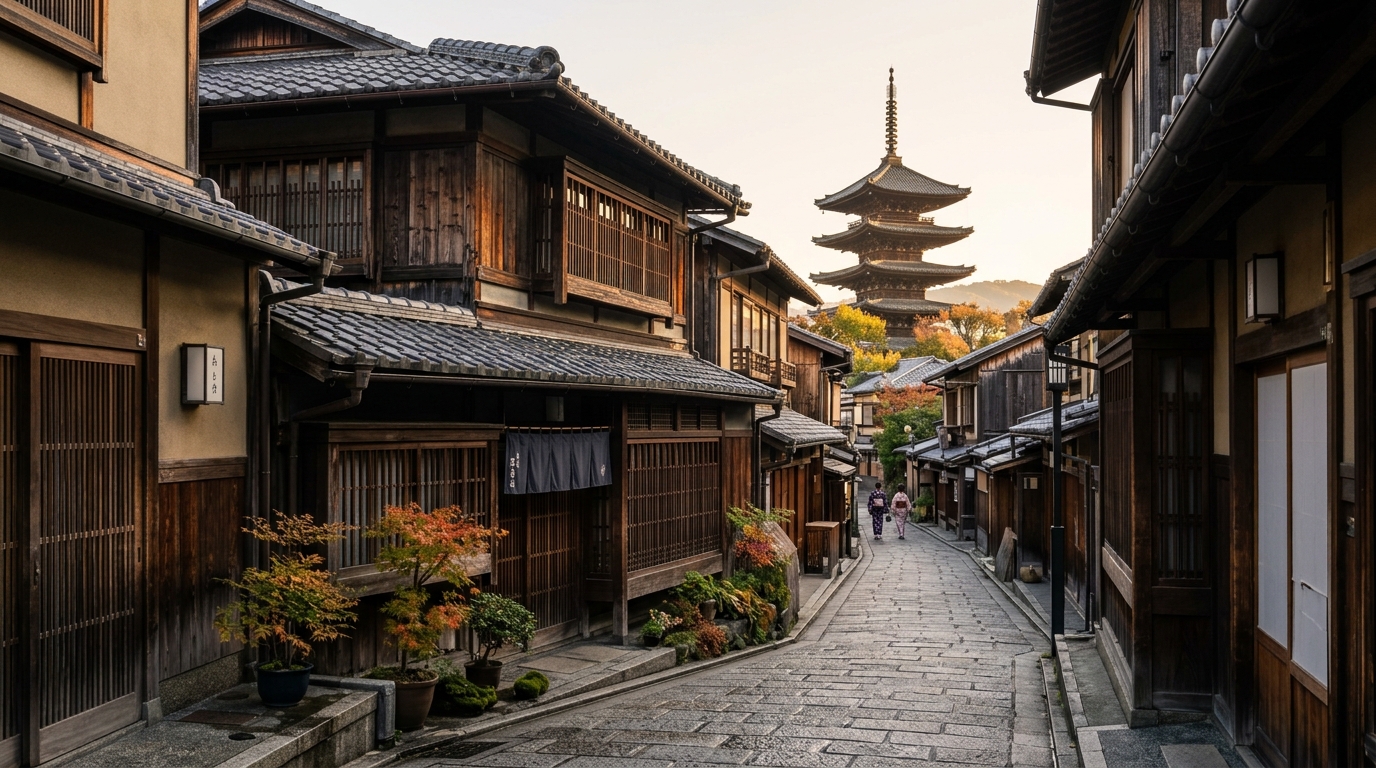
In honor of the anniversary of Heian-kyo's founding, this article explores the serene residential environment protected under strict landscape regulations, alongside market trends for single-family homes and pre-owned houses based on the latest 2026 transaction data. Let us delve into how revitalizing historic homes creates both comfortable living and long-term asset value.
1. Kyoto’s Historic Townscape and Landscape Preservation: Unraveling Higashiyama Ward from the Anniversary of the Capital's Transfer
Kyoto possesses a unique historical background distinct from any other regional city in Japan. From the relocation of the capital in 794 through the modern era, the urban grid and cultural continuity have been preserved despite numerous wars and historical shifts. Higashiyama Ward in particular, set against the lush backdrop of the Higashiyama Thirty-Six Peaks (東山三十六峰 - Higashiyama Sanjurokku), is an area where shrines, temples, and daily human life have remained intimately interconnected.
The greatest charm of this area lies in its Kyo-machiya and kominka (古民家 - traditional Japanese houses) tucked away at the ends of narrow alleys. Traditional architectural features—such as the unique lot layout known as unagi no nedoko ("eel's nest," featuring narrow frontages and deep interiors), tori-niwa (earthen passageways), hibukuro (high-ceilinged ventilation spaces above hearths), and tsubo-niwa (small courtyard gardens)—represent the accumulated wisdom of ancestors designed to endure Kyoto’s scorching summers and severe winter cold.
In modern times, constructing such historic buildings anew from scratch is extremely difficult due to the Building Standards Act and prohibitive costs. Consequently, acquiring an existing Kyo-machiya or traditional house and revitalizing it as a primary residence while preserving its historical value has become a compelling path for many. By retaining exposed wooden pillars and beams while modernizing floor plans and plumbing fixtures, homeowners create a truly unique living space where historic charm seamlessly meets modern comfort.
2. Protected Living Environments and Design Guidelines under Kyoto's Strict "New Landscape Ordinance"
The primary reason Higashiyama’s picturesque townscape remains protected from unregulated development is the exceptionally strict landscape controls independently established by Kyoto City. In 2007, Kyoto City enacted the "New Landscape Ordinance" (新景観条例 - Shin Keikan Jorei), instituting rigorous rules governing building height, structural design, roof slope and materials, exterior wall colors, and even outdoor advertising signage down to the finest detail.
For instance, real-world data from a surveyed location in Higashiyama Ward (Higashiyama Ward, Kyoto City, Kyoto Prefecture; City Code 26105) shows that the zoning is classified as a "Commercial District." Under standard national guidelines, this zone permits a building coverage ratio of 80% and a floor area ratio of 700%, reflecting high development potential where high-rise towers or major commercial complexes could typically be built. In reality, however, Kyoto's strict proprietary height limits and design guidelines apply comprehensively across this area, preventing the sudden appearance of oppressive mega-structures that would disrupt the surrounding aesthetic.
While these rigid regulations present hurdles for developers by limiting architectural flexibility and profitability, they offer immeasurable benefits to homebuyers and residents. The risk of a high-rise condominium suddenly rising next door to block sunlight and airflow is extremely low. The peace of mind that comes with knowing a beautiful, tranquil residential environment is guaranteed long into the future is an invaluable factor when choosing a home. Rather than merely preserving aesthetics, landscape regulations act as a robust bulwark permanently safeguarding residents' quality of life (QOL).
3. 2026 Market Trends: Transaction Prices for Detached Homes and Pre-Owned Residential Properties in Higashiyama
What budget is actually required to purchase a home in Higashiyama? Let us examine market trends using proprietary data and quarterly aggregated 2026 market statistics compiled via our BigQuery platform from the Ministry of Land, Infrastructure, Transport and Tourism (MLIT) Real Estate Transaction Price Information.
Across 922 transaction samples in Higashiyama Ward overall (period: 2021–2026), the average transaction price stands at approximately 59.57 million JPY, with a median of 28.00 million JPY. While the highest transaction reached 1.3 billion JPY, the lowest was 350,000 JPY—reflecting a wide price spectrum driven by location, size, and property condition. The overall average unit price is roughly 610,000 JPY/m².
The tables below summarize median transactions by property type for Q1 2026 (2026Q1), alongside top-ranking school districts and neighborhood sectors by transaction volume.
| Property Type | Q1 2026 Transactions | Median Price/m² | Median Total Price | YoY Change (Unit Price) |
|---|---|---|---|---|
| Pre-Owned Condominiums, etc. | 14 | Approx. 800,000 JPY/m² | 42.00 million JPY | +71.4% |
| Residential Land (Land Only) | 1 | Approx. 270,000 JPY/m² | 66.00 million JPY | -6.9% |
| Residential Land (Land and Building) | 17 | Approx. 380,000 JPY/m² | 14.00 million JPY | -12.3% |
| Top Areas by Transaction Volume (Type) | Transaction Volume | Median Price/m² |
|---|---|---|
| Kiyomizu School District (Pre-Owned Condominiums, etc.) | 19 | Approx. 420,000 JPY/m² |
| Imagumano Minamihiyoshi-cho (Land and Building) | 16 | Approx. 180,000 JPY/m² |
| Shudo School District (Land and Building) | 12 | Approx. 370,000 JPY/m² |
| Ikkyu School District (Land and Building) | 12 | Approx. 280,000 JPY/m² |
| Rokuhara School District (Land and Building) | 10 | Approx. 800,000 JPY/m² |
*Source: Quarterly aggregated data compiled via our BigQuery from MLIT Real Estate Transaction Price Information.
Data indicates that while unit prices for pre-owned condominiums rose sharply by +71.4% year-over-year, the median price per square meter for residential land with buildings fell -12.3% year-over-year to approximately 380,000 JPY/m², with a median price of 14.00 million JPY—showing that reasonably priced detached properties are actively available.
A detailed look at actual Q1 2026 transaction samples highlights this diversity. For instance, in Imagumano Minamihiyoshi-cho (今熊野南日吉町 - Category I Mid/High-Rise Oriented Residential Zone, building coverage ratio 60%, floor area ratio 200%), a spacious family-oriented 140 m² wooden house (6LDK) built in 2000 traded at 50.00 million JPY.
Conversely, in Imagumano Hojo-cho (今熊野宝蔵町 - Category I Low-Rise Exclusive Residential Zone, coverage 60%, FAR 200%), a 35 m² property built in 1986 (residential/parking use) sold for 11.00 million JPY. In the Category I Mid/High-Rise Zone of the same neighborhood, a 20 m² 2DK built in 1982 traded for 7.60 million JPY. Furthermore, in Imagumano Tsurugimiya-cho (今熊野剣宮町), a 30 m² wooden 2K property was acquired for just 2.60 million JPY, illustrating abundant opportunities to acquire compact traditional homes at highly accessible prices. Additionally, in Imagumano Naginomori-cho (今熊野椥ノ森町 - Category I Residential Zone, coverage 60%, FAR 200%), a generous 240 m² plot of land transacted for 66.00 million JPY (approx. 270,000 JPY/m²), indicating that a segment of buyers seeks to build custom single-family homes on spacious plots.
4. Livability and Modern Comfort in Renovating Kyo-machiya and Traditional Houses
This approach of acquiring reasonably priced compact traditional houses or pre-owned homes and renovating them to suit modern lifestyles is immensely popular among end-user buyers in Higashiyama. By preserving historic design elements like tori-niwa, hibukuro, and tsubo-niwa while upgrading wet areas (kitchens and bathrooms) alongside thermal insulation and seismic strength using state-of-the-art technology, homeowners can achieve a refined balance between historic character and modern living comfort.
Natural materials such as solid wood flooring and earthen plaster walls possess exceptional humidity-regulating properties, naturally mitigating Kyoto's notoriously humid summers and severe winter chill. Offering a refreshing living experience that leverages natural airflow—unlike modern homes focused solely on airtightness—this lifestyle holds tremendous appeal for families raising children and single individuals seeking a relaxed pace of life.
However, when purchasing and considering the renovation of an older property, many buyers worry about what the finished space will look like and how much the total budget will run. To solve this, the "AI Building Simulator" included in the Pro Plan of Mekiki Research comes into play. By simply inputting real local data and your specific preferences, this tool easily generates 2D floor plans, 3D structural models, summer/winter solstice sunlight simulations, exterior visual concepts, and estimated total budgets—helping you vividly visualize your post-renovation life.
5. Tax Benefits and Subsidy Advantages when Purchasing and Renovating Homes in Historic Preservation Districts
To pass down historic townscapes to future generations and encourage young families to settle in the city, Kyoto City offers some of the most generous subsidy programs in Japan for acquiring and renovating traditional houses and Kyo-machiya.
As of 2026, key initiatives include the "Machi no Takumi Plus" (京町家・木造住宅 耐震・防火改修支援事業 - Kyoto-machiya and Wooden House Seismic/Fire-Resistant Renovation Support Program), which offers grants of up to 3 million JPY for seismic upgrades and full renovations of Kyo-machiya. Additionally, the "Designated Kyo-machiya Renovation Subsidy" (指定京町家改修補助金) provides up to 2.5 million JPY for properties with high historical value. Furthermore, families with preschool children purchasing and renovating existing homes can receive up to 2 million JPY under the "Kyoto Anshin Sumai Support Grant" (京都安心すまい応援金 - Kyoto City Child-Rearing Household Existing Home Acquisition Grant). By leveraging these subsidies wisely, buyers can significantly lower initial capital requirements and renovation costs to create a safe, comfortable home.
However, evaluating natural hazard risks is vital when selecting a property in Higashiyama. Hazard data for our surveyed location indicates potential flood risks (Maximum Inundation Depth Rank 4: 5 to 10 meters) alongside sediment disaster risks (debris flows and steep slope collapses) due to the mountainous backdrop. Before buying, reviewing the latest hazard maps and integrating flood-resistant foundation reinforcements and physical landslide barriers into your renovation plan is an absolute prerequisite for long-term peace of mind.
6. Asset Value Scarcity Born from Landscape Controls: A Contrast with Cities Fueled by Data Center Developments and High-Net-Worth Migration
In recent years, land prices in city suburbs and regional hub cities have surged due to major data center attractions and station-front redevelopments. However, the real estate market in Higashiyama Ward, Kyoto operates on a fundamentally different mechanism from these development-driven markets.
The ultimate source of asset value in Higashiyama stems from the absolute scarcity of its "irreplaceable historic townscape," safeguarded by strict landscape regulations. Precisely because large-scale redevelopments and high-rise condo towers are physically and regulatory impossible, the underlying land and traditional structures continue to appreciate in relative value. Indeed, domestic and international high-net-worth individuals who value this uniquely authentic Kyoto character maintain steady demand for primary relocations and second-home acquisitions.
While temporary land value spikes caused by development booms carry the risk of devaluation once trends shift, Higashiyama’s value—anchored in deep culture and history—never pales. Because landscape ordinances restrict new large-scale housing supply, existing homes and traditional houses maintain and enhance their value over time, making Higashiyama an exceptionally stable asset choice for long-term homeowners.
7. Spotlight on the Opening of Imperial Hotel Kyoto: Living Convenience and Residential Appeal for Families and Single Residents
Beyond historic ambiance and strong asset preservation, Higashiyama offers continuously improving day-to-day convenience. From areas around Gion-Shijo Station (祇園四条駅) on the Keihan Electric Railway, residents can easily walk or bike to Shijo Kawaramachi (四条河原町), Kyoto’s premier downtown district. (Note: Because passenger count data or school district transaction records for certain points may be partially undisclosed or limited, conducting detailed local research and comparisons remains essential).
Furthermore, high-profile world-class luxury hotel entries are bolstering the area's overall brand equity. On March 5, 2026, Imperial Hotel, Kyoto (帝国ホテル 京都) opened to widespread acclaim through the historic preservation and adaptive reuse of the Yasaka Kaikan (弥栄会館) building on the grounds of the Gion Kobu Kaburenjo theater. In the same month, Capella Kyoto (カペラ京都) opened on the former site of Shindo Elementary School (元新道小学校). The influx of top-tier hospitality establishments elevates regional prestige, encouraging enhanced local safety, infrastructure upgrades, and a growing concentration of refined dining choices.
Regarding living infrastructure, the area boasts 15 medical clinics—including Hashihira Clinic (はしひら医院), Muto Clinic (医療法人武藤医院), and Kawai Clinic (河合医院)—providing reassuring support for everyday health management and emergencies. With educational and medical resources compactly clustered, Higashiyama provides a highly comfortable living environment for both car-free singles and families who treasure local community ties.
8. Conclusion: Key Points for Successfully Choosing a Home Amidst Higashiyama’s Historic Scenery
Revisiting Higashiyama Ward's real estate appeal on the anniversary of Heian-kyo's founding highlights three core strengths: a tranquil residential setting protected semi-permanently by strict landscape controls, modern living comfort achieved through traditional house renovation, and irreplaceable, long-term asset value.
Latest 2026 transaction trends reveal numerous accessible, compact properties. Paired with Kyoto City’s generous homebuying subsidies, owning a home in cherished Kyoto is a fully achievable reality. However, conducting thorough hazard evaluations and developing tailored plans that respect the nuances of historic architecture are vital steps.
By registering for a free membership, you can directly query the Ministry of Land, Infrastructure, Transport and Tourism data used in this blog from your own Claude or ChatGPT via Model Context Protocol (MCP) integration. Effortlessly continue investigating your target neighborhoods with your favorite AI tools—sign up today to streamline your property research!