
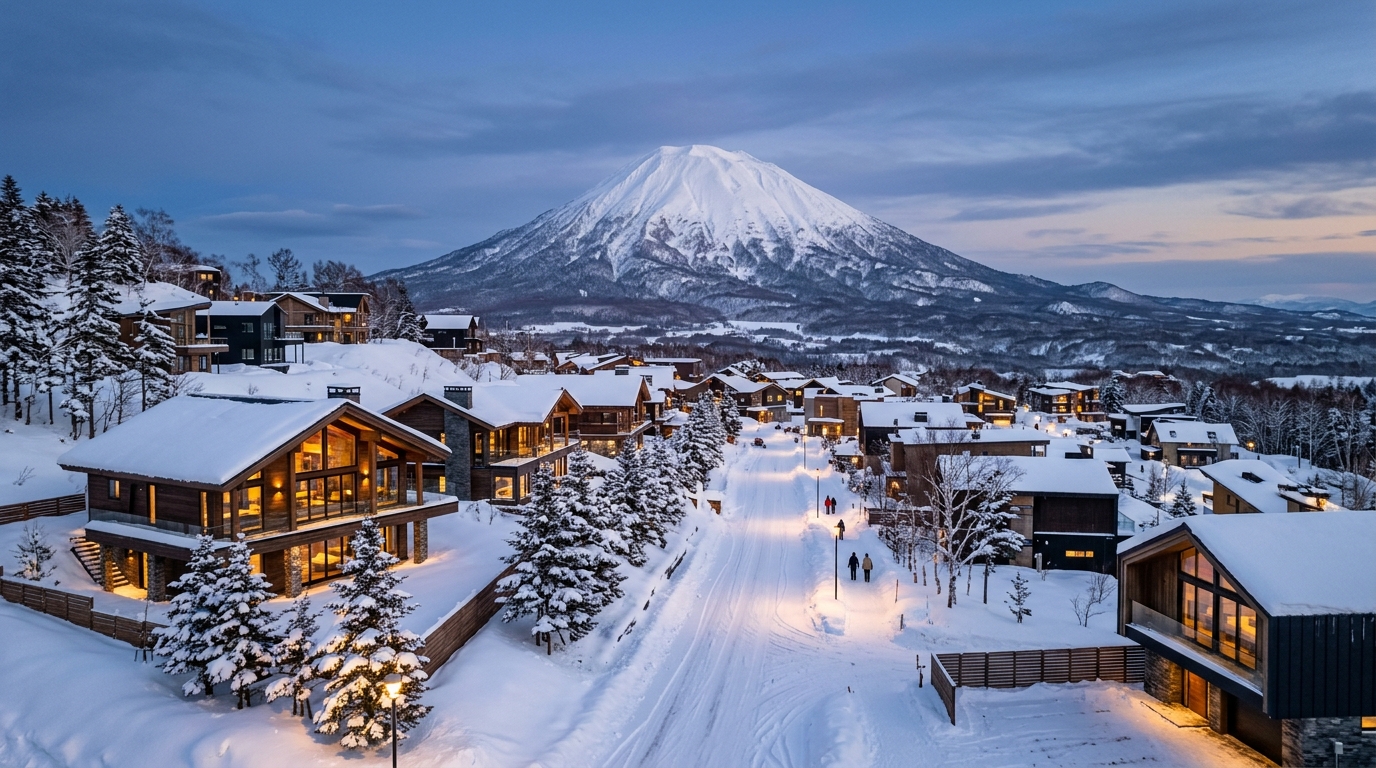
October 20 is "Overseas Migration Day" (Kaigai Iju no Hi) in Japan. Historically established to mark the departure of Japanese emigrants setting off for new frontiers abroad, the vector of migration is reversing in the modern era. People from all over the world now dream of moving to or enjoying extended stays in Japan as a destination for an international lifestyle. Within Japan, one area drawing exceptionally intense global interest is Kutchan Town in Abuta District, Hokkaido (part of the renowned Niseko area).
Attracted by its legendary powder snow and the majestic backdrop of Mount Yotei, the region has experienced an influx of luxury international hotel brands and high-net-worth residents. As a result, Kutchan is no longer merely a seasonal resort destination. Driven by the widespread adoption of remote work, it has surged in popularity as a base for dual-location living (dual life), an appealing setting for families raising children in nature, and a viable market for primary home purchases.
In honor of Overseas Migration Day, this article delivers an in-depth analysis of Kutchan Town’s real estate market and long-term potential. Drawing from transaction data provided by the Ministry of Land, Infrastructure, Transport and Tourism (MLIT) and the latest urban redevelopment plans, we explore Kutchan's genuine appeal—not just through an investment lens, but from a practical perspective focused on livability and home buying.
1. October 20 is "Overseas Migration Day": Current Global Focus on Kutchan Town
While October 20 serves as "Overseas Migration Day" to reflect on Japan's history of outward migration, the concept of migration in today's real estate market has diversified—encompassing movement from overseas into Japan, as well as shifts from major urban centers to regional areas. Regions with clear drivers of land value growth, such as data center developments or incoming affluent residents, are demonstrating strong asset value growth nationwide. Kutchan Town in Hokkaido stands out as a prime example of this trend.
Together with neighboring Niseko Town, Kutchan forms part of "Niseko United," one of the world's premier winter resort destinations, drawing skiers and snowboarders from across the globe every winter. However, what is taking place in this area today extends far beyond a simple tourism boom. Infrastructure is rapidly being established to allow international high-net-worth individuals to own vacation residences and enjoy extended stays year-round.
This cosmopolitan atmosphere creates a unique environment where residents can enjoy an international lifestyle while living in Japan. Consequently, Kutchan has become a compelling destination for families wishing to raise their children in a global setting, as well as professionals seeking a dual-location lifestyle that balances nature with urban convenience. The town offers immense potential not only to real estate investors, but also to buyers looking for a primary residence.
2. Rush of Foreign Luxury Hotel Developments and Land Price Trends
The Niseko area, centered around Kutchan Town, has experienced a rapid wave of luxury international hotel developments in recent years. Following the opening of "Setsu Niseko" in 2022, Hoshino Resorts is slated to open its first residence-style hotel, "Hoshinoya Lodge Niseko" (tentative name), in autumn 2026. Furthermore, winter 2026 will see the launch of a new hotel condominium replacing the former Hotel Niseko Alpen, and in 2029, the global luxury brand "The Chedi Niseko" will make its debut in Japan. News of major development projects continues unabated.
This wave of resort development is clearly reflected in actual property transaction prices. According to quarterly transaction data compiled from the MLIT Real Estate Information Library between 2021 and 2026, Kutchan recorded 363 total transactions, with an average price of approximately ¥44.44 million, a median price of ¥11 million, and an average unit price of around ¥54,000/m².
The price increase in residential land (land and buildings combined) is particularly noteworthy. In the first quarter of 2026 (2026Q1), there were 4 transactions for residential land with buildings, recording a median unit price of approximately ¥183,000/m². This represents a substantial year-on-year (YoY) increase of +25.1% compared to approximately ¥146,000/m² in 2025Q1.
Meanwhile, median unit prices for residential land (land only) show firm support, despite fluctuations caused by seasonal factors and specific property characteristics. After reaching ¥110,000/m² in 2025Q1, prices adjusted to approximately ¥37,000/m² in 2025Q2 and ¥46,000/m² in 2025Q3, before returning to ¥110,000/m² in the most recent 2026Q1 period (3 transactions, 0% YoY change).
The graph below visually illustrates the quarterly trend of median unit prices per square meter for residential land (land only).
3. The Impact of Resort Development on Central Kutchan and Residential Neighborhoods
While high-end hotel developments and ski resort projects tend to concentrate in resort areas such as the Hirafu district, the resulting economic ripple effects and land value growth are spreading into central Kutchan and standard residential neighborhoods.
For instance, in the Niseko Hirafu district, a large-scale commercial project known as the "Aruku-zaka Street Project" (tentative name) by Special Purpose Company MHL ARK Development is underway. It includes plans for two complex commercial buildings and three hotel buildings, further enhancing the area's commercial appeal. This expansion has driven housing demand for resort workers and new residents, invigorating real estate activity in the town center.
Looking at recent quarterly transaction counts by sub-district (cho-chome), significant activity is visible near the town center. The table below outlines top-ranking neighborhoods by transaction volume along with their median unit prices (Source: Compiled from MLIT transaction data).
| Neighborhood (Cho-chome) | Property Type | Transaction Volume | Median Unit Price/m² |
|---|---|---|---|
| Kita 6-jo Nishi | Residential Land (Land only) | 4 | Approx. ¥37,000/m² |
| Kita 4-jo Higashi | Residential Land (Land only) | 4 | Approx. ¥60,000/m² |
| Aza Yamada | Forest Land | 3 | Approx. ¥4,000/m² |
| Kita 7-jo Higashi | Residential Land (Land only) | 3 | Approx. ¥36,000/m² |
| Minami 4-jo Nishi | Residential Land (Land & Building) | 3 | Approx. ¥108,000/m² |
Examining specific transaction samples in 2026Q1, a 360 m² wooden apartment building built in 2026 in central "Kita 4-jo Nishi" (Category 1 Residential Zone, 60% building coverage ratio / 200% floor area ratio) was sold for ¥85 million. Similarly, in "Kita 7-jo Nishi," a 230 m² wooden 2LDK single-family house built in 2020 (Category 2 Residential Zone, 60% building coverage / 200% floor area ratio) transacted for ¥42 million. These records demonstrate that high-quality, primary-residence homes are commanding solid evaluations in the local market.
4. Livability in Kutchan as a Base for Dual-Location Living (Dual Life)
When contemplating a relocation or setting up a dual-location home, everyday livability is just as crucial as resort glamour. Kutchan Town is designated as a Special Heavy Snowfall Zone with some of the highest snowfall levels in Hokkaido, but it benefits from robust winter infrastructure and long-established snow-country living practices.
Zoning data shows that residential districts in Kutchan include Category 1 Mid/High-Rise Oriented Residential Zones with standard parameters like 60% building coverage and 150% floor area ratios. These regulations preserve spacious living environments with ample sunlight and ventilation. Plots are typically sized to allow proper distance between neighboring houses, leave room for generous yards or parking, and accommodate snow removal needs during winter.
Slightly away from the resort strip, the town center (including the Hojo and Nanjo districts) features supermarkets, drugstores, and home improvement centers that meet everyday shopping needs. On weekends, world-class powder snow is just a short drive away, alongside outdoor activities like white-water rafting, golfing, and camping during the summer. This clear distinction between work and leisure makes Kutchan an ideal setting for remote workers and dual-life practitioners seeking true work-life balance.
5. Daily Amenities, Education, Healthcare, and Living Comfort for Families
For families looking to buy a primary home and settle down long-term, childcare facilities and healthcare infrastructure are vital factors. Because Kutchan has cultivated a diverse, international community, local children have unique opportunities to experience different cultures and languages naturally—an educational advantage rarely found in regional Japanese towns.
Official district maps place local children in schools such as Higashi Elementary School and Kutchan Junior High School, providing a calm learning environment. Regarding medical care, dataset checks confirm four healthcare institutions operating within the surveyed area. Clinics such as Yotei Pediatric and Allergy Clinic, Kutchan Azuma Eye Clinic, and the Kutchan Town Health and Welfare Center offer routine care and prompt assistance for child health issues, giving raising families peace of mind.
Furthermore, Kutchan Town actively supports families through municipal initiatives and housing subsidies. In addition to medical expense subsidies for children through high school, the "Kutchan-style Housing New Construction Subsidy" offers an additional ¥100,000 top-up for families with children building quality homes. Other programs include subsidies for winter-proofing renovations and durability improvement grants (up to ¥500,000), offering tangible assistance to relocators and home buyers intending to settle permanently.
6. The Future of Transportation Infrastructure: Hokkaido Shinkansen Extension and Accessibility Changes
Transportation infrastructure developments play a major role in shaping medium- to long-term property values. Kutchan is currently the site of a major project: the ongoing redevelopment of Kutchan Station in preparation for the Hokkaido Shinkansen extension.
In the dataset used for this analysis, station names and passenger volume fields returned null values. This reflects limitations in MLIT API coverage for regional transit lines or lower transaction density in specific data samples. In reality, however, street layout revisions and access road construction around Kutchan Station are actively progressing ahead of the high-speed rail opening.
While there are delays relative to the original target date (the end of fiscal year 2030) for the extension to Sapporo, urban planning and land readjustment efforts around the station remain underway. Once the Shinkansen line opens, travel times from Tokyo and Sapporo will drop significantly, boosting domestic and international visitor arrivals. Strengthened as a regional transit hub, Kutchan Station's commercial convenience will rise, supporting long-term property values in surrounding residential neighborhoods.
7. Area Selection and Key Considerations for Single-Family Homes and Vacation Homes in Kutchan
When planning to build a house or acquire a vacation property in Kutchan, several practical factors should guide your choice of location.
First is the broad price spectrum. Alongside well-serviced residential plots in the town center, raw forest land (rinchi) transactions appear on the outskirts. For example, transaction records show 165 m² of forest land in "Aza Toyooka" selling for ¥100,000, and 8,888 m² in "Aza Fuso" selling for ¥500,000. Buying a large tract of land at a low entry price to build a private retreat is appealing, but buyers must factor in the costs of connecting utilities (water, sewage, electricity) and ensuring winter snow removal route coverage.
Second, reviewing hazard maps before purchasing is essential. In the Kutchan dataset evaluated here, landslide risk was assessed as "None," but flood risk was marked as "Present," with certain areas classified under maximum flood depth Level 4 (inundation depth of 5 to 10 meters). Living alongside rich natural surroundings entails natural disaster risks. When selecting land to build a house, checking official hazard maps and incorporating flood mitigation measures—such as elevated foundations—into architectural design is vital.
Relocating to a regional area or building a resort home involves localized considerations distinct from buying urban properties. If you would like to explore property market trends or hazard risks for your specific area of interest, consider registering for a free account on our site. Free members can query the official MLIT datasets featured in this blog directly using Claude or ChatGPT via MCP integration, enabling you to conduct customized AI-driven research.
For those seeking to visualize custom home designs, our Pro Plan offers an "AI Architectural Simulator." By entering real neighborhood data and your design preferences, the AI generates 2D floor plans, 3D structural models, summer/winter solstice sunlight simulations, exterior renderings, and estimated total project budgets. You can even upload existing floor plan images to render them in 3D—making it easier to evaluate options with your family or present concepts to construction professionals.
8. Conclusion
In connection with "Overseas Migration Day," we have examined the real estate market in Kutchan Town, Hokkaido—a destination commanding international attention. Alongside macro growth factors like luxury hotel developments and Shinkansen infrastructure planning, Kutchan provides genuine livability through family subsidies, medical care, and everyday commercial amenities.
Although property values are buoyed by high-net-worth resort demand, practical residential plots and existing single-family homes in the town center remain accessible for primary home buyers and families. Successfully choosing a home or executing a relocation plan ultimately comes down to addressing local conditions—such as winter snow management and flood risk.
To start planning your ideal lifestyle, begin your search with objective, data-driven insights.
Check the latest land price and hazard information for Kutchan Town, Hokkaido on Mekiki Research 👉