
Today, October 19, is "Overseas Migration Day" in Japan. In the past, long-term stays or relocations abroad usually pointed to traditional overseas resorts like Hawaii or Southeast Asia. However, against the backdrop of the recent weak yen, global inflation, and increasingly diverse lifestyles, "domestic resorts" are rapidly emerging as a compelling alternative. At the forefront of this trend, drawing intense interest both domestically and internationally, is Miyakojima City, Okinawa Prefecture (沖縄県宮古島市).
To summarize the main conclusion of this article: Miyakojima City today holds strong potential for long-term land price appreciation, driven by a wave of incoming foreign luxury hotel brands alongside major infrastructure and redevelopment projects. Yet capital is not flowing in merely as a speculative investment object. As remote work becomes established and local living infrastructure matures, the defining characteristic as of 2026 is the surge in actual end-user demand—ranging from singles pursuing a dual-life (two-location living) setup, to families seeking a nature-rich environment for raising children, as well as buyers looking for tailored second homes.
In this article, we draw on the latest 2026 transaction data and real insights into living environments—including medical and educational infrastructure—to provide an in-depth analysis of Miyakojima City's future asset value and true quality of life.
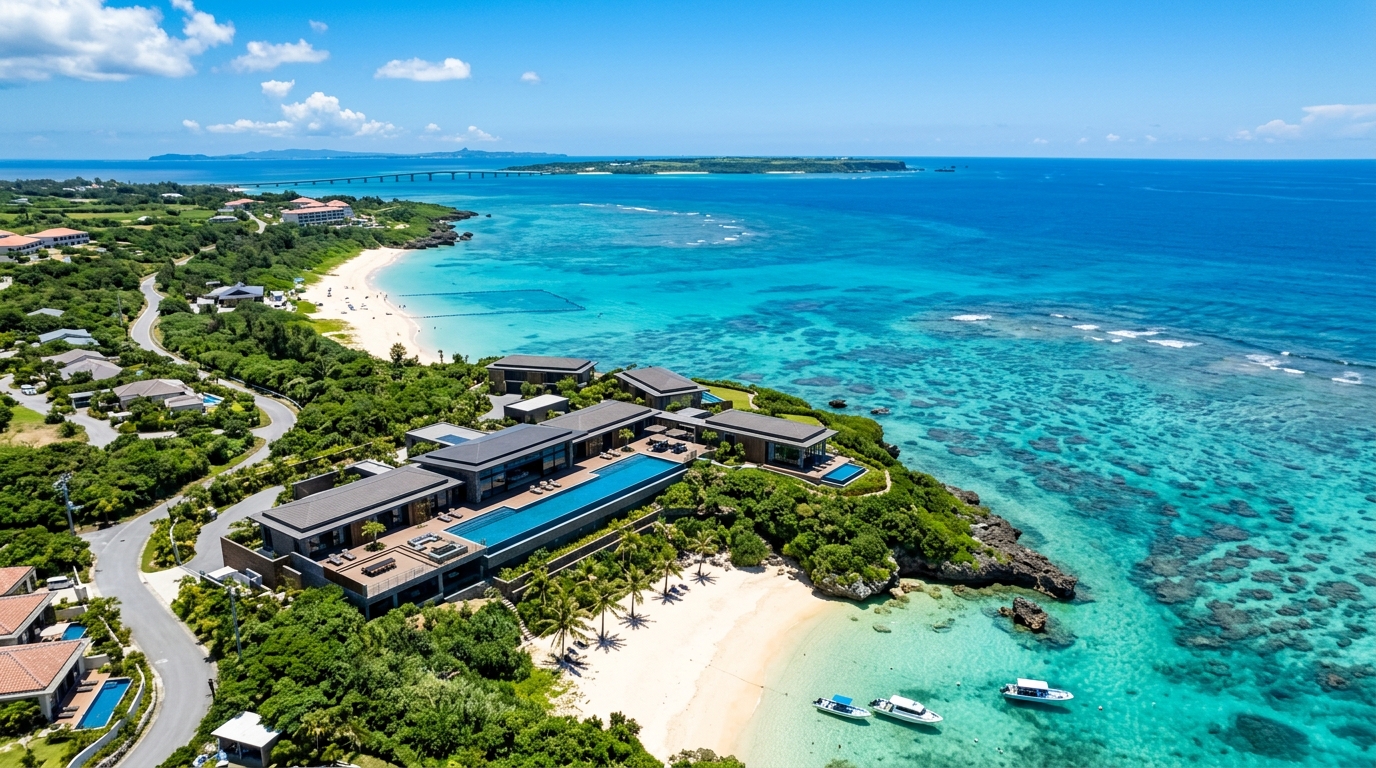
1. Reflecting on October 19 "Overseas Migration Day": Why the Domestic Resort of Miyakojima Is Drawing Attention for Relocation and Dual Living
In keeping with the theme of "Overseas Migration Day," let us explore why Miyakojima, a premier domestic resort, is increasingly chosen today as a destination for relocation and dual-life living.
The main reason is that residents can enjoy an overwhelming sense of getaway combined with world-class, comfortable infrastructure—all while remaining within Japan. The island's natural environment, surrounded by coral reefs and the crystal-clear waters known as "Miyako Blue," rivals renowned overseas luxury resorts such as Hawaii or the Maldives. While Miyakojima was long perceived primarily as a "beautiful island for short-term tourists," that landscape has shifted dramatically in recent years.
A major turning point was the commercial reuse and route expansion of Shimojishima Airport (下地島空港). Thanks to the entry of low-cost carriers (LCCs) and expanded international flights, the island is now easily accessible via direct flights from major metropolitan areas like Tokyo and Kansai. This has made dual-life setups realistic for executives and freelancers, who can work from urban offices during the week and enjoy marine sports from their own home in Miyakojima on weekends. Furthermore, as detailed below, upgrades to educational and healthcare infrastructure are strongly supporting full relocations by families with children. Today's Miyakojima allows residents to realize a top-tier resort lifestyle while avoiding hurdles associated with overseas emigration, such as visa acquisition, foreign exchange risk, and language barriers.
2. Shimojishima Airport and Luxury Hotel Developments: The Background Behind Soaring Land Prices Driven by Foreign Capital Entry
The single largest impact on Miyakojima City's real estate market stems from large-scale coastal redevelopments—such as in the Turiver (トゥリバー) district—and a rush of global luxury hotel openings. Between 2025 and 2026, major facilities capable of reshaping the industry landscape have opened one after another.
| Opening Date | Facility / Plan Name | Summary & Features |
|---|---|---|
| March 2025 | Rosewood Miyakojima (ローズウッド宮古島) | Ultra-luxury brand making its debut in Japan. All 55 villas feature ocean views. |
| June 2025 | Fully detached private villas. Each villa is equipped with a private heated pool, ensuring high privacy. | |
| April 1, 2026 | Canopy by Hilton Okinawa Miyakojima Resort (キャノピーbyヒルトン沖縄宮古島リゾート) | The first resort-style Canopy property in the Asia-Pacific region. Features a rooftop infinity pool overlooking the Irabu Bridge (伊良部大橋). |
| April 1, 2026 | Commercial Facility "Yard miyakojima" | Opened simultaneously adjacent to the Hilton property above. Developed by Mitsubishi Estate (三菱地所) and Kajima Corporation (鹿島建設). Houses 8 establishments including a craft brewery. |
| April 29, 2026 | Allamanda Splendid (アラマンダスプレンディド) | A new luxury hotel inside the Shigira Resort (シギラリゾート) on the southern coast of Miyakojima. |
Particularly noteworthy are "Canopy by Hilton Okinawa Miyakojima Resort" and the adjacent commercial facility "Yard miyakojima," which opened simultaneously on April 1, 2026. Developed jointly by Mitsubishi Estate and Kajima Corporation, this integrated resort development does not merely offer guest accommodations; it was designed around the concept of "Miyakojima's Shared Courtyard." The site features eight establishments, including "mueh brewing"—a craft brewery utilizing local island ingredients—and Miyakojima's first Spanish restaurant, creating a sophisticated gathering spot for tourists, local residents, and relocators alike.
The arrival of foreign luxury brands and the accompanying attraction of high-quality commercial amenities elevate the region's brand value on a global scale. As stays by affluent travelers increase, surrounding infrastructure development accelerates, which in turn attracts new investment and genuine residential demand—a positive cycle serving as a clear driver behind Miyakojima's rising land values.
3. From Central Hirara to Coastal Districts: Area-by-Area Land Price Trends and Living Environments in Miyakojima City
So, at what price points is the actual real estate market operating? We examine market trends based on real transaction data through Q1 2026, compiled quarterly by our firm from the Ministry of Land, Infrastructure, Transport and Tourism (MLIT) Real Estate Information Library for Miyakojima City (City Code 47214).
Across the sample period from 2021 to 2026, there are 842 transaction records. The average transaction price stands at approximately 28.12 million yen, with a median of 8.5 million yen. Transactions range widely from 20,000 yen to 1.5 billion yen, reflecting the wide variation typical of resort destinations. The overall average price per square meter has hovered around 34,000 yen/㎡.
Below is a chart showing the quarterly trend in median price per square meter for residential land (land only).
From 2024 through late 2025, anticipation surrounding the development boom kept median prices for residential land (land only) steady in the 30,000 to 40,000 yen/㎡ range. However, in the latest Q1 2026 data, median unit prices have moderated to around 10,000 yen/㎡ (9,900 yen/㎡, -0.746 YoY). Similarly, residential property (land and building) prices—which remained elevated around 120,000 yen/㎡ through late 2025—reached approximately 31,000 yen/㎡ in Q1 2026 (-0.554 YoY). This indicates that a market overheated by speculative capital has entered a temporary adjustment phase, soft-landing into a healthier, more realistic price level that makes it easier for end-users seeking primary or second homes to enter.
Key sub-area trends are summarized below:
| Area | Transaction Type | Count | Median Price / ㎡ | Area Characteristics |
|---|---|---|---|---|
| Hirara (平良) | Residential Land (Land only) | 45 | ~39,000 yen/㎡ | Central urban area. High convenience driving market values. |
| Hirara (平良) | Residential Land (Land & Building) | 34 | 200,000 yen/㎡ | Same as above. Strongest real residential demand. |
| Shimoji (下地) | Agricultural Land | 10 | 506 yen/㎡ | Coastal & suburban areas. Dominated by large plot transactions. |
| Shimoji (下地) | Residential Land (Land & Building) | 6 | 100,000 yen/㎡ | Housing demand gradually rising due to resort development spillover. |
| Gusukube (城辺) | Residential Land (Land & Building) | 6 | ~22,000 yen/㎡ | Farther from urban center; lower prices allow securing larger lots. |
While central "Hirara" leads the market in both transaction volume and prices, areas such as "Shimoji" and "Gusukube" offer opportunities to acquire large parcels of land at lower price points.
4. Quality of Life in a Resort Destination: Real Infrastructure for Healthcare, Education, and Shopping
When evaluating relocation or dual living in earnest, everyday living infrastructure matters even more than stunning resort scenery. Miyakojima City is steadily upgrading its urban functions to balance environmental protection with practical livability.
For instance, localized data for our reference point (lat=24.8055, lng=125.2811) shows a zoning designation under the City Planning Act of "Category I Mid-to-High-Rise Exclusive Residential Zone" (第1種中高層住居専用地域). Regulations specifying a 60% building coverage ratio and a 200% floor area ratio create an ideal environment for spacious detached homes or low-density residential buildings with good sunlight and airflow.
In terms of education, the local school district includes Higashi Elementary School (東小学校) and Kita Junior High School (北中学校), providing a sound foundation for raising children. Addressing the top concern regarding island living—medical access—the surrounding area hosts 16 medical facilities, including Ikemura Internal Medicine Clinic (池村内科医院), Okinawa Prefecture Miyako Health Center (沖縄県宮古保健所), and Ishimine Clinic (いしみねクリニック). Data confirms strong local access for routine care as well as sudden illnesses.
Equally noteworthy are aggressive child-rearing initiatives led by local government. In April 2025, Miyakojima City issued its "Miyakojima City Child-Support Declaration," aiming to become "Japan's most child-friendly island." As a flagship policy, effective April 2026 care visits, eligibility for the "Child Medical Expense Subsidy" was significantly expanded from middle-school age up to high-school age students. In-person free coverage at medical counters and automatic reimbursement systems substantially ease financial burdens on households.
In addition, relocation subsidies of up to 600,000 yen for single-person households and up to 1 million yen for family households are available. Coupled with new ordinances safeguarding child rights and welfare established through the "Children-First Citizens' Conference," social living infrastructure is expanding just as quickly as physical redevelopment.
5. Growing Demand for Second Homes and Primary Residences: Features Sought in Detached Houses by Families and Single Relocators
With living conditions improving dramatically, local demand in Miyakojima is shifting noticeably toward end-user single-family homes (primary residences and second homes), beyond investment condominiums and apartments.
For relocators and dual-life residents, a home in Miyakojima is more than just a place to sleep. Essential features include dedicated, spacious work areas for remote work, large yards or roof terraces for weekend barbecues with family and friends, and—above all—durable construction (such as reinforced concrete / RC frame) capable of withstanding severe salt air and major typhoons. Recently, custom home designs incorporating EV charging stations and zero-energy house (ZEH) systems powered by solar energy have gained widespread popularity.
When planning custom home construction or comparing multiple districts, our site's Pro Plan features an "AI Building Simulator" (generating floor plans, 3D renders, summer/winter solstice sunlight analyses, exterior designs, and estimated total budgets based on area data) as well as free neighborhood research tools.
6. Long-Term Asset Value Potential: Sustainable Tourism Demand and Land Scarcity
Real estate asset value in Miyakojima is backed by sustainable tourism demand and island-specific land scarcity, rather than a transient resort bubble.
Diving deeper into transaction samples highlights the interplay between end-user demand and investment. In the "Ueno" (上野) district, where resort development spillovers are significant, a 2023-built RC structure home (650 ㎡ plot, 60% coverage, 200% FAR, designated urban planning area outside urban/adjustment zones) transacted at 38 million yen. High-quality end-user properties capitalizing on generous plot sizes command solid valuations. In the same district, agricultural land parcels of 8,888 ㎡ and 3,500 ㎡ were traded at 4.1 million yen and 2.0 million yen respectively, demonstrating ongoing interest in acquiring large tracts for future development.
Meanwhile, in the tranquil "Gusukube" district, RC properties built in 1983 (145 ㎡ plot) and 1968 (360 ㎡ plot) transacted at 4.5 million yen and 8.0 million yen respectively. These transactions point to savvy buyers and second-home seekers who secure larger plots and sturdy structures at low initial costs with the intention of full custom renovations.
As global recognition of Miyakojima rises alongside incoming luxury hotel brands, supply remains strictly limited for developable land and infrastructure-equipped urban lots. This simple law of expanding demand against finite supply represents the single strongest anchor for long-term asset value retention and growth.
7. Key Considerations and Precautions When Planning Homes or Bases in Miyakojima
While Miyakojima offers immense appeal, prospective real estate buyers and builders should evaluate several critical factors objectively.
First, natural disaster risks and hazard assessments. Fortunately, environmental data for our target reference point indicates "None" for both flood risk (maxDepthRank null) and landslide risk (phenomena []). However, given that Miyakojima is an island surrounded by open ocean, buyers are strongly advised to verify localized hazard conditions for specific parcels prior to purchase, accounting for storm surge and airborne debris risks during severe typhoons, and selecting suitable ground conditions and building structures.
Second, the difficulty of assessing market values. Outside of central Hirara, Miyakojima contains many areas with sparse public transaction data (such as around specific farmland or small villages). When evaluating areas with minimal or zero recorded transactions, buyers should not rely solely on asking prices; thorough market comparisons and physical checks on utility connections (water/sewer) are essential. Furthermore, buyers must anticipate island-specific challenges, including elevated transportation costs for building materials and construction delays or budget overruns stemming from chronic labor shortages.
8. Conclusion
Miyakojima City, Okinawa Prefecture stands at the intersection of incoming global luxury hotels and maturing everyday infrastructure. As temporary speculative land price surges cool down, the market is entering a stable, healthy phase of asset value formation anchored by genuine end-user demand from relocators and second-home buyers. Breathtaking natural surroundings paired with robust child-rearing support—highlighted by medical subsidies extended through high school—make Miyakojima an exceptional location for relocation or multi-base living.
To achieve an ideal dual-life setup or relocation while securing a property that retains its value over time, objective data-driven area analysis is crucial—far beyond relying on popular trends or imagery.
By registering for a free membership, you can connect the Ministry of Land, Infrastructure, Transport and Tourism data used in this blog directly to your own Claude or ChatGPT via MCP integration. Empower your AI to conduct seamless real estate research and find the ideal location for your new base.