
Two and a half years have passed since the extension of the Hokuriku Shinkansen to Tsuruga in March 2024, and the area around Awara-Onsen Station (芦原温泉駅), the central hub of Awara City, Fukui Prefecture (福井県あわら市), has entered a new stage of growth. Centered around "Aflare" (アフレア), a vibrant public facility built at the station’s West Exit, station-front redevelopment and hot spring town urban planning are progressing hand-in-hand. This synergy is rapidly elevating the area’s potential not only as a tourist destination, but also as a residential area for primary homes and second residences. Furthermore, the spillover effects of new industry initiatives promoted across Fukui Prefecture—such as attracting data centers and Green Transformation (GX) strategies—are drawing significant attention as major factors expected to boost local property values leading up to 2030.
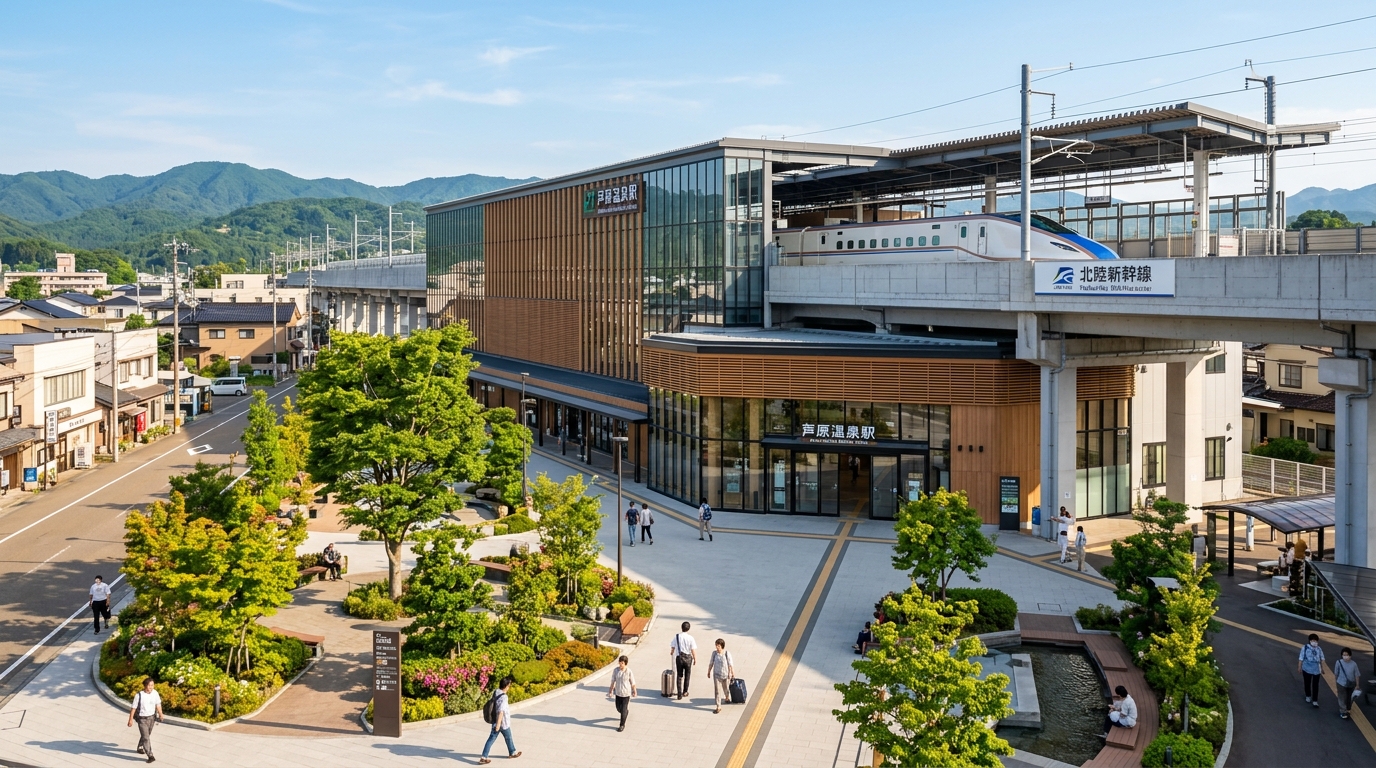
From a professional real estate analyst’s perspective, this article objectively evaluates the livability and future property values of Awara City, Fukui Prefecture, by examining actual transaction data from the Ministry of Land, Infrastructure, Transport and Tourism (MLIT; 国土交通省) alongside the local government’s latest child-rearing support initiatives. With transport access from the Tokyo metropolitan and Kansai areas dramatically improved, we hope this analysis serves as a data-backed guide for families and individuals considering dual-hub living (two-region lifestyle) or relocation, ensuring a choice they will not regret.
1. The Extension of the Hokuriku Shinkansen and the Transformation Around Awara-Onsen Station
The extension of the Hokuriku Shinkansen goes beyond merely improving transit options—it carries the power to transform the very fabric of the city. Positioned as Fukui Prefecture’s northern gateway, Awara-Onsen Station underwent large-scale station-front redevelopment ahead of the bullet train’s arrival in 2024. A key symbol of this revitalized area is "Aflare" (アフレア), a vibrant public complex constructed at the West Exit. This facility functions both as a promotional hub showcasing local attractions to tourists and as a public space where local residents gather and interact daily.
Additionally, with the parallel conventional railway line transferred to the third-sector operator "Hapi-Line Fukui" (ハピラインふくい), a community-oriented public transit network is actively being restructured. According to the latest real-world transaction data from MLIT, daily passenger traffic at Awara-Onsen Station stands at 3,522, solidifying its role as a vital regional transit hub.
Evolution in transportation infrastructure delivers direct real estate benefits in the form of enhanced market liquidity. Upgraded pedestrian spaces and barrier-free circulation routes around the station foster a walkable urban environment accessible to everyone from seniors to families with young children—ultimately bolstering local residential demand.
2. Redevelopment around Awara-Onsen Station, East/West Exit Urban Planning, and the Spillover Effects of New Industries
Redevelopment in Awara City is shifting focus from isolated "point" developments at the station front to holistic "area-wide" revitalization across the entire hot spring town district. In May 2026, the "Awara Onsen Town Redevelopment Master Plan" (あわら温泉街再整備基本計画) was officially established, incorporating feedback from local residents and businesses. The plan includes reshaping the townscape while preserving the historical ambiance of the Taisho and early Showa eras, alongside eco-friendly mobility strategies (such as joint shuttle bus trials), aiming to transform Awara into a sustainable, next-generation city for both tourism and living.
Another critical factor is the accelerating momentum across Fukui Prefecture to attract emerging industries. Under the national "Green Transformation (GX) Strategic Region" framework, Fukui Prefecture (including Fukui City and Obama City) was selected as a promising area for decarbonized energy power usage. In tandem with this move, in October 2026, Fukui Prefecture launched an open request for proposals for a "Feasibility Study on Attracting Large-Scale Data Centers." In the Sakaikita Hilly Area (坂井北部丘陵地帯), which extends near Awara City, plans are under consideration for industrial parks powered by renewable energy, raising high expectations for a cluster of advanced infrastructure facilities such as data centers.
| Timing | Major Developments in Redevelopment, Facility Attraction, and Infrastructure |
|---|---|
| March 2024 | Extension of the Hokuriku Shinkansen to Tsuruga opens; "Aflare" public facility opens at Awara-Onsen Station West Exit |
| April 2025 | Progress in surrounding road and landscape improvements under the Urban Renaissance Plan for "JR Awara-Onsen Station Lively Exchange District" |
| May 2026 | Adoption of the "Awara Onsen Town Redevelopment Master Plan"; public-private collaboration begins on landscape reorganization and mobility strategies |
| October 2026 | Fukui Prefecture launches feasibility study for attracting large-scale data centers; momentum builds for clustering GX-related industries |
| 2030 (Target) | Decarbonization of the hot spring town area and adoption of next-generation mobility; establishment of permanent relocation and dual-hub living from Tokyo and Kansai metropolitan areas |
These redevelopment efforts and industrial initiatives—including data center attraction—are expected to bring an influx of high-income professionals, such as specialized IT personnel, engineers, and corporate assignees. Because many of these individuals seek spacious residential lots in quality living environments, this trend offers clear long-term potential to apply upward pressure on land prices and single-family home demand in Awara City.
3. Livability in Awara City: Child-Rearing Environment and Daily Shopping Convenience
When buying a primary home or relocating, everyday livability is just as crucial as transportation convenience and future outlook. Awara City is well known as a municipality offering exceptional financial support for families raising children.
Particularly noteworthy is the "At-Home Child Care Support Allowance" (在宅育児応援手当), which completely abolished income limits in September 2024. Under this scheme, households caring for a second child or subsequent children at home between 8 weeks and under 3 years old receive 10,000 yen per month per child, allowing a broader demographic to benefit. Additionally, Awara City provides continuous support spanning pregnancy, childbirth, and parenting—including the FY2025 Young Newlywed Support Grant (paying up to 400,000 yen to eligible young couples), the "Awarakko First Birthday Celebration Grant" (30,000 yen), and pediatric influenza vaccination subsidies.
Let us examine data reflecting the actual living environment. Environmental surveys powered by our real-data analysis system show that the local school districts include Kanazu Elementary School (金津小学校) and Kanazu Junior High School (金津中学校), offering strong educational access. On the medical front, five healthcare facilities—including Tsubota Dermatology Clinic (坪田皮膚科クリニック), Kanazu Obstetrics and Gynecology Clinic (金津産婦人科クリニック), and Okumura Clinic (奥村医院)—are scattered throughout the area, providing peace of mind for daily wellness. Regarding retail facilities, supermarkets and drugstores necessary for daily shopping are practically distributed around areas zoned as Neighborhood Commercial Districts (近隣商業地域), making day-to-day life exceptionally convenient.
4. Dual-Hub Living and Second Homes Gain Traction with Improved Access from Tokyo and Kansai
The extension of the Hokuriku Shinkansen has enabled direct, transfer-free access from Tokyo Station to Awara-Onsen Station, introducing a new lifestyle alternative: dual-hub living (dual life). As hybrid work models combining remote work and office attendance become standard, demand for second homes is surfacing among people who work in the Tokyo metropolitan area during the week and unwind on weekends in Awara City, surrounded by natural hot springs and rich landscape.
While access from the Kansai region was already convenient, the bullet train line has reduced psychological distance even further. Awara City is increasingly viewed as an attractive candidate for relocation not only by high-net-worth individuals and retirees, but also by mid-career professionals and IT workers.
The aforementioned influx of new industries via data center attraction and GX strategies will accelerate this trend. As cutting-edge enterprises enter the region, the area's identity evolves from a simple weekend retreat into a dynamic city balancing modern business opportunities with comfortable living. Buyers seeking relocation or dual-hub lifestyles tend to prefer custom-built single-family homes tailored to their tastes—or spacious residential properties where hot spring water can be directly piped in—rather than standardized condominium units. This preference serves as a catalyst for active land transactions driven by end-user demand.
5. Residential Differences and Characteristics: Hot Spring Town District vs. Station Area
When searching for land for a primary home or second house in Awara City, designated zoning regulations and building conditions vary depending on the area, significantly impacting the living environment.
For example, real-world data shows that districts near Awara-Onsen Station such as Omizo (大溝) and Hananomori (花乃杜) are zoned as Category I Residential Zones (第1種住居地域) or Category I Low-Rise Exclusive Residential Zones (第1種低層住居専用地域). Residential plots in the Omizo district feature a building coverage ratio of 60% and a floor area ratio of 200%, while parts of the Hananomori district feature a 50% coverage ratio and an 80% floor area ratio, cultivating quiet, spacious residential neighborhoods with comfortable distance between houses. Transaction records in Omizo show a 160-square-meter lot sold for approximately 4.8 million yen (around 31,000 yen/m²), an accessible price point for single-family housing lots. Conversely, areas closer to the hot spring town center are zoned as Neighborhood Commercial Districts (近隣商業地域), with an 80% coverage ratio and 200% floor area ratio. These higher allowances permit efficient land use and accommodate diverse building plans, such as shop-cum-residences or three-story homes.
However, one critical step when buying property is evaluating hazard risks. Risk assessments powered by our transactional and spatial data indicate that certain parts of Awara City carry flood risks (projected inundation depth up to Rank 4: 5 to 10 meters) as well as sediment disaster risks like debris flows. While the natural surroundings are deeply appealing, these hazards directly affect life safety and property value. Prospective buyers must verify exact plot locations against official hazard maps and incorporate structural flood mitigation measures, such as elevated foundations, into their home designs.
6. Residential Land Price Trends and Asset Value Outlook for Single-Family Home Buyers
Next, let us objectively analyze actual transaction prices and trends in Awara City’s residential market using data. According to quarterly data compiled independently by our firm from MLIT's "Real Estate Information Library" (不動産情報ライブラリ), there were 282 recorded transactions across all of Awara City between 2021 and Q1 2026. The overall average transaction price was approximately 6.49 million yen, with a median of approximately 3.35 million yen (ranging from a minimum of 29,000 yen to a maximum of 120 million yen), yielding an average unit price of around 15,000 yen/m².
The chart below illustrates the quarterly median price per square meter for residential land (plots) in Awara City.
As seen in the chart, the median unit price per square meter for residential land was 20,000 yen/m² in Q4 2024, but shifted significantly to 3,200 yen/m² in Q1 2026 (-78.7% year-on-year). This volatility stems from a characteristic typical of regional cities: low public transaction volume (small sample size). For instance, there was only 1 recorded land transaction in Q1 2025 and only 2 in Q1 2026, causing median figures to fluctuate dramatically depending on the location and size of individual properties sold.
On the other hand, the median unit price for "residential land with structures" (including existing single-family homes) stood at approximately 11,000 yen/m² (10,857 yen/m²) in Q1 2026, maintaining a relatively stable level.
Looking at transaction volume by sub-district (chōchōme), agricultural land transactions rank high in areas such as Sashinaka (指中), Funatsu (舟津), and Shimoban (下番). Meanwhile, residential land transactions cluster in convenient downtown areas like Ichihime (市姫; ~23,000 yen/m², 4 transactions) and Omizo (大溝; ~31,000 yen/m², 3 transactions). Overall, land prices in Awara City remain overwhelmingly affordable compared to the Tokyo metropolitan area, presenting an ideal environment for building a dream primary home or second house while minimizing initial investment. Because public data is limited, carefully comparing nearby market comps is essential. However, strong fundamentals—such as the Shinkansen extension and data center attraction—provide a bright long-term outlook for supporting property values.
7. Key Considerations when Choosing a Primary or Second Home near Awara-Onsen Station
To maintain and enhance long-term property value when choosing a location in Awara City, a key rule of thumb is to target areas with convenient access to Awara-Onsen Station, districts benefiting from redevelopment infrastructure, or locations aligned with the hot spring town master plan. When considering single-family homes or second residences, it is crucial to understand the overall budget balance—combining both land costs and construction expenses—early in the process to build a comfortable financial plan.
For buyers evaluating single-family home projects, we highly recommend utilizing the "AI Building Simulator" available through Mekiki Research's Pro Plan (paid tier). By entering your preferences alongside real-world data for candidate relocation or dual-hub sites, this powerful AI tool automatically generates 2D floor plans, 3D models, summer/winter solstice sunlight simulations, exterior renderings, and estimated total budgets for your ideal single-family home. You can also upload existing floor plan images to instantly convert them into 3D visualizations. Generated output can be exported as PowerPoint slides (.pptx) or 3D assets (.glb), or shared easily with family members and architects via web links. (*Note: This simulator is designed exclusively for planning single-family residential homes. It does not support multi-family developments such as apartments or condominiums, cash flow/yield calculations, or official contractor bids.)
Even if you do not yet have a formal building plan, this tool serves as an indispensable asset during land hunting, allowing you to visually answer questions like: "What kind of house can be built on this plot, and how much will it cost?"
8. Conclusion
As of 2026, Awara City in Fukui Prefecture continues its steady progress following the extension of the Hokuriku Shinkansen. Dual growth engines—station-front redevelopment centered around Aflare at Awara-Onsen Station's West Exit, alongside the revitalization of the historic hot spring town—are dramatically boosting the city's appeal not only as a tourist destination, but also as a community for permanent living and dual-hub lifestyle.
Furthermore, the spillover effects of next-generation industrial initiatives—such as attracting data centers and Green Transformation (GX) strategies promoted statewide across Fukui—hold strong potential to create job growth and new housing demand leading toward 2030. Generous child-rearing support policies and land prices that remain exceptionally affordable relative to major urban centers make Awara City an enticing option for primary home buyers and second-home seekers alike. However, localized hazard risks and price volatility caused by lower transaction volumes mean that objective, data-backed area selection and meticulous property vetting remain essential.
By signing up for a free account, you can directly pull the Ministry of Land, Infrastructure, Transport and Tourism data used in this blog from your own Claude or ChatGPT assistant via Model Context Protocol (MCP) integration. This offers the huge advantage of continuing your research alongside your favorite AI partner—take a moment to explore the true potential of your target areas!