
[2026 Update] How Is Kaga Onsen Station Changing with the Shinkansen Extension and Redevelopment? A Deep Dive into Liveability and Asset Values by 2030 Driven by Data Centers and Hot Springs Revitalization
Kaga City, Ishikawa Prefecture (石川県加賀市), is undergoing a dramatic transformation triggered by the extension of the Hokuriku Shinkansen. The opening of Kaga Onsen Station (加賀温泉駅) in March 2024 sparked a massive boost in regional accessibility. Today, redevelopment around the station is moving forward rapidly: the all-weather public plaza "Galleria" (ガレリア) opened in May 2026, and a major redevelopment project on the station's South Exit side is underway, featuring plans to attract a large outlet mall and hotels.
Long renowned for famous hot spring resorts like Yamashiro Onsen (山代温泉), Yamanaka Onsen (山中温泉), and Katayamazu Onsen (片山津温泉), Kaga City is expanding its appeal beyond traditional tourism. Through hot spring town revitalization, the attraction of new industrial hubs, and proactive migration policies, the area is gaining traction as a prime candidate for permanent residence and dual-hub (two-location) living. How will residential housing demand and property values evolve moving forward? Drawing on 2026 transaction data, local hazard profiles, and the area's appeal for young families, this article offers a comprehensive outlook on the Kaga Onsen area toward 2030.
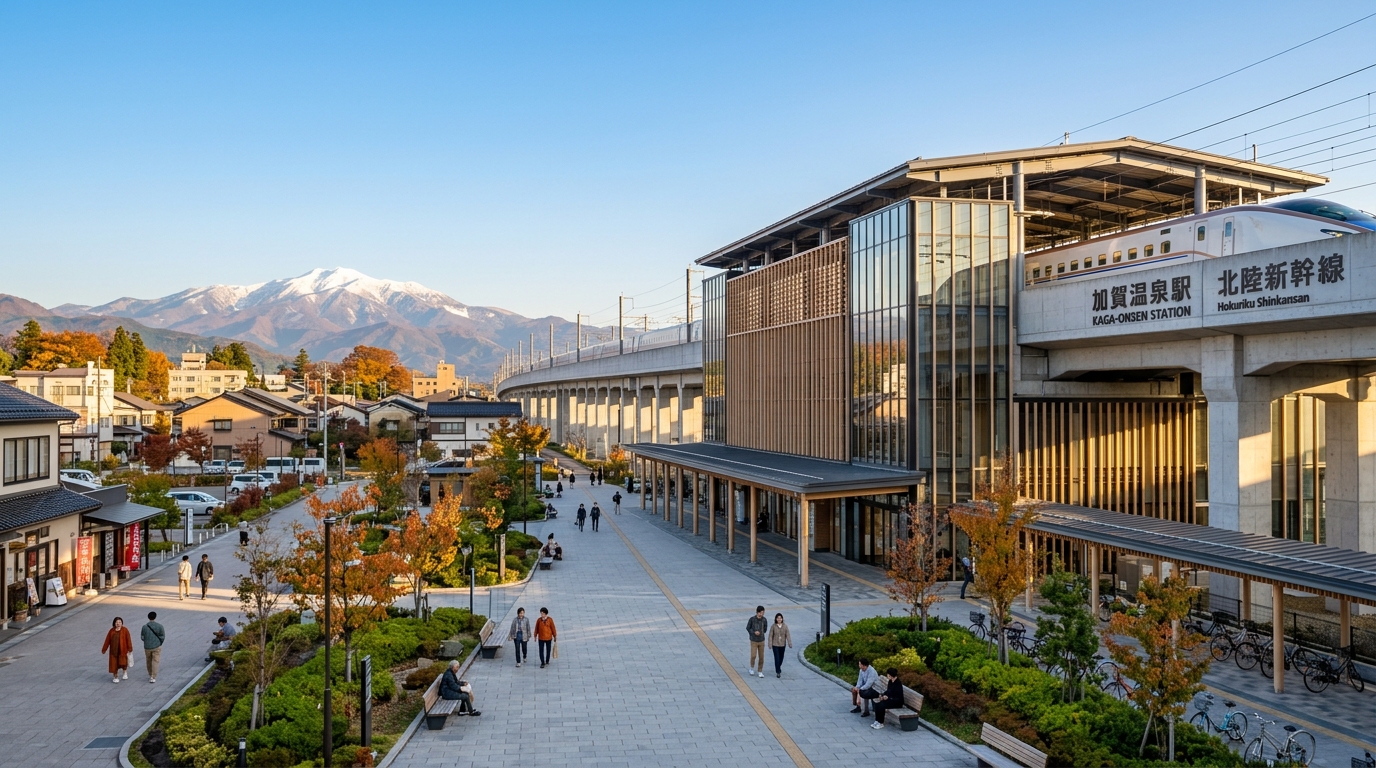
1. The Impact of the Hokuriku Shinkansen Extension and Station Area Redevelopment
Kaga Onsen Station, the primary gateway to Kaga City, was connected to the Hokuriku Shinkansen extension in March 2024, cutting travel time from the Tokyo Metropolitan Area down to as fast as two hours and change. Leveraging this dramatic infrastructure upgrade, the city is pushing forward with a master-planned urban initiative known as the "Kaga Rise Town Concept" (加賀ライズタウン構想).
In May 2026, "Galleria," an all-weather public plaza, opened directly outside the station. Enclosed under a massive glass roof and equipped with large digital screens and comfortable waiting areas, it serves as the vibrant new "face" of the station where residents and visitors gather.
Even more noteworthy is the large-scale commercial development planned south of the station. In June 2026, Mayor Toshiaki Yamada (山田利明) officially announced the continuation of the Kaga Onsen Station South Exit redevelopment project following expert evaluations. This decision has formally launched steps to attract a major commercial complex featuring an outlet mall and hotel accommodations.
| Date / Period | Facility / Project | Overview |
|---|---|---|
| March 2024 | Opening of Hokuriku Shinkansen Kaga Onsen Station | Direct access from the Tokyo area in under 3 hours (fastest 2+ hrs) |
| May 2026 | "Galleria" Station-Front All-Weather Plaza | A community hub featuring waiting areas and large digital displays |
| FY2026 | Budget execution for station south access roads & infrastructure | Mayor confirms project continuation; laying groundwork for commercial tenants |
| FY2029 (Target) | Major Station-South Commercial Complex (Outlet, etc.) | Scheduled opening of a multi-use development featuring hotels and retail |
If realized by FY2029, this redevelopment will transform Kaga City from a traditional tourist destination into a regional commercial powerhouse capable of drawing visitors from across neighboring prefectures. The jump in everyday convenience offers substantial benefits to local residents, while new job creation is expected to spur residential housing demand.
2. Liveability in Kaga City: Fusing Tourism Revitalization with Living Comfort
Tourism and retail are not the only reasons Kaga City is attracting attention. Aiming to overcome regional depopulation, the city has actively promoted next-generation digital industries. Since being designated as a "Digital Garden Health Special Zone" (国家戦略特区「デジタル田園健康特区」) under Japan's National Strategic Special Zone framework in 2022, Kaga has gained national prominence as a real-world proving ground for cutting-edge technologies like autonomous driving, drones, AI, and IoT. In October 2024, the city opened the "Kaga City Next-Generation Technology Testing One-Stop Center" (加賀市近未来技術実証ワンストップセンター) to foster a technology cluster centered on next-generation aviation and smart tech.
Furthermore, Ishikawa Prefecture introduced new location incentives to attract data centers, offering subsidies of up to 25% for new facilities built in designated areas of Kaga City (such as the former Yamanaka Town / 旧山中町) and up to 10% in other districts. The influx of data centers and tech hubs is expected to draw IT engineers and skilled professionals, subsequently driving up demand for quality housing and single-family homes.
By combining historical hot spring charm and rich natural surroundings with forward-looking technology industries, Kaga City offers a unique brand of liveability. For relocators from major metro areas, the opportunity to raise children surrounded by nature while participating in advanced industries makes Kaga a highly compelling option.
3. Latest Trends in Residential Land Prices and Transaction Values Around Kaga Onsen Station
How are the Shinkansen launch and redevelopment plans influencing the real estate market? Below, we analyze transaction trends in Kaga City using official data (sample size: 651 cases) spanning 2021 through 2026 from the Ministry of Land, Infrastructure, Transport and Tourism (MLIT / 国土交通省).
During this period, the overall average transaction price for real estate in Kaga City stood at approximately ¥6.22 million (¥6,224,580), with a median of approximately ¥2.1 million. The overall average unit price was around ¥14,000/m² (¥14,214/m²).
Looking at quarterly trends as of Q1 2026 compiled from MLIT data reveals interesting shifts. For "Residential Land (Land Only)," the median price per square meter was approximately ¥7,000/m² (¥6,500/m²), representing a modest year-on-year increase of +4.8%. On the other hand, for "Residential Land (Land & Building)"—which reflects primary home purchases by end-users—the median unit price reached approximately ¥14,000/m² (¥14,400/m²), marking a sharp year-on-year gain of +20.0%. The data clearly demonstrates how post-Shinkansen settlement demand is boosting the single-family housing market, including pre-owned homes.
Let's look at specific transaction examples from Q1 2026:
- Ikiri-machi (Residential Land - Land Only): Transaction price ¥860,000; unit price approx. ¥7,000/m² (¥6,500/m²); plot area 135 m². Located outside designated urban planning zones, building coverage ratio 60%, floor area ratio (FAR) 200%.
- Iburi-hashi-machi (Residential Land - Land & Building): Transaction price approx. ¥8.7 million; land area 190 m². A wooden home built in 1996 in a Class 1 Residential Zone (60% coverage, 200% FAR).
- Kamo-machi (Agricultural Land): A notable transaction of a large 8,888 m² plot priced at approx. ¥12 million.
- Kanami-machi (Residential Land - Land & Building): Transaction price approx. ¥7.2 million; land area 500 m². A wooden single-family house built in 1980 (outside designated urban planning zones).
As these examples illustrate, spacious residential plots and single-family homes in Kaga City are available at prices significantly more accessible than in major metropolitan areas. When evaluating specific properties, understanding local market benchmarks is crucial. Using the free Area Survey feature available to registered members on our platform, you can effortlessly review transaction histories and local living conditions for your target area.
4. Child-Rearing Environment and Shopping Convenience for Families
For families considering a move to Kaga City, educational facilities and day-to-day convenience are top priorities. The school districts around our surveyed points include Yamashiro Elementary School (山代小学校) and Yamashiro Junior High School (山代中学校), offering a peaceful atmosphere within the historic Yamashiro Onsen district to raise children. Note that medical data for the immediate search vicinity indicates 0 clinics, meaning that driving a personal automobile is standard for routine medical visits and everyday grocery shopping.
Conversely, municipal financial incentives for relocation and parenting are exceptionally generous. Under the "Kaga City Relocation Support Grant" (加賀市移住支援金), individuals who have resided or commuted to Tokyo's 23 wards for at least 5 years and relocate to Kaga City for employment, remote work, or entrepreneurship can receive up to ¥1 million in subsidies. Additional allowances are provided for households with children, alongside home acquisition grants through the Vacant Home Bank (e.g., up to ¥200,000 for purchasing pre-owned homes), substantially lowering the financial hurdle to homeownership.
Regarding daily retail, major options are currently centered around "Abio City Kaga" (アビオシティ加賀) near Kaga Onsen Station and local supermarkets along main arterial roads. However, once the proposed outlet shopping complex on the station's south side becomes operational in FY2029, choices for weekend leisure, dining, and shopping will expand dramatically.
5. Evaluating Natural Disaster Risks: Hazard Checks in the Kaga Onsen Area
Ensuring long-term peace of mind requires assessing natural disaster risks alongside property prices and commercial convenience. According to location-specific hazard data for Kaga City, landslide and sediment risks are rated as "None (No phenomenon detected)."
However, flood risk is designated as "Present," with a maximum inundation depth level classified as "Rank 3" (projected at 3 to 5 meters). Rivers such as the Daishoji River (大聖寺川) and Iburi-hashi River (動橋川) flow through Kaga City, presenting potential inundation risks during severe downpours or typhoons.
When buying a home, always consult the municipality's latest hazard maps to confirm the elevation and flood risk level of your target lot. Implementing sound flood mitigation measures—such as securing primary living quarters on the second floor or higher and pre-confirming community evacuation routes—is essential for safe living.
6. Growing Demand for Permanent and Dual-Hub Living Post-Shinkansen
Driven by flexible work arrangements and widespread remote employment, Kaga City—combining natural beauty with hot spring living—has emerged as an ideal setting for dual-hub living or complete relocation. Under three hours from Tokyo, Kaga enables a modern lifestyle: working remotely from a spacious single-family house during the week and commuting to Tokyo on weekends or as needed. Simultaneously, the clustering of data centers and drone technology is creating high-skilled local employment opportunities.
When planning a custom house in areas experiencing new residential demand, success relies on visualizing "what kind of house can actually be built." With the "AI Architectural Simulator" available on our platform's Pro Plan, simply entering local transaction data and your personal design criteria automatically generates 2D floor plans, 3D home models, summer/winter solstice sunlight simulations, exterior renderings, and estimated total project budgets. You can even upload existing floor plan images to render them in 3D, making it an invaluable tool for sharing home visions with family members living elsewhere.
7. Real Estate Asset Value and Future Outlook Based on Transaction Data
Finally, we examine real estate transaction volumes across Kaga City neighborhoods to forecast future asset values. Proprietary data compiled for top-ranking sub-districts as of Q1 2026 shows the following:
- Katayamazu-machi (片山津町): 10 agricultural land transactions (approx. ¥92/m²), 5 forest land transactions. Primarily large-scale land transfers.
- Yamashiro Onsen (山代温泉): 8 transactions for residential land (land & building), median unit price approx. ¥25,000/m² (¥24,681/m²).
- Iburi-hashi-machi (動橋町): 6 transactions for residential land (land & building), median unit price approx. ¥21,000/m² (¥21,212/m²).
- Yamanaka Onsen Tsukatani-machi (山中温泉塚谷町): 4 transactions for residential land (land & building), median unit price approx. ¥3,000/m² (¥3,030/m²).
Around Yamashiro Onsen and Iburi-hashi-machi, transactions involving owner-occupant land and existing houses are relatively frequent, with unit prices staying well above the citywide average (approx. ¥14,000/m²). Areas combining the prestige of historic hot spring resorts with established living infrastructure are demonstrating resilient real estate demand.
Regarding pre-owned condominiums, only 1 public transaction was recorded in Q1 2026 (median price approx. ¥97,000/m²), indicating an extremely thin market. Anyone considering buying or selling condo units here must conduct meticulous comparisons with neighboring municipal markets.
Overall, the Kaga Onsen Station area holds significant long-term potential for land value appreciation, buoyed by the Shinkansen effect, ongoing station redevelopment, and high-tech industrial clustering. However, current data indicates that price growth remains localized and gradual, meaning it is too early for speculative hype. Investors and home buyers should calmly monitor progress on the south exit commercial developments and employment retention as data centers go operational.
8. Summary: Key Points for Buying a Home in the Kaga Onsen Station Area
Two years after the Hokuriku Shinkansen extension in 2024, the Kaga Onsen Station area is making steady progress—from the launch of "Galleria" in May 2026 to the planned major commercial complex targeted for FY2029. Coupled with new digital special zone industries and comprehensive relocation grants, the region provides strong momentum for families seeking to build a stable life amidst natural surroundings.
While regional considerations exist—such as evaluating flood hazards and relying on car transportation—Kaga's current modest land prices make it an exceptionally attractive market balancing lifestyle quality and long-term asset value.
By registering for a free account, you can access MLIT transaction data used in this article directly through your preferred AI assistant (via MCP integration) such as Claude or ChatGPT. Leverage our tools today to streamline your local real estate research!