
As the autumn deepens following "Railway Day" (Tetsudo no Hi) on October 14, many people find themselves reflecting on their housing situations and evaluating their future life plans. Evolutions in rail infrastructure do far more than merely shave minutes off commute times; they reshape the structural backbone of cities and exert a profound influence on real estate markets. Today, we focus on Komatsu City in Ishikawa Prefecture, where two and a half years have passed since the Hokuriku Shinkansen extension (Kanazawa to Tsuruga) opened in March 2024, dramatically transforming the urban landscape.
Komatsu has long flourished as a manufacturing powerhouse (monozukuri town). However, triggered by station area redevelopment alongside the arrival of the bullet train, the city is rapidly upgrading its urban functions. Furthermore, a steady stream of new industries—including data centers, semiconductor-related businesses, and IT firms—is setting up shop here. As a result, Komatsu is raising its profile not as a mere bedroom community, but as a self-sustaining economic center.
From the perspective of a real estate analyst, this article explores how the Shinkansen extension and station redevelopment have transformed the living environment in Komatsu. Backed by data on land price trends and insights into the local child-rearing environment, we will logically and objectively compare location options for homebuyers looking to purchase a primary residence, analyzing housing asset values projected toward 2030.
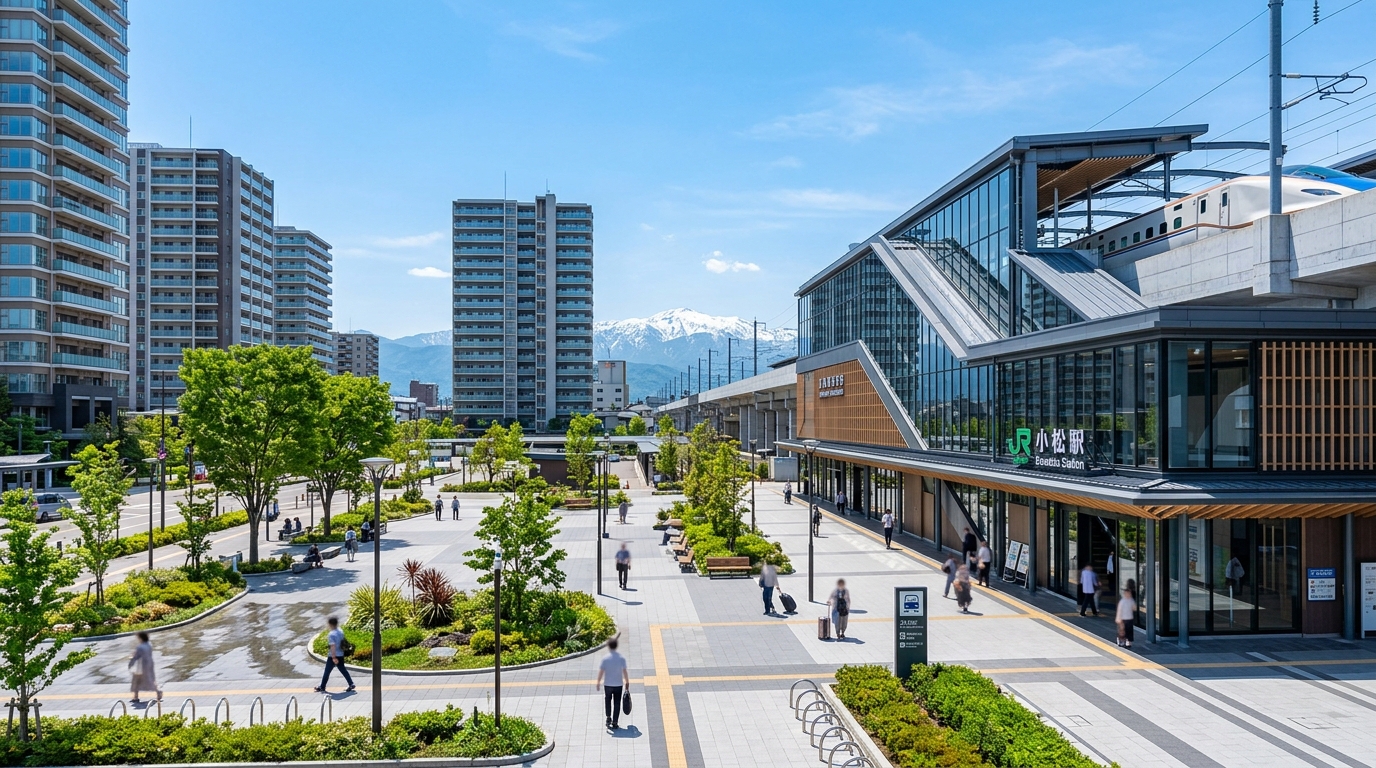
1. Reevaluating Komatsu's Townscape on Railway Day: The Impact of the Hokuriku Shinkansen Extension and Station Area Redevelopment
Upgrading transit hubs is one of the most critical factors in urban development. For many years leading up to the opening of Hokuriku Shinkansen Komatsu Station in March 2024, Komatsu City pursued redevelopment around the station. The arrival of the Shinkansen dramatically improved connectivity to both the Tokyo Metropolitan Area and the Kansai region, while fundamentally altering the surrounding cityscape and the flow of people.
A prominent symbol of this transformation is "Komatsu Nine" (Komatsu 九), a multi-purpose commercial complex that held its grand opening under the elevated tracks of Komatsu Station in September 2023. Comprising four main zones—souvenir & café, food, coworking, and gallery/events—the facility serves not only tourists and business professionals waiting for their trains, but also local students and families as a daily gathering space.
Of particular note is that Komatsu Nine received a 2024 Good Design Award. The facility won high societal praise for redefining the station as a place of open, multi-generational interaction that actively contributes to local community building, rather than acting purely as a commercial space. Where local high school students once lacked a comfortable place to hang out while waiting for trains, the station has successfully transformed from a mere "transit point" into a meaningful "destination."
2. Living in Komatsu Station Area: Environment Improvements Beneficial for Families and Singles
The infrastructure enhancements resulting from station redevelopment have greatly elevated Komatsu's appeal as a residential area. For single residents and dual-income professionals, teleworking at the coworking spaces in Komatsu Nine and enjoying the varied food offerings around the station significantly boost daily convenience. Furthermore, the station-front campus of Komatsu University (公立小松大学), established in 2018, has driven an influx of younger demographics, injecting fresh vitality into the entire downtown core.
For families, the robust child-care support system and educational environment are major highlights. Ishikawa Prefecture leads the nation in nursery facility availability, maintaining a strong track record of zero waitlisted children. This established environment—where dual-income households can seamlessly balance work and family life—provides immense reassurance when considering a home purchase.
In addition, Komatsu City offers generous housing subsidies, such as the "Settlement Promotion Incentive Grant" (Teiju Soshin Shoreikin), designed to support young people and child-rearing households moving to or settling in the area. Qualifying applicants can receive a base grant of 300,000 yen, plus an additional 100,000 yen for young buyers under 45, along with extra bonuses for acquiring eco-friendly homes aligned with Green Transformation (GX) standards—totaling up to around 2 million yen in subsidies in certain cases. Coupled with cultural and educational hubs like "Science Hills Komatsu" clustered near the station, the city has evolved into a highly livable environment that combines urban convenience with rich educational resources.
3. Land Price Trends and Housing Prices in Komatsu: The Real Impact of the Shinkansen Extension
Transportation infrastructure developments and improvements in living conditions impact the real estate market directly. Looking at trends in the Ministry of Land, Infrastructure, Transport and Tourism (MLIT) official land prices and various statistics, commercial and residential land around Komatsu Station has shown steady upward momentum from the pre-opening anticipation phase through to the present. However, this growth is not driven solely by a "Shinkansen boom." Komatsu's core strength lies in an "industrial boost" driven by proactive corporate attraction, which firmly underpins actual end-user housing demand.
In recent years, Komatsu has seen rapid development of large-scale industrial parks and corporate expansions. For example, in the Shorenji Industrial Park, semiconductor-related CKD Corporation built its Hokuriku Plant, creating approximately 300 new jobs. In the Ataka-Shin Industrial Park, Kyowa Kogyosho invested approximately 2 billion yen to build a new plant scheduled to begin operations in 2027.
Beyond manufacturing, the attraction of IT companies and data centers is accelerating. In May 2026, Wiz One Co., Ltd. opened its new "Komatsu Hub" office to secure top-tier IT talent. In September of the same year, Komatsu City and the Keio University Graduate School signed an agreement on creating new industries and fostering advanced talent, further accelerating the formation of an innovative industrial cluster. This concentration of new industries continuously attracts high-income and younger demographics, directly feeding into increased housing demand and solidifying land values.
The table below outlines key redevelopment milestones, corporate expansion schedules in Komatsu, and their respective impacts on the real estate market.
| Date | Event / Project Name | Summary and Real Estate Market Impact |
|---|---|---|
| April 2018 | Opening of Komatsu University | Boosted vibrant station-front activity; increased single-tenant rental demand due to youth influx. |
| September 2023 | Opening of Commercial Complex "Komatsu Nine" | Enhanced daily convenience via a community hub under the elevated tracks; raised baseline value of station area. |
| March 2024 | Opening of Hokuriku Shinkansen Komatsu Station | Improved access to the Tokyo area; raised demand for regional relocation and business bases. |
| Spring 2024 | Completion of CKD Hokuriku Plant | Created ~300 jobs at Shorenji Industrial Park; increased demand for family housing in surrounding areas. |
| May 2026 | Opening of IT Firm Wiz One's "Komatsu Hub" | Attracted IT professionals; generated demand for housing close to work (shokuju-kinsetsu). |
| September 2026 | Signing of New Industry Creation Agreement | Startup support and advanced talent cultivation; expected future influx of high-income households. |
| October 2027 | Operations Start at Kyowa Kogyosho New Plant (Target) | Job creation at Ataka-Shin Industrial Park; stimulation of suburban single-family home demand. |
| 2030 and Beyond | Advancement of Industrial Clustering & Smart City Tech | Establishment of a sustainable urban model integrating work, living, and education; stabilization of asset values. |
4. Within Walking Distance of Komatsu Station vs. Suburban Areas: Location Choice Comparison for Home Buyers
When considering buying a home in Komatsu, buyers generally choose between two primary options: the "walkable area around Komatsu Station" or "car-dependent suburban areas." Each option holds unique appeal with significant differences in land price, requiring a rational comparison based on your lifestyle and budget.
Features of the Komatsu Station Walkable Area The station area is favored by business professionals who travel frequently via Shinkansen or conventional rail, as well as those who prefer to accomplish daily errands on foot. In recent years, renovations of historic traditional townhouses (machiya) into residences and shops have increased in neighborhoods like Yokaichi-machi, blending historic charm with modern convenience. Redevelopment around the station has fueled demand for new condominiums and compact urban houses; while land acquisition costs per square meter tend to be relatively higher, the key advantage lies in long-term asset value retention.
Features of Suburban Areas Conversely, suburban areas remain immensely popular in the Hokuriku region, where driving is the norm. These locations offer smooth commutes to nearby employment centers like Ataka-Shin Industrial Park and Kushi Industrial Park. Along Route 8 (Komatsu Bypass), large commercial facilities such as "AEON MALL Komatsu" provide ample convenience. Because land unit prices are lower than around the station, the primary appeal of suburban areas is the ability to acquire generous lot sizes—making it easier to build spacious single-family homes with large yards, multi-car parking, or trendy single-story layout homes (hiraya).
As demonstrated, market rates and living environments vary greatly depending on the target area. When searching for properties, it is essential to objectively compare historical and current land price trends alongside neighborhood environment data.
5. Housing Asset Value Projections for Komatsu Looking Ahead to 2030
When purchasing real estate, a primary concern for buyers is the risk of future asset devaluation. Against the backdrop of Japan's overall population decline and vacant home (akiya) issues, real estate markets in regional cities are often viewed with skepticism. However, regarding Komatsu City, an overly pessimistic outlook is unwarranted.
The key reason for this optimism is the aforementioned concentration of growth industries. Fields like data centers, semiconductors, and IT/AI solutions represent indispensable infrastructure for the future—not short-term trends. By establishing long-term bases in Komatsu, these companies create stable, continuous employment, helping maintain and grow the resident population.
Furthermore, Komatsu is a rare regional city boasting a "dual air and land hub" with Komatsu Airport and a Hokuriku Shinkansen station. This powerful synergy between transportation infrastructure and industrial growth raises the city's fundamental competitiveness. Therefore, looking toward 2030, while speculative market surges are unlikely, residential asset values in Komatsu are expected to perform solidly, supported by strong end-user real demand. In particular, highly accessible station-area properties and locations with easy commutes to newly established industrial parks are likely to maintain a clear edge in resale value.
6. Choosing a Single-Family Home Without Regrets: Hazard Maps and Daily Life Convenience Checkpoints
Equal in importance to maintaining asset value is ensuring safety against natural disasters and day-to-day convenience. No matter how attractive a location may seem, ignoring disaster risk can lead to deep regret.
The Kakehashi River (梯川 - Kakehashi-gawa), a class-one river, runs through the central part of Komatsu City. Although flood control projects have been continuously implemented over the years, checking flood hazard maps is mandatory given the rise in severe weather events and torrential downpours across Japan. Before purchasing, verify whether the prospective land falls within designated inundation zones or carries liquefaction risks, and plan appropriate countermeasures—such as ground improvement or raising foundation heights—if necessary.
Additionally, a winter lifestyle consideration unique to the Hokuriku region is snow readiness. To ensure smooth vehicle entry and exit during snowfalls, confirm whether snow-melting pipes (shosetsu pipes) are installed on the fronting street and whether the road is wide enough for snowplows to operate efficiently (generally 6 meters or wider is ideal). Evaluating how seamlessly you can manage daily shopping trips and hospital access on snowy days plays a major role in overall Quality of Life (QOL).
7. Home-Buying Steps for Success: Utilizing Actual Transaction Units, Floor Plans, and Sunlight Simulations
To build your ideal home, it is essential to avoid relying solely on emotion or vague impressions. Following structured steps grounded in objective data is crucial. The first step is to analyze actual unit transaction prices and past price trends in your target area to establish a realistic, balanced budget.
Once budget and location parameters are set, shift focus to architectural plans adapted to local climate conditions. Because the Hokuriku region experiences high winter precipitation and shorter daylight hours, indoor natural light planning is vital. By leveraging the "AI Architectural Simulator" available in the Mekiki Research Pro Plan, you can automatically generate customized single-family home 2D floor plans, 3D models, summer/winter solstice sunlight simulations, exterior renderings, and estimated budgets using real local data and your specific criteria. You can even convert existing 2D floor plan images into 3D models or export data to PowerPoint and 3D formats, helping you move forward with confidence and clarity.
How much precious winter sunlight reaches your living spaces depends heavily on building placement and window orientations. Using simulation tools to compare various scenarios before finalizing plans is the surest pathway to a successful, regret-free home build.
8. Summary
Directly connected to the Tokyo Metropolitan Area via the Hokuriku Shinkansen extension, Komatsu City in Ishikawa Prefecture exemplifies a new regional growth model—driven by dual engines of station-front redevelopment and the clustering of next-generation industries. The creation of multi-generational community spaces, epitomized by "Komatsu Nine," along with generous child-rearing support programs, offers an exceptionally attractive residential environment for both families and single residents.
Even from a long-term perspective pointing toward 2030, housing demand in Komatsu shows steady potential, promising stable underlying asset value. Whether you prioritize the urban convenience of the station area or the spacious living of suburban neighborhoods depends on your personal lifestyle; either way, thorough preliminary research into hazard data and sunlight planning remains critical.
Why not start by exploring objective data for your target areas? By signing up for a free membership, you can pull the MLIT data used in this article directly into your own Claude or ChatGPT assistant via MCP integration. Empower your property search with your personalized AI workflow today!
Check the latest land prices and hazard information for Komatsu City, Ishikawa on Mekiki Research 👉