
Two and a half years have passed since the Hokuriku Shinkansen extension to Tsuruga City, Fukui Prefecture (福井県敦賀市) opened in March 2024. Once a prosperous port town on the Sea of Japan and a critical transit hub connecting rail and maritime routes, Tsuruga is now experiencing a vibrant resurgence as a major junction linking the Hokuriku region with the Kansai and Chukyo (Nagoya) metropolitan areas. Ahead of the Shinkansen launch, extensive redevelopment took place around Tsuruga Station—including the opening of mixed-use complexes and sidewalk widening projects. As a result, the area has seen a dramatic improvement not only in transit convenience, but also in daily livability and neighborhood walkability.
This article provides a multifaceted analysis of post-extension housing demand changes, land price trends, and real estate market forecasts through 2030 around Tsuruga Station, based on actual transaction data. Whether you are an investor evaluating real estate potential or a family or single homebuyer seeking to balance quality of life with asset value, we offer detailed insights to help you make an informed property choice without regret.
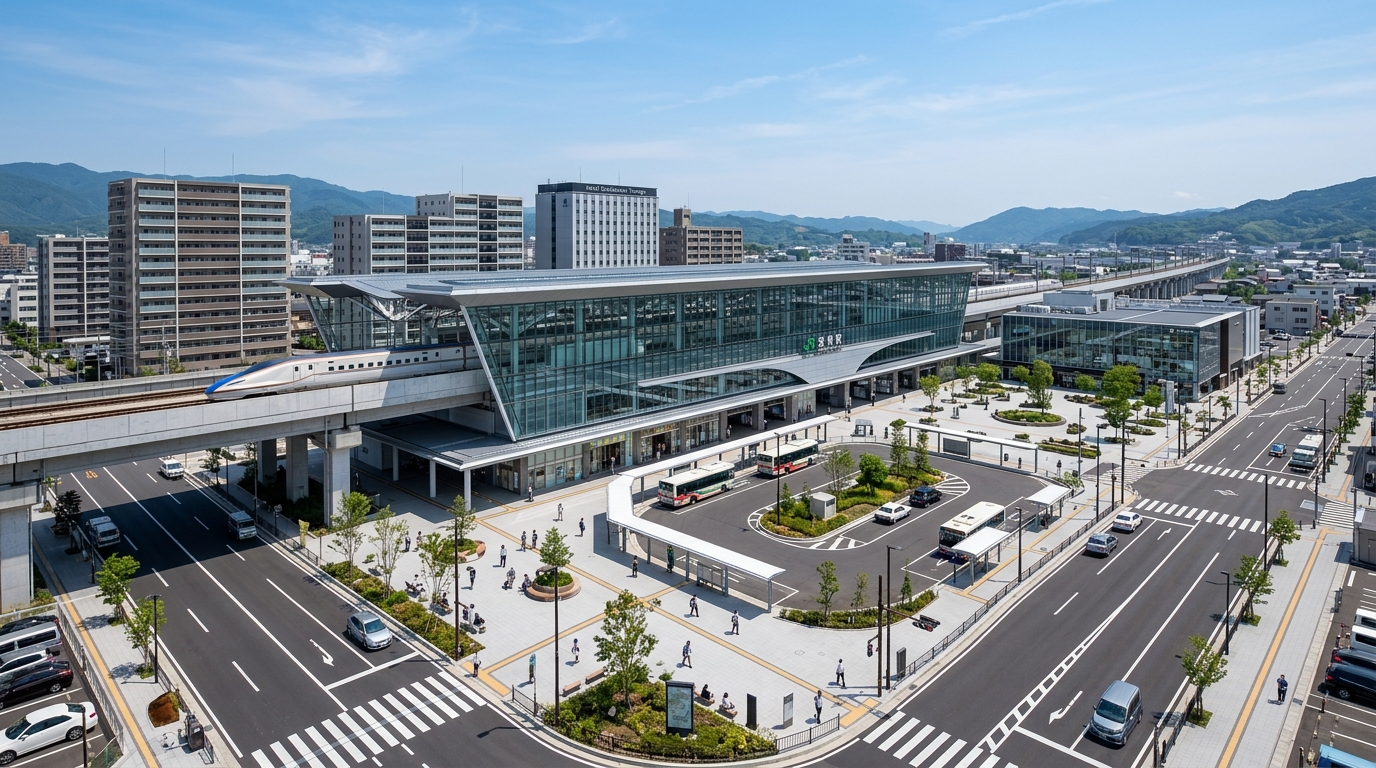
1. Two Years Post-Extension: Current Status and Full Redevelopment Picture Around Tsuruga Station
To state the conclusion up front: driven by the Shinkansen launch and the birth of station-front mixed-use facilities, the living environment around Tsuruga Station has improved dramatically. The station area has evolved into a promising district expecting solid demand across the board—from primary residences to medium- and long-term real estate investments.
Redevelopment in Tsuruga City leading up to the Shinkansen extension went beyond mere transit infrastructure upgrades; it was designed around urban planning that prioritizes livability for residents and vibrant activity for visitors. Below is a chronological overview of major redevelopment initiatives and facility additions:
| Period | Major Redevelopment & Facility Highlights |
|---|---|
| September 2022 | Public-private commercial complex "TSURUGA POLT SQUARE otta" opened at Tsuruga Station's West Exit, featuring the "Chienamiki" intellectual hub, a hotel, and more. |
| March 2024 | Hokuriku Shinkansen (Kanazawa–Tsuruga) opened. Japan's tallest station building (approx. 37m / equivalent to a 12-story building) was completed. |
| March 2026 | Sidewalk widening (~240m) completed along Kagura-dori Avenue (Kagura-cho 1-chome Shopping Street), the approach to Kehi Shrine. Pavement repaving and bench installations enhanced walkability. |
| Towards 2030 | Ongoing expansion of residential and tourism infrastructure, including plans for a community hub on the former Municipal Tsuruga Kita Elementary School site and railway park developments in the Kanegasaki area. |
Today, Tsuruga Station also serves as an essential hub for Hapi-Line Fukui (ハピラインふくい), a third-sector railway operator that took over portions of the Hokuriku Main Line. According to our propriety transaction data, daily passenger traffic reaches 7,769 people. By serving as the terminal for the Shinkansen line, Tsuruga has seen a significant influx of visitors from outside the prefecture. Paired with revitalized station-area infrastructure, the city has transformed into a highly attractive living base for local residents as well.
2. East vs. West Exits: Livability Insights from Commercial and Childcare Complexes
A standout highlight of Tsuruga's redevelopment is TSURUGA POLT SQUARE otta, located at the West Exit of Tsuruga Station. Developed under the concept of a "gathering space that creates daily vitality," this complex houses restaurants and Hotel Granbinario TSURUGA, alongside dedicated childcare support and educational facilities. Particularly noteworthy is "Chienamiki," a labyrinthine book-cafe space housing roughly 30,000 books that has captured the attention of book lovers nationwide. It offers an intellectually stimulating environment for all ages, serving as a compelling draw for families. On weekends, families can be seen relaxing on the central lawn, creating a serene and relaxed atmosphere right in front of the station.
Daily essential infrastructure around the station is equally robust. The target area includes nine healthcare facilities centered on clinics—such as Meiho Clinic, Fukui Prefecture Reinan Promotion Bureau Nissu Health and Welfare Center, and Special Nursing Home Second Keizanso Poppo Medical Office—ensuring peace of mind for routine health management and eldercare. On the education front, designated school districts such as Nakago Elementary School and Kehi Junior High School provide a stable foundation for raising children.
Furthermore, Tsuruga City actively offers housing support programs for relocators, newlyweds, and households with children. Generous financial support is available, including subsidies of up to several hundred thousand yen for renovating vacant homes or modifying properties for multi-generational living. These combined soft and hard infrastructure initiatives strongly assist buyers seeking primary residences.
3. Shifting Housing Demand: Tsuruga as an Access Hub for Kansai and Chukyo Regions
While Tsuruga has long been a transit hub, the opening of the Hokuriku Shinkansen further elevated its geographic advantage. Currently, the JR Limited Express Thunderbird connects Tsuruga directly to Osaka in about 1 hour and 20 minutes, cementing its role as the primary gateway from the Kansai region to Hokuriku. Access from the Chukyo (Nagoya) area is also seamless via the Limited Express Shirasagi, positioning Tsuruga as an ideal regional base for business and tourism.
This leap in transit convenience has triggered a tangible shift in local housing demand. While the market was previously dominated by local primary buyers, it now attracts growing interest from out-of-prefecture relocators and individuals seeking dual-location lifestyles (combining remote work with periodic office commutes). For corporate professionals headquartered in Kansai or Chukyo, Tsuruga offers an appealing "sweet spot" distance—allowing them to enjoy rich natural surroundings nestled between the mountains and the sea while retaining swift access to metropolitan centers when needed. With the Shinkansen streamlining travel toward Tokyo as well, Tsuruga has quickly emerged as a top relocation candidate for mobile singles and for families seeking a spacious environment to raise children without sacrificing their careers.
4. Tsuruga Land Price Trends & Comparison of Popular Family Residential Areas
Using real estate transaction data, let us examine Tsuruga's land price trends and popular neighborhoods in detail. Across 759 transaction records in Tsuruga City between 2021 and 2026, the overall average transaction price stands at approximately 13.63 million yen, with a median of 8.9 million yen. The average unit price is approximately 35,000 yen/㎡ (ranging from a minimum of 20,000 yen to a maximum of 470 million yen), indicating a stable market for a regional city.
Top districts (neighborhoods) by transaction volume include Chuo-cho, Tsunai, Showa-cho, Kizaki, and Kushikawa. These areas are especially favored by families seeking homes due to their excellent daily convenience and residential environment. Here is a comparison based on specific transaction examples:
-
Convenience-Focused Areas (Category I Residential Zones, etc.) In Showa-cho (designated with a 60% building coverage ratio / 200% floor area ratio), a compact 145㎡ residential plot (land only) transacted at 6.2 million yen (approx. 42,000 yen/㎡). This suits buyers prioritizing proximity to the station and retail centers. In Kushikawa under the same zoning, residential plots with buildings (150㎡–480㎡) transacted between 15 million and 20 million yen, offering abundant options for buyers looking to renovate pre-owned homes.
-
Spacious Living Environment Areas (Category I Exclusively Low-Rise Residential Zones, etc.) In Izumigaoka-cho, where a quiet residential environment is strictly preserved under a 40% building coverage / 60% floor area ratio, a spacious 240㎡ lot (land only) was sold for 2.1 million yen (approx. 8,800 yen/㎡). This price point is highly attractive for buyers seeking to build a large single-family home with a yard on a modest budget. Similarly, in Kawasaki-cho's Category I Exclusively Medium-to-High-Rise Residential Zone (60% coverage / 200% FAR), a 135㎡ plot transacted at 2 million yen (approx. 15,000 yen/㎡).
-
Mixed-Use Areas (Quasi-Industrial Zones) In Kizaki's Quasi-Industrial Zone (60% coverage / 200% FAR), where retail, business, and residential properties coexist, a large 460㎡ lot transacted at 25 million yen (approx. 54,000 yen/㎡). This reflects strong demand for versatile land accommodating live-work setups or multi-generational housing.
By registering for a free Mekiki Research account, you can easily review and save the latest land price trends and surrounding environmental data for any area of interest. Gaining an accurate understanding of neighborhood characteristics matching your budget and lifestyle is the crucial first step toward a satisfying property search.
5. Asset Value Trends and Housing Market Forecast Around Tsuruga Station Through 2030
How are asset values around Tsuruga Station trending after absorbing the major catalyst of the Shinkansen extension? Based on quarterly market trends (marketTrend) compiled by our firm from the Ministry of Land, Infrastructure, Transport and Tourism (MLIT) Real Estate Information Library, the table below summarizes median unit price per square meter and year-over-year (YoY) changes by property type.
| Property Type | 2026 Q1 Median Price/㎡ | Year-over-Year (YoY) | Market Trend Analysis |
|---|---|---|---|
| Pre-owned Condominiums, etc. | Approx. 385,000 yen/㎡ | +77.5% | While transaction volume remains sparse (~1 deal/quarter), prices are surging due to demand for station-front convenience. |
| Residential Land (Land Only) | 42,000 yen/㎡ | +10.5% | Single-family plot demand remains solid, sustaining a moderate upward trend. |
| Residential Land (Land & Building) | Approx. 46,000 yen/㎡ | -1.8% | Prices vary widely depending on building age and condition, hovering flat to slightly down overall. |
As the data indicates, "Residential Land (Land Only)" exhibits the most stable performance. Looking at quarterly trends from 2024 Q2 through 2026 Q1, prices have remained steady in the 35,000 to 45,000 yen/㎡ range, reaching 42,000 yen/㎡ in 2026 Q1 (+10.5% YoY). This demonstrates that the positive impact of the Shinkansen extension has taken firm root, driven by steady land acquisition for single-family homes among end-user buyers.
Conversely, while public market data for "Pre-owned Condominiums, etc." remains thin—requiring careful local comparison—recent transaction prices have jumped sharply to approximately 385,000 yen/㎡. This highlights a growing premium placed on smart, station-adjacent living. Looking toward 2030, the market is expected to polarize between localized price appreciation around the station and a stable, steady single-family home market in suburban sectors.
6. Land Selection & Key Considerations for Purchasing or Building a Single-Family Home in Tsuruga
Tsuruga is an inviting city blessed with ocean bounty and rich nature, but prospective buyers and homebuilders must remain mindful of natural disaster risks. Maintaining long-term asset value requires analyzing hazard data alongside local amenities.
According to hazard profiles for our surveyed locations (around Category I Residential Zones), sediment disaster risks (landslides) are absent; however, "Flooding" carries an explicit "Risk Identified" rating. Notably, certain areas fall under a maximum inundation depth rank of "4" (signifying potential flooding of 5 to 10 meters)—a factor requiring careful attention. Several rivers flow through Tsuruga City, and heavy rainfall or typhoons linked to extreme weather events can cause water levels to rise rapidly. Before purchasing land for a home, always consult the municipality's latest hazard maps to check if the property lies within a designated flood inundation zone. If building in an affected area, incorporate fundamental flood mitigation measures from the design phase—such as raising the lot elevation with embankment fill, designing a higher foundation, or placing living spaces on the second floor above a ground-level garage.
7. Key Points for Home Building in Tsuruga: Balancing Livability and Future Value
Thanks to the Shinkansen extension and station-area redevelopment, Tsuruga has evolved from a pure tourist destination into a well-rounded city that is both "great to visit and great to live in." Supported by strong transit links to Kansai and Chukyo, the area surrounding Tsuruga Station holds significant potential from a resale value perspective, whether for future sales or rental operations. For families and relocators in particular, demand will remain concentrated on single-family homes that offer generous lot sizes that are difficult to afford in major urban centers. Simulating floor plans and financial estimates tailored to local market conditions early in the process is key to building your ideal home.
To assist with this, consider utilizing the "AI Architectural Simulator" available on the Mekiki Research Pro Plan (paid). Powered by real transaction data in single-family demand markets like Tsuruga and your custom preferences, this tool rapidly generates 2D floor plans, 3D exterior models, sunlight simulations for summer and winter solstices, and estimated total construction budgets. You can also upload existing floor plan images to convert them into 3D. Generated assets can be exported to PowerPoint (.pptx) or 3D files (.glb), or shared with family members and builders via shareable links for seamless collaborative planning. Note: This feature is specialized for single-family housing projects and does not support yield/cash flow calculations or multi-family housing projects (such as apartment buildings).
8. Conclusion: Analytical Perspectives for a Decision You Won't Regret Around Tsuruga Station
In this article, we reviewed current conditions in Tsuruga City, Fukui Prefecture—two and a half years after the Hokuriku Shinkansen extension—and analyzed future asset value trends toward 2030 using real estate transaction data and local lifestyle insights.
The dramatic boost in station-front daily convenience driven by the "otta" complex, seamless connectivity to the Kansai and Chukyo metro areas, and robust municipal childcare support make Tsuruga an exceptional choice for primary homebuyers. At the same time, carefully evaluating flood hazards and choosing safe land is essential to ensuring a home purchase free of regret.
By registering for a free account, you can access the MLIT real estate data used in this article directly through Claude or ChatGPT via Model Context Protocol (MCP). Continuing your regional research within your preferred AI environment enables data-driven, confident decision-making. We invite you to leverage these modern tools to design your ideal lifestyle and secure future asset value in Tsuruga City.