
October 14, 2026, marks "Railway Day" (鉄道の日, Tetsudō no Hi) in Japan. Two and a half years have passed since the Hokuriku Shinkansen extension to Tsuruga in March 2024, and the area surrounding Fukui Station has undergone an unprecedented transformation. This dramatic enhancement of transport infrastructure has not only boosted tourism but continues to exert a profound impact on urban planning and the real estate market across Fukui City. This article analyzes the latest land price trends and lifestyle convenience shifts in 2026, examining the real estate asset value of the Fukui Station area looking toward 2030, alongside essential tips for families and single residents looking to buy a home without regrets.
In summary, the synergy between ongoing large-scale urban redevelopment and the Shinkansen launch gives the Fukui Station real estate market high potential for maintaining and increasing medium-to-long-term asset value. In particular, the dramatic improvement in daily convenience—driven by the clustering of commercial facilities and hotels—strongly supports steady residential demand from end-users. At the same time, as localized price surges begin to stabilize, adopting a calm, long-term perspective to evaluate each specific sub-market will be essential moving forward.
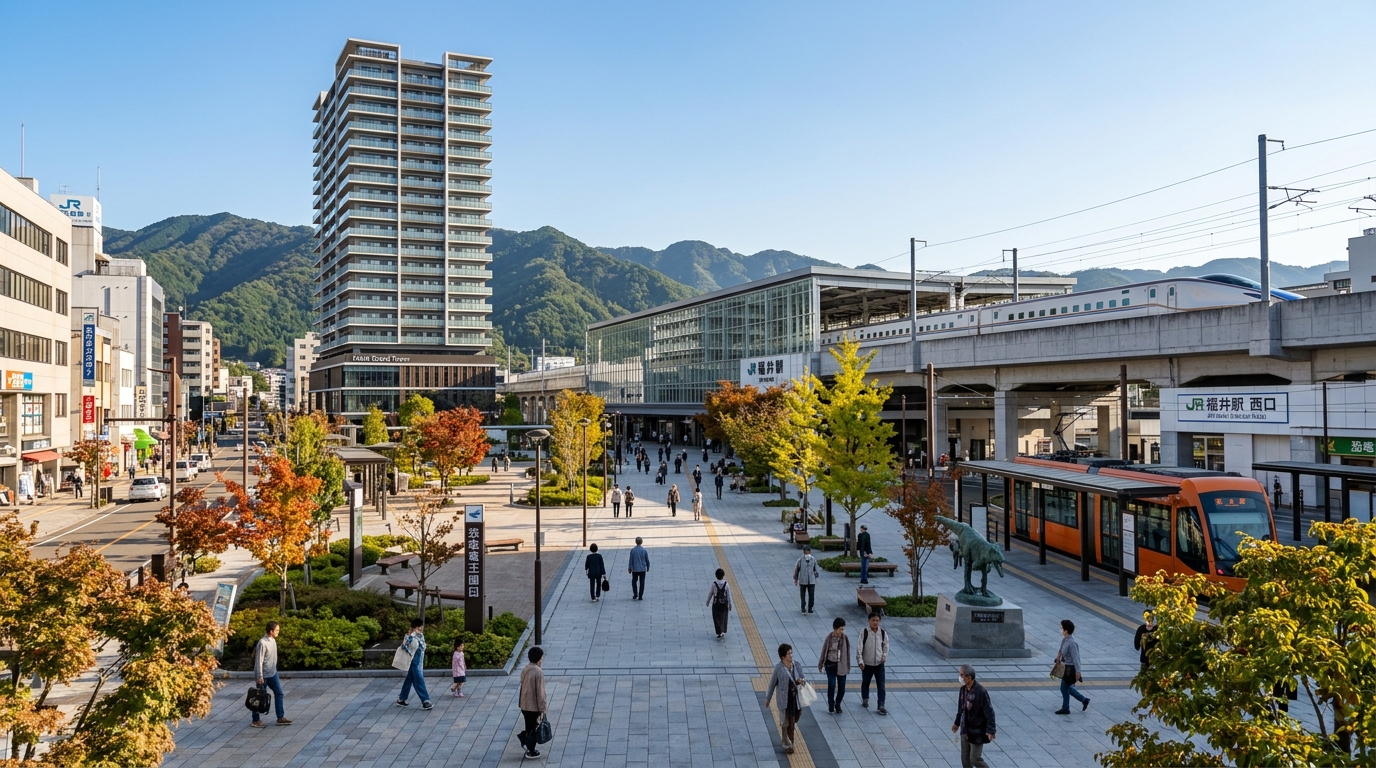
1. Railway Day Spotlight: Urban Planning Around Fukui Station and the Impact of the Shinkansen Extension
The spring 2024 extension of the Hokuriku Shinkansen to Tsuruga marked a historic turning point for Fukui Station, the gateway to Fukui Prefecture. By connecting Fukui directly to the Greater Tokyo area without transfers, both physical and psychological distances for business and leisure travel narrowed dramatically. The benefits of this extension go well beyond faster travel to Tokyo. Transit across the three Hokuriku prefectures—including Kanazawa and Toyama—became remarkably smooth, encouraging businesses to treat the entire Hokuriku region as a single integrated economic zone. Furthermore, travel routes from the Kansai and Chukyo (Nagoya) regions are being restructured via seamless transfers at Tsuruga, positioning Fukui Station as a pivotal central hub. Now in 2026, two and a half years post-opening, these effects have moved beyond a temporary boom, embedding themselves into the structural fundamentals of the city.
Fukui Station’s strength extends beyond high-speed rail. It serves as a comprehensive transit nexus, connecting Hapiline Fukui (ハピラインふくい), Echizen Railway (えちぜん鉄道), and the Fukui Railway (福井鉄道) streetcar network. This setup seamlessly bridges regional access from outside the prefecture with detailed local transit throughout Fukui City and neighboring municipalities. Strengthening this transport hub directly generates new local business opportunities and enhances daily commutes, serving as a powerful engine for broader urban development.
From a real estate market perspective, infrastructure development remains one of the strongest backstops for land values. Enhanced pedestrian spaces around the station and revamped plazas at both the West and East Exits have dramatically improved foot traffic flow. As a result, even in Fukui City—where car ownership was historically taken for granted—a new lifestyle centered on walkable station-front living has become a reality, driving a widespread revaluation of the station area as a prime residential zone.
2. Redevelopment at Fukui Station Front: Enhanced Lifestyle Convenience and Commercial Vitality
In tandem with the Shinkansen launch, major urban redevelopment projects around Fukui Station have come to fruition one after another. In March 2024, the retail complex under the elevated tracks, formerly Prism Fukui (プリズム福井), reopened as Kurufu Fukui Station (くるふ福井駅), significantly boosting daily shopping and gift-buying convenience for commuters and visitors alike.
Even more noteworthy is FUKUMACHI BLOCK, a major mixed-use complex that opened in the West Exit "Triangle Zone." This facility is far more than just a cluster of offices and hotel rooms. On the first floor, the food hall MINIE (みにえ) brings together popular local eateries and a craft brewery, serving as a vibrant community hub day and night. MINIE's appeal lies in its rich selection of farm-to-table menus featuring local seafood and agricultural produce, creating a lively venue where local producers and consumers meet. Combining the casual warmth of a traditional alleyway—akin to the nearby Fukumachi Yokocho (ふくまち横丁)—with sophisticated modern design, it injects new vitality into the district. Furthermore, the upper floors host Courtyard by Marriott Fukui (コートヤード・バイ・マリオット福井), significantly elevating the city's overall brand prestige.
Currently drawing major attention is the Fukui Station South Street District Urban Redevelopment Project (福井駅前南通り地区市街地再開発事業). The table below outlines the timeline of major development projects around Fukui Station:
| Timeline | Project / Development | Overview, Lifestyle Impact, and Expected Benefits |
|---|---|---|
| March 2024 | Opening of Hokuriku Shinkansen Fukui Station & Kurufu Fukui Station | Enhanced regional connectivity and enriched in-station retail boost daily convenience |
| March 2024 | Opening of FUKUMACHI BLOCK | Upgraded downtown experience with the MINIE food hall, hotel, and residential condominiums |
| Spring 2027 (Est.) | Completion of South Street District Hotel Tower | Opening of Candeo Hotels (カンデオホテルズ, first in Hokuriku), expanding capacity for inbound and business travelers |
| Spring 2028 (Est.) | Completion of South Street District Residential Tower | Completion of an 18-story condominium tower (Duo Hills) and multi-story parking garage, expanding the downtown resident population |
| Spring 2029 (Est.) | Grand Opening of Entire South Street District | Completion of commercial and office towers centered on "Food" and "Health" street concepts, giving rise to a vibrant new block |
| 2030s | Fukui Arena (Provisional) Concept | Planned multi-purpose arena around Higashi Park, establishing a major new sports and entertainment venue |
High-rise residential developments like Duo Hills (デュオヒルズ) in the South Street district will bring hundreds of new residents into the station neighborhood. This influx is expected to generate fresh demand for essential daily businesses—such as supermarkets, medical clinics, and daily goods retailers—creating a positive feedback loop that rejuvenates the surrounding shopping arcades. Heading toward its full opening in 2029, the Fukui Station area continues to evolve into a compact city integrating living, working, and leisure. This upward trajectory in lifestyle convenience will serve as a powerful driver of long-term housing demand.
3. Post-Shinkansen Land Price Trends and Residential Market Dynamics in Fukui City
In areas undergoing major infrastructure upgrades and urban redevelopment, land prices typically rise ahead of time upon project announcements. Fukui Station was no exception, showing an upward trend in central commercial land prices several years before the Shinkansen launch. By 2026, with the major milestone of the opening behind us, speculative price surges have leveled off, giving way to steady, sustainable growth backed by genuine end-user demand.
A key highlight of recent land price dynamics is the spillover effect. Beyond commercial zones adjacent to the station, surrounding residential districts within easy walking, cycling, or transit distance—such as Matsumoto (松本), Bunkyo (文京), Kida (木田), and Hanandō (花堂)—are experiencing a gradual rise in property values. This reflects steady demand from buyers seeking a quiet residential environment while maintaining quick access to station-front conveniences.
When purchasing real estate, evaluating objective price trend data from past to present is vital. To avoid buying at an inflated peak, buyers must carefully compare local historical transaction prices with current market benchmarks. Using the free area lookup features on Mekiki Research, you can instantly review official transaction price histories, hazard maps, and local lifestyle environment metrics for any specific address or point based on Ministry of Land, Infrastructure, Transport and Tourism (MLIT) data. Checking where your target neighborhood stands in today's market is a recommended first step.
Looking beyond 2026, while residential property values in Fukui City may feel subtle impacts from interest rate shifts and fluctuating construction costs, the overall boost in community value from ongoing redevelopment provides a strong cushion, keeping the risk of a sharp market decline relatively low.
4. Why Families Choose Fukui: A Dynamic Balance of Education and Accessibility
A primary driver behind Fukui City's sustained residential potential is its exceptional liveability for families. Fukui Prefecture is widely recognized as a top-tier educational hub in Japan, consistently ranking at the top in national academic performance tests. This high-quality educational environment prompts many child-rearing families to relocate or buy homes here. Fukui also boasts one of the highest dual-income household rates in the country, supported by robust after-school care programs and tight-knit, supportive local communities. For working parents, a safe, nurturing environment for raising children is one of the strongest motivations when choosing a home.
Generous municipal housing and child-rearing support policies provide additional momentum. For instance, Fukui City offers the "Multi-generation Co-residence Renovation Support Project" (多世帯同居リフォーム支援事業) and the "Multi-generation Near-residence Renovation Support Project" (多世帯近居リフォーム支援事業), providing subsidies of up to 600,000 yen for floor plan alterations and plumbing upgrades (including bonuses for designated residential attraction zones). To promote eco-friendly home construction and renovations, the city grants up to 605,000 yen for installing paired solar power and battery storage systems, helping families transition to sustainable living with lower running costs. Subsidies lowering the bar for relocation are also abundant, such as the "Fukui City UI-Turn Relocation and Employment Support Subsidy" (福井市UIターン移住就職等支援金) and the temporary rent-assisted "Trial Relocation Program" (お試し移住プログラム).
Fukui City also offers distinct advantages in transport accessibility. While daily life remains largely car-centric—making automobiles essential for weekend errands and trips to suburban shopping malls—living near Fukui Station or along major transit lines enables a balanced, hybrid lifestyle: commuting via public transit on weekdays and using a car for weekend shopping trips. This seamless blend of transit and driving dramatically improves daily time efficiency for working parents.
5. Station-Proximity Value for Singles and DINKS: Urban Convenience Analysis
Single professionals and DINKS (Dual Income, No Kids) evaluate the Fukui Station area from a different perspective than families, prioritizing proximity to work and urban convenience above all else.
Station-adjacent developments—such as "The Fukui Tower Sky Residence" (ザ・福井タワー スカイレジデンス) inside FUKUMACHI BLOCK and the upcoming "Duo Hills" in the South Street district—directly target these preferences. Living within a few minutes' walk of the station eliminates daily commute stress while offering strong long-term asset value retention and resale potential.
The emergence of vibrant dining hubs like MINIE and Fukumachi Yokocho allows residents to drop by for craft beer or dinner on the way home from work, or unwind at local cafes on weekends—bringing a complete urban lifestyle within reach inside Fukui City.
In recent years, Fukui Station has also attracted remote workers relocating from the Greater Tokyo area. A travel time of under three hours to Tokyo via the Shinkansen offers an ideal balance for professionals who commute to a Tokyo office a few times a month while enjoying lower living costs and rich natural surroundings on a daily basis. Serving as a flexible base for these evolving lifestyles continues to fuel robust housing demand around the station.
6. Real Estate Asset Value Outlook to 2030: Opportunities and Key Risk Factors
How will real estate asset values in Fukui City evolve between 2026 and 2030? Overall, core properties near Fukui Station are well-positioned to maintain or increase their market value.
The primary growth drivers are the scheduled 2029 grand opening of the South Street district and the proposed "Fukui Arena" (provisional name) near Higashi Park (東公園). Once completed, these developments will expand pedestrian traffic, generate new local employment, and attract permanent residents. If realized, a multi-purpose arena hosting regular sports fixtures and major concerts will draw thousands to tens of thousands of visitors per event, triggering a surge in hotel and dining demand. This positive spillover could lift commercial rental rates across the station area, creating favorable tailwinds for the broader real estate investment market. Fukui's key strength lies in building genuine structural utility rather than relying on a temporary "Shinkansen bubble."
However, homebuyers must also keep potential risk factors in sight. Rising construction costs—a nation-wide challenge—have pushed up new construction prices in Fukui as well. Additionally, potential interest rate hikes could increase mortgage burdens and constrain purchasing power among end-users.
When choosing a home today, buyers should look beyond the appeal of brand-new construction. Considering high-quality renovated resale properties or prioritizing prime locations with strong future resale and rental liquidity is increasingly vital. Making a calm, objective decision aligned with your personal budget and life plan will yield the best long-term outcome.
7. Area Selection and Land Evaluation Standards for Buying a Home in Fukui
When searching for a primary residence in Fukui City, buyers generally choose between two primary options: convenient station-centric neighborhoods and quiet suburban residential zones.
While condominium demand centers around the station, suburban areas retain strong demand for single-family homes offering spacious yards and multi-car parking. For example, the Morita district (森田地区) in northern Fukui City is highly popular among young families as a growing residential community; it offers abundant natural surroundings along the Kuzuryu River (九頭竜川) alongside convenient rail access via Morita Station on the Hapiline Fukui line. Meanwhile, the Owada area (大和田エリア) features large-scale commercial centers and excellent road access, appealing to buyers who want spacious plots to raise children comfortably.
When evaluating land, assessing natural disaster risk is an indispensable first step. Fukui City is traversed by major rivers such as the Asuwa River (足羽川), and certain areas carry flood risks. Once you identify candidate plots, review the latest municipal hazard maps to confirm whether the property falls within designated flood risk zones and check what mitigation measures are in place.
Beyond land pricing, understanding total project costs—including the type of house that can be built on the lot—from the outset is essential. Using the "AI Construction Simulator" available on the Mekiki Research Pro Plan, you can easily generate floor plans, 3D architectural models, sunlight simulations, exterior renderings, and estimated total budgets for single-family home projects. Combined with local environmental data, it serves as a powerful tool to concretely plan your ideal home.
8. Summary: Evolving Home Search and Future Outlook Around Fukui Station
On this "Railway Day," we examined the real estate market around Fukui Station amidst the Hokuriku Shinkansen extension and ongoing urban redevelopment, looking ahead to asset value trends through 2030.
Enhanced lifestyle convenience from developments like Kurufu Fukui Station and FUKUMACHI BLOCK, alongside the upcoming 2029 completion of the South Street district, has brought unprecedented urban appeal to Fukui City. Coupled with comprehensive child-rearing support and relocation subsidies, the city offers an ideal foundation for a wide range of lifestyles—from growing families to single professionals.
While extreme land price appreciation has moderated, this reflects a maturing market transitioning into a stable, value-driven phase grounded in real end-user demand. The key to a successful home purchase today lies in matching your personal lifestyle with data-backed, objective evaluations of neighborhood growth potential. By carefully assessing Fukui's evolving urban landscape, you can secure a home you will enjoy for years to come.
By creating a free account, you can access the MLIT data used in this article directly through your own Claude or ChatGPT assistant via MCP integration. Continue your property research seamlessly with your personal AI to find a home you truly love.