
Two years have passed since the grand opening of Nagasaki Stadium City (長崎スタジアムシティ) in October 2024, and the cityscape and real estate market north of Nagasaki Station (around Saiwaimachi and Takaramachi / 幸町・宝町) in Nagasaki City, Nagasaki Prefecture (長崎県長崎市) have undergone an unprecedented transformation. With an estimated 5.35 million annual visitors and a projected regional economic impact of approximately ¥37.8 billion annually across Nagasaki Prefecture, the scale of this privately led, integrated stadium and arena development is immense.
Far more than a venue for sports and entertainment, this district seamlessly combines everyday shopping, offices, and hotel accommodations. It has emerged as a top residential choice for families and single professionals seeking to live close to work. Concurrently, progress on the once-in-a-century redevelopment surrounding Nagasaki Station (長崎駅) has significantly boosted both local convenience and asset values across the area.
In this article, we analyze land price trends and shifting residential demand around Nagasaki Stadium City using official transaction data from the Ministry of Land, Infrastructure, Transport and Tourism (MLIT), local hazard assessments, and municipal family support programs. Whether you are a homebuyer looking for a primary residence or a real estate investor focused on long-term property value, this analysis delivers objective, data-backed insights.
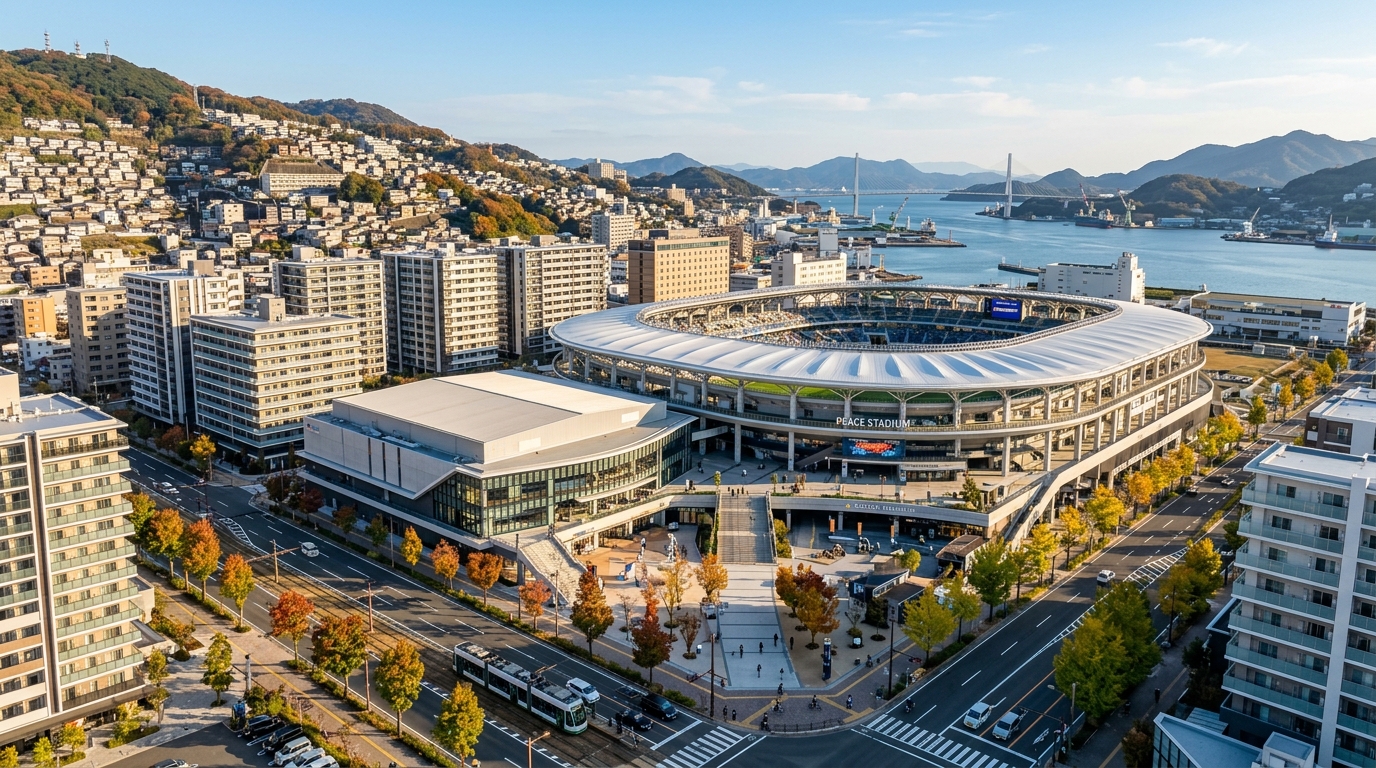
1. Urban Transformation and Latest Area Trends Driven by Nagasaki Stadium City
Nagasaki Stadium City is a landmark mixed-use project rare in Japan. It brings together Peace Stadium (ピーススタジアム), a 20,000-seat soccer stadium, and Happiness Arena (ハピネスアリーナ), a multi-purpose arena for basketball and live events, alongside retail complexes, a hotel, and corporate office space. This scale of development has turned the area north of Nagasaki Station from a simple transit route into a major hub where people gather, stay, and reside.
Redevelopment around Nagasaki Station has moved forward in sync with Stadium City. Following the full opening of the JR Nagasaki Station Building (JR長崎駅ビル) in 2025, modern facilities such as the AMU PLAZA Nagasaki New Building (アミュプラザ長崎 新館) and the luxury Nagasaki Marriott Hotel (長崎マリオットホテル) have established themselves as prominent city landmarks. This major infrastructure investment has dramatically improved pedestrian flow from Nagasaki Station through to Saiwaimachi and Takaramachi, driving positive real estate activity throughout the surrounding neighborhoods.
Job creation within Stadium City—estimated at roughly 4,600 positions across office and retail operations—has generated a distinct surge in housing demand. As a prime location for living close to work, the area is attracting strong interest across property types, from rental apartments for single workers to pre-owned condominiums and single-family homes for growing families.
2. Land Price Trends and Transaction Unit Price Movement North of Nagasaki Station (Saiwaimachi & Takaramachi)
Analyzing concrete transaction data is essential to gauging an area's long-term trajectory. Looking at real estate transaction data in Nagasaki City from 2021 through 2026 (sample size: 3,997 transactions), the average transaction price stands at approximately ¥27.6 million, with a median price of ¥15 million and an average unit price of about ¥88,000 per square meter.
To inspect recent market shifts in detail, we compiled quarterly transaction data for Q1 2026 (2026Q1) from the MLIT Real Estate Information Library. Breaking the data down by property type highlights a clear market divergence. The pre-owned condominium segment recorded 50 transactions with a median price per square meter of approximately ¥373,000/sqm—a sharp year-over-year increase of +38.3%. Condominiums within easy reach of Stadium City and Nagasaki Station continue to draw strong purchasing interest from both end-users and real estate investors.
In contrast, residential land with buildings (single-family homes) logged 64 transactions in Q1 2026, with a median unit price of ¥60,000/sqm, down -18.9% year-over-year. Vacant residential land also softened, recording 28 transactions and a median unit price of around ¥52,000/sqm (-14.8% YoY). Rising land prices in central districts have led single-family buyers to shift toward suburban locations, while older inventory coming to market has worked to pull down overall averages.
3. The Impact of Integrated Sports and Commercial Development on Family Livability
A primary advantage of Nagasaki Stadium City is its appeal as a daily destination, even on days without scheduled games or events. Complete with dining venues, retail stores, and hot spring facilities, it has established itself as a convenient weekend spot for local families.
Zoning around the complex is designated primarily as Category I Residential (第一種住居地域), ensuring a comfortable living environment regulated by a 60% building coverage ratio and a 200% floor area ratio. Family buyers consistently highlight this balance between high commercial convenience and a quiet residential setting.
Data on top districts by transaction volume (topDistricts) reveals how residential demand is distributed across Nagasaki. In Ebisumachi (恵美須町), situated near Nagasaki Station, pre-owned condominiums saw 12 transactions with a high median price of roughly ¥785,000/sqm, reflecting strong asset retention. Meanwhile, suburban areas tailored to car owners saw active single-family home transactions: Nameishi (滑石) recorded 14 home sales (median ~¥43,000/sqm), Dialand (ダイヤランド) recorded 11 (median ~¥93,000/sqm), Oebaru (小江原) logged 11 (median ~¥86,000/sqm), and Nishimachi (西町) recorded 11 vacant land transactions (median ~¥36,000/sqm). Buyers are clearly matching their choice of neighborhood to their specific lifestyle preferences.
4. Proximity to Work and Public Transit: Enhanced Mobility via Nagasaki Station Redevelopment
Transit access north of Nagasaki Station relies heavily on the Nagasaki Electric Tramway (長崎電気軌道) streetcar network. Takaramachi Station (宝町駅), one of the closest tram stops to Stadium City, serves 2,563 daily passengers and functions as a core transit link for residents. The tram offers direct connections to Nagasaki Station, the Prefectural Government Office, business centers, and main tourist sites—making it ideal for single professionals and dual-income couples living car-free.
Furthermore, the opening of the Nishi-Kyushu Shinkansen (西九州新幹線) bullet train line and improved pedestrian connectivity around Nagasaki Station have streamlined transit within and beyond the prefecture. The addition of new station facilities and commercial office buildings has increased business traffic, giving local residents the convenience of living, working, and relaxing all within walking or transit distance.
5. Educational and Disaster Prevention Infrastructure for Families
School district quality and access to healthcare rank among the highest priorities for family homebuyers. School zones in this area include Inasa Elementary School (稲佐小学校) and Yamazato Junior High School (山里中学校), both located in traditional educational districts within Nagasaki. In addition, around 20 medical facilities are situated nearby, including Inoue Hospital (井上病院), Ken Clinic (けんクリニック), and Aso Eye Clinic (医療法人あそう眼科), offering accessible care across multiple specialties.
At the same time, homebuyers must evaluate natural hazard risks associated with Nagasaki's steep terrain. Hazard maps for the area designate portions as flood risk zones, with maximum predicted inundation depths between 3 and 5 meters. Landslide hazard zones are also present along nearby sloped terrain, where risks include debris flows and steep slope failures. When buying real estate here, checking current hazard maps is essential. Strategies such as choosing units on middle-to-higher floors in condominium buildings or selecting elevated, flood-resistant construction for single-family homes are critical risk mitigation measures.
6. Single-Family vs. Condominium Market Trends and Key Factors for Homebuyers
The table below outlines actual Q1 2026 transaction examples in Akasako (赤迫), a residential neighborhood located just north of Stadium City.
| Property Type | District | Transaction Price | Area | Layout | Year Built | Structure | Zoning |
|---|---|---|---|---|---|---|---|
| Pre-owned Condominium | Akasako | Approx. ¥31M | 70 sqm | 3LDK | 2009 | SRC | Commercial |
| Pre-owned Condominium | Akasako | Approx. ¥28M | 75 sqm | 3LDK | 2018 | RC | Neighborhood Commercial |
| Pre-owned Condominium | Akasako | Approx. ¥28M | 75 sqm | 3LDK | 2008 | RC | Commercial |
| Pre-owned Condominium | Akasako | Approx. ¥22M | 70 sqm | 3LDK | 2002 | SRC | Commercial |
| Residential Land & Building | Akasako | Approx. ¥8.3M | 180 sqm | 5DK | 1998 | Light Gauge Steel | Category I Residential |
Pre-owned 3LDK condominiums built within the last 10 to 20 years trade between ¥22 million and ¥31 million, forming an accessible price point for families. Conversely, older single-family properties offer larger lot sizes at lower price points—around ¥8.3 million—making them ideal options for renovation-minded buyers.
To encourage families to settle in the city long-term, local authorities offer the "Nagasaki City Child-Rearing Housing Support Grant" (長崎市子育て住まいづくり支援費補助金). For FY2026, child-rearing and multi-child families purchasing or renovating pre-owned housing can receive up to ¥600,000 (covering up to one-fifth of eligible expenses). Taking advantage of these municipal grants is an effective way to optimize your purchase budget.
Additionally, subscribers to the Mekiki Research Pro Plan can utilize our "AI Building Simulator." Inputting specific preferences alongside actual district data allows users to generate custom 2D floor plans, 3D home renders, sunlight simulations, and preliminary construction budgets for single-family homes (note: multi-family residential planning and financial yield calculations are not supported). This provides practical visualization for buyers looking to purchase land and build a custom home.
7. Medium- to Long-Term Housing Value Outlook Around Nagasaki Stadium City
Two years into operation, Nagasaki Stadium City continues to demonstrate strong growth potential. The project's ¥37.8 billion annual economic footprint is driving sustained tenant interest and commercial office space demand across the surrounding district.
From an investment perspective, well-located condominiums near Nagasaki Station and within walking distance of Stadium City are positioned for steady rental demand and price stability. The +38.3% year-over-year growth in median condo unit prices highlights the area's growing brand recognition and desirability. Conversely, the single-family home market shows clear price differentiation relative to suburban neighborhoods. The market is expected to polarize further as buyers choose between transit convenience in the central district or space and affordability in the suburbs. For investors and primary homebuyers alike, evaluating micro-location factors—including station distance, hazard exposure, and school zones—will remain essential.
8. Conclusion
The launch of Nagasaki Stadium City and the redevelopment of Nagasaki Station have reshaped both the livability and asset value of the area north of Nagasaki Station. A rich commercial footprint, reliable educational options, and supportive municipal housing grants create a compelling environment for families purchasing a home. However, given localized flood and landslide hazards, buyers should maintain a cautious, data-driven approach during property selection.
To evaluate specific neighborhoods in greater detail, consider signing up for a free account. Free registration allows you to access MLIT transaction data directly through Claude or ChatGPT via Model Context Protocol (MCP) integration. You can continue researching your target locations seamlessly using your preferred AI assistant.