
The surrounding area of Kanazawa Station (金沢駅), the gateway to Kanazawa City, Ishikawa Prefecture (石川県金沢市), has drawn widespread national attention as a vital business and tourism hub following the Hokuriku Shinkansen extension to Tsuruga in March 2024. Amid rebounding inbound tourism and a surge in corporate expansions, the location is being re-evaluated not just as a commercial and tourist hub, but as a residential area for permanent settlement. Within this market, the northern area of Kanazawa Station, where large-scale sports-centered mixed-use developments are underway, is attracting particular interest.
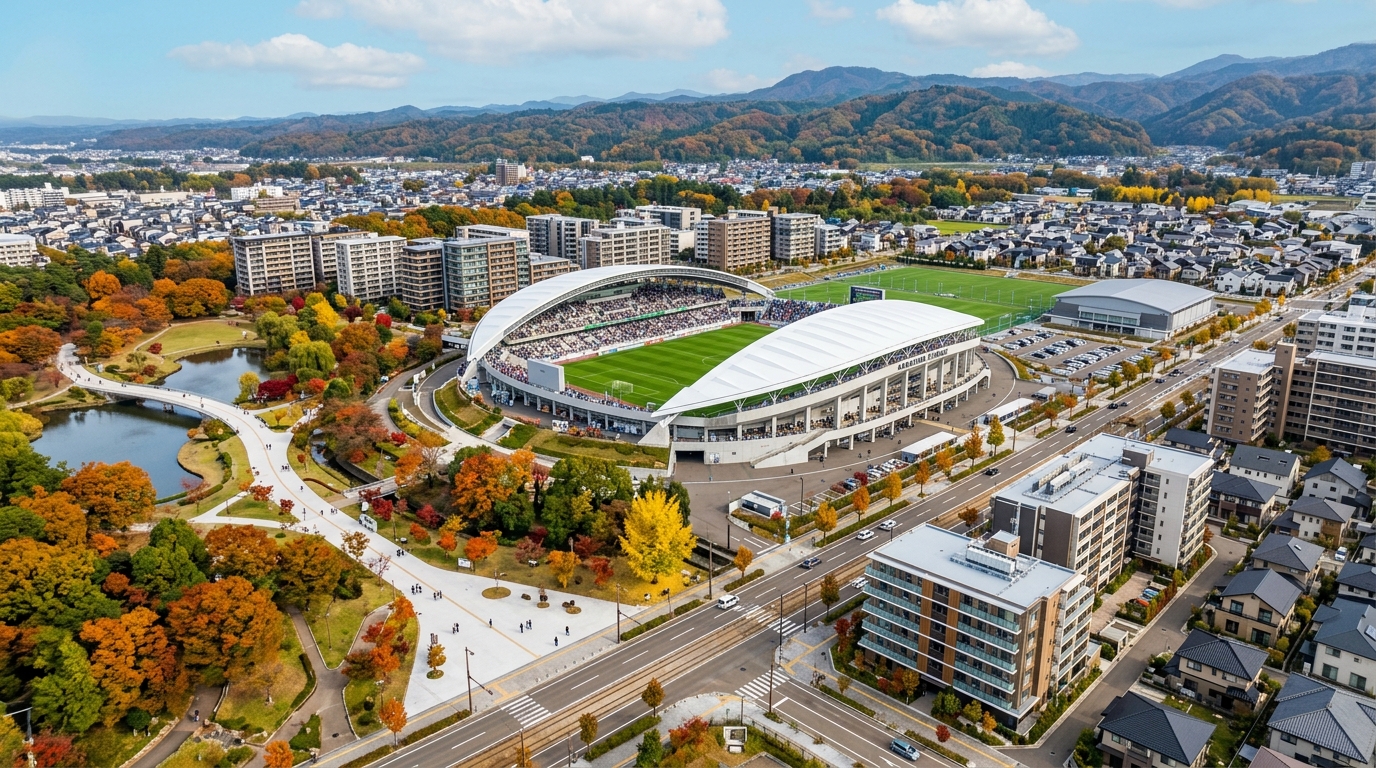
Centered around the "Kanazawa Go Go Curry Stadium" (金沢ゴーゴーカレースタジアム), which opened in February 2024, the surrounding area is rapidly developing into a new urban space integrating sports facilities with daily living. Integrated developments featuring stadiums and arenas not only bring non-routine excitement to the community, but past precedent proves they yield immense spillover effects on residential demand by improving daily pedestrian flow and surrounding infrastructure.
This article presents an in-depth analysis of how the opening of this stadium is impacting livability and real estate values in the northern Kanazawa Station area. Incorporating objective transaction data from the Ministry of Land, Infrastructure, Transport and Tourism (MLIT), the latest redevelopment projects promoted by Kanazawa City, and 2026 child-rearing support initiatives, we provide an objective and expert perspective. This guide offers key insights for real estate investors as well as families and individuals considering home purchases to evaluate the balance between livability and asset value.
1. Northern Kanazawa Station Area Gaining Attention with the Birth of Kanazawa Go Go Curry Stadium
In February 2024, Hokuriku's first football-specific stadium meeting J.League standards—the "Kanazawa Go Go Curry Stadium" (金沢ゴーゴーカレースタジアム / Kanazawa Civic Soccer Stadium / 金沢市民サッカー場)—opened inside Johoku Civic Sports Park (城北市民運動公園) in Isobe-machi, Kanazawa City (金沢市磯部町). Built with an investment of approximately 8 billion yen to replace the aging former soccer ground, the facility generated significant momentum when local business Go Go Curry Group acquired the naming rights.
Currently seating approximately 10,444 spectators, the stadium's design allows for future expansion to a 15,000-seat capacity required for J1 standards. As the home ground for J.League team Zweigen Kanazawa (ツエーゲン金沢), match days bring crowds of supporters from both inside and outside the prefecture, imbuing the local area with vibrant energy.
The stadium's standout feature is the extremely close distance between the pitch and spectator seats—just 7 meters at its shortest point. The overwhelming sense of presence, allowing fans to directly feel the players' breathing and hear the sound of the ball being kicked, is a major attraction unmatched by other venues. Furthermore, beyond accommodating various viewing styles with VIP lounges and field-level seating, it features abundant amenities for families raising children, such as a kids' terrace, nursing rooms, and accessible multipurpose toilets. The entire stadium is completely cashless, representing an advanced approach that meets modern convenience demands.
With the birth of this stadium, the northern Kanazawa Station area has transformed from a "quiet suburban sports park" into a "major regional attraction hub surging with sports and entertainment excitement." As of 2026, how to best optimize the balance between non-routine event usage for sports spectating and daily usage by local residents remains a central theme dictating the sustainable growth of this district.
2. Transformation of Johoku Civic Sports Park and the Creation of Urban Buzz
The development of the Johoku Civic Sports Park area, anchored by Kanazawa Go Go Curry Stadium, has dramatically improved pedestrian spaces and mobility in the surrounding neighborhood. Green parks stretch around the stadium, and even on non-match weekdays and weekends, local residents can regularly be seen jogging, walking, or enjoying picnics with their children. A park-integrated development centered around sports facilities is a highly attractive factor for homebuyers seeking a high-quality residential environment.
This surge in activity creates an even stronger synergy when combined with several large-scale redevelopment projects progressing concurrently around Kanazawa Station. At the East Exit of Kanazawa Station, a plan is underway to construct a government-private mixed-use building standing approximately 160 meters tall (38 stories above ground) on the former site of the Kanazawa Miyako Hotel. In June 2025, a surrounding area of roughly 59 hectares was designated by the national government as an "Urban Renaissance Urgent Development Area," enabling dynamic urban development through relaxed floor area ratios (FAR) and height restrictions. Additionally, in the Musashigatsuji A District (武蔵ヶ辻A地区), located along Kanazawa's central urban axis, the city planning decision for a Category 1 Urban Redevelopment Project was finalized on September 1, 2026. This large-scale project will replace the aging Kanazawa Sky Building area with three mixed-use buildings measuring up to 60 meters in height and totaling approximately 95,000 square meters in total floor area, reorganizing commercial, hospitality, and residential functions.
Meanwhile, at the West Exit of Kanazawa Station, construction is scheduled to begin in May 2026 on "Zepp Kanazawa" (tentative name), the first live performance hall of its brand on the Sea of Japan coast, with completion targeted for autumn 2027. The creation of an entertainment facility with a capacity of approximately 1,200 people will undoubtedly stimulate an influx of younger demographics and boost surrounding food and beverage demand.
In this way, commercial, business, and entertainment functions across the east, west, and northern sides of the station are undergoing comprehensive, area-wide updates. This broader wave of redevelopment is stimulating interest among food and retail businesses near the stadium to open new locations, thereby strongly attracting new residents seeking proximity between work and home.
3. Transportation Access in Northern Kanazawa Station and the Reality of Walkability and Bus Connectivity
Supporting the potential of the northern Kanazawa Station area as a residential district is its excellent access to Kanazawa Station, the largest transit hub in Hokuriku. Operated by JR West, Kanazawa Station sees approximately 40,021 daily passengers and serves as a vital hub not only for the Shinkansen but also for local rail lines and an extensive regional bus network.
Examining city planning data for the surrounding region reveals that much of the target area is designated as a "Category 2 Residential Zone" (第2種住居地域). This zone features flexible development standards with a building coverage ratio (BCR) of 60% and a floor area ratio (FAR) of 200%, allowing for a versatile mix from medium- to high-rise condominiums to single-family detached homes. Looking at published transaction data, in Asano-honmachi (浅野本町)—a Quasi-Industrial Zone (準工業地域) north of the station with a 60% BCR and 200% FAR—there are records of residential land transactions where a 100-sqm lot sold for approximately 4.1 million yen (approx. 40,000 yen/sqm). Despite being a Quasi-Industrial Zone, residential developments are progressing, indicating that land is available at relatively affordable price points.
Furthermore, following the opening of the stadium, bus routes from Kanazawa Station were reorganized, shuttle services were introduced, and pedestrian walkways were widened. This has eased the constraint of "mandatory car ownership" typical of provincial car-centric cities. Even on non-match days, high transit convenience—allowing smooth access via bus or bicycle to major commercial facilities around the station and central areas like Omicho Market (近江町市場)—stands as a major strength of this district.
4. Everyday Livability and Natural Environment for Families with Children
For families with children considering a home purchase, living infrastructure such as education and healthcare, along with robust municipal support programs, are just as crucial as transit access and property value. The northern Kanazawa Station area falls under the school districts for local institutions such as Toita Elementary School (戸板小学校) and Nagata Junior High School (長田中学校), offering a well-established educational environment. Regarding healthcare infrastructure, there are 17 medical facilities scattered around the area, including Park Building Dialysis Clinic (パークビル透析クリニック), Kanazawa Kokoro Clinic (金沢こころクリニック), and Kanazawa Medical Station ViQ (金沢メディカルステーション ヴィーク), providing peace of mind with prompt care available during sudden illnesses.
In addition, the expanded housing subsidies and child-rearing support programs available in 2026 are key highlights when planning a home in Kanazawa City. Under the national government's "Mirai Eco Housing 2026 Initiative" (みらいエコ住宅2026事業), newly constructing a "GX-oriented housing unit" (GX志向型住宅) equipped with high insulation and energy-efficient facilities yields generous subsidies of up to 1.1 million yen (for general regions such as Kanazawa City), regardless of household composition requirements. Utilizing this system makes it possible to build a high-performance, cost-effective home that remains comfortable while reducing utility costs during the cold Hokuriku winters. Additionally, Kanazawa City offers its own "Our Town Kanazawa Housing Acquisition Incentive" (わがまち金沢住宅取得奨励金). Those building or acquiring a residence within designated "Residential Attraction Zones" (居住誘導区域) along public transit corridors may receive grants of up to 2 million yen.
Regarding daily financial support, Kanazawa City has also implemented proactive, independent measures. In response to the national government's November 2025 decision to issue a "Child-Rearing Support Allowance for Rising Prices" (物価高対応子育て応援手当, 20,000 yen per child), Kanazawa City added an extra 10,000 yen of its own funds using local priority allocation grants, providing a total of 30,000 yen per child. This accumulation of practical financial support reinforces Kanazawa's reputation as a family-friendly city, driving an influx of family demographics.
5. Residential Land Price Trends in Kanazawa City and the Positioning of the Northern Kanazawa Station Area
Based on objective data, let us analyze real estate market trends across Kanazawa City and the positioning of the northern station area. According to our transaction database spanning 2021 through 2026 across Kanazawa City (sample size: 7,404 cases), the overall area's average transaction price stands at approximately 24.9 million yen with a median of 18.0 million yen, and an overall average unit price of roughly 80,000 yen/sqm.
Furthermore, examining recent market trends for Q1 2026—compiled quarterly by our team from the MLIT Real Estate Information Library—reveals distinct trend variations across property types.
| 2026Q1 Property Type | Median Price/m² | YoY Change | Quarterly Transactions |
|---|---|---|---|
| Pre-owned Condominiums, etc. | Approx. ¥246,000/m² | +5.5% | 84 cases |
| Residential Land (Land Only) | Approx. ¥85,000/m² | +11.8% | 55 cases |
| Residential Land (Land & Building) | Approx. ¥126,000/m² | 0.0% | 170 cases |
Particularly noteworthy is the double-digit surge of +11.8% YoY in the median unit price per square meter for residential land (land only). This indicates intensifying competition for site acquisition among developers and individual investors anticipating the spillover effects of station redevelopment plans and the stadium opening. The pre-owned condominium market also remains strong at +5.5% YoY; against a backdrop of rising construction costs, demand for existing condominiums in highly convenient locations is surging.
Looking at top districts by transaction volume, areas such as Yokogawa (横川; 25 land & building cases, median unit price approx. ¥236,000/m²), Kita-Yasue (北安江; 24 pre-owned condo cases, median unit price approx. ¥267,000/m²), and Kodatsuno (小立野; 23 land & building cases, median unit price approx. ¥97,000/m²) are leading the market. Examining specific transaction samples within the area for Q1 2026, a residential land and building property in Akatsuki-machi (暁町) transacted at 12 million yen (115 m², wooden structure, built in 1966), while a property in Asahi-machi (旭町) sold for 23 million yen (135 m², 4LDK, wooden structure, built in 1990, Category 1 Mid-High-Rise Exclusive Residential Zone). The data clearly reflects actual demand from buyers purchasing older single-family homes at affordable prices for renovation, as well as families seeking generous plot sizes.
6. Measures Against Event Congestion/Noise and Livability as a Residential Area
When evaluating homes near major entertainment venues like stadiums and arenas, the primary concerns for prospective buyers are "congestion" and "noise" during events.
At Kanazawa Go Go Curry Stadium, match days attract up to 10,000 visitors, inevitably causing temporary traffic congestion on surrounding roads and crowded bus and pedestrian routes from the station. However, stadium management recognizes these issues and has implemented countermeasures to separate visitor flows from resident living routes, such as actively promoting park-and-ride schemes, increasing shuttle bus frequency, and dispersing pedestrian traffic routes. Noise mitigation measures have also been thoughtfully designed. The roof over the welcome gate on the stadium's south side is designed not merely for rain protection, but with acoustic engineering to reflect supporters' cheers back onto the pitch. This creates a unified atmosphere inside the stadium while suppressing excessive noise leakage to neighboring residential areas.
There is a clear segment of residents who view this vibrant energy and convenience positively. For instance, in Asahi-machi (旭町), a pre-owned condominium (60 m², 2LDK, built in 1992, reinforced concrete structure) transacted at approximately 9 million yen. For single professionals or DINKS (double income, no kids) who choose soundproof reinforced concrete condos to enjoy the stadium excitement and the growing commercial benefits of nearby dining options, this area serves as a highly attractive rental and purchase target.
7. Surrounding Infrastructure and Long-Term Prospects to Check When Buying a Home
The northern Kanazawa Station area is a promising district positioned to benefit from redevelopment while maintaining long-term asset value. However, when purchasing real estate, evaluating safety against natural disasters (hazard risks) is just as essential as assessing property value.
According to hazard data based on Geospatial Information Authority of Japan (GSI) records, the target area's landslide risk is classified as "None," but flood risk is marked as "Risk Present," with an estimated maximum inundation depth of "3 to 5 meters (Rank 3)." In recent years, localized heavy rains exceeding expectations have become more frequent nationwide. Therefore, when considering a newly built single-family home in this area, architectural measures to mitigate flood risk—such as raised foundations, placing living rooms and critical utilities on the second floor or higher, and selecting water-resistant building materials—are essential.
Looking at long-term prospects, the continuous updating of Kanazawa's central urban axis—including the skyscraper project at the former Miyako Hotel site near the East Exit, large-scale redevelopment in Musashigatsuji A District, and the opening of Zepp Kanazawa at the West Exit—will significantly elevate Kanazawa's overall city stature. Combined with the establishment of sports culture brought by the integrated stadium development, the brand strength and residential potential of the northern Kanazawa Station area are projected to be well-maintained and enhanced leading up to 2030.
8. Conclusion: Smart Home Building in Northern Kanazawa, Where Sports and Daily Living Harmonize
The birth of Kanazawa Go Go Curry Stadium extends far beyond the creation of a professional football venue; it has generated new pedestrian traffic, commercial demand, and a vibrant community in the northern Kanazawa Station area. As MLIT transaction data demonstrates, double-digit land price growth (+11.8% YoY) and a robust pre-owned condo market (+5.5% YoY) clearly reflect the solid underlying demand and future expectations for this district. Enhanced housing subsidies from national and local governments, alongside Kanazawa City's unique child-rearing support additions, make this area an exceptionally attractive choice for both end-user homebuyers and value-focused real estate investors.
For those seriously considering building a home or purchasing property in this area, gaining a firm grasp of objective data—such as land price trends and hazard risks—prior to making decisions is the key to success. By registering for a free membership, you can connect the MLIT dataset used in this blog directly to your Claude or ChatGPT via MCP (Model Context Protocol). Seamlessly continuing your research with your own AI assistant will help streamline your property search and neighborhood evaluation.
Furthermore, with the "AI Architecture Simulator" available on our Pro Plan, you can easily generate 2D floor plans, 3D models, summer/winter solstice sun exposure simulations, exterior renderings, and estimated total budgets for custom single-family homes based on local market data and your specific preferences. Whether planning a second-floor living room to mitigate flood risks or visualizing your dream home, make the most of these tools to bring your project to life.