
Since the opening of Escon Field Hokkaido (エスコンフィールドHOKKAIDO), Kitahiroshima City in Hokkaido has captured nationwide attention. Now, three years after its grand opening in 2023, the city is rapidly transforming from a venue for watching professional baseball into a vibrant place people actively want to call home.
Especially entering 2026, as the official name for the new railway station was finalized and large-scale redevelopment plans around the station took concrete shape, Kitahiroshima has drawn intense interest not only from real estate investors but also from families and single professionals considering buying a home. The fusion of a quiet, established residential environment—long developed as a commuter suburb of Sapporo—with world-class stadium entertainment is giving birth to an unprecedented lifestyle.
As of October 2026, this article provides an in-depth look at Kitahiroshima’s present and future, covering the latest redevelopment trends, land price shifts based on actual transaction data, and robust living infrastructure ideal for raising a family.
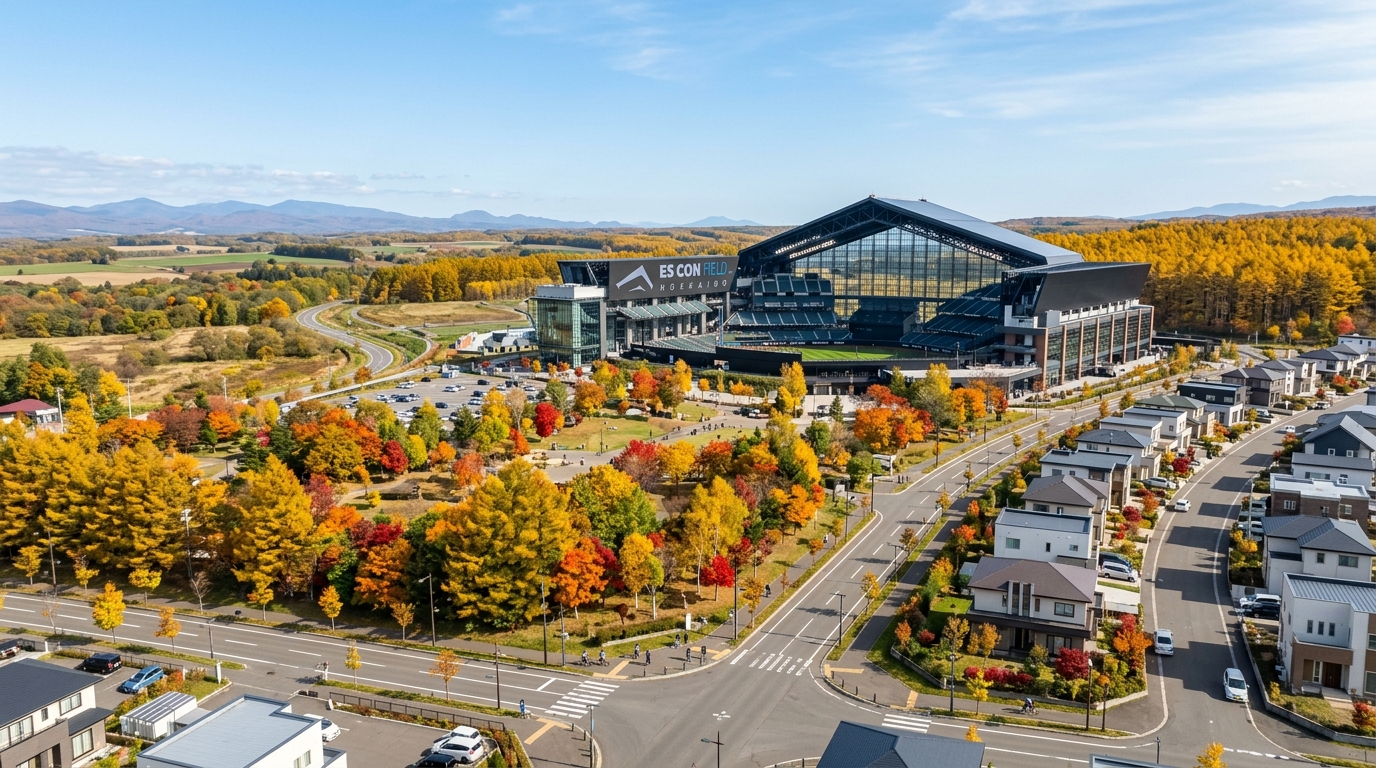
1. Where Kitahiroshima Stands Today: Transformation Driven by the Ballpark
Hokkaido Ballpark F Village (北海道ボールパークFビレッジ), centered around Escon Field Hokkaido—the home stadium of the Hokkaido Nippon-Ham Fighters that opened in March 2023—brought a dramatic paradigm shift to Kitahiroshima's urban planning. Three years after the opening, in 2026, redevelopment is progressing at an unprecedented pace across the entire city, far beyond the ballpark area itself.
At the west exit of JR Kitahiroshima Station (JR北広島駅), the gateway to the city, the directly connected commercial complex "tonarie Kitahiroshima" (tonarie北広島) opened in March 2025, bustling as a new hub for local interaction. Right next to it, construction of the condominium complex "Le Jade Hokkaido Kitahiroshima" (レ・ジェイド北海道北広島) is underway, completely renewing the station-front landscape over the past few years. Furthermore, nearby Kitahiro Park (北広公園) is undergoing renovations targeted for a November 2026 reopening, reshaping it into a public space for multi-generational relaxation.
New movements are also visible in the older residential district of Kitahiroshima Danchi (北広島団地). On the former site of the Aoba Water Purification Plant along the JR Chitose Line, a new neighborhood called "ORKA Village" (オルカビレッジ) was established. Combining single-family homes, rental units, and a convenience store, this district plays a role in community building and disaster prevention, successfully spreading the ballpark’s momentum into local residential improvements.
2. Land Price Trends and Market Rates Around Escon Field
How is this rapid evolution affecting the local real estate market? Let's examine actual market trends using the latest transaction data retrieved by our system.
Analyzing 1,112 transaction samples collected in and around Kitahiroshima City between 2021 and 2026 shows an overall average transaction price of approximately 21.17 million yen, with a median of 16.0 million yen. The overall average price per square meter is around 45,000 yen/sqm. Transaction prices range widely from 100 yen to approximately 1.3 billion yen (including a few specialized deals), highlighting diverse real estate demand across the region.
Next, let's look at quarterly market trends (as of Q1 2026) aggregated by our system from the Ministry of Land, Infrastructure, Transport and Tourism (MLIT) Real Estate Information Library data.
Demand for "residential land (land and buildings)"—primarily single-family homes—represents the bulk of transactions and remains exceptionally robust, with the median price per square meter reaching approximately 84,000 yen/sqm in Q1 2026. This reflects a +13.9% year-over-year increase, demonstrating steady popularity among actual home seekers.
On the other hand, the median price per square meter for pre-owned condominiums in Q1 2026 recorded approximately 320,000 yen/sqm, soaring by +146.2% year-over-year. While this is partly influenced by a small sample size (4 transactions in the quarter), it clearly demonstrates how station-front condominium developments and investment capital flowing into the ballpark perimeter have pushed market expectations dramatically higher. In contrast, land-only transactions settled down slightly to around 30,000 yen/sqm in the same quarter (-18.9% YoY).
Looking at specific transaction samples, land and detached homes in the Aobacho (青葉町) area traded in the 15 million to 17 million yen range, while a relatively new 4LDK detached house (built in 2019) in Asahicho (朝日町) sold for 39 million yen, demonstrating a broad price spectrum depending on age and location.
Below are data for the top 5 neighborhood districts by recent transaction volume:
| District Name | Transaction Type | Volume | Median Price / sqm |
|---|---|---|---|
| Omagari Kashiwaba (大曲柏葉) | Residential (Land & Building) | 15 transactions | ~65,000 yen/sqm |
| Omagari Midorigaoka (大曲緑ヶ丘) | Residential (Land & Building) | 15 transactions | ~95,000 yen/sqm |
| Nijigaoka (虹ヶ丘) | Residential (Land & Building) | 8 transactions | ~91,000 yen/sqm |
| Omagari Minamigaoka (大曲南ヶ丘) | Residential (Land & Building) | 8 transactions | ~65,000 yen/sqm |
| Nishinosato Higashi (西の里東) | Residential (Land & Building) | 7 transactions | ~54,000 yen/sqm |
These top areas are concentrated in the Omagari district near outlet shopping centers, as well as the Nijigaoka and Nishinosato districts near the Sapporo city border, underscoring high market appraisal for their convenience as commuter suburbs for Sapporo.
3. Improved Transit and Infrastructure Driven by the New JR Station Plan
An indispensable factor in discussing Kitahiroshima's future asset value is the new station project on the JR Chitose Line. In September 2026, it was officially announced that the new station, previously tentatively named "Hokkaido Ballpark Station," will be named "F Village Station" (Fビレッジ駅).
Initially targeted for a summer 2028 launch, civil engineering works have progressed smoothly, moving the expected opening forward to coincide with the March 2028 timetable revision. Currently, walking from JR Kitahiroshima Station to Escon Field takes about 20 minutes, but once the new station opens, the distance will be only about 300 meters—dramatically reducing walk time to approximately 4 minutes.
Serving as a catalyst, several major developments around F Village are moving forward simultaneously toward 2028:
First, halfway between F Village Station and the stadium, the 11-story mixed-use facility tentatively named "F Village Complex" is scheduled to open in spring 2028. Housing commercial tenants and rental offices, it adds a "work" dimension to the ballpark zone. Nearby, Banyan Group's luxury resort hotel "DHAWA" is set to open in autumn 2027, while construction is underway for the 36-story, 508-unit residential tower tentatively named "Kitahiroshima New Station Tower Project," aiming for completion in September 2028. Furthermore, in April 2028, Health Sciences University of Hokkaido (北海道医療大学) plans to relocate its campus to the F Village area, generating new rental demand from students and healthcare professionals.
In our current dataset, nearest station information and daily passenger counts appear as "null," which reflects this transitional phase prior to the opening of F Village Station. Once operational, vast surrounding areas will be elevated to "station-walkable" status, significantly boosting daily convenience.
4. Why Families Choose Kitahiroshima: Lush Nature and Robust Childcare Support
Kitahiroshima attracts strong enthusiasm from homebuyers—especially families—not just for its high-profile entertainment offerings, but also for its generous city-led family support policies and spacious living environment.
Starting in April 2026, medical cost subsidies for children in Kitahiroshima were expanded to include high school students, and income caps were completely eliminated. In addition, school lunches for elementary students are now free (0 yen), alongside a slate of other economic relief measures for households with children. Seamless support spans from pregnancy through childbirth, including pregnancy support grants (50,000 yen × 2), childbirth lump-sum grants (500,000 yen), and a new 1-month infant health checkup subsidy (4,000 yen) introduced in FY2026.
Relocation incentives are equally strong. Kitahiroshima offers a relocation support grant program; starting in FY2026 (Reiwa 8), relocating families with children under 18 receive an additional bonus of up to 1 million yen per child. This provides a major boost for families planning to build a new home.
Looking at education and medical data: nearby designated school zones for the analyzed area include Tobu Elementary School (東部小学校) and Tobu Junior High School (東部中学校). Medical facilities within walking distance include two established practices: Koyo Clinic (社会医療法人即仁会広葉クリニック) and Kagami Dental Clinic (医療法人社団加々見歯科), offering everyday peace of mind.
Zoning indicators reveal that much of the residential area set slightly back from the ballpark is designated as "Category I Exclusive Low-Rise Residential Zone" (第1種低層住居専用地域). With building coverage capped at 40% and floor area ratio limited to 50%, the neighborhood avoids high-density tall structures, preserving a sunlit, airy, and green living atmosphere.
5. Commute and Access Convenience as a Sapporo Suburb
Positioned almost midway between downtown Sapporo and New Chitose Airport, Kitahiroshima has historically thrived as a commuter town. Taking the JR Rapid Airport train, Kitahiroshima Station offers seamless direct connections—about 17 minutes to Sapporo Station and about 21 minutes to New Chitose Airport Station without transfers.
As highlighted earlier, the Omagari district—including Omagari Kashiwaba and Omagari Midorigaoka—dominated transaction volume for clear reasons. Bordering Sapporo’s Kiyota Ward, Omagari permits smooth automobile commutes into central Sapporo. Furthermore, it hosts Mitsui Outlet Park Sapporo Kitahiroshima (三井アウトレットパーク 札幌北広島)—one of Hokkaido’s largest outlet malls—alongside major home improvement centers and supermarkets, making daily shopping effortless.
When F Village Station opens in 2028, transit convenience along the Chitose Line will strengthen further. Homebuyers can select location based on lifestyle: car-oriented buyers might opt for Omagari or Nijigaoka, while train-reliant commuters can target Kitahiroshima Station or the new station district.
6. Practical Checkpoints When Considering a Home in Kitahiroshima
While Kitahiroshima offers compelling appeal, buyers should review essential practical factors before committing to a contract—specifically, natural disaster risk management.
According to retrieved hazard data, the searched area shows risks for flooding (estimated max inundation depth of 0.5 to 3.0m) and sediment disasters (steep slope collapse). Kitahiroshima features rolling hilly terrain; while rich in natural beauty, properties near rivers or sloped terrain carry inherent hazard risks.
Rather than buying solely on future potential like "proximity to Escon Field" or "the new station," buyers must check local hazard maps to verify property-specific risks before making decisions.
By registering for a free account on our platform, you can access MLIT transaction data and detailed hazard maps directly through Claude or ChatGPT via Model Context Protocol (MCP) integration. Utilizing your AI assistant allows seamless, objective research on target neighborhoods to support data-driven decision-making.
7. Medium- to Long-Term Asset Value Outlook Around the Stadium
Is the Kitahiroshima real estate boom sparked by Escon Field Hokkaido merely temporary? From a medium- to long-term perspective, asset values around the stadium area are likely to demonstrate resilient, sustained growth.
The primary reason is the convergence of multiple mega-projects scheduled for 2028: the opening of F Village Station, the relocation of Health Sciences University of Hokkaido, and the completion of commercial buildings, offices, and high-rise condominiums. Rather than relying solely on stadium event crowds, creating a city infrastructure that blends work, living, education, and recreation ensures continuous growth in both permanent and visiting populations.
However, localized surges are evident—as seen in the pre-owned condo price metric spiking +146.2% year-over-year. Speculative investment capital has driven up prices in select niches. Buyers seeking homes for personal use should carefully evaluate local comps to determine fair market value with a clear, calm perspective.
8. Conclusion: Home Building in Kitahiroshima Where Sports Meets Living
Kitahiroshima continues to evolve alongside the energy of Escon Field Hokkaido. Looking ahead to the 2028 opening of F Village Station, this city—combining transportation convenience, commercial amenities, and comprehensive childcare policies—presents a highly appealing home-building destination for families.
By objectively analyzing both positive indicators (solid land price growth) and potential risks (hazard map details), you can find the ideal location suited to your family's lifestyle.
Registering for a free account unlocks the neighborhood analysis tools used in this article, enabling you to pull the latest real estate data seamlessly via external AI tools (Claude / ChatGPT). Why not explore real data for your area of interest today?
Check the latest land prices and hazard info for Kitahiroshima City, Hokkaido on Mekiki Research 👉