
Today, October 8th, is celebrated in Japan as "Investment Day" (Toushi no Hi)—a day designated by the Japan Securities Dealers Association and other industry groups based on a Japanese wordplay (10/to and 8/ba combining to sound like toushi, meaning investment). While stock markets and mutual funds often take center stage on this day, it is also a prime opportunity to re-examine real estate—a key asset pillar that serves as the very foundation of our daily lives. In recent years, driven by persistent inflation and rising construction costs, choosing a location that can maintain its asset value long into the future has become more critical than ever.
Against this backdrop, Aoba Ward (青葉区), the central hub of Sendai City (仙台市) in Miyagi Prefecture (宮城県) and the political and economic heart of the Tohoku region, is drawing intense interest from real estate investors and homebuyers alike. Having transitioned from the long phase of post-disaster reconstruction following the 2011 Great East Japan Earthquake, Sendai City is now executing a fundamental upgrade of its urban functions, dramatically reshaping its cityscape through large-scale redevelopment projects.
In this report, we decode the economic ripple effects generated by redevelopment around Sendai Station (仙台駅) while analyzing land price trends and living environment features in Aoba Ward based on the latest transactional data. Whether you are an investor looking toward future wealth building, or a family or single professional prioritizing quality of life, this comprehensive area report provides essential insights.
1. Spotlight on Aoba Ward, Sendai City for October 8 "Investment Day"! How Downtown Urban Redevelopment is Transforming the City's Appeal
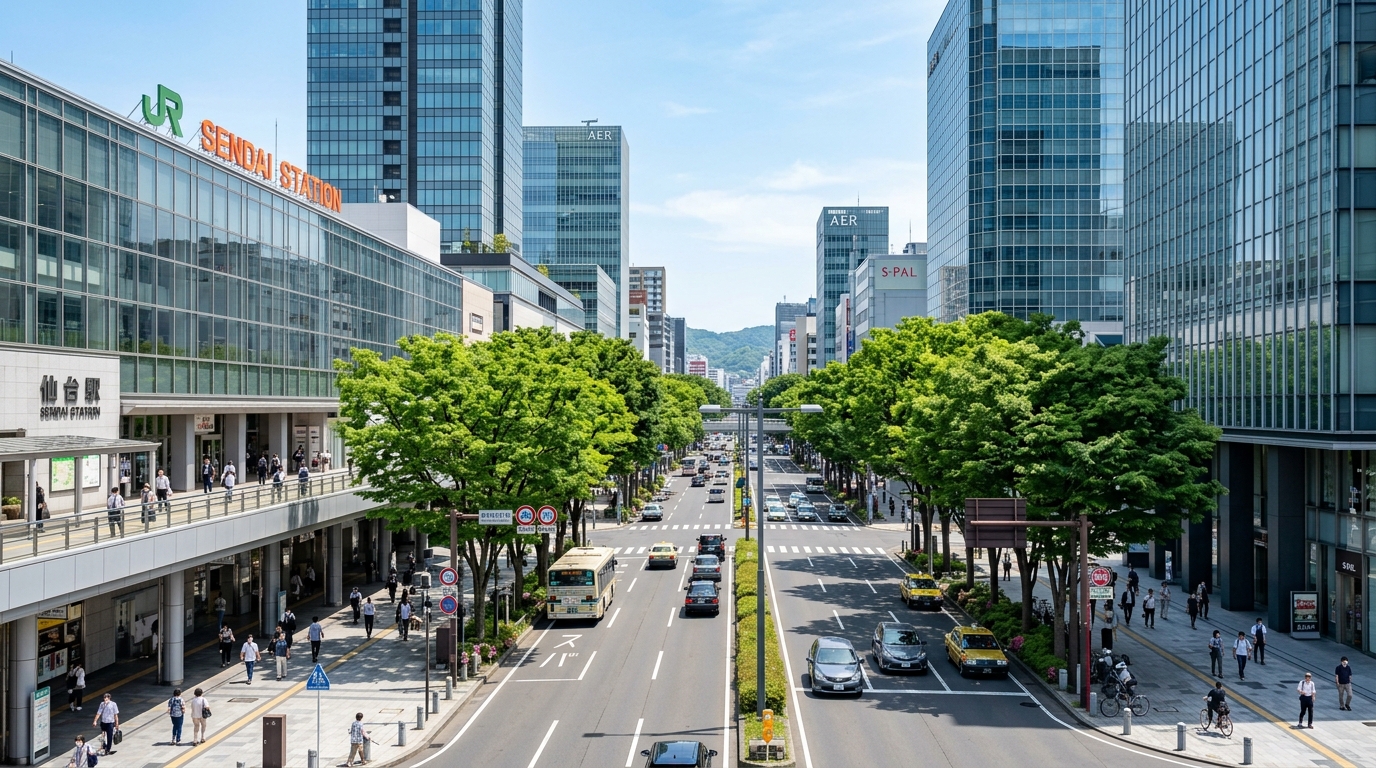
Aoba Ward, Sendai City houses Sendai Station—the largest transit hub in Tohoku—and concentrates major office buildings, commercial facilities, and government institutions. As of 2026, the central core of Sendai City, centered on Aoba Ward, is undergoing one of the largest urban transformations seen in decades.
At the core of this transformation is a major municipal urban redevelopment initiative. Launched in 2019, the "Sendai Downtown Reconstruction Project" (せんだい都心再構築プロジェクト) aimed to incentivize the replacement of aging buildings with modern, high-function office spaces to attract corporate investment and generate employment. In 2026, this program evolved into "Sendai Downtown Reconstruction 2036" (せんだい都心再構築2036), entering a new phase with expanded policy incentives to holistically boost economic vitality, tourism, and downtown functions over the next decade.
Environmental data for our survey location in Aoba Ward shows that it is designated as a "Commercial Zone" (商業地域), featuring high-density development potential with a Building Coverage Ratio (BCR) of 80% and a Floor Area Ratio (FAR) of 400%. Capitalizing on this high FAR capacity, a steady stream of new office complexes and mixed-use facilities is emerging in central Sendai.
Upgrading urban infrastructure through redevelopment does not merely enhance convenience for office workers; it directly elevates the value of surrounding residential areas. As more people seek a short commute ("work-live proximity"), this shift is acting as a powerful engine driving up land and property values across the district.
2. Surrounding Housing Demand and Economic Ripple Effects Brought by "Sendai Downtown Reconstruction 2036"
As part of the "Sendai Downtown Reconstruction 2036" initiative, several landmark developments are already injecting fresh vitality into the city. A primary example is the UrbanNet Sendai Chuo Building (アーバンネット仙台中央ビル), completed in 2024. As the flagship project of the initiative, it serves as a hub for innovation, linking with next-generation synchrotron radiation facilities and supporting local startups.
Looking ahead, projects such as "NANT Sendai Minamimachi" (NANT仙台南町, scheduled for completion in 2025), the "Ichibancho 3-Chome 7-District Urban Redevelopment" (一番町三丁目七番地区市街地再開発), and the "Sendai City Hall Main Building Redevelopment Project" (仙台市役所本庁舎建替事業, targeted for initial use in fiscal 2028) represent a robust pipeline of megaprojects continuing into the 2030s.
These massive developments and corporate relocations create thousands of new jobs, rapidly spurring local housing demand. For high-earning business professionals, corporate transferees from outside the prefecture, and local families seeking a stable living environment, the areas adjacent to redevelopment zones offer the ideal location to realize a seamless work-life proximity.
As commercial centers and office districts undergo modernization, pedestrian walkways and public spaces are being upgraded to complement the lush greenery that earned Sendai its title as the "City of Trees" (Mori no Miyako). This transformation extends far beyond economic output; it fundamentally improves the Quality of Life (QOL) for residents, serving as a resilient fundamental supporting long-term real estate asset values.
3. Land Price Trends and Latest Housing Market Dynamics around Sendai Station & Aoba Ward
How is this urban expansion reflected in actual real estate transactions? Below, we analyze market trends in Aoba Ward using the latest quarterly transaction data (as of Q1 2026) aggregated by our team from the Ministry of Land, Infrastructure, Transport and Tourism (MLIT) Real Estate Information Library.
Looking at overall transaction statistics across Aoba Ward from 2021 through 2026 (sample size: 8,201 cases), the average transaction price stands at approximately ¥38.41 million, with a median price of ¥24.00 million and an average unit price of roughly ¥150,000/m². Transaction values span a wide spectrum, reflecting a vibrant market ranging from luxury central properties to suburban homes.
The table below outlines the latest market breakdown by asset type for Q1 2026:
| Property Type | Q1 2026 Transaction Volume | Median Price per m² | YoY Change |
|---|---|---|---|
| Resale Condominiums | 216 transactions | Approx. ¥350,000/m² | +5.1% |
| Residential Land (Land & Building) | 129 transactions | Approx. ¥140,000/m² | -17.1% |
| Residential Land (Plot Only) | 16 transactions | Approx. ¥80,000/m² | -30.0% |
Source: Compiled from MLIT Real Estate Information Library (aggregated quarterly via internal BigQuery).
The clear growth driver in Aoba Ward's real estate market is the resale condominium segment. In Q1 2026, the median unit price per m² reached approximately ¥350,000/m², reflecting a solid +5.1% increase year-over-year. As shown in the quarterly chart, despite brief periodic consolidation phases, the overall trend displays a firm upward trajectory.
Looking at high-demand individual districts, Ichibancho (一番町) commands the highest prices at approximately ¥640,000/m², followed by Kamisugi (上杉, ~¥390,000/m²), Itsutsubashi (五橋, ~¥380,000/m²), Kimachi-dori (木町通, ~¥370,000/m²), and Futsukamachi (二日町, ~¥280,000/m²). It is clear that asset values are appreciating most prominently in central areas directly benefiting from redevelopment.
On the other hand, detached housing and land lot markets require nuanced reading. Residential land plot transactions totaled only 16 cases in Q1 2026, with unit prices appearing to plunge -30.0% YoY. However, this primarily reflects the extreme scarcity of land parcels available for single-family homes in central Aoba Ward. In quarters where transactions shift predominantly toward outlying suburban neighborhoods, sample averages drop significantly. Buyers and investors should avoid taking these aggregate numbers at face value without comparing local micro-market data.
4. Seamless Work-Life Balance: Exceptional Transport Convenience and the Lush Living Environment of the "City of Trees"
Beyond an investment lens, Aoba Ward holds immense appeal for primary-residence buyers prioritizing lifestyle quality and convenience.
In terms of transit, JR East's Sendai Station stands as Tohoku's premier railway hub, serving 149,344 passengers daily. Via the Shinkansen high-speed rail, Tokyo is accessible in roughly 90 minutes, making the location ideal for professionals managing frequent business trips or dual-base lifestyles between Tohoku and the Greater Tokyo Area.
Examining actual transaction samples provides practical market benchmarks:
- In the Asahigaoka (旭ケ丘) district, a pre-owned 85 m² (4LDK) condo built in 2013 recently traded for around ¥35 million (located in a Category II Exclusive Medium-High-Rise Residential Zone).
- Another condo in Asahigaoka (1988 construction, 80 m², 3LDK+S) traded for approximately ¥20 million (Category II Residential Zone), demonstrating accessible options across various building ages and layouts for growing families.
For those preferring detached homes, recent transactions in the Akasaka (赤坂) district offer a helpful reference point:
- A wooden single-family house built in 2020 (225 m² land, 4LDK+S) sold for around ¥30 million.
- A 1994 property (315 m² land, 4LDK+S) changed hands for roughly ¥14 million. Situated in Category I Exclusive Low-Rise Residential Zones (with strict 40% BCR / 60% FAR limits), these neighborhoods cater to buyers seeking spacious lots in quiet, green surroundings.
Furthermore, medical infrastructure in the area is highly developed, with 94 medical facilities concentrated nearby. Facilities range from comprehensive general hospitals like JR Sendai Hospital (JR仙台病院) to specialized medical clinics such as Yoda Plastic Surgery Clinic (よだ形成外科クリニック) and Solaria Clinic (ソララクリニック), offering peace of mind for both daily care and emergencies.
5. Educational Environment and Shopping Convenience in Aoba Ward: A Perspective for Families and Singles
For families raising children, school districts and municipal support systems are major factors in choosing a home. The primary school catchment area for our survey location covers Tsutsugaoka Elementary School (榴岡小学校) and Toka Junior High School (東華中学校)—a sought-after educational zone surrounding the quiet residential neighborhoods east of Sendai Station. The neighborhood is dotted with tutoring centers and extracurricular schools, earning high marks from education-focused parents.
Additionally, families looking to purchase a home in Sendai in 2026 should take full advantage of generous municipal housing grants.
The Sendai City Relocation Support Project for Young and Child-Rearing Households (若年・子育て世帯住み替え支援事業) offers grants of up to ¥250,000 to ¥300,000 for households under 39 or those with children in 6th grade or younger purchasing a single-family home in the city. If purchasing and renovating a vacant property (akiya), the subsidy rises up to ¥650,000, serving as strong financial support for young buyers settling in the city.
Additional subsidies targeting energy efficiency, such as the local Sendai Healthy & Energy-Saving Housing Subsidy (せんだい健幸省エネ住宅補助金) and the national Mirai Eco Housing 2026 Project (みらいエコ住宅2026事業), can be combined effectively. Leveraging these programs helps buyers lower initial acquisition costs while securing a well-insulated, comfortable home capable of handling Sendai's chilly winters.
6. Essential Ground and Hazard Information When Choosing Real Estate in Aoba Ward
Evaluating natural hazard risks is indispensable for protecting asset value and family safety. As extreme weather and heavy rainfall events increase across Japan, reviewing hazard maps has become a standard requirement in real estate acquisition.
Analysis of Geospatial Information Authority of Japan (GSI) hazard data for our specific survey location (lat=38.2601, lng=140.8824) indicates No Risk (hasRisk: false) for both flooding and landslide hazards.
While this data point is highly encouraging, local topography requires careful interpretation. Aoba Ward covers a expansive area with varied terrain, extending from lowlands along the Hirose River (広瀬川) to hilly terrain around Mount Aoba (青葉山). Consequently, moving even a short distance from the target site can shift a property into designated flood risk or landslide warning zones.
Rather than assuming all of Aoba Ward shares the same safety profile, prospective buyers should systematically inspect site-specific hazard maps for every candidate property.
7. Key Criteria for Assessing Area Potential in Aoba Ward, Sendai to Maintain Long-Term Asset Value
As explored throughout this report, Aoba Ward's overarching brand and property valuations are being continuously elevated by the momentum of the "Sendai Downtown Reconstruction 2036" initiative.
To select properties that maintain high liquidity and asset resilience over the long term, focus on two core metrics: the reach of redevelopment ripple effects and property scarcity. Central districts such as Ichibancho and Kamisugi, where condo prices are climbing rapidly, will continue to command strong, stable demand due to their premium convenience and prestige. Meanwhile, in residential districts like Asahigaoka and Akasaka, distance to transit, local neighborhood amenities, and school district reputation will serve as the primary determinants of long-term value.
Whether purchasing as an investor or buying a home for personal residence, adopting an investor mindset—asking "Will this location remain attractive to buyers or renters if I sell or lease it in the future?"—is the best formula for safeguarding your wealth in a dynamic market.
Note: By signing up for a free membership on our platform, you can directly query MLIT transactional datasets—like those used in this article—directly through your own Claude or ChatGPT environment via our Model Context Protocol (MCP) integration. This allows you to effortlessly run custom analyses on specific neighborhoods across Aoba Ward or explore other districts tailored to your criteria.
8. Conclusion
In honor of October 8 "Investment Day," we have unpacked the real estate dynamics and living environment of Aoba Ward, Sendai City—the premier city of Northeastern Japan.
Driven by the ambitious urban vision of "Sendai Downtown Reconstruction 2036," the area surrounding Sendai Station is evolving from a traditional business district into an exceptional urban living environment where work and home life seamlessly intersect. As demonstrated by the robust performance of the resale condominium market (+5.1% YoY price growth), this growth potential is backed by tangible market data.
By combining municipal homebuyer subsidies, carefully verifying site-specific hazard profiles, and selecting well-connected locations, buyers can successfully balance lifestyle satisfaction with sound asset investment. Now is an ideal time to explore homeownership opportunities in Sendai—the advancing "City of Trees"—to secure both your quality of life and long-term financial wellbeing.