
October 10 is recognized as "Investment Day" in Japan. On this milestone occasion, why not reconsider the real estate potential of regional core cities as a promising backdrop for future asset building and homeownership? Today, we shine the spotlight on Matsuyama City, Ehime Prefecture (愛媛県松山市)—the largest city in Shikoku, boasting a population of nearly 500,000.
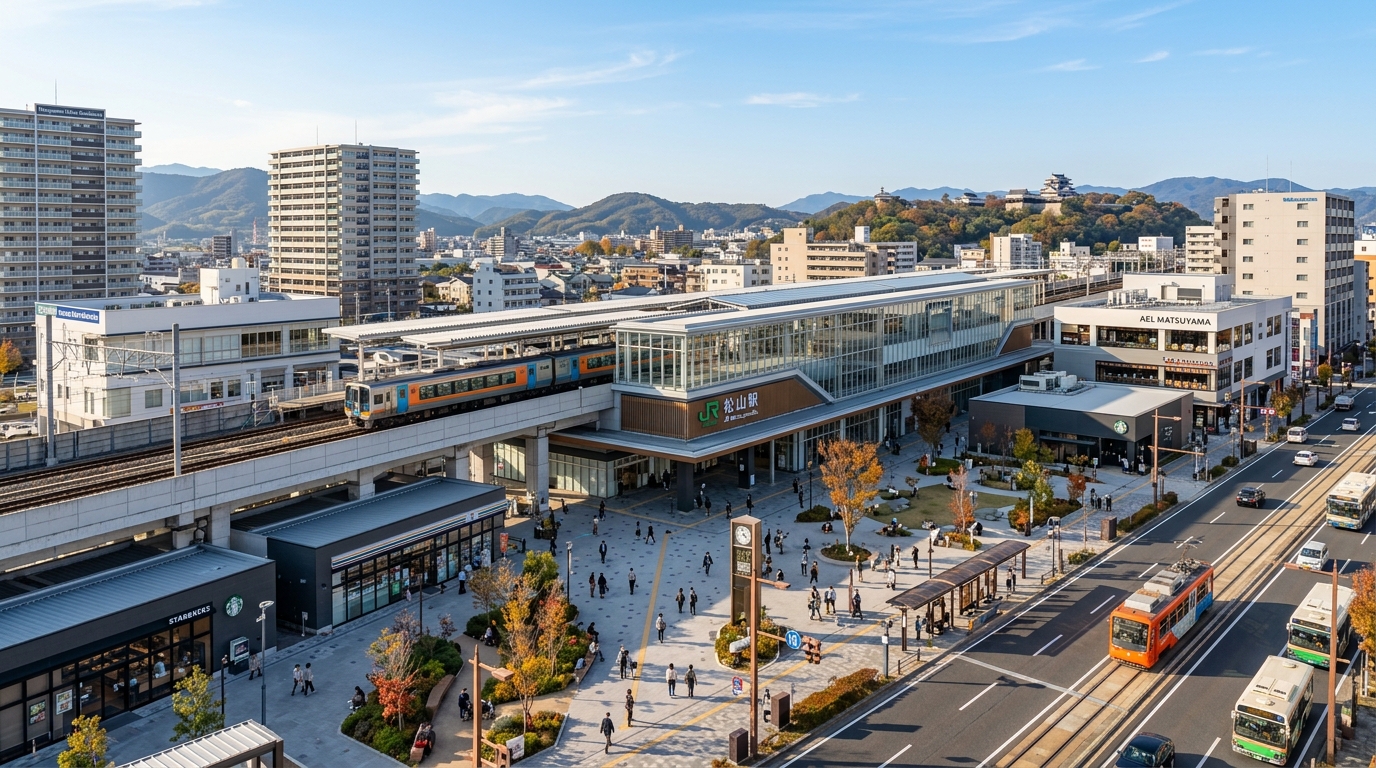
In recent years, urban redevelopment in regional cities across Japan has attracted significant attention. In particular, the area surrounding JR Matsuyama Station is in the midst of a historic overhaul often described as a "once-in-a-century" transformation. Starting with the elevated railway tracks completed in September 2024, the integration of the city's east and west sides—long divided by railway lines—and the rapid creation of new commercial and cultural exchange hubs are underway. The ripple effects are already beginning to reflect in the surrounding real estate market.
In this article, drawing on real data acquired by "Bukken Mekiki Research" (物件目利きリサーチ) and the latest local developments, we thoroughly examine land price trends in the redeveloping Matsuyama Station area, the daily living environment for families and single residents, and future prospects from home-buying and real estate investment perspectives.
1. Reevaluating the Real Estate Value of Regional Core Cities: Matsuyama City, Ehime Prefecture on "Investment Day"
As real estate prices continue to surge in major metropolitan areas like Greater Tokyo, investor and homebuyer interest is shifting toward regional core cities that offer relatively higher yields and maintain strong, independent economic spheres. Matsuyama City in Ehime Prefecture, the political, economic, and cultural heart of Shikoku, is an exceptionally attractive city. It blends rich tourism assets like Dogo Onsen (道後温泉) and Matsuyama Castle (松山城) with the convenience and functionality of a compact city.
In recent years, driven by the spread of remote work and diversifying lifestyles, Matsuyama has drawn keen interest from buyers seeking primary homes (both families and single residents) relocating from major metropolitan hubs. Offering a balanced lifestyle where rich natural surroundings coexist with well-developed urban amenities, it stands out as an ideal choice for those prioritizing quality of life (QOL).
When assessing property asset value, infrastructure upgrades and large-scale urban redevelopment serve as the most reliable signals of land price growth. The ongoing initiatives around JR Matsuyama Station satisfy both criteria on a major scale, making its medium- to long-term investment potential remarkably high.
Note: By signing up for a free membership on our site, you can pull the official transaction data from the Ministry of Land, Infrastructure, Transport and Tourism (MLIT) used in this blog directly into your own Claude or ChatGPT environment via Model Context Protocol (MCP) integration. This seamless AI-driven research capability is a major advantage for gathering local market insights.
2. Redefining East and West Urban Planning through the Elevated Railway Project Around JR Matsuyama Station
The primary catalyst driving real estate value around Matsuyama Station is the long-term "JR Matsuyama Station Area Continuous Grade Separation Project." In September 2024, the station and a 2.4 km stretch of rail achieved long-awaited elevation, accompanied by the grand opening of the new third-generation station building, beautifully adorned with local timber and Tobe ware (砥部焼) ceramics.
This track elevation completely eliminated eight level crossings around the station. Removing these physical barriers—which had long caused chronic traffic congestion and hindered seamless urban growth—is of monumental significance. Furthermore, in August 2026, a portion of the new eastern frontage road (including the Takehara Kita section / 竹原北工区) built on former ground-level rail land opened to traffic, making travel between the east and west sides dramatically smoother. The west side, historically viewed as the "back of the station," is now seamlessly connected to the central commercial district on the east, unlocking fresh commercial potential and residential value.
According to urban planning data acquired by our firm, the target district surrounding Matsuyama Station (around latitude 33.8361, longitude 132.7522) is designated as a "Commercial Zone" (商業地域), with a building coverage ratio of 80% and a floor area ratio of 400%. These generous parameters allow for high-density development—including mid-to-high-rise condominiums, office buildings, and commercial complexes—laying a strong urban planning foundation to propel future private development.
3. Station-Front Redevelopment: Evolving Convenience, Child-Rearing, and Living Environments
The elevated railway is merely the opening chapter. The "Matsuyama Station Area Urban Development Plan," released by Matsuyama City on March 13, 2026, sets forth an ambitious grand design to transform the station from a simple transportation node into a premier exchange hub for the entire Shikoku region.
A flagship component of the plan is a proposed multi-purpose arena seating approximately 5,000 on the station's west side (the former railyard site), targeting operation startup in fiscal year 2031. Hosting professional sports fixtures and major concerts, it is poised to become a regional destination drawing visitors from across Shikoku. On the east side, plans are underway to extend the Iyotetsu (伊予鉄道) streetcar line directly into the station plaza. This will allow passengers transferring from JR lines to reach streetcars without exposure to rain, providing seamless access to Dogo Onsen and the central city. Additionally, an integrated highway bus and taxi terminal ("Busta") is planned, utilizing multi-level road airspace rights to construct a mixed-use skyscraper featuring retail, hotels, offices, and residential units above it (targeting completion in fiscal year 2033).
Everyday convenience has already improved dramatically. Coinciding with the new station building launch in September 2024, the "JR Matsuyama Station Dandan Dori" (JR松山駅だんだん通り) shopping complex opened inside, providing residents with upgraded retail and dining options. Environmental and city data reveal that daily passenger volume at JR Matsuyama Station (Shikoku Railway Company / JR Shikoku) stands at 14,476. The immediate area hosts 22 medical facilities, including Matsuyama City Hospital (松山市民病院), offering peace of mind. For education, the district falls within established public school catchments such as Misake Elementary School (味酒小学校) and Katsuyama Junior High School (勝山中学校), making it well-suited for families.
Matsuyama City also actively encourages residential relocation and child-rearing through generous local housing incentives. Examples include the "Home Renovation Support Project" (わが家のリフォーム応援事業) and the "Matsuyama City Zero Carbon Promotion Subsidy" (松山市ゼロカーボン推進補助金) for Net Zero Energy Houses (ZEH). Combined with national family welfare initiatives—such as the October 2024 removal of income limits for child allowances and their extension through high school age—the financial backing for families purchasing homes in this city is exceptionally solid.
4. Land Price Trends in the Matsuyama Station Area and Future Outlook Based on Latest Data
Let us objectively analyze the real estate market in the Matsuyama Station area using transaction data. According to our compiled transaction statistics from 2021 through 2025 (sample size: 6,940 records), the average transaction price in Matsuyama City was approximately 24.5 million JPY, with a median of 16.0 million JPY and an average unit price of roughly 80,000 JPY/㎡. The gap between average and median figures reflects a market structure where high-end new builds and prime-location properties pull up overall mean values.
The chart below shows quarterly trends in median price per square meter by property category, calculated from the Ministry of Land, Infrastructure, Transport and Tourism (MLIT) Real Estate Information Library.
Focusing on the recent Q1 2026 (2026Q1) data, clear divergences across property sectors become visible:
- Pre-owned Condominiums ("中古マンション等"): The median price per square meter registered at approximately 246,000 JPY/㎡, remaining unchanged (0% YoY). Supported by improved transit convenience from ongoing redevelopment, demand remains firm among buyers prioritizing proximity to the station.
- Residential Land ("宅地(土地)"): The median price per square meter stood at approximately 78,000 JPY/㎡ (-4.9% YoY).
- Residential Land with Structures ("宅地(土地と建物)"): The median price per square meter was around 104,000 JPY/㎡ (-22.2% YoY).
Single-family homes and vacant land are undergoing a minor price adjustment, influenced by broader macroeconomic conditions such as high construction material costs. For prospective buyers, this market environment offers favorable room for price negotiation.
Looking at popular districts by transaction volume, "Honmachi" (本町) leads condo demand, while "Nishi-Habu-machi" (西垣生町) and "Minami-Sain-machi" (南斎院町) capture strong single-family home demand. Districts like "Minami-Yoshida-machi" (南吉田町) and "Kita-Sain-machi" (北斎院町) host active land trades. This highlights clear market segmentation between central urban zones with high density and car-oriented suburban neighborhoods.
5. Home Buying Perspectives for Families and Single Residents
When purchasing a primary residence, matching the property category and zoning district to your lifestyle is essential. Below are selected transaction samples from Q1 2021:
| District | Category | Use | Structure / Year Built | Area | Transaction Price | Zoning District |
|---|---|---|---|---|---|---|
| Ishite-Shiraishi | Residential Land (Land & Structure) | Residential | Wooden / 2020 | 120 ㎡ | Approx. 27M JPY | Category I Exclusively Low-Rise Residential Zone |
| Imazaike | Residential Land (Land & Structure) | Residential | Wooden / Unknown | 140 ㎡ | Approx. 27M JPY | Category I Exclusively Low-Rise Residential Zone |
| Ishite-Shiraishi | Residential Land (Land) | - | - | 190 ㎡ | Approx. 11M JPY | Category I Exclusively Low-Rise Residential Zone |
| Imazaike | Residential Land (Land) | - | - | 160 ㎡ | Approx. 13M JPY | Category I Exclusively Low-Rise Residential Zone |
The examples in "Ishite-Shiraishi" (石手白石) and "Imazaike" (今在家) belong to "Category I Exclusively Low-Rise Residential Zones" (第1種低層住居専用地域). Under strict restrictions (50% building coverage and 80% floor area ratio), high-rise buildings and large commercial developments are prohibited, preserving quiet, sunlit living environments. Purchasing a spacious 120–140 ㎡ detached wooden house for around 27 million JPY is an attractive proposition for growing families. Combining this with local government grants (renovation aid or ZEH subsidies) makes homeownership even more affordable.
Conversely, for single professionals or DINKs (Dual Income, No Kids), purchasing a condominium in "Commercial Zones" (商業地域) or "Exclusively Medium-to-High-Rise Residential Zones" (中高層住居専用地域) near Matsuyama Station offers direct access to redevelopment benefits. Considering future rental flexibility or resale liquidity, properties in high-density station precincts maintain resilient asset value.
6. Rental Demand and Long-Term Asset Value in the Matsuyama Metropolitan Area from an Income Property Viewpoint
From a real estate investment perspective, rental demand surrounding the redevelopment precinct looks promising. Below is an example of an income-generating residential building transaction:
In Iwasaki-cho (岩崎町), a residential land and building asset designated for multi-family use ("共同住宅") traded at approximately 29 million JPY. Built in 1985 with reinforced concrete (RC) construction on a 165 ㎡ site, it is located in a "Category I Exclusively Medium-to-High-Rise Residential Zone" (第1種中高層住居専用地域) with a 60% coverage ratio and a 200% floor area ratio.
As construction progresses on the multi-purpose arena and the Busta transit center on the west side of Matsuyama Station, new economic activity will generate steady employment—not only during construction but also among venue operators, event staff, and retail personnel upon completion. This inflow of working populations will provide strong long-term support for single and family rental demand in nearby neighborhoods.
In addition, connecting the streetcar line directly into the station plaza significantly improves connectivity to tourist destinations like Dogo Onsen, opening up opportunities in short- to medium-term stay markets such as vacation rentals (minpaku) and monthly corporate apartments. From a long-term asset perspective, the Matsuyama Station area warrants close attention for both steady income yields and capital appreciation potential.
7. Neighboring Area Comparisons and Living Environment Checks for Regret-Free Property Selection
When buying property, assessing natural disaster and hazard risks is just as vital as evaluating land prices or commuting convenience. As extreme weather events become more frequent across Japan, selecting a safe location is a crucial step in asset defense.
According to official hazard data from the Geospatial Information Authority of Japan (GSI), the surveyed Matsuyama Station area shows "No Risk" for landslide hazards. However, flood risk requires careful attention. Portions of the target area are flagged for potential flooding, including localized zones with maximum inundation depth projections reaching Rank 4 (5 to 10 meters).
This should not be viewed as an immediate dealbreaker, but it underlines the importance of reviewing hazard maps prior to purchase. Risk mitigation strategies—such as selecting upper floors in a condominium, elevating home foundations, or utilizing flood-resistant architectural designs—allow homeowners to live comfortably with complete peace of mind.
8. Summary: Finding Your Ideal Home and Investment Opportunities in Post-Elevation Matsuyama Station Area
Timed with "Investment Day" on October 10, we have examined the redevelopment, land price trends, and residential environment surrounding JR Matsuyama Station.
The station building's first complete renewal in 71 years, the unification of eastern and western districts through elevated tracks, and the "Matsuyama Station Area Urban Development Plan"—which anticipates a new arena and bus terminal—are powerful drivers boosting local convenience and asset value. Families can enjoy generous local child-rearing incentives and spacious single-family housing, while single residents and investors can leverage the growth potential of redevelopment-adjacent condos and income properties.
Finding your ideal home or investment asset requires objective, data-driven area analysis. By registering as a free member of "Bukken Mekiki Research" (物件目利きリサーチ), you can review price trends, detailed hazard evaluations, and neighborhood metrics for areas across Japan at any time.
Furthermore, free registration unlocks Model Context Protocol (MCP) integration, enabling you to query MLIT real estate transaction data directly within your own Claude or ChatGPT assistant. It serves as a powerful, personalized tool to support your real estate research using the AI interface you prefer.
For users seeking deeper capabilities, upgrading to the Pro Plan offers unlimited search queries and unlocks our "AI Architectural Simulator." This tool generates 2D floor plans, 3D structural models, sunlight simulations, exterior visual renderings, and estimated total budget calculations for single-family homes in a one-stop workflow (Note: This simulation feature is exclusively designed for single-family homes and does not support yield simulation for multi-family apartment buildings).
If you are interested in the growth story of Matsuyama City, Ehime Prefecture, explore the latest market prices and hazard profiles today.