
With the arrival of "Investment Day" (投資の日) on October 4, 2026, many individuals are taking the opportunity to reassess their asset portfolios and future residential bases. In recent real estate trends, while land prices in major metropolitan areas like Tokyo and Osaka continue to surge, an increasing amount of attention is shifting toward "regional core cities." Investors and homebuyers seeking solid yields and accessible price points are actively looking beyond overheated primary markets.
Among these emerging hubs, Shimonoseki City in Yamaguchi Prefecture (山口県下関市)—the western gateway to Japan's main island of Honshu—is standing at a historic turning point. Driven by twin growth engines—a massive redevelopment around its central train station and major waterfront improvements along the Kanmon Straits (関門海峡)—Shimonoseki has set out a clear growth scenario heading toward 2030.
In this article, based on the latest 2026 developments, we thoroughly examine the future potential and real estate asset value of the Shimonoseki Station area. Beyond investment market fundamentals, we also highlight practical insights into liveability, including generous housing subsidies and comprehensive child-rearing support for end-user homebuyers. Read on to discover actionable real estate strategies backed by objective market data and urban development trends.
1. The Appeal of Regional Core Cities on Investment Day and Shimonoseki's Current Standing
"Investment Day" serves as an ideal occasion to evaluate real estate values from a long-term perspective. In modern property investment and home selection, the paramount focus has shifted to sustainability—specifically, whether a property's value can be maintained or enhanced over time, rather than just its current price tag. From this perspective, regional core cities that attract concentrated infrastructure investment and clear redevelopment master plans offer compelling choices, even within a national context of population decline.
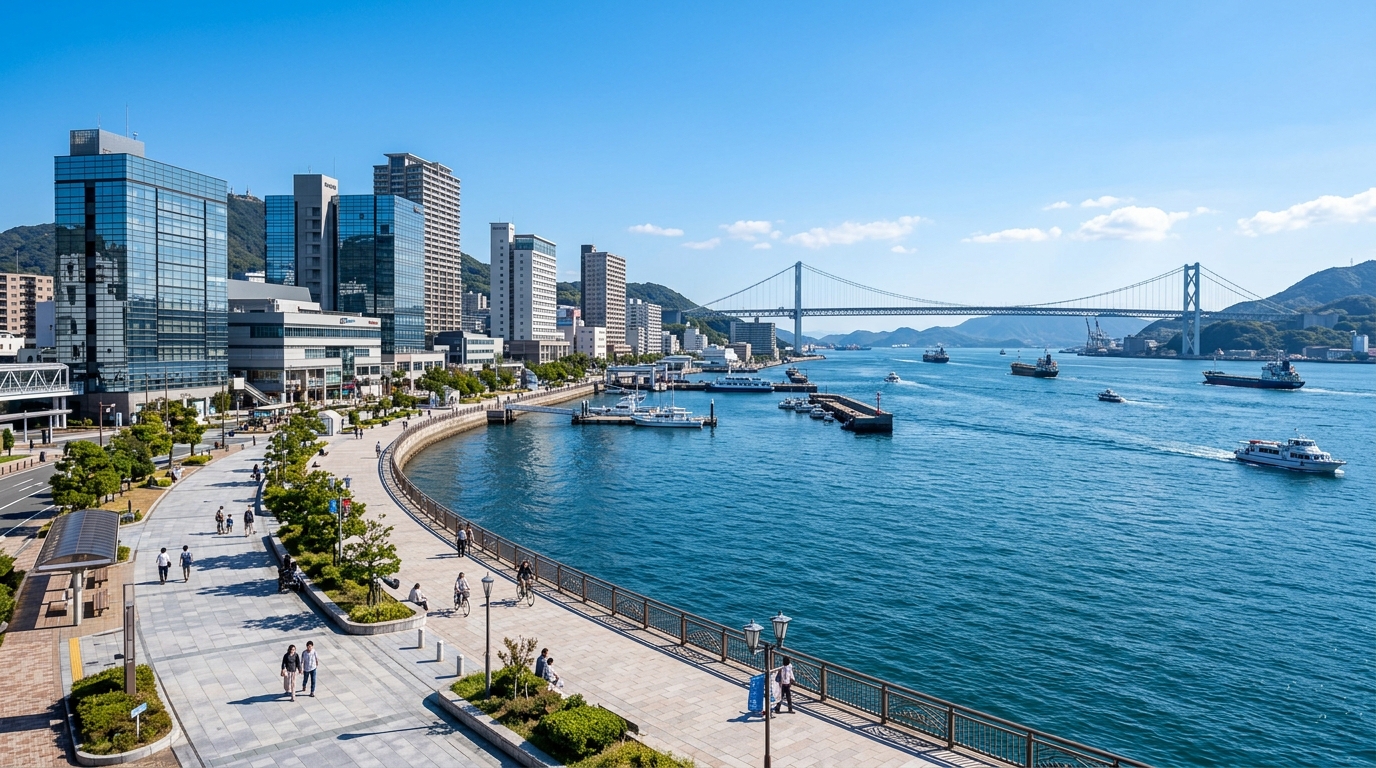
Shimonoseki City, Yamaguchi Prefecture, is a historic port city that has long thrived as a vital transportation, logistics, and fisheries hub. Despite enjoying a prime geographical advantage along the Kanmon Straits connecting Kyushu and Honshu, the city has faced challenges such as population outflow in recent years. Today, however, Shimonoseki is undergoing a fundamental urban update, aiming to transform itself into one of Japan's premier waterfront cities.
As a standard principle of real estate dynamics, large-scale urban infrastructure upgrades backed by public-private partnerships directly boost surrounding land values while creating fresh residential and commercial demand. In Shimonoseki, two major developments are proceeding simultaneously: the revitalization around Shimonoseki Station and the transformation of the coastal Arukaport and Karato area (あるかぽーと・唐戸エリア). Together, these initiatives are elevating the city's overall brand value from the ground up.
For investors, this represents a prime target with anticipated growth in tenant and rental demand. For families and single residents considering a home purchase, the area is evolving into an appealing location offering enhanced daily convenience and scenic surroundings. The Shimonoseki market has clearly entered a high-potential phase spanning both investment opportunities and end-user demand.
2. Enhanced Living Convenience Driven by Redevelopment around Shimonoseki Station
In regional core cities, redevelopment around central transit hubs is the single strongest factor driving real estate asset values. Around Shimonoseki Station, multiple major projects are currently underway to refresh the city's main entrance for a new era.
A symbolic milestone in this movement is the scheduled closure of the long-beloved Daimaru Shimonoseki Department Store (大丸下関店) at the end of August 2027, alongside plans for repurposing the site. To prepare for this large-scale transformation of land and building use, Shimonoseki City selected major think tank The Japan Research Institute, Limited (日本総合研究所 / JRI) in autumn 2026 to lead advisory studies for the site's re-utilization. Moving beyond a standalone retail role, expectations are high for the birth of a next-generation landmark integrating retail, commercial offices, residential spaces, and public functions.
In tandem with this site, broader redevelopment efforts across the entire Shimonoseki Station precinct are progressing. Upgrades to the station plaza and pedestrian walkways aim to improve mobility and barrier-free access, with modernized infrastructure incorporating smart-city approaches.
These functional updates around the station significantly elevate daily convenience for commuting, school runs, and shopping. For car-free singles and dual-income working families prioritizing work-life proximity, these environmental improvements can be the decisive factor when selecting a residence. From an investor's perspective, station-front redevelopment is a classic indicator supporting capital appreciation and steady rental demand, suggesting that the property market around Shimonoseki Station will see further vitality heading toward 2030.
3. Waterfront Development Elevating Coastal Scenery and Living Environments
Alongside station redevelopment, the secondary growth engine is waterfront revitalisation that maximizes the dynamic vistas of the Kanmon Straits. Under its "Arukaport and Karato Area Master Plan" (あるかぽーと・唐戸エリアマスタープラン), Shimonoseki City is aggressively boosting the area's appeal under the vision of "a modern Japanese port town where visitors and locals can enjoy the straits from morning to night."
The centerpiece of this plan was realized in December 2025 with the grand opening of RISONARE Shimonoseki by Hoshino Resorts (星野リゾート「リゾナーレ下関」). Designed as a "designer hotel on the straits," all guest rooms offer waterfront views overlooking the passage, featuring concept rooms showcasing local culture such as blowfish (fugu) cuisine and regional Japanese sake. The arrival of this top-tier resort hotel has dramatically increased local tourism value while contributing to the refinement and branding of the surrounding district.
Furthermore, in spring 2026, private operator Senyo Kogyo Co., Ltd. (泉陽興業) was selected as the preferred negotiator for redeveloping city-owned land adjacent to the hotel, previously home to the "Yes! Karatto Yokocho" (はい!からっと横丁) amusement park. Plans have been announced to retain the iconic giant Ferris wheel while introducing new sports and dining facilities, creating a relaxing recreation space seamlessly integrated with the waterfront greenway.
This waterfront development extends beyond tourism promotion; it directly enhances the quality of life (QOL) for local residents. An open environment where people can enjoy meals or walks overlooking the sea presents an attractive lifestyle proposition for prospective homeowners. At the same time, this resort-like setting serves as a strong catalyst for second-home demand among high-net-worth individuals and investment in premium coastal condominiums.
4. Land Price Trends and Recent Transaction Data in Key Areas of Shimonoseki
How are these physical and conceptual urban upgrades affecting the actual real estate market? Analyzing publicly available transaction data from the Ministry of Land, Infrastructure, Transport and Tourism (MLIT) and official land price publications reveals distinct trend shifts across key districts in Shimonoseki.
Even amidst general population decline trends common to regional Japanese cities, areas directly benefiting from redevelopment or concentrated public infrastructure spending show resilient land prices, with localized upward movements. The table below outlines major redevelopment factors and real estate market trends across Shimonoseki's primary districts:
| Area / District | Major Redevelopment / Infrastructure Drivers | Land Price Trends / Real Estate Market Trends (Estimated) | Housing Demand / Target Demographic |
|---|---|---|---|
| Around Shimonoseki Station | Utilization studies for the former Daimaru site; re-landscaping of station plaza and connecting walkways | Resilient across commercial and residential lands, showing localized upward trends due to redevelopment expectations | Single professionals, dual-income families, and seniors seeking proximity between work and home |
| Arukaport & Karato | Opening of RISONARE Shimonoseki; attraction of new sports and dining facilities | Enhanced branding and land value support driven by rising scenic value and tourism demand | High-net-worth individuals, second-home buyers, and tourism/service industry workers |
| General Residential Promotion Zones | Eligible for Shimonoseki City's generous housing purchase subsidies (up to 2.5 million yen, etc.) | Stable transaction volume and prices backed by policy-driven end-user demand | End-user home buyers and families with children |
In the Shimonoseki Station area, demand for condominium sites and prime commercial land remains solid in anticipation of future mixed-use developments and infrastructure renewals, maintaining transaction prices at a relatively high level. Around Arukaport, brand value improvements driven by Hoshino Resorts and new facility developments are beginning to add a price premium to surrounding land and buildings.
For investors, the key lies in accurately identifying the reach of these redevelopment ripple effects to balance capital gains and rental yields. For end-user buyers, purchasing a home in an area with stable land values acts as a strong safeguard against asset depreciation, ensuring the property remains easy to resell or lease should circumstances change.
5. Liveability and Housing Demand for End-User Families and Singles
In the long run, property values are sustained by the genuine end-user demand of the people who live in the community. In recent years, Shimonoseki City has introduced some of the nation's most generous support measures aimed at encouraging relocation, settlement, and child-rearing family retention, providing strong momentum for residential demand.
A standout initiative in housing support is the "Housing Acquisition Support Program" (住宅取得支援事業), targeted at inbound movers or residents relocating to designated Residential Promotion Zones (居住誘導区域) or the Shimonoseki Station district. Qualifying applicants can receive substantial grants of up to 2.5 million yen (or 2.0 million yen) toward house construction or purchase costs. Designed with the explicit goal of promoting compact-city population concentration around Shimonoseki Station, this policy significantly boosts liquidity for both new single-family homes and existing properties in the area.
Additionally, the city's child-rearing support initiatives under the "For Kids For Future" banner are noteworthy. As of 2026, Shimonoseki provides fully subsidized medical expense coverage for youth up to high school age, free school lunches at preschool facilities, and waived daycare fees for second and subsequent children in multi-child households. Comprehensive soft support is also available, including maternity support grants and subsidized "Baby Taxis" (子育てタクシー / Babi-Taku) tailored for hospital visits and shopping trips.
These measures offer families compelling reasons to choose Shimonoseki as their long-term living base. From an investor's perspective, neighborhoods backed by strong municipal policies that attract young families present low vacancy risks for family-oriented rentals, making them attractive targets for stable cash flow.
6. Disaster Prevention and Liveability Evaluation via Hazard Maps and Local Infrastructure
While Shimonoseki offers attractive coastal scenery and urban convenience, evaluating natural disaster risk remains an essential step when purchasing or investing in property. In coastal and low-lying areas, assessing hazard maps for storm surge risks during typhoons and potential tsunami impacts is critical.
Because Shimonoseki has historically developed as a port town, local disaster prevention infrastructure—such as coastal seawalls and floodgates—has been continuously maintained over many years. However, given the increasing severity of weather events in recent years, factors like elevation and ground stability are becoming even more critical criteria in property selection.
For buyers planning decades-long occupancy or long-term real estate investments, an effective strategy involves choosing slightly elevated inland areas—such as the historic residential neighborhoods in the Chofu district (長府地区), which retains its traditional castle-town atmosphere—while retaining easy access to coastal amenities. Quiet, elevated residential areas continue to enjoy strong popularity among safety-conscious families and high-net-worth buyers.
Similarly, for station-front or waterfront condominium investments, building-level resilience—such as locating electrical equipment on higher floors and securing emergency power supplies or storage facilities—now significantly impacts asset value. Enjoying seaside views as part of daily life while ensuring structural and location safety is the fundamental rule for smart real estate selection in Shimonoseki.
7. Area Selection Perspectives for Long-Term Asset Value Preservation and Growth
As of 2026, Shimonoseki City is successfully transforming from a historic port town into a modern, attractive waterfront city. Ongoing projects, including the redevelopment of the former Daimaru site and the expansion of tourism and commercial infrastructure toward 2030, will continue to supply energy to the local real estate market.
To preserve and grow asset value over the long term, property selection should not rely solely on low current prices or high gross yields. Instead, buyers should target areas where municipal master plans align closely with demographic trends. The redevelopment district surrounding Shimonoseki Station and designated Residential Promotion Zones eligible for generous municipal subsidies fit these exact criteria.
For those seeking objective and detailed data analysis during their search, registering for a free account on our site enables you to pull transaction data from the Ministry of Land, Infrastructure, Transport and Tourism (MLIT)—as referenced in this article—directly into your Claude or ChatGPT tools via Model Context Protocol (MCP) integration. This seamless connection allows you to continue deep-dive research using your own AI assistant.
Whether you are an investor looking for robust market analytical support or a prospective homebuyer searching for an ideal plot of land, leverage objective data to guide your real estate decisions.
8. Conclusion
In celebration of "Investment Day," this article evaluated the real estate market in Shimonoseki City, Yamaguchi Prefecture, a region energized by major station redevelopment and waterfront projects.
Key drivers include dramatic convenience upgrades stemming from the station-front redevelopment (including the former Daimaru Shimonoseki site) and enhanced coastal branding fueled by the opening of RISONARE Shimonoseki by Hoshino Resorts alongside new leisure facilities. Beyond physical updates, powerful municipal support—such as housing acquisition grants of up to 2.5 million yen and free medical care through high school—is attracting strong interest from end-user families.
Few regional core cities combine such a clear growth trajectory with comprehensive residential support measures. For real estate investors, Shimonoseki represents a promising market with stable demand; for prospective homeowners, it offers an appealing residential choice that maintains asset value over time. Nonetheless, careful attention to coastal hazards and micro-level land price variations remains essential. Verifying historical transaction trends and local risk maps before purchasing is strongly recommended.
Mekiki Research offers a free "Area Research" feature that allows you to inspect historical transaction prices, hazard map data, and local neighborhood conditions simply by entering an address or point on the map. Additionally, for those planning a single-family house, our "AI Architecture Simulator (Pro version)" can generate 2D floor plans, 3D models, sunlight simulations, and total budget estimates based on local land data and your personal preferences.
Start by exploring our free area research tools to discover the potential of Shimonoseki City for yourself.