
Today, October 4th, is "Investment Day" (Toshi no Hi / 投資の日) in Japan. When planning medium- to long-term asset formation, real estate markets in regional hub cities—which possess unique growth potential and attractive rental yields alongside major metropolitan areas—serve as crucial targets for real estate investors. In this article, we focus on Matsue City, Shimane Prefecture (島根県松江市), a renowned "City of Water" home to the national treasure Matsue Castle (松江城) and the scenic vistas of Lake Shinji (宍道湖).
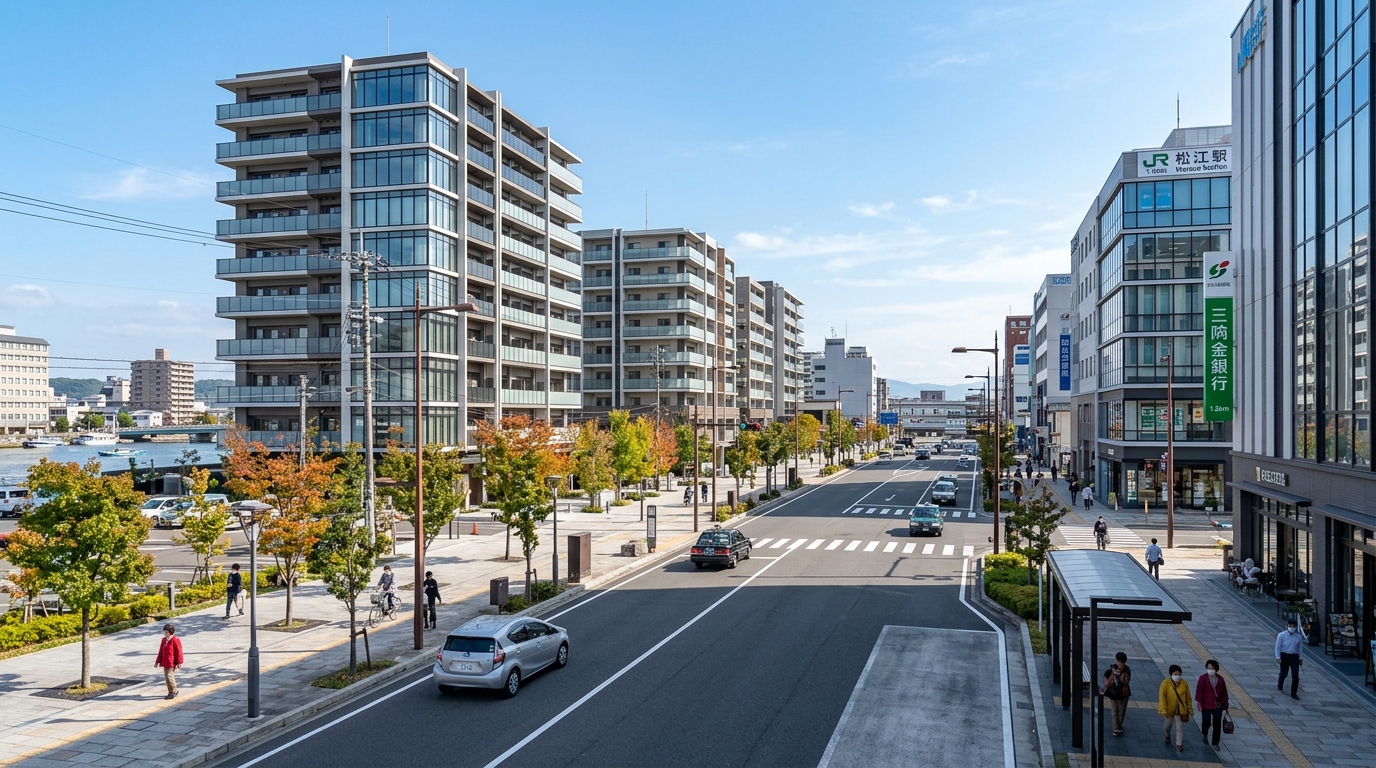
Currently, discussions around JR Matsue Station (JR松江駅) are accelerating regarding large-scale redevelopment targeting the 2028–2030 timeframe. Expectations are high for enhanced transit hub capabilities and a comprehensive revitalization of commercial infrastructure. Based on objective evidence—including actual transaction data and hazard map information from the Ministry of Land, Infrastructure, Transport and Tourism (MLIT / 国土交通省)—this article delivers an in-depth analysis of land price trends around Matsue Station, livability for families and single residents, and long-term investment potential.
3 Key Investment Takeaways in This Article
- Asset value appreciation potential unlocked by the redevelopment plans around Matsue Station targeting 2028–2030
- Area-by-area land price trends and residential market conditions decoded from actual transaction data in Matsue City (2021–2025)
- Robust child-rearing support/housing subsidy programs and essential hazard risk strategies for end-user buyers (families and single residents)
1. Potential of Matsue City, Shimane Prefecture: A Regional Hub City in the Spotlight on October 4th "Investment Day"
October 4th, "Investment Day" (Toshi no Hi / 投資の日), is an ideal opportunity to review your portfolio and map out your next investment strategy. In the Japanese real estate market, as property prices in major metropolitan areas like Tokyo continue to skyrocket, investors face shrinking yields and heightened acquisition hurdles. Consequently, institutional investors and high-net-worth individual investors are turning their attention to "regional hub cities" that anchor regional economies.
Matsue City, the prefectural capital of Shimane Prefecture (島根県), functions as the administrative, economic, and cultural hub of the San'in region (山陰地方). Featuring rich historical and natural assets such as Matsue Castle and Lake Shinji, it also thrives as an international cultural tourism city attracting visitors year-round. However, nationwide demographic shifts have not spared Matsue, creating a need for new catalysts to sustain long-term urban growth.
Against this backdrop, a major wave of transformation is sweeping through the area surrounding JR Matsue Station. Urban planning initiatives that restructure a city's core directly influence underlying real estate values. In the following section, we examine these specific redevelopment dynamics and future market projections.
2. JR Matsue Station Redevelopment Concept and Urban Planning Direction Targeting 2028 and 2030
| Timeline | Redevelopment Schedule & Urban Planning Dynamics Around Matsue Station | Projected Land Price Trends |
|---|---|---|
| 2024 | Jan: Ichibata Department Store, the long-standing centerpiece of the station area, closes; redevelopment momentum gathers pace | Flat to slight decline (Temporary adjustment phase due to concerns over reduced commercial functionality) |
| 2025 | Nov: Matsue Station Front Design Conference presents new station front design concepts, establishing project direction | Rebound & bottoming-out expectations (Rising investor sentiment driven by concrete redevelopment plans) |
| 2026 | Oct: Waves of new retail openings at Shamine Matsue, including "Gelato Pique"; modernization of existing assets continues | Gentle upward trend (Launch of detailed execution plans and renewed buyer demand) |
| 2028 | Completion of initial phase developments including multi-purpose complexes and a new bus terminal (Projected) | Expansion phase (Enhanced transit hub functions, improved residential and commercial convenience) |
| 2030 | Master plan for Matsue Station front redevelopment completed, revealing the city's new skyline (Projected) | Stable growth & spillover effect (Solidification of asset value driven by commercial and business concentration) |
A pivotal event in the recent history of the real estate market around Matsue Station was the closure of Ichibata Department Store (一畑百貨店) in January 2024. While the loss of this long-cherished landmark dealt a temporary shock to the local economy, it simultaneously provided a powerful impetus to re-imagine the station-front area from the ground up and modernize it into a next-generation urban center.
Matsue City and the Matsue Chamber of Commerce and Industry (松江商工会議所) established the "Matsue Station Front Design Conference" (松江駅前デザイン会議) to formulate a medium- to long-term vision for the district. In November 2025, two draft proposals for the "Matsue Station Front Design" were unveiled. Public-private partnership redevelopment projects are now materializing, including multi-purpose commercial and residential complexes on the former Ichibata site and adjacent Matsue Terrsa (松江テルサ) land, a reconfigured bus terminal, and enhanced pedestrian connectivity.
Moreover, updates to existing commercial infrastructure are progressing steadily ahead of the main redevelopment completion. For instance, at the end of October 2026, popular lifestyle brand "Gelato Pique" opened its first San'in location inside "Shamine Matsue" (シャミネ松江), the commercial facility directly connected to JR Matsue Station. Active leasing efforts targeting younger demographics and family shoppers are breathing new life into the area.
As these urban planning concepts take physical shape between 2028 and 2030, the Matsue Station district will be reborn as the vibrant focal point of everyday civic life. This structural concentration of urban amenities creates strong fundamentals to support surrounding land values and rental demand.
3. Land Price Trend Analysis in Matsue City: Price Trends in Station-Adjacent Areas and Residential Zones
Given the long-term outlook of these redevelopment initiatives, where do current property prices stand in Matsue City? We analyzed actual transaction data (sample size: 3,040 transactions) from 2021 to 2025, retrieved via MLIT APIs by the backend engine of "Mekiki Research" (物件目利きリサーチ).
The data reveals an average transaction price of approximately 16.38 million yen across all of Matsue City. However, the median price—which provides a clearer picture of typical transactions—stands at 9.8 million yen, highlighting a substantial gap from the mean. This variance stems from the wide spectrum of properties included in the dataset, ranging from small land parcels sold for as little as 100 yen to major commercial properties trading for up to 1.2 billion yen. The overall average unit price is roughly 43,000 yen/㎡, representing a balanced and accessible price point typical for regional cities.
Consider these notable transaction benchmarks:
- Oba-cho (大庭町): Residential land with building, 55 ㎡, Category I Residential Zone (building-to-land ratio 60% / floor area ratio 200%), traded at approximately 42 million yen.
- Okudani-cho (奥谷町): Residential land with building, 210 ㎡, Category I Mid/High-Rise Exclusive Residential Zone (building-to-land ratio 60% / floor area ratio 200%), traded at approximately 14 million yen.
- Kashima-cho Takayo (鹿島町武代): Residential land (land only), 135 ㎡, traded at 1.3 million yen (approx. 10,000 yen/㎡). Located outside designated urban planning areas, accounting for its highly discount valuation.
These examples illustrate that property prices within Matsue City fluctuate widely depending on location, zoning regulations, and existing structures. While land surrounding the station and city center holds firm values, suburban areas offer opportunities to acquire sizable lots at modest prices.
[Free Member Registration] Interested in evaluating transaction benchmarks for your target area? Register for a free account on Mekiki Research. By simply specifying an address or map point, you can access our "Area Survey Feature" to instantly analyze local price histories and neighborhood environment data at no cost.
4. Livability in Matsue City for End-Users (Transportation, Child-Rearing, and Living Environment)
In real estate investment, evaluating whether end-user buyers or tenants (families and working singles) actually want to live in the neighborhood is a vital sanity check.
Transit Convenience and Everyday Infrastructure The district immediately surrounding Matsue Station is designated as a Commercial Zone with high-density zoning parameters (80.0% building-to-land ratio, 400.0% floor area ratio). This regulatory framework actively encourages mid- to high-rise residential condominium and commercial building developments. JR West's "Matsue" Station averages 8,730 daily passenger boardings, serving as one of the primary transit nodes in the San'in region. Medical infrastructure is equally robust, with 18 medical facilities identified within the immediate search area around the station, including "Yamao Internal Medicine Clinic" (医療法人山尾内科医院) and "Yamaguchi Orthopedics Higashihonmachi Clinic" (山口整形東本町クリニック). Access to healthcare is a primary driver in residential site selection. (Note: Because elementary and middle school district data is currently unlisted [null] in this dataset, family buyers should verify school zones directly via municipal channels before entering contracts.)
Child-Rearing Support and Housing Subsidies Matsue City aggressively promotes residential relocation and family support programs. For instance, under the "Child-Rearing Household Settlement Housing Lot Acquisition Support Subsidy" (子育て世帯定住団地取得支援補助金), families building a residence in qualified developments receive 1 million yen when relocating within the city, or up to 1.5 million yen for UIJ-turn households moving from outside the prefecture. Furthermore, starting in FY2025, the "Child-Rearing Green Housing Support Project" (子育てグリーン住宅支援事業) offers up to 1.6 million yen in grants for energy-efficient home construction, creating an exceptionally supportive financial ecosystem for home buyers.
Essential Hazard Risk Assessment Because Matsue is a coastal "City of Water," flood risk preparation is imperative. According to compiled hazard data, the station area carries a "Flood Risk Present" designation, with a maximum anticipated inundation depth rated at Rank 3 (3.0 to 5.0 meters). Conversely, landslide risk is registered as "None." For end-users purchasing homes and investors developing or acquiring assets in this market, flood risk must be factored into property design. In multi-family developments, locating residential units on the 3rd floor or above (6+ meters elevation)—or installing elevated foundations for single-family homes—allows residents to mitigate disaster risks while enjoying urban conveniences.
5. Residential Needs and Surrounding Market Rates for Families vs. Singles
Housing demand in Matsue City splits clearly along household demographic lines.
Family Housing Needs Family buyers prioritize school environments, dedicated parking, and spacious layouts. As shown in recent market data, a pre-owned 70 ㎡ 3LDK condominium unit in Kasuga-cho (春日町) (Category II Mid/High-Rise Exclusive Residential Zone, 60% building-to-land ratio / 200% floor area ratio) traded for approximately 17 million yen. Amid rising new construction costs nationwide, well-maintained pre-owned condominiums in the mid-to-upper 10-million-yen range present an attractive value proposition for young families. For buyers seeking detached homes, quiet residential enclaves like Okudani-cho (land and building at approx. 14 million yen for 210 ㎡) or new suburban builds leveraging municipal homebuyer grants represent primary targets. Land transactions in Kasuga-cho (1.5 million yen for 75 ㎡; ~20,000 yen/㎡) and land/building packages around 13 million yen (165 ㎡) underscore a flexible market capable of accommodating varied household budgets.
Single Household Needs For young professionals and single workers, short commute times and proximity to lifestyle amenities are paramount. The commercial zone surrounding Matsue Station directly absorbs this rental demand. In live-work-play areas within walking distance of station retail, cafes, and dining options, single-family studio (1K/1R) units enjoy consistent baseline occupancy.
6. Real Estate Prospects and Rental Demand in Matsue City from an Investor Perspective
Looking backward from a 2030 strategic horizon, the current market surrounding Matsue Station offers an attractive entry window for real estate investors. The temporary contraction in commercial activity following the closure of Ichibata Department Store triggered a price adjustment phase. However, from a value-investing standpoint, this environment allows buyers to acquire prime real estate at discounted cost bases. As multi-purpose facilities and modern transit hubs open from 2028 onward under the new station design framework, urban convenience and neighborhood appeal will expand significantly.
The primary attraction of investing in regional hub cities lies in "stable cash flow (rental income)." Because acquisition prices are low compared to major metropolitan centers like Tokyo, gross yields are structurally higher. Matsue City combines prefectural government functions, corporate regional offices, and a robust tourism economy, generating consistent rental demand from stable tenant profiles such as civil servants and corporate employees. As redevelopment upgrades city infrastructure, maintaining rental rates and capturing long-term capital gains become highly achievable goals.
7. Smart Property Selection: Steps to Conduct Area Surveys and Understand Market Rates in Matsue City
The golden rule for avoiding costly mistakes in real estate investment or home purchases is conducting rigorous area research backed by objective data. However, manually compiling and analyzing transaction records, hazard maps, and municipal zoning regulations from government portals can be an arduous process.
This is where the free membership features of "Mekiki Research" provide immediate value. By registering for a free account, you can perform thorough area surveys using the following tools:
- Track Surrounding Transaction Prices & Unit Rates: Graphically visualize historical transaction prices and price-per-square-meter trends across specific neighborhoods.
- One-Stop Hazard & Infrastructure Check: Instantly evaluate flood and landslide risks, land zoning regulations, building ratios, distance to transit, and nearby medical facilities.
- Save Search History & Targeted Areas: Bookmarks facilitate effortless comparison across multiple candidate locations.
- Access AI Area Report Summaries: Review automated analytical summaries highlighting key neighborhood demographics and economic drivers.
For users planning real estate developments or single-family construction projects, our Pro Plan unlocks the "AI Construction Simulator." This tool automatically generates 2D floor plans, 3D building models, sunlight exposure simulations, exterior renderings, and total estimated construction budgets for single-family homes. (Note: This simulation feature is optimized exclusively for single-family residential homes and does not support cash-flow modeling, yield calculations, or multi-family apartment/condo developments.) We encourage you to start by exploring your target location using our free Area Survey tool.
8. Conclusion: Asset Building and Housing Selection Capitalizing on Matsue Station Redevelopment
On this "Investment Day," we evaluated the real estate market dynamics and growth drivers in Matsue City, Shimane Prefecture. Following the historic turning point marked by the closure of Ichibata Department Store, the area surrounding Matsue Station is embarking on a comprehensive urban modernization journey toward 2030. Moderate entry prices validated by transaction data, strong municipal family grants, and impending asset value growth driven by redevelopment present a compelling narrative for investors and end-users alike.
At the same time, localized risk factors—such as flood inundation zones and micro-market price variations (discrepancies between average and median figures)—require disciplined evaluation. Making data-backed decisions rather than relying on market sentiment remains the ultimate key to investment success.
By registering as a free member, you can query official Ministry of Land, Infrastructure, Transport and Tourism data referenced in this article directly through your own Claude or ChatGPT via MCP integration. This seamless AI connection eliminates manual data gathering and allows you to conduct conversational market analysis. Take advantage of these powerful research tools to guide your next real estate decision.