
Today, October 2, is "Land Day" (土地の日, Tochi no Hi) in Japan. In the real estate market, the value of land extends far beyond its current appraised price—it fluctuates significantly based on future infrastructure development and industrial expansion. In 2026, Ishikari City, Hokkaido (北海道石狩市, Hokkaido Ishikari-shi) is drawing nationwide attention as a growing cluster for data centers (DC) powered by renewable energy. Located adjacent to Sapporo City (札幌市), this municipality—blessed with a rich natural environment and expansive land—is rapidly evolving into a key hub supporting next-generation digital infrastructure.
In this article, we analyze real transaction data from Ishikari City and neighboring Kita Ward, Sapporo (札幌市北区) to examine how employment expansion driven by data center recruitment is impacting land prices and housing demand. We also explore the area's livability for families and projected housing asset values looking toward 2028 through 2030. Whether you are an end-user looking to purchase a primary home or a real estate investor evaluating long-term growth potential, this article offers valuable insights from multiple perspectives.
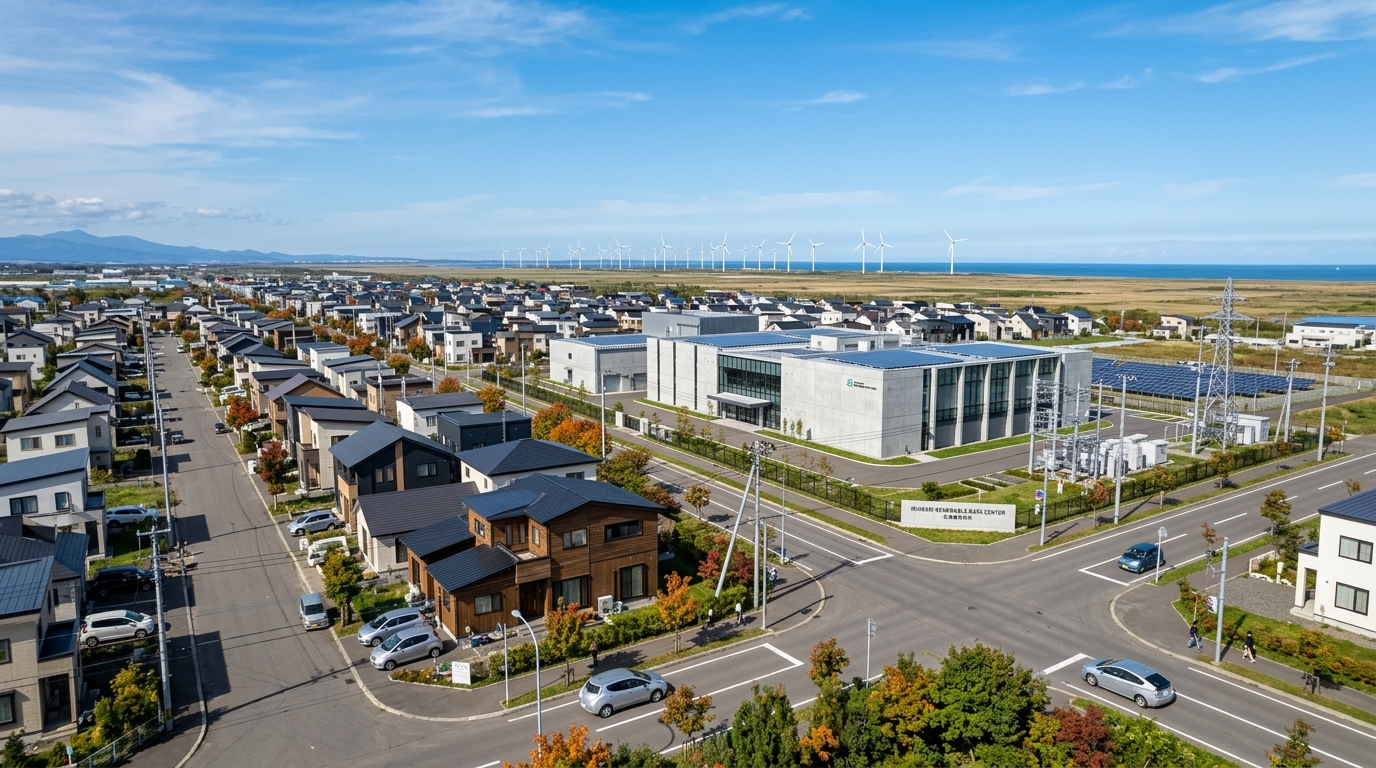
3 Key Takeaways for Homebuyers and Investors
- Job Expansion & Rising Housing Demand via Renewable Energy Data Centers: Insights from 2026 trends on industrial growth in the Ishikari area and future catalysts for rising land values.
- Understanding Market Trends through Real Data: Real-world price levels for single-family homes and condominiums based on 2021–2025 transaction data (average transaction price: approx. ¥26.84 million).
- Balancing Livability and Disaster Risk: Smart home selection utilizing child-rearing support programs and subsidies, alongside essential preparations for flood risks (up to 3–5 meters).
1. Spotlighting October 2 "Land Day"! Ishikari City, Hokkaido: Today's Renewable Energy Data Center Hub
In real estate investment and home buying, industrial clustering is a vital metric for gauging an area's future potential. Hokkaido's Ishikari City is currently attracting intense focus from the national government and major corporations as a data center hub that leverages rich renewable energy potential and a cool climate. As generative AI expands, creating massive demand for power and cooling infrastructure, Ishikari's environment offers an ideal setting.
Working backward from 2030 forecasts, present-day Ishikari is in a crucial "run-up period" for growth. The table below summarizes major redevelopment projects, industrial infrastructure trends, and projected land price movements in the Ishikari area.
| Period | Major Redevelopment & Industrial Trends | Projected Impact on Land & Housing Market |
|---|---|---|
| 2026 | Completion and operational start of "Ishikari Renewable Energy Data Center No. 1"<br>Establishment of "Ishikari DCC" to strengthen inter-business collaboration | Influx of DC-related companies and engineers begins. Localized rise in rental demand and an increase in prospective home buyers across a broader area, including Sapporo's Kita Ward. |
| 2028 | Completion of domestic logistics infrastructure restructuring (full operation of Nitori Ishikari DC, etc.)<br>Expansion of surrounding infrastructure and commercial facilities | Retention of logistics and IT employment. Permanent settlement of family households, providing solid support for single-family residential land demand. Gradual increase in land prices. |
| 2030 | Establishment of a 100% Renewable Energy Supply Zone (RE Zone)<br>Recognition as Japan's third major DC hub after Kanto and Kansai | Increased tax revenue from industrial clustering reinvested into municipal services. Elevated brand value as a Sapporo commuter belt due to improved living environments. Stabilization of asset values. |
The key takeaway for investors today is clear: secure prime land and properties now, before industrial clustering is fully reflected in land prices. For families, this represents an exceptional opportunity to enjoy a spacious child-rearing environment while benefiting from the city's future growth.
2. Latest Trends in Renewable Energy DC Projects and Local Job Creation in Ishikari City
The primary driving force behind Ishikari City is the rapid development of its data center sector. In March 2026, the "Ishikari Renewable Energy Data Center No. 1" (石狩再エネデータセンター第1号), developed by Tokyu Land Corporation and partners, was completed and began phased operations in the summer. Powered 100% by renewable energy, this facility serves as a national model for eco-friendly, next-generation infrastructure.
Furthermore, on July 28, 2026, leading local enterprises and infrastructure providers—including SAKURA Internet, Kyocera Communication Systems, and NTT East—collaborated to establish the Ishikari Data Center Consortium (Ishikari DCC / 石狩データセンターコンソーシアム). Aiming to jointly strengthen infrastructure, cultivate talent, and boost local employment, this consortium acts as a powerful catalyst positioning Ishikari as one of Japan's top data center hubs alongside Kanto and Kansai.
Beyond IT, Ishikari also serves as a vital logistics hub. The massive Ishikari Distribution Center (Ishikari DC), completed by Nitori Holdings in 2022, serves as a core pillar in the restructuring of Japan's domestic logistics network through 2025.
The launch of these large-scale data centers and logistics hubs creates ongoing, diverse employment opportunities for engineers, maintenance managers, logistics staff, and more. Job creation translates directly into increased demand for both rental and owner-occupied housing, signaling strong positive momentum for the local real estate market.
3. Appeal as a Sapporo Commuter Belt: Livability and Child-Rearing Environment in Ishikari City
While developing a strong industrial identity, Ishikari City has long served as a popular bedroom community for Sapporo. Located just a 30-minute drive from central Sapporo, it offers a highly attractive living environment for families, combining spacious public parks and rich nature within easy reach.
The city also emphasizes educational resources. Recent regional data highlights nearby schools such as Orebuto Elementary School (生振小学校, Orebuto Shogakko) and Ishikari Middle School (石狩中学校, Ishikari Chugakko), offering a quiet, balanced environment for raising children. Furthermore, Ishikari City offers generous housing subsidies and family support programs.
For example, the "Ishikari Marriage and New Life Support Project" (石狩市結婚新生活支援事業) provides newlyweds with up to ¥600,000 to offset housing and relocation expenses. Additionally, the city operates the "FY2026 Ishikari Housing Renovation Subsidy (Ishikari Home Support Project)" (令和8年度 石狩市住宅リフォーム補助金 [石狩市住まいの応援事業]), assisting homeowners with maintenance and upgrades, reflecting strong municipal backing for long-term, comfortable living.
In terms of climate, Ishikari experiences relatively mild conditions compared to other parts of Hokkaido, with smaller temperature swings. Well-established winter snow removal and clearing operations provide peace of mind to newcomers moving from outside Hokkaido as well as first-time homebuyers.
4. Land Price Trends and Residential Market Data in Key Ishikari Areas
Let's examine objective real estate market data for Ishikari City and neighboring Kita Ward, Sapporo (within commuting distance of Ishikari Bay New Port / 石狩湾新港, Ishikari-wan Shinko). Aggregating official Ministry of Land, Infrastructure, Transport and Tourism (MLIT / 国土交通省) data from 2021 to 2025 via our Mekiki Research (物件目利きリサーチ) system reveals the following trends:
During this period, transaction volume reached 5,627 cases, demonstrating a highly active market. The overall area average transaction price stood at approximately ¥26.84 million, with a median of ¥20.00 million—creating a realistic, accessible price range for first-time family buyers. The average land unit price is roughly ¥80,000/sqm, offering significant value compared to central Sapporo and making it easier to secure spacious lots.
The chart below shows sample real transaction price trends in the area:
Examining specific transaction samples in a table format clarifies market expectations for both condominiums and single-family houses:
| Location (District) | Property Type | Transaction Price | Size / Layout | Year Built / Structure |
|---|---|---|---|---|
| Ainosato 2-jo (あいの里2条) | Pre-owned Condominium | Approx. ¥14 million | 90 sqm / 3LDK | 1992 / RC |
| Kita 34-jo Nishi (北34条西) | Pre-owned Condominium | Approx. ¥5.3 million | 40 sqm / 1LDK | 1990 / – |
| Kita 35-jo Nishi (北35条西) | Pre-owned Condominium | Approx. ¥16 million | 80 sqm / 3LDK | 1996 / RC |
| Kita 35-jo Nishi (北35条西) | Pre-owned Condominium | Approx. ¥23 million | 75 sqm / 3LDK | 1995 / RC |
| Shinkawa 4-jo (新川4条) | Residential Land (Land & Building) | Approx. ¥27 million | 135 sqm / 4LDK | 2020 / Wood |
For pre-owned condominiums around 30 years old, family-sized units (80–90 sqm) are often available in the ¥10 million to lower ¥20 million range. Meanwhile, newer single-family homes—such as the 2020 property in Shinkawa 4-jo (135 sqm) sold for around ¥27 million—are particularly noteworthy. For workers at data centers seeking stable incomes, securing a spacious single-family house with parking for under ¥30 million serves as a compelling incentive to relocate and settle permanently.
Note that in this dataset, information regarding nearest stations and passenger volume shows as "null," and healthcare facility counts are recorded as "0." This reflects the car-centric nature of the region, where daily life relies heavily on automobiles rather than railway transit, as well as sparse public data coverage for large medical facilities within specific grid mesh units. In daily life, residents rely on personal vehicles to access nearby commercial facilities and clinics, making it essential for prospective buyers to test-drive local driving routes during their house hunt.
5. Evolving Rental and Single-Family Housing Demand from Inflowing DC Workers and Families
The expansion of renewable energy DC operations in Ishikari is driving rental demand from relocating engineers and young employees, while also bolstering long-term demand for single-family homes among families moving into the region.
Market data shows that much of the surrounding area is designated as Category I Exclusively Low-Rise Residential Zones (第1種低層住居専用地域, Dai-isshu Teiso Jukyo Sen'yo Chiiki), subject to strict zoning limits like a 40% building coverage ratio and an 80% floor area ratio. While these restrictions prevent high-rise developments or high-density housing, they preserve quiet, sunlit, and well-ventilated residential neighborhoods with generous spacing between properties. For families seeking a relaxed environment away from urban density, this zoning classification is a major advantage.
For prospective homebuyers, understanding what kind of home can be built within these zoning parameters is essential. With the Pro Plan of Mekiki Research, you can use our AI Architectural Simulator to generate 2D floor plans, 3D models, sunlight simulations, and rough budget estimates based on real area data. Furthermore, free members can directly query the Ministry of Land, Infrastructure, Transport and Tourism data used in this blog straight from Claude or ChatGPT via MCP integration. Why not start by exploring your target area for free to take your first data-driven step toward building your home?
6. Land Selection Tips for Buying or Building a Home in Ishikari City
As mentioned above, strict building restrictions (40% coverage / 80% floor area ratio) protect the spacious living environment in Ishikari City and parts of neighboring Kita Ward, Sapporo. However, this also means you will need a substantial lot size to build a home with your desired floor space.
For example, to build a standard 100 sqm (approx. 30 tsubo) two-story family home on a lot with an 80% floor area ratio, you need a minimum land area of 125 sqm (approx. 38 tsubo). In car-dependent Ishikari, families often own two vehicles and must reserve space for winter snow storage. Consequently, securing a lot size of at least 135 sqm (approx. 40 tsubo)—similar to the Shinkawa 4-jo sample data—serves as a solid benchmark for successful land selection.
As data center jobs become well-established toward 2030 and the city's brand value continues to grow, well-positioned residential land of this caliber is likely to hold its asset value well, offering advantages for future resales or downsizing.
7. Future Asset Value Outlook: Balancing Disaster Risk and Living Convenience
When evaluating real estate asset value, assessing disaster risks is imperative. Extreme weather events and floods have intensified nationwide, making land safety a key factor influencing real estate value.
Hazard risk analysis based on current property data indicates no landslide risk in the target area, but identifies flood risk with projected inundation depths of up to 3–5 meters (Rank 3). This risk is characteristic of areas situated near major rivers like the Ishikari River (石狩川, Ishikari-gawa).
Before purchasing a home, it is essential to verify local hazard maps and implement appropriate precautions. Recommended steps include elevating building foundations, placing primary living quarters and key electrical systems (such as circuit breaker panels) on the second floor or higher, and simulating evacuation routes and shelter locations in advance.
One reason data centers cluster around the Ishikari Bay New Port area is the region's strong bedrock and relatively low risk of earthquakes and tsunamis. However, savvy buyers and real estate investors must recognize localized flood risks in residential zones and carefully balance them against living convenience and future growth potential.
8. Summary: Navigating Smart Home Buying and Asset Valuation in Growing Ishikari City
In honor of "Land Day" on October 2, we have explored the real estate market in and around Ishikari City, Hokkaido—a region gaining momentum as a renewable energy data center hub. As of 2026, infrastructure development and job growth are steadily progressing. Looking toward 2028 and 2030, Ishikari's established status as a Sapporo commuter belt is being enhanced by its emerging identity as a next-generation industrial city.
As real transaction data demonstrates, the current market—offering spacious single-family homes in the ¥20 million range—presents a highly appealing opportunity for families. However, factors such as securing sufficient land size under building coverage limits and preparing for potential flood depths of up to 3–5 meters require careful review prior to purchase.
Whether investing in real estate or purchasing a personal home, success relies on calm, data-backed decisions. By signing up for a free membership, you can access the MLIT dataset used in this article directly through Claude or ChatGPT via MCP integration. Equip yourself with AI-driven tools to research your target locations and make confident, regret-free real estate decisions.
Check the latest land prices and hazard information for Ishikari City, Hokkaido on Mekiki Research 👉