
October 2 marks "Land Day" (Tochi no Hi) in Japan—an important annual milestone to reassess the intrinsic value and medium- to long-term potential of the land where we build our daily lives. As of 2026, one location in the Kansai region attracting intense interest from real estate investors and home-seeking families alike is Ibaraki City in Osaka Prefecture, specifically the Saito (International Cultural Park City / Kokusai Bunka Koen Toshi) area.
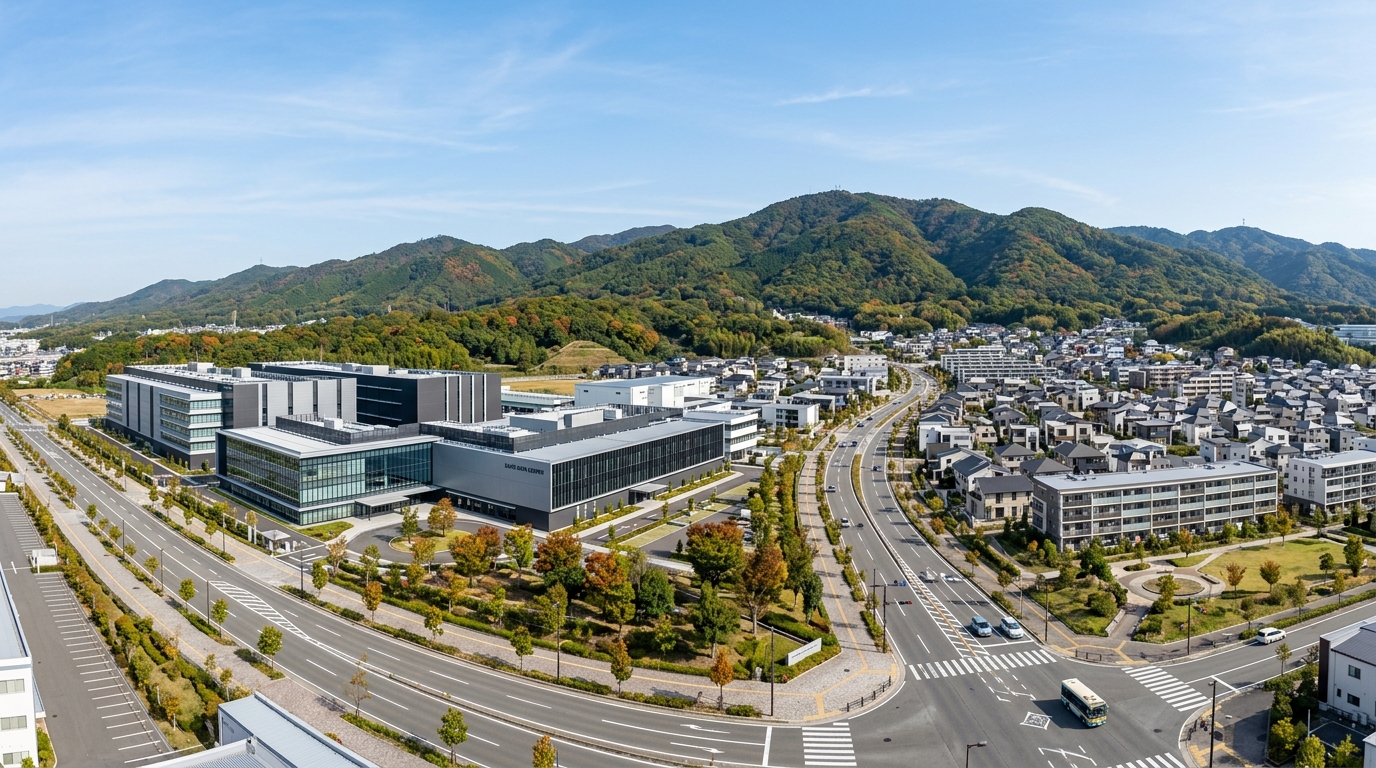
Far exceeding its former identity as a suburban "new town," the present-day Saito area is rapidly accelerating as Kansai's largest hub for data centers (DCs), backed by hundreds of billions of yen in infrastructure investment. At the same time, it offers a harmonious blend of abundant natural surroundings and robust child-rearing support, driving strong residential demand among buyers seeking an ideal lifestyle close to work. Based on actual transaction data from the Ministry of Land, Infrastructure, Transport and Tourism (MLIT) and the latest urban planning data, this article provides an in-depth analysis of land price trends and asset values in the Ibaraki and Saito areas looking ahead to 2028–2030.
3 Key Investment Takeaways from This Article
- Emergence as Kansai's largest digital infrastructure hub: Medium- to long-term economic ripple effects and job creation driven by next-generation AI data center developments from NTT DATA, Gouda, ESR, and others.
- Current land price realities based on actual data: A resilient market showing an average transaction price of approximately ¥42.35 million based on 2021–2025 data, alongside future asset value boosted by station-front redevelopment.
- Livability and environment driving end-user demand: Strong family demand attracted by the opening of the new community hub "MOKU MOKU Saito" and a comprehensive medical and educational ecosystem.
1. What Is Osaka's Ibaraki City and Saito Area, Spotlighted on "Land Day" (October 2)?
October 2 is "Land Day" in Japan. Re-evaluating the intrinsic value and medium- to long-term potential of land on this occasion is a highly meaningful action for both real estate investors and end-user homebuyers. Among the many cities in Kansai, Ibaraki City in Osaka Prefecture is currently undergoing one of the most dynamic transformations.
Located almost midway between Osaka City and Kyoto City, Ibaraki City has long developed as a highly convenient bedroom community. JR Ibaraki Station, a major transportation hub in the city, serves 88,183 passengers daily (according to West Japan Railway Company). Using Special Rapid or Rapid trains, residents enjoy direct, exceptional access to major hubs such as Osaka Station, Shin-Osaka Station, and Kyoto Station.
Furthermore, the Saito (International Cultural Park City) area, extending from the northern part of Ibaraki City into Minoh City, has passed more than 20 years since its town opening and entered a new phase of development. In addition to its original identity as a life science and R&D hub, the area's solid bedrock and vast parcels of land have spurred a rapid concentration of digital infrastructure in recent years, leading to a major re-evaluation of its potential. It is an ideal benchmark city for measuring future asset values on Land Day.
2. Background and Latest Trends Behind the Cluster of Kansai's Largest Data Centers
To understand the real estate market in Ibaraki and Saito, the most crucial keyword today is the concentration of "data centers (DCs)." Driven by the practical application of generative AI and the explosive growth of cloud services, demand for digital infrastructure is rising on an unprecedented scale. Within this landscape, Saito stands out due to its high elevation and solid bedrock, carrying minimal risk of earthquakes and flooding. As a result, it has been selected both as a backup site for the Tokyo metropolitan region and as a primary hub for Western Japan.
| Development Project / Facility Name | Scheduled / Operational Timing | Overview and Impact |
|---|---|---|
| NTT DATA "Osaka North Data Center" | H2 FY2027 (Phase 1) | Large-scale DC under construction in Ibaraki City. Delivers a stable power supply of up to 36 MW IT capacity. |
| Gouda / ESR Next-Generation AI Data Center | Scheduled to open in 2029 | Located in the Saito area. An eco-friendly facility utilizing solar power and battery storage for renewable energy and efficiency. |
| MC Digital Realty (MCDR) | Operational / Expanding | Provides high-density infrastructure supporting AI workloads at its "KIX Campus" in the Saito area. |
| Hankyu Ibaraki-shi Station West Exit Redevelopment (Socio Ibaraki) | Association establishment from FY2026 | Landowner-led voluntary rebuilding. Planned 24-story and 13-story mixed-use commercial and residential towers. |
In recent developments, NTT DATA Group announced plans to launch services at its "Osaka North Data Center" in the second half of FY2027, with construction scheduled to start in autumn 2025. The facility is ultimately expected to supply a massive 36 megawatts of power. Additionally, local enterprise Gouda Co., Ltd. has partnered with logistics and real estate giant ESR to open a next-generation AI data center powered by renewable energy in the Saito area in 2029.
These infrastructure investments not only generate massive economic benefits during construction, but also drive the inflow of highly skilled IT talent once operational. The gathering of data center-related companies and engineers serves as a powerful long-term engine that will bolster residential demand in the surrounding area.
3. Land Price Trends and Asset Value Impact in Ibaraki City Driven by Infrastructure Investment
How are these massive infrastructure investments and station-area redevelopments affecting actual real estate transaction prices? Looking at the latest transaction data (sample size: 4,896) for Ibaraki City (cityCode: 27211) from 2021 to 2025 obtained via "Mekiki Research," the strength and stability of the current market become clear.
During the target period, the average transaction price was approximately ¥42.35 million, with a median of ¥31.00 million, highlighting active transactions ranging from residential end-user properties for families to investment land. The average unit price stands at approximately ¥234,000/m², maintaining a relatively high asset value within the Hokusetsu region and forming a resilient market with low downside risk.
A closer look at specific district-level trends reveals a diverse mix of demand: from recently built, spacious single-family homes (Motohara-cho: approx. ¥50 million) to older properties ideal for renovation or rebuilding (Oda: approx. ¥17 million), and land for new construction (Kaminakajo: approx. ¥270,000/m²).
| District | Type / Usage | Transaction Price | Area / Unit Price | Zoning / FAR & BCR | Year Built |
|---|---|---|---|---|---|
| Motohara-cho | Residential Lot (Land & Building) / House | Approx. ¥50.0 million | 135 m² / - | Category 1 Residential Zone (200% / 60%) | 2021 |
| Ushitora | Residential Lot (Land Only) | Approx. ¥30.0 million | 240 m² / Approx. ¥130,000/m² | Category 2 Residential Zone (200% / 60%) | - |
| Oda | Residential Lot (Land & Building) / House | Approx. ¥17.0 million | 85 m² / - | Category 1 Medium-High-Rise Exclusive Residential Zone (200% / 60%) | 1999 |
| Kaminakajo | Residential Lot (Land Only) | Approx. ¥26.0 million | 100 m² / Approx. ¥270,000/m² | Category 2 Medium-High-Rise Exclusive Residential Zone (200% / 60%) | - |
Stable real-demand transactions are notably visible in zones such as Category 1 and 2 Medium-High-Rise Exclusive Residential Zones and Residential Zones (building coverage ratio of 60%, floor area ratio of 200%), which protect a high-quality residential environment while permitting a decent building volume.
4. Why Families Choose Saito: Living Environment and Residential Appeal
While large industrial infrastructure like data centers tends to draw headlines, the true attraction of Ibaraki City—and particularly Saito—lies in its exceptional living environment and everyday convenience. Rather than serving as a mere bedroom town where residents only return to sleep, the area allows families to realize an ideal work-life balance in harmony with nature, making it immensely popular among homebuyers.
Looking at urban planning data for the surrounding area, key commercial nodes around stations are designated as "Neighborhood Commercial Zones (80% BCR / 400% FAR)," offering compact clusters of daily shopping and essential services. The educational environment is also robust: under the citywide slogan "Leave No Child Behind," public schools such as Hozumi Elementary and Seiryo Junior High are actively advancing ICT education, including tablet distribution to students.
Healthcare provision is another standout feature. Recent survey data indicates 56 medical facilities operating in the surrounding area. Institutions such as Tanigawa Memorial Hospital (Medical Corporation Tokushokai), Nishokai Hospital (Medical Corporation Association Nishokai), and Ibaraki Clinic (Yodogawa Workers' Welfare Association) provide a dense network covering everything from primary care to specialized medical treatments, ensuring a safe living foundation for both young families and seniors.
In January 2026, Hankyu Hanshin Properties celebrated the partial pre-opening of "MOKU MOKU Saito," a new community hub directly in front of Saito-nishi Station. Constructed using abundant locally sourced timber from Osaka Prefecture, the facility features a café and multipurpose hall, serving as a new neighborhood gathering point that enhances Saito's brand value. Furthermore, Ibaraki City offers unique housing subsidies for households moving in from outside the city to encourage multi-generational living (such as interest rate discounts through Flat 35 regional partnerships), providing solid financial backing for home purchases.
5. The Rise of Work-Life Proximity and Growing Residential Demand
Thanks to the synergy between job creation from infrastructure investments and a high-quality living environment, the number of people seeking a lifestyle close to work has surged in Ibaraki City. Highly skilled personnel working at R&D centers and next-generation data centers in Saito are increasingly buying homes in the city to minimize long commutes while securing an exceptional environment for raising children.
Significant momentum is also visible in central urban areas near JR Ibaraki Station and Hankyu Ibaraki-shi Station. At the west exit of Hankyu Ibaraki-shi Station, the landowner-led redevelopment of "Socio Ibaraki" (Ibaraki Building and Eitai Building, originally constructed for the 1970 Osaka Expo) is underway to create 24-story and 13-story mixed-use commercial and residential towers. Aiming to establish a redevelopment association in FY2026 and beyond, this project will dramatically revitalize aging station-front space and generate strong demand among buyers seeking urban convenience.
For those ready to search for specific properties or start planning, using free member features to conduct detailed area analyses—or utilizing the Pro plan's "AI Building Simulator" to visualize custom floor plans, sunlight conditions, and exterior designs—is highly recommended. Making concrete decisions based on objective data is the key to real estate success.
6. Essential Property Selection Points for Homebuyers and Investors
While Ibaraki and Saito offer immense promise and appeal, there is one factor where buyers must never compromise: thorough verification of hazard risks.
According to our actual data survey, no landslide risk (phenomena: none) was identified around the target area, but flood risk requires careful attention. The area is classified as "Risk Present" in flood hazard maps, with maximum depth rankings reaching "3" (maximum depth of 3 to 5 meters) in certain parts.
High-elevation hilly areas in Saito generally carry low flood risk; however, when considering properties in the plains or along riverbanks in Ibaraki City, cross-referencing municipal hazard maps before purchase is essential. Defensive measures—such as designing layout plans that place living spaces and critical equipment on the second floor or higher, and securing flood-inclusive fire insurance—will ensure long-term asset protection.
7. Future Outlook for Ibaraki and Saito from a Long-Term Perspective
Looking ahead to 2028 through 2030, Ibaraki City and the Saito area are poised to solidify their position as the "digital infrastructure heartland" of the Kansai region. As mega data centers by NTT DATA, Gouda, and ESR become fully operational, the resulting influx of related enterprises and working population will support and drive further increases in land values.
Concurrently, the redevelopment of mixed-use towers at the west exit of Hankyu Ibaraki-shi Station and the ongoing expansion of new community facilities in Saito will dramatically improve urban livability and convenience. Working backward from a 2030 forecast, "now"—before ongoing infrastructure investments and redevelopment plans are fully priced into real estate values—presents an optimal timing for both end-users and investors to take proactive steps.
Rather than being swayed by short-term price fluctuations, the golden rule of resilient real estate selection is to calmly evaluate both macro-level industrial structural shifts (expanding demand for AI and data centers) and micro-level livability factors (robust educational, medical, and community infrastructure).
8. Conclusion
Taking "Land Day" on October 2 as an opportunity, we analyzed the current state and future potential of Osaka's Ibaraki City and Saito area based on objective data. Combining a strong economic base driven by Kansai's largest cluster of data centers with rich natural surroundings and top-tier child-rearing and medical infrastructure, this area represents a compelling choice for both real estate investors and families seeking a new home.
By accurately understanding risk factors such as flooding and making rational decisions grounded in actual transaction data from the Ministry of Land, Infrastructure, Transport and Tourism, buyers can achieve both reliable asset growth and an ideal lifestyle heading toward 2030.
We strongly encourage you to conduct detailed research on your target areas using accurate, real-world data rather than guesswork. By signing up for a free membership, you can directly pull the MLIT data used in this blog into your Claude or ChatGPT via MCP integration. Leverage AI to seamlessly continue your own expert area analysis.