
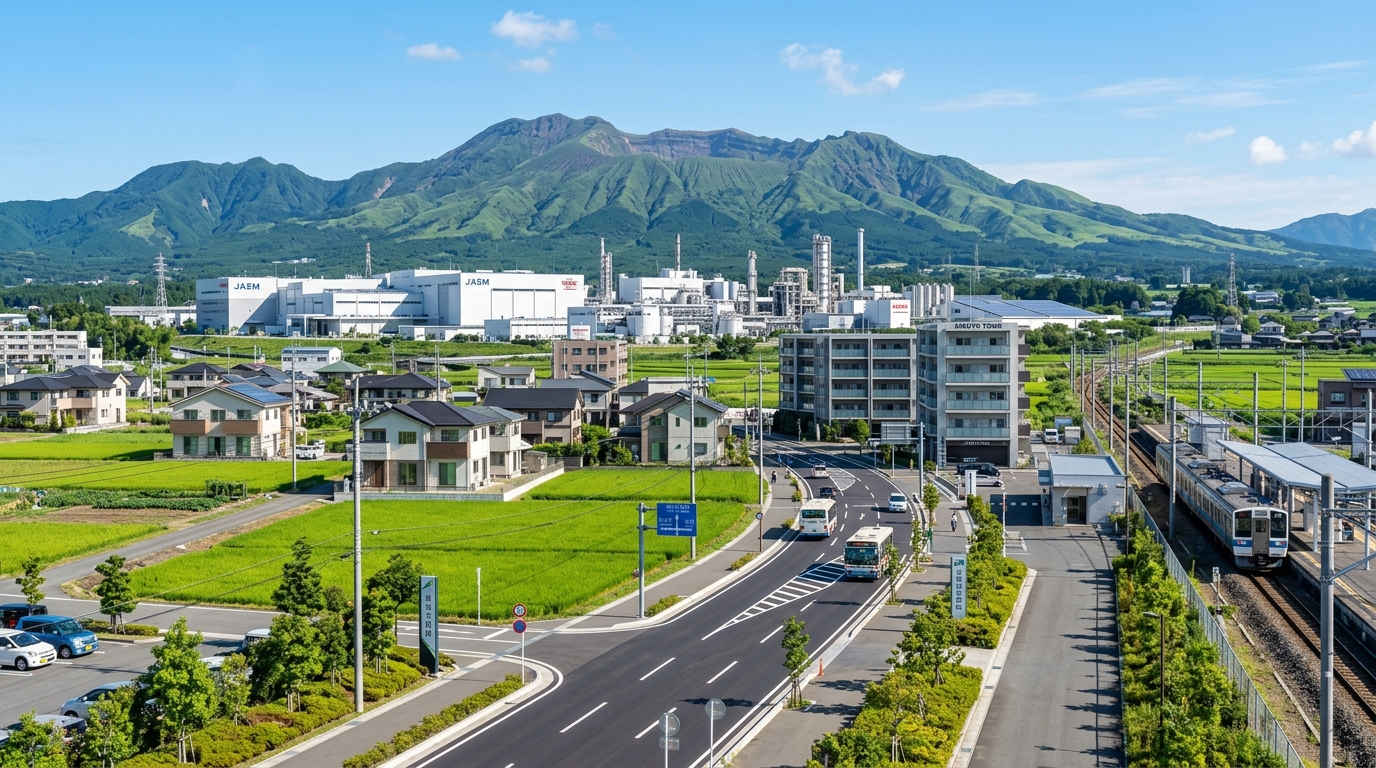
Ever since JASM (Japan Advanced Semiconductor Manufacturing), a subsidiary of TSMC (Taiwan Semiconductor Manufacturing Company), officially launched operations at its Fab 1 at the end of 2024, Kikuyo Town in Kumamoto Prefecture (熊本県菊陽町, Kumamoto-ken Kikuyo-machi) has transformed into one of Japan's most watched real estate markets. As of 2026, walking through the town reveals a vibrant landscape where new road networks are being constructed at a rapid pace, and brand-new residential and commercial developments are springing up one after another. This unprecedented industrial concentration is far more than a temporary windfall; it serves as a powerful engine fundamentally updating the town's infrastructure and living environment.
In this article, we provide an in-depth analysis of Kikuyo's mid- to long-term real estate potential looking ahead to 2028–2030, aimed at institutional and individual investors, as well as families and single residents considering buying a home. Drawing on a wide array of data—including the progress of major transportation infrastructure projects like the proposed new station on the JR Hohi Main Line (JR豊肥本線) and the Kumamoto Airport Access Railway (熊本空港アクセス鉄道), as well as an increasingly comprehensive suite of child-rearing support policies—we unpack why this area is earning high marks as a place to live long-term.
From land price trend forecasts that will shape future asset value to key checkpoints on flood hazard maps essential when buying a home, we offer an objective, cool-headed analysis. Use this guide as a compass for making regret-free housing searches and solid investment decisions in a town undergoing rapid transformation.
3 Key Investment Takeaways in This Article
- The full scope and timeline of infrastructure projects (new station and road networks) aligned with JASM Fab 2 opening in 2028 and looking ahead to 2030
- Insights into shifting housing demand driven by population inflows, alongside robust support systems and living environments attracting child-rearing families
- Mid- to long-term asset value outlooks based on past land price trends and future forecasts, plus tips on site selection and natural hazard mitigation
1. Demographics and Housing Demand Shifts in Kikuyo Town Driven by JASM’s Full Operation
Since JASM's Fab 1 went operational at the end of 2024, demographic dynamics in Kikuyo Town and surrounding municipalities have underwent a dramatic transformation. Highly skilled engineers from Japan and abroad, along with corporate personnel tied to the semiconductor supply chain, have continuously poured into the region, resulting in a marked increase in the working-age population. This influx has spurred intense demand across a wide spectrum of the real estate sector, ranging from rental apartments for single workers to single-family detached homes for families.
Looking at the market environment in 2026, prime properties are seeing fierce bidding wars, often finding buyers the moment they hit the market. Furthermore, mass production at JASM’s Fab 2—which will handle cutting-edge processes such as the 3nm node—is scheduled to begin in 2028, making a second wave of population influx and job creation virtually certain. This continuous wave of demand provides an exceptionally strong foundation for the real estate market.
Additionally, a major earthquake reaching maximum seismic intensity 7 that occurred in July 2026 (measuring upper 5 in Kikuyo Town) served as a litmus test proving the resilience of the area. Designed under stringent earthquake-resistant and base-isolation standards, JASM’s facilities briefly halted operations following safety protocols immediately after the quake. However, without major damage to buildings or equipment, production lines were swiftly restored. This rapid response earned high praise from a corporate Business Continuity Planning (BCP) perspective, validating Kikuyo Town as an area where businesses and residents can establish a presence with peace of mind. Such confidence in safety continues to boost real end-user housing demand.
2. Living Environment in the Hikarinomori Area & Haramizu Station Surroundings: Positive Impacts on Child-Rearing Families
The main reason Kikuyo Town has transcended the label of a mere "factory town" to become a location of choice for many residents lies in its exquisite balance—a living environment that feels neither overly urban nor excessively rural. In particular, the Hikarinomori (光の森) area, the town’s primary commercial hub, brings together large shopping malls, movie theaters, and a diverse range of restaurants in a compact footprint, making it renowned for its high convenience for daily shopping and weekend entertainment.
Currently drawing significant attention as the next new urban center after Hikarinomori is the proposed Haramizu Station Area Land Readjustment Project (原水駅周辺土地区画整理事業). This massive project encompasses a vast area of approximately 70 hectares surrounding a new station planned between Haramizu Station (原水駅) and Sanrigi Station (三里木駅) on the JR Hohi Main Line. Major players like Mitsui Fudosan and JR Kyushu have joined as partner developers, outlining an advanced, forward-looking urban vision that integrates housing, commercial space, and R&D facilities.
Furthermore, Kikuyo Town is throwing its full administrative weight behind child-rearing support, strongly aiding families in purchasing homes. Under the "Settlement Promotion Subsidy Program" (定住促進補助金制度), financial aid is provided for building, purchasing, or renovating homes for child-rearing families settling in designated areas like the Kikuyo Minami Elementary School district. Homebuyers can also leverage subsidies for state-of-the-art energy-efficient housing, such as the "Mirai Eco Housing 2026 Project" (みらいエコ住宅2026事業). On top of these, the town offers robust household assistance, including medical fee subsidies for youth up to age 18 and complete waivers for school lunch and side dish fees introduced in FY2025. This dual engine of hardware-side urban development and software-side support creates a powerful pull for families raising children.
3. Changes in Transportation Convenience: Kumamoto Airport Access Railway and Road Infrastructure Enhancements
Traffic congestion on local roads caused by rapid population growth and increased traffic was Kikuyo’s single biggest challenge. However, national, prefectural, and local governments have joined forces to advance infrastructure projects at unprecedented speed to address this issue. On the road development front, projects such as the newly built Kikuyo Airport Line (菊陽空港線)—which crosses over the JR Hohi Main Line via an elevated overpass—and widening work on the Ozu-Ueki Line (大津植木線) supporting logistics around the JASM facilities are moving at full speed, with partial sections expected to open as early as FY2026. This will significantly ease commuter traffic around the plants and improve safety on neighborhood streets.
Moreover, the proposed Kumamoto Airport Access Railway project stands as a major catalyst that will dramatically elevate mid- to long-term real estate values. This large-scale infrastructure initiative branches off from Higo-Ozu Station (肥後大津駅) on the JR Hohi Main Line and connects to Aso Kumamoto Airport (阿蘇くまもと空港) via a ~6.8 km rail link. Long in the planning stage, the project gained momentum in August 2026 with the establishment of Aso Kumamoto Airport Access Railway Co., Ltd. (阿蘇くまもと空港アクセス鉄道株式会社), a public-private third-sector entity created to oversee operations.
Targeting an opening at the end of FY2034, the line will connect Kumamoto Station (熊本駅) directly to Aso Kumamoto Airport in as little as 39 minutes. This will dramatically enhance scheduling reliability from Kikuyo and neighboring Ozu Town to the airport, significantly improving connectivity to major domestic cities and international destinations, particularly in Asia. Beyond business convenience for global corporate hubs, this expanded regional transport network is a decisive factor in cementing the area’s residential potential for frequent business travelers and active families alike.
4. Land Price Trends and Single-Family/Residential Lot Demand Analysis in Kikuyo Town
Since the announcement of JASM's entry, land prices in Kikuyo Town have consistently recorded some of the highest growth rates nationwide. The table below presents estimates and projections for average residential land prices over the past five years and the next five years, based on public trends from the Ministry of Land, Infrastructure, Transport and Tourism (MLIT) land price disclosures and actual market transaction data.
| Year | Average Residential Land Price in Kikuyo Town (Est./Forecast) | Key Topics Driving the Market |
|---|---|---|
| 2021 | Approx. ¥45,000/㎡ | Eve of the JASM announcement. Steady demand as a commuter town. |
| 2024 | Approx. ¥70,000/㎡ | Launch of JASM Fab 1 operations. Influx of related supplier enterprises. |
| 2026 | Approx. ¥95,000/㎡ | Living environment enhanced by full-scale road grid work and readjustments. (Present) |
| 2028 | Approx. ¥115,000/㎡ | Planned start of JASM Fab 2 mass production. Second population wave & demand rise. (Forecast) |
| 2030 | Approx. ¥120,000/㎡ | Transition into a mature phase driven by new station opening & urban town launch. (Forecast) |
Note: Figures in the table are estimates and forecasts based on public land price disclosures and transaction trends; they do not guarantee actual transaction prices at specific locations.
From levels typical of a general regional commuter town in 2021, land prices have nearly doubled in just a few short years. The upward trend persists in 2026, and demand for residential lots is expected to remain exceptionally strong heading toward the 2028 start of Fab 2 mass production and the scheduled opening of the new JR Hohi Main Line station in spring 2029 or later.
Particularly noticeable is the robust "detached home demand" among families who place a high priority on preserving mid- to long-term asset value. Even as land prices rise, there is a strong preference for detached single-family homes with ample yards and parking spaces rather than condominiums, creating intense competition for quality residential plots whether for turnkey or custom-built homes.
If you wish to examine market values and living environments in your target area in detail, sign up for a free membership at Property Mekiki Research (物件目利きリサーチ, Bukken Mekiki Research) to easily view local transaction price trends and hazard data. Additionally, the paid Pro Plan offers an AI Architecture Simulator that automatically generates single-family floor plans, 3D models, and cost estimates based on regional data. Leveraging such objective data and simulations to pinpoint the ideal location matching your budget and requirements is the key to navigating today’s Kikuyo market.
5. Living Environments Enabling Work-Life Proximity: Why It’s Popular with Families
In the real estate market, the single biggest reason Kikuyo Town attracts such overwhelming support from end-user buyers is its ideal environment for achieving high "work-life proximity" (職住近接, shokujū kinsetsu). Because residents can reach the cluster of semiconductor-related companies—including JASM—in a short time by car or public transit, the physical and mental stress of daily commuting is drastically reduced. The leisure time created by shorter commutes can be devoted to family time or personal growth, directly translating into better time performance and elevated Quality of Life (QOL).
In addition, Kikuyo Town is actively promoting a "Compact City Concept" under its Urban Planning Master Plan to prevent chaotic urban sprawl while preserving a balance between existing commercial, residential, industrial, and agricultural zones. As a result, rich natural surroundings and farmland are preserved right alongside highly convenient urban areas.
On weekends, families can play with their children while enjoying the changing seasons at the spacious Kikuyo Suginamiki Park (菊陽杉並木公園), then drop by a major shopping center on the way home for weekly groceries or dining out—a seamless lifestyle experience. This harmony between urban convenience and rich nature is also immensely appealing to hybrid workers utilizing telework, cementing Kikuyo’s status as a top-tier residential town built for long-term living.
6. Hazard Maps and Site Selection Tips for Home Buying and Investing
To preserve asset value over the long term and, above all, protect your family’s safety, cool-headed risk analysis based on hazard maps is indispensable. As mentioned, a major earthquake with a maximum seismic intensity 7 struck Kumamoto in July 2026. While strong tremors were felt in Kikuyo Town, most homes built under modern earthquake resistance standards escaped catastrophic damage. However, this experience has heightened consumer awareness regarding ground stability, building seismic performance, and site safety to unprecedented levels.
The first step in site selection is to avoid proximity to active fault zones as much as possible. Furthermore, while the Kumamoto region is blessed with abundant groundwater, flood risk from major class-A rivers like the Shirakawa River (白川) is not zero. It is crucial to inspect official municipal flood hazard maps and inland inundation projection maps, exercising caution when considering low-lying areas or former marshlands prone to flooding. In particular, when purchasing land in newly readjusted areas or plots recently converted from agricultural use, it is strongly advised to trace land-use history and verify that proper ground improvement works have been carried out.
From an investment perspective, a solid rule of thumb for site selection is to target areas surrounding the proposed site for the new JR station—rescheduled for opening in spring 2029 or later—or locations with good access to newly opened arterial roads. These areas boast resilient future rental demand and offer significant advantages for resale value. However, to minimize noise and exhaust impacts from increased traffic, selecting quiet residential subdivisions set one block back from main thoroughfares, or neighborhoods with proper separation between local streets and main roads, is the secret to balancing living comfort with asset retention.
7. Sustainable Regional Development Through Industrial Clustering and Future Asset Value Outlook
Looking backward from a mid- to long-term projection toward 2030, Kikuyo Town’s real estate market can be characterized as being in a transitional phase: moving smoothly from a windfall-driven "rapid growth period" to a "mature and stable period" of sustainable development. Following successful global science park models like Taiwan's Hsinchu Science Park (新竹科学園区), Kikuyo is building a robust ecosystem through industry-government-academia collaboration, going beyond simply attracting manufacturing plants.
The Haramizu Station Area Land Readjustment Project, where partners like Mitsui Fudosan are helping shape a concrete future vision, holds the potential to become a benchmark smart city blending state-of-the-art urban functions with green natural surroundings. This high-caliber urban development will serve as an exchange hub fostering innovation, raising the brand value of the entire region to the next level.
For investors and homebuyers, the core strategy today is to use "guaranteed future events"—such as the 2028 start of JASM Fab 2 mass production, the new station opening in spring 2029 or later, and the FY2034 opening of the airport access railway—as benchmarks to secure prime locations that directly benefit from these milestones.
For primary residence buyers, the soundest approach is to maximize child-rearing support programs and housing subsidies to minimize initial acquisition costs while capturing capital gains from future asset appreciation. While the initial wave of speculative mania has calmed, Kikuyo’s real estate value—backed by steady infrastructure delivery and an increasingly refined living environment—is expected to remain exceptionally solid moving forward.
8. Conclusion
This article has explored the current landscape and 2030 real estate market outlook for Kikuyo Town, Kumamoto Prefecture, an area rapidly emerging as the heart of Japan's semiconductor industry following JASM’s full launch. Key infrastructure developments—such as the new station project on the JR Hohi Main Line, the commercialization of the Kumamoto Airport Access Railway, and rapid road network expansions—are fundamentally reinforcing the area’s transport convenience and urban framework.
At the same time, generous town-led child-rearing policies—including fully subsidized school meals, robust medical fee coverage, and settlement incentive grants—offer irreplaceable appeal to real end-user families. A living environment that harmonizes commercial convenience with rich natural scenery cements its value as a premier commuter town offering exceptional QOL.
While continuous land price increases have raised the bar for entry compared to the past, Kikuyo Town remains, without a doubt, a top-tier candidate worthy of investment and homebuying consideration when weighing future asset stability against the elevated convenience offered by upcoming infrastructure. To succeed in homebuying or property investment here, you need objective, clear-headed judgment that pairs macro growth forecasts with micro-level site selection and hazard risk analysis.
If you would like to analyze future asset values and living environments in greater detail, verify the data yourself. By signing up for a free membership, you can connect the Ministry of Land, Infrastructure, Transport and Tourism data used in this blog directly to your Claude or ChatGPT via MCP integration. Continuing your research seamlessly with your own AI assistant will help you make confident, well-informed decisions for your home search or investment strategy. Check the latest land prices and hazard information for Kikuyo Town, Kumamoto Prefecture on Mekiki Research 👉