
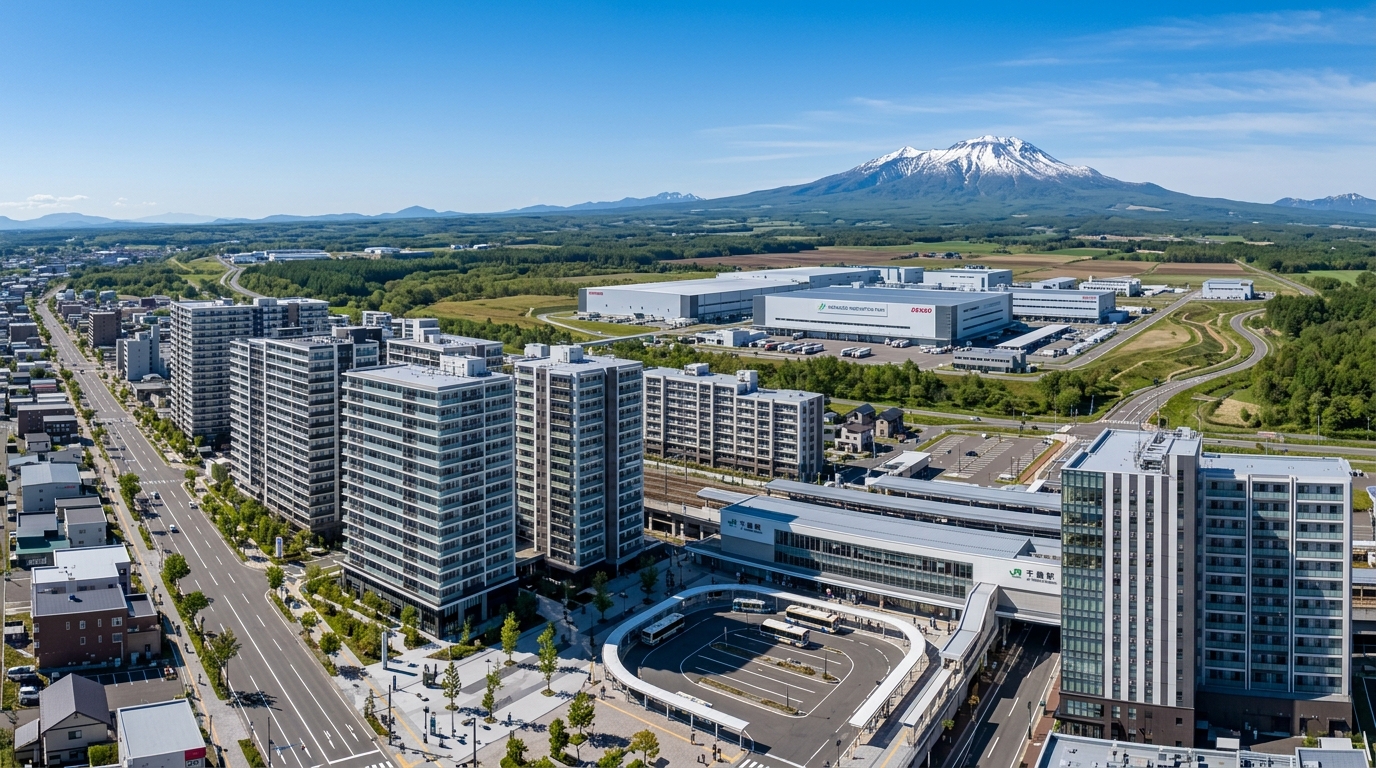
Chitose City, Hokkaido (北海道千歳市, Hokkaido Chitose-shi) is currently undergoing an unprecedented urban transformation, driven by the arrival of a major next-generation semiconductor manufacturing hub. With its highly anticipated pilot production line launching in spring 2025 and city planning moving at full speed toward full-scale mass production in 2027, the local landscape is evolving rapidly. Redevelopment around JR Chitose Station (JR千歳駅, JR Chitose-eki) and an explosive surge in residential demand are fundamentally reshaping the area's real estate market.
In this article, we analyze actual transaction data from the Ministry of Land, Infrastructure, Transport and Tourism (MLIT) updated for 2026, alongside regional hazard assessments, to examine land price trends and real-world livability in Chitose City. Whether you are a family looking to purchase a primary residence or an investor seeking medium- to long-term asset growth, we break down the value of living and investing in Chitose today from every angle.
3 Key Investment Takeaways
- Status and Future Outlook of JR Chitose Station Redevelopment Ahead of 2027 Mass Semiconductor Production
- Real Price Trends and Land Values in Key Chitose Neighborhoods Based on Official MLIT Data
- Essential Livability Factors for Homebuyers: Educational Infrastructure, Healthcare, and Hazard Risk Evaluations
1. Structural Changes and Housing Demand in Chitose City, Hokkaido in 2026
To understand Chitose City today, one must look at Rapidus, the national project establishing a advanced semiconductor manufacturing base in the region. This massive industrial cluster is doing far more than building a factory—it is triggering a dramatic paradigm shift across the city's infrastructure and housing market.
Looking back from a medium- to long-term perspective (2028–2030), Chitose is entering a crucial transition phase, moving from a runway period into full-fledged expansion. To help investors and end-users pinpoint the right actions to take now, the table below outlines the redevelopment schedule, industrial developments, and real estate market forecast themes through 2030.
| Year | Redevelopment & Industrial Schedule | Land Price & Real Estate Market Forecasts |
|---|---|---|
| 2025 | Launch of semiconductor plant pilot (prototype) production line | Sharp increase in demand for office space and short-term corporate rentals due to incoming supplier businesses |
| 2026 | Completion of multiple hotels and mid-to-high-rise office buildings near JR Chitose Station | Urban function restructuring and land price growth, fueled by discussions on relaxing Floor Area Ratio (FAR) regulations on the station's West Exit |
| 2027 | Scheduled start of mass production for next-gen 2nm logic chips | Accelerating population inflow leading to a tight supply of family-oriented residential housing |
| 2028 | Sales launch for the new industrial park adjacent to Chitose Outlet Mall Rera | Land value appreciation spilling over into live-work zones near Bibi and Kashiwadai |
| 2030 | Completion of regional transit and living infrastructure upgrades | Long-term asset value stabilization as an international "semiconductor hub" tied to New Chitose Airport |
Chitose's strength lies in this clear, long-term growth trajectory. Backed by an estimated 5 trillion yen in total capital investment and substantial job creation, sustained residential demand—rather than a short-lived speculative bubble—will underpin local property values. Securing quality land or residential units early remains one of the most strategic decisions buyers and investors can make today.
2. Population Inflow and Employment Expansion Driven by Full-Scale Semiconductor Plant Operations
The biggest game-changer in Chitose is Rapidus's "IIM-1" next-generation semiconductor facility, located in industrial areas like Chitose Bibi World (千歳美々ワールド, Chitose Bibi Waarudo). With pilot production starting in April 2025, progress toward mass-producing 2nm generation logic chips in 2027 is moving steadily forward.
The impact of full operation will be immense. The primary plant alone is expected to generate over 1,000 direct jobs, with thousands more created across supporting sectors. Semiconductor manufacturing relies on a vast ecosystem of equipment suppliers, material vendors, and maintenance specialists. These secondary firms are establishing operations across Chitose and neighboring municipalities, accelerating an influx of high-skilled IT talent, engineers, and their families from across Japan.
In a country facing overall demographic decline, Chitose stands out as a rare exception: its population has maintained an upward trend over the past five years, and its average resident age of 44.7 makes it one of the youngest cities in Hokkaido. As the 2027 mass-production deadline approaches, demand is spiking not only for compact rental units suited for temporary assignees, but also for family condominiums and newly built single-family homes intended for long-term settlement. With supply struggling to keep pace, this structural supply-demand gap presents a significant window of opportunity for property acquisitions and residential purchases.
3. Redevelopment at JR Chitose Station: Enhancing Commercial Convenience and Urban Appeal
In tandem with industrial growth, urban renewal around JR Chitose Station is accelerating rapidly. Since the announcement of the Rapidus facility, older structures on prime land near the station have been cleared to make way for new hotels and mid-sized office buildings developed by companies such as Alpha Court (アルファコート), Daiwa House Industry (大和ハウス工業), and local firm Sugihara Shoji (杉原商事). Multiple hospitality facilities opened in 2026 alone, catering to domestic business travelers, international technicians, and inbound tourists.
Another key movement is the city's proposal to relax Floor Area Ratio (FAR / 容積率) restrictions around the West Exit of JR Chitose Station. Increasing the FAR limit from the current 300% to 400% will enable the construction of larger, taller mixed-use developments. Recent transaction data from the Ministry of Land, Infrastructure, Transport and Tourism (MLIT) covering 2021–2025 highlights this potential: for instance, a 260 sqm commercial plot in the central Shimizu-cho (清水町) district (designated 80% BCR / 400% FAR) recently traded for 19 million yen, equating to approximately 71,000 yen/sqm—a valuation that reflects high-density development potential.
Higher FAR allowances encourage integrated land use, such as ground-floor retail and cafes topped by offices or hotel rooms. As the station area converts into a walkable, urban core, JR Chitose Station is shifting from a transit stop into a high-utility lifestyle hub. This rise in core convenience will serve as a long-term catalyst for surrounding residential land values.
4. Livability and Educational Environment in Chitose City: What Families and Singles Need to Know
When assessing long-term real estate value, local quality of life is just as critical as macro-level economic indicators. Chitose City continues to gain strong traction among end-user homebuyers, particularly young families.
Location data for central Chitose shows that the area falls within the school districts for Suehiro Elementary School (末広小学校, Suehiro Shogakko) and Chitose Junior High School (千歳中学校, Chitose Chugakko), providing a stable community-rooted educational environment. Medical infrastructure is equally robust, with 15 healthcare facilities operating near the city center. Key specialized providers include Himawari Ikiki Home Clinic Chitose (向日葵活き粋在宅クリニック千歳診療所), Chitose Matsumoto Eye Clinic (千歳まつもと眼科), and Peure Otolaryngology Clinic (ペウレ耳鼻咽喉科), offering accessible healthcare for both young children and seniors.
Furthermore, Chitose City offers municipal housing and child-rearing incentives. Under the "Young Couples and Child-Rearing Households Home Acquisition Support Program," eligible buyers can receive subsidies up to 500,000 yen for new home construction or up to 200,000 yen for purchasing an existing home. The city also provides medical subsidies for children up to age 18 and offers grants for energy-efficient equipment (such as high-efficiency water heaters) through its zero-carbon housing program, directly reducing household overhead.
For single professionals, the abundant dining options around the station and direct access to New Chitose Airport (新千歳空港, Shin-Chitose Kuko) offer a convenient balance between work and leisure. This solid foundation of daily livability helps retain both temporary corporate transferees and long-term residents.
5. Residential Property Price Trends Across Key Areas in Chitose City During Land Value Escalation
Below is an analysis of residential property values in Chitose City based on official MLIT transaction records from 2021 through 2025.
Across the city, 1,964 transactions were recorded over this period, indicating strong market liquidity. While the overall average transaction price reached approximately 27.14 million yen, the median price stood at roughly 17.5 million yen. High-value commercial and industrial acquisitions elevated the mean, but the primary price bracket for typical residential buyers remains between 15 million and 30 million yen. The maximum single transaction recorded was 530 million yen, underscoring active corporate land assembly. The overall average unit price across all property types was approximately 54,000 yen/sqm.
The chart below illustrates historical transaction price points in Chitose over recent quarters.
To highlight local variations across Chitose, representative property transactions are detailed below:
| Area (District) | Zoning (BCR / FAR) | Property Type | Size / Layout / Built Year | Transaction Price (Approx. Unit Price) |
|---|---|---|---|---|
| Inaho (稲穂) | Category 1 Residential (60% / 200%) | Land & Building | 265 sqm, 4LDK, Built 1979 | 13.0 million yen |
| Fukuzumi (福住) | Category 1 Low-Rise Exclusive (40% / 60%) | Land & Building | 320 sqm, 5LDK, Built 1995 | 14.0 million yen |
| Asahigaoka (旭ケ丘) | Urbanization Control Area (60% / 200%) | Land only | 9,999 sqm | 170.0 million yen (~32,000 yen/sqm) |
| Asahigaoka (旭ケ丘) | Urbanization Control Area (60% / 200%) | Land & Building | 170 sqm, Single home, Built 2022 | 31.0 million yen |
| Shimizu-cho (清水町) | Commercial Zone (80% / 400%) | Land only | 260 sqm | 19.0 million yen (~71,000 yen/sqm) |
| Sumiyoshi (住吉) | Quasi-Industrial Zone (60% / 200%) | Land only | 230 sqm | 1.1 million yen (~4,800 yen/sqm) |
The data points to clear market segmentations. In low-density residential zones like Fukuzumi (福住)—where 40% BCR / 60% FAR limits ensure generous setback distances and good sunlight access—a large 320 sqm lot with a 5LDK home sold for 14.0 million yen. This represents an accessible price point for buyers interested in acquiring established homes for custom renovation.
By contrast, newer single-family construction in Asahigaoka (旭ケ丘) (built in 2022) commanded 31.0 million yen, reflecting recent upward pressure on new build costs. Meanwhile, lower land unit costs in quasi-industrial zones like Sumiyoshi (住吉) (~4,800 yen/sqm) offer economical options depending on intended land use.
6. Key Considerations for Land Selection and Total Budgeting When Planning New Home Builds
When considering new construction in a market experiencing land value growth, assessing environmental safety alongside purchase price is critical. As natural disasters increase in frequency across Japan, a site's hazard profile directly impacts its long-term asset security and resale potential.
Geospatial hazard data from the Geospatial Information Authority of Japan (GSI) for central Chitose (lat=42.8283, lng=141.6525) indicates no registered flood risk or landslide risk (hasRisk: false) for the evaluated central coordinates. Choosing sites with low disaster risk offers homebuyer families peace of mind and protection for their primary investment.
While aggregate market data provides helpful benchmarks, successful real estate acquisitions require analyzing precise, site-specific information. By creating a free account with Mekiki Research (物件目利きリサーチ), you can query official MLIT transaction records and GSI hazard data directly within your existing workflows on Claude or ChatGPT via Model Context Protocol (MCP) integration.
7. Strategic Asset Value Underpinned by Airport Access and Regional Transit Networks
The foundation supporting Chitose’s long-term real estate valuation is its regional transport infrastructure. JR Chitose Station serves 16,128 daily passengers (based on official station data), placing it among Hokkaido's busiest hubs, and offers rapid train service to central Sapporo in approximately 30 minutes.
Crucially, the station sits just a few stops—or roughly 10 minutes by car—from New Chitose Airport. This proximity to Japan’s primary northern aviation gateway gives Chitose a distinct positional advantage. As global technology firms establish operations nearby, direct airport connectivity facilitates seamless transit for international executives, engineers, and corporate partners.
Zoning designations near the core, such as Neighborhood Commercial Zones (近隣商業地域, 80% BCR / 300% FAR), permit flexible combinations of retail, commercial office, and residential space. As infrastructure investments continue through 2030, Chitose is evolving from a traditional suburb of Sapporo into an independent economic hub and international technology cluster.
8. Conclusion: The Blueprint for Successful Home Ownership in Rapidly Growing Chitose
Driven by the twin engines of semiconductor manufacturing investments and central station redevelopment, Chitose City is moving through a period of sustained growth. With 2027 mass production approaching and broader urban projects targeted for 2030, current land values likely reflect an early phase of broader structural revaluation.
Whether buying a primary home or acquiring investment property, decisions should rely on verified market facts rather than speculation. Verifying hazard profiles, checking zoning limits to gauge future streetscape developments, and benchmarking target pricing against actual nearby sales remain essential steps for risk-managed property acquisition.
For buyers actively planning single-family home construction, the AI Building Simulator available under our site's Pro Plan offers automated visual modeling. By entering target lot metrics and design preferences, the tool automatically generates 2D floor plans, 3D structural previews, summer/winter solstice sunlight projections, exterior renderings, and baseline cost estimates. Users can also upload custom floor plan images to convert them into 3D visualizations, or export project files to PowerPoint (.pptx) and 3D format (.glb) to review with family members or builders. (Note: This feature is designed exclusively for detached single-family homes and does not support multi-family apartment planning or financial yield calculations).
To start researching prospective neighborhoods using official MLIT land data, sign up for a free account to enable direct MCP data access inside Claude or ChatGPT.
Check the latest land prices and hazard information for Chitose City, Hokkaido on Mekiki Research 👉