
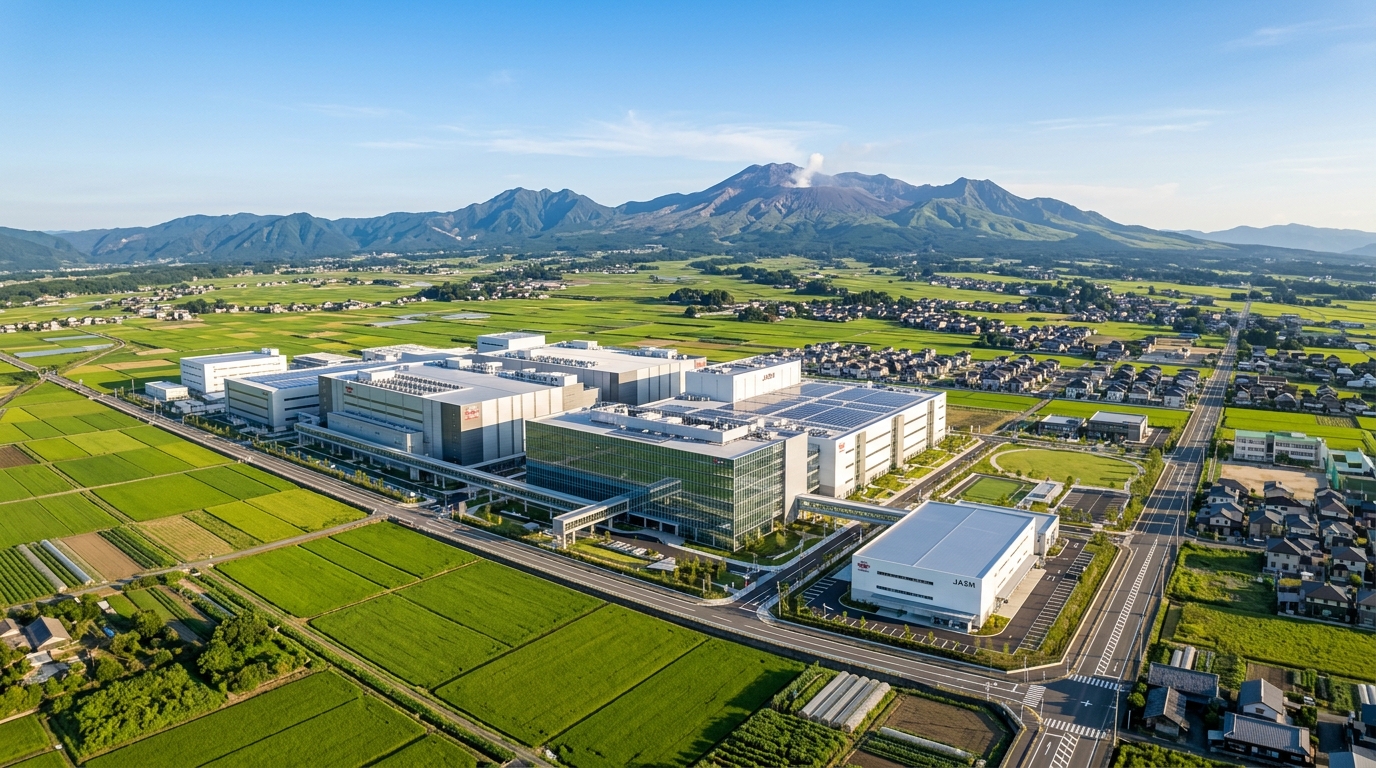
As of 2026, one of the most closely watched areas in the Japanese real estate market nationwide is Kikuyo Town, Kumamoto Prefecture (熊本県菊陽町). Sparked by the arrival of the massive semiconductor plant by Taiwan Semiconductor Manufacturing Company (TSMC), a rapid agglomeration of related supply chain companies has unfolded. Now, we are witnessing a successive influx of data centers (DCs)—another pillar of next-generation industries. Through the synergistic effect of semiconductors and DCs, the area is transforming into an industrial hub of unprecedented scale.
This historic paradigm shift has triggered a dramatic surge in land prices, not only for surrounding commercial and industrial sites but also within the residential market. A massive influx of highly skilled IT professionals, engineers, and their families—essential for supporting these next-generation industries—has caused real estate demand across the entire area to explode. For investors and developers, accurately grasping the phenomena occurring here is absolutely critical for predicting future asset value trends and building an optimal asset allocation.
In this article, from the specialized perspective of a B2B real estate analyst, we will provide an in-depth explanation of the asset value trends, future real estate investment potential, and associated risks of this next-generation industrial hub centered around Kikuyo Town. This analysis is backed by the latest actual data—such as APIs from the Ministry of Land, Infrastructure, Transport and Tourism (MLIT) and hazard information from the Geospatial Information Authority of Japan (GSI)—acquired through "Mekiki Research" (物件目利きリサーチ).
1. 2026 Latest: The Reality of Soaring Land Prices in the Kikuyo Town Area
First, let us objectively unravel the reality of the soaring land prices using actual real estate transaction data in Kikuyo Town (Municipality Code: 43404). For this analysis, we extracted a sample of 759 actual transactions spanning from 2021 to 2025 (based on data provided by MLIT) via Mekiki Research.
The table below outlines the overall picture of transaction prices in the target area.
| Metric | Actual Data Value | Notes / Analysis |
|---|---|---|
| Target Period | 2021–2025 | Covers the fluctuation period from the announcement of the semiconductor plant to full-scale operations. |
| Number of Transactions | 759 | A highly active transaction market for a specific area in a regional city. |
| Average Transaction Price | Approx. 41.47 million JPY | The overall average, including both residential and commercial sites, has been significantly pushed up. |
| Median Transaction Price | 23 million JPY | Suggests the volume zone for general detached housing. |
| Maximum Transaction Price | 1.3 billion JPY | Proves the existence of large-scale commercial and development land transactions. |
| Average Unit Price | Approx. 58,000 JPY/sqm | An indicator of the baseline rise in price per tsubo (unit price) across the entire area. |
What we can discern from this data is the fact that while a few exceptionally large transactions (up to 1.3 billion JPY) are heavily inflating the average price (approx. 41.47 million JPY), the median price (23 million JPY) indicates that residential transactions driven by actual demand are also highly active. This means that the demand for commercial land accompanying industrial agglomeration and the housing demand accompanying population influx are exploding simultaneously.
Looking at individual transaction cases, this diversity becomes even more apparent. In the Oaza Tsukure (大字津久礼) area, a residential lot (land) designated as a "Category I Mid/High-Rise Oriented Residential Zone" (Building Coverage Ratio 60% / Floor Area Ratio 150%) was transacted at 11 million JPY for 200 sqm (unit price approx. 58,000 JPY/sqm). For newly built or recently constructed houses (land and building) in the same area, prices range from 22 million JPY (150 sqm) to 45 million JPY (185 sqm) depending on the specifications and scale of the property. This suggests that bullish pricing is being accepted in the market, backed by robust demand.
2. Operation of TSMC's Second Plant and the Agglomeration of the Semiconductor Supply Chain
The biggest trigger for the soaring land prices in Kikuyo Town is, without a doubt, the entry of TSMC. Following the start of operations at its first plant in 2024, the full-scale operation of the second plant and the expansion of related facilities are currently underway in 2026, accelerating the agglomeration of the entire semiconductor supply chain.
[Overview of the Main Industrial Agglomeration Schedule in the Kikuyo Town Area]
- 2021–2022: Announcement of TSMC's entry; rush to acquire surrounding land begins.
- 2023–2024: Completion and start of operations for the first plant; initial entry of related companies.
- 2025–2026: Development of the second plant; successive announcements of entry by data center (DC) operators.
- 2027 onwards (Planned): Completion of new transportation infrastructure and promotion of next-generation smart city initiatives.
This movement is directly reflected in the prices of commercial and industrial land. The actual data includes a case where a 1,800 sqm residential lot (land) in an "Industrial Zone" (Building Coverage Ratio 60% / Floor Area Ratio 200%) in Oaza Tsukure was transacted for 150 million JPY. The unit price for this transaction reached approximately 85,000 JPY/sqm, significantly exceeding the area average (approx. 58,000 JPY/sqm). Competition among supply chain companies to secure land for plants and logistics warehouses is intensifying. This is a classic example of how the scarcity of industrial-zoned land is generating premium pricing.
3. The Background Behind the Synergistic Effect of Semiconductors and Data Centers (DCs)
A notable point in the 2026 real estate market is the rapid surge in the development of large-scale data centers (DCs) in and around Kikuyo Town, trailing the agglomeration of semiconductor plants. Why do semiconductors and DCs cluster together as a set?
The first reason is "the reduction of latency (communication delay) through physical proximity." The latest semiconductor manufacturing processes require advanced quality control using IoT sensors and AI. To process massive amounts of manufacturing data in real time, it is essential to locate data centers capable of edge computing physically close to the plants.
The second reason is "the sharing of infrastructure development." Both semiconductor plants and data centers require enormous amounts of "electricity" and "water resources for cooling." The area around Kikuyo Town boasts abundant groundwater, and the strengthening of the power grid is advancing with strong backing from the national and local governments. This makes it a rare location that simultaneously satisfies the infrastructure requirements of both industries.
This synergistic effect is extremely vital for real estate investors. By moving beyond the risks of a company town dependent on a single enterprise (such as TSMC) and instead achieving a complex agglomeration of modern industrial foundations—AI, cloud, and semiconductors—the downside risk for land prices is mitigated, and the formation of more robust and long-term asset value can be expected.
4. The Impact of Rapidly Increasing Highly Skilled IT Professionals and Working Population on the Surrounding Housing Market
Industrial agglomeration inevitably triggers a large-scale population influx. In particular, workers related to semiconductors and data centers often consist of highly skilled IT professionals and engineers with high income levels. The quality and quantity of housing they demand far exceed the historical market scale of Kikuyo Town.
According to the environmental data acquired this time, the zoning of the target area is primarily designated as "Category I Mid/High-Rise Oriented Residential Zone" (Building Coverage Ratio 50% / Floor Area Ratio 100%), holding the potential to form quiet residential neighborhoods. The designated school districts include Kikuyo Minami Elementary School (菊陽南小学校) and Kikuyo Junior High School (菊陽中学校), and interest in the educational environment is growing alongside the influx of families.
Looking at the actual transaction data, we can confirm cases such as a 240 sqm lot with a wooden building (house) built in 2020 transacting for 28 million JPY in a "Category I Residential Zone" (Building Coverage Ratio 60% / Floor Area Ratio 200%) in Oaza Tsukure, and another wooden house built in 2020 (170 sqm, Category I Mid/High-Rise Oriented Residential Zone) transacting for 24 million JPY. This substantiates the exceptionally strong actual demand for high-quality, recently built detached houses.
On the other hand, there is also data that requires caution. In the data acquired this time, the name of the nearest station, the railway operator, and the number of station passengers all show up as "null" (indicating an area with sparse public transaction data or not applicable). This indicates that Kikuyo Town is a typical car-oriented society, and its living sphere relies heavily on the arterial road network rather than urban formation centered around existing railway lines. Furthermore, in capturing actual data on surrounding medical institutions, only one sample—Kikuyo Chubu Clinic (菊陽中部クリニック)—was confirmed. This reveals that the area is in a transitional phase where the development of living infrastructure, such as commercial facilities and medical institutions, has not yet caught up with the rapid population growth.
5. The Chain Reaction of Rising Rents and Land Prices Due to the Depletion of Commercial Land and Logistics Facilities
In parallel with the booming residential market, investors must pay attention to "the overwhelming depletion of commercial land and logistics facilities." Vendors supplying semiconductor components and companies maintaining and operating data center server equipment need to establish their bases in close proximity to the plants and DCs.
However, as mentioned earlier, developable industrial zones and roadside commercial/business sites are limited. Due to a supply-demand imbalance where demand vastly outstrips supply, rents for commercial real estate are on an upward trend. According to real estate investment theory, an increase in rent (NOI: Net Operating Income), coupled with capitalization rate compression, leads to a dramatic rise in property prices.
The transaction case in Oaza Tsukure involving an industrial zone property for 150 million JPY (approx. 85,000 JPY/sqm) can be seen as capturing the very early stages of this chain reaction. Going forward, the development of commercial real estate is expected to become even more active, involving the renovation of existing warehouses and plants, or the securing of new development land through the conversion of agricultural land.
👉 Check the latest yield trend data for commercial land and logistics facilities
6. New Urban Development Brought About by Traffic Congestion Countermeasures and Transportation Infrastructure Development
As previously mentioned, in a car-oriented area where station data shows up as "null," the greatest challenge brought about by rapid industrial agglomeration and population growth is "traffic congestion." In particular, congestion on arterial roads during the morning and evening rush hours is worsening, sparking concerns that this could lead to logistics delays and decreased productivity.
However, from a real estate investment perspective, this very "challenge" presents "new development opportunities." Currently, infrastructure development plans—such as the large-scale expansion of road networks, the introduction of new smart mobility, conceptual plans for new stations, and the reorganization of bus routes—are being advanced at a rapid pace under the leadership of the national and local governments.
Land surrounding new intersections that will serve as transport nodes, as well as areas along widened bypasses, holds hidden potential for future large-scale commercial facilities or new residential subdivisions. If current land prices have not yet fully priced in the value post-infrastructure completion, acquiring land by anticipating the trends of transportation planning could yield significant capital gains.
7. Risks and Medium- to Long-Term Outlook for Real Estate Investment in Next-Generation Industrial Hubs
Up to this point, we have explained the overwhelming growth potential of Kikuyo Town. However, one thing that must never be forgotten in real estate investment is "risk management." Especially in today's world where climate change is intensifying, assessing natural disaster risks is a mandatory requirement.
The hazard information data acquired this time from the GSI issues an extremely critical warning to investors. According to the hazard data for the target area, flood risk is determined as "Present," and the maximum inundation depth rank is recorded at an exceptionally high "4 (5–10m)." An inundation depth of 5 to 10 meters means a level where the second to third floors of a standard building would be submerged. Furthermore, landslide risk is also categorized as "Present," with "debris flows" cited as a specific phenomenon.
Data centers and semiconductor plants, which are the cornerstones of next-generation industries, are extremely vulnerable to water damage. Additionally, in residential investments within areas carrying this level of inundation risk, substantial disaster prevention costs are anticipated. This includes adopting a piloti structure for buildings (using the first floor for parking, etc., and placing living spaces on upper floors) and locating electrical equipment and server rooms at high elevations.
Rather than investing blindly just because land prices are rising, it is an absolute requirement for professional investors to check this hazard information before purchasing. They must appropriately factor into their business plans (such as IRR simulations) the risks of increased construction costs, higher insurance premiums, or reduced liquidity at the time of future sale.
8. Conclusion: How Will Asset Values in Kikuyo Town Evolve Moving Forward?
The rapid surge in land prices in Kikuyo Town, Kumamoto Prefecture, is by no means a transient bubble. In addition to the massive catalyst of TSMC's entry, next-generation infrastructure in the form of data centers is creating a synergistic effect, driving forward a robust industrial agglomeration backed by actual demand.
As the actual transaction data of 759 cases shows, the highly active market—with an average price of approx. 41.47 million JPY and a median of 23 million JPY—is running on the dual engines of commercial land and residential zones. On the other hand, the data also clearly reveals challenges that must be overcome, such as the immaturity of transportation infrastructure (station data being "null") and serious hazard risks like flooding (up to 5–10m) and debris flows.
Future asset values will depend on the progress of infrastructure investments aimed at solving these challenges, as well as the extent to which high-quality real estate development implementing disaster prevention measures advances. By combining a macro perspective with micro data, we can conclude that Kikuyo Town remains one of the most attractive investment areas in the country.
[For those who wish to research and analyze data themselves] The latest and most objective data is always essential for analyzing the real estate market. By registering for a free membership, you will be able to pull the MLIT transaction data and hazard information used in this blog directly from your Claude or ChatGPT (via MCP integration). Leveraging AI, you can smoothly continue your own advanced real estate research.