
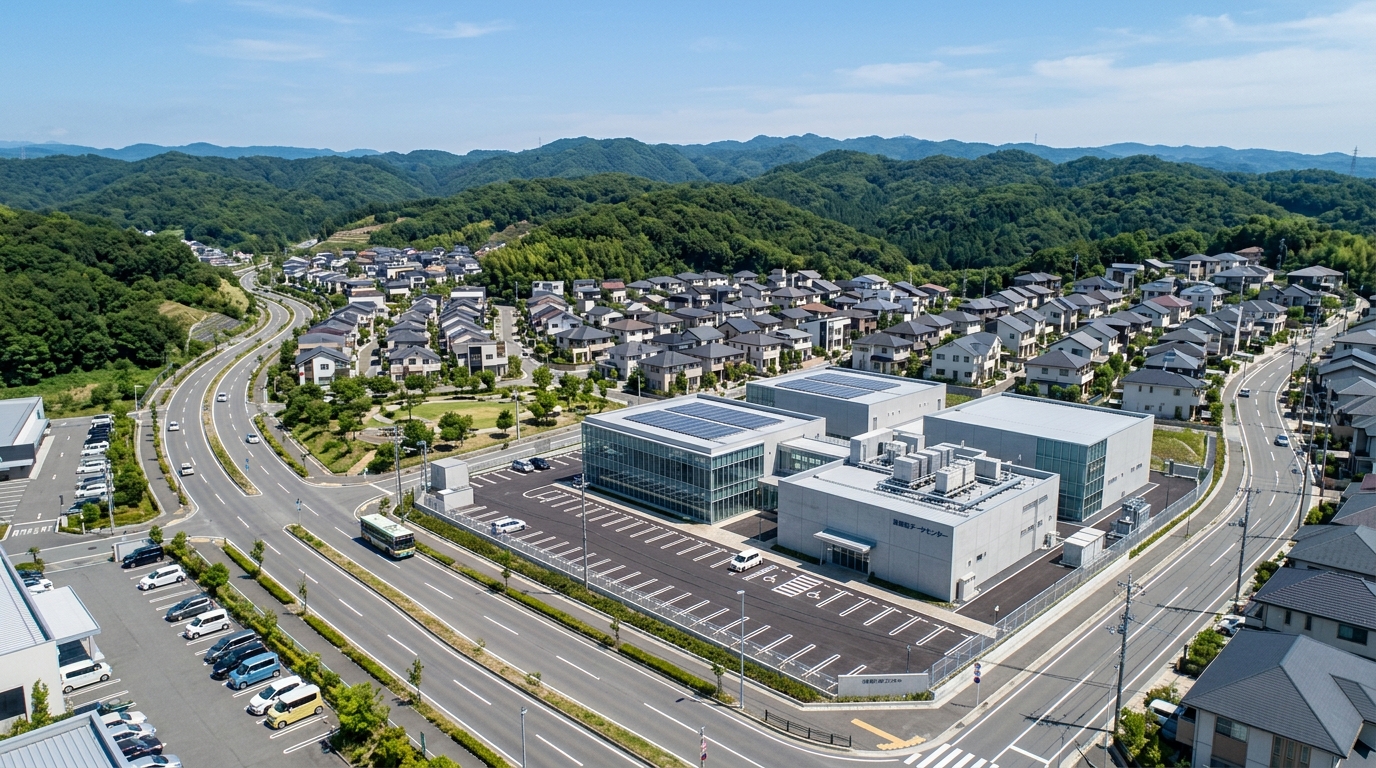
As of 2026, "Data Centers" (DCs) reign as one of the most spotlighted asset classes in the Japanese real estate market. With the explosive adoption of generative AI and the expansion of cloud services, the demand for digital infrastructure is surging at an unprecedented scale. Amidst this trend, the Saito (彩都) and northern areas of Ibaraki City (茨木市) in Osaka Prefecture (大阪府) are rapidly transforming into one of the Kansai region's largest DC hubs.
The concentration of massive digital infrastructure supporting next-generation industries goes far beyond localized industrial development. It drives job creation, improves surrounding infrastructure, and attracts related businesses, creating a profound ripple effect on real estate prices—from neighboring commercial plots to residential areas. In this article, we thoroughly analyze the impact of northern Ibaraki City's data center development on local land prices and the future outlook for asset values in real estate investment, using the latest real estate transaction data, urban planning details, and hazard information from a professional perspective.
[Investment Judgment Summary (Conclusion)]
- Overwhelming Demand for Industrial Land and Baseline Price Increases: Backed by solid ground and an extensive transportation network such as the New Meishin Expressway (新名神高速道路), the development of hyperscale DCs is heavily concentrated here. Acting as a catalyst, this continues to drive up price levels for both commercial and residential land across the entire city.
- Positive Ripple Effects on the Surrounding Residential Market: Supported by robust transportation infrastructure at JR Ibaraki Station (JR茨木駅)—boasting over 88,000 passengers daily—and excellent medical and educational environments, the demand for practical and investment residential properties driven by job creation remains exceptionally resilient.
- Strict Assessment of Hazard Risks is Essential: While the northern hilly areas where DCs are located offer high safety, some downtown areas face flood risks with maximum inundation depths of 3 to 5 meters. When acquiring real estate, micro-level site selection and risk hedging will dictate the success or failure of the investment.
1. Ibaraki City and the Saito Area: Transforming into Kansai's Largest Data Center Hub
Located in the northern part of Osaka Prefecture, Ibaraki City has long thrived as a key transportation junction. Today, the hilly terrain stretching from the northern Saito area to the inland parts of the city is undergoing a dramatic evolution into a "next-generation industrial hub," which can be considered the heart of the Kansai economic zone. At the core of this transformation is the concentration of large-scale data centers (DCs) built by foreign cloud vendors and major domestic telecommunications companies.
The city's fundamental potential is exceptionally high. Its main access point, Ibaraki Station operated by the West Japan Railway Company (西日本旅客鉄道), handles 88,183 passengers daily. This ranks among the top major stations in Osaka Prefecture, demonstrating how robust transportation infrastructure underpins the city's vitality.
To gauge the current momentum of Ibaraki City's real estate market, let's look at the latest transaction overview based on data from the Ministry of Land, Infrastructure, Transport and Tourism.
[Table: Overview of Real Estate Transactions in Ibaraki City, Osaka Prefecture (Period: 2021–2025)]
| Metric | Actual Data Value | Notes / Analysis |
|---|---|---|
| Target Area | Ibaraki City, Osaka Prefecture (City Code: 27211) | A regional hub located between Osaka and Kyoto |
| Target Period | 2021–2025 | Coincides with the period when DC development went into full swing |
| Sample Size | 4,896 transactions | Ensures sufficient liquidity to analyze market conditions |
| Average Transaction Price | Approx. 42.35 million JPY | Overall average, including residential and commercial properties |
| Median Transaction Price | 31.00 million JPY | Indicates the primary volume zone of actual market prices |
| Average Unit Price | Approx. 230,000 JPY/sqm | A benchmark for average land valuation across the city |
(Created based on actual acquired data. Transaction prices are rounded off.)
As the data shows, there is a rich track record of 4,896 transactions over the past few years, indicating high market liquidity. With an average transaction price of approximately 42.35 million yen and a median of 31 million yen, a healthy market has formed, attracting a wide range of players from end-users to investors. The massive capital injection into data centers is strongly backing the "growth expectations" underlying these active real estate transactions.
💡 Want to know more detailed average prices and yield rates by area? Check out undisclosed latest transaction data and area reports 👉
2. Why Northern Ibaraki City is Chosen: Solid Ground and Power Infrastructure Essential for DCs
In selecting a location for data centers, the most critical factors are "resilience against natural disasters" and a "high-capacity, stable power supply network." The primary reason the Saito area in northern Ibaraki City is chosen is that it clears these stringent conditions at a very high level.
Being a hilly area situated at a high elevation and maintaining a certain distance from active faults allows it to physically avoid flood risks—an absolute requirement for hyperscale DCs that must operate 24/7/365 without interruption.
On the other hand, as a real estate investor, you must be cautious about the hazard risks in the "downtown areas" of Ibaraki City. According to actual data retrieved from the system near the center of Ibaraki City, while the risk of sediment-related disasters is evaluated as "No Risk" (phenomenon field blank), the flood risk is assessed as "Present," with a maximum inundation depth rank of "3 (3 to 5 meters)."
An inundation depth of 3 to 5 meters is extremely dangerous, with water reaching from just below the eaves of the second floor to the floor level of the third floor in a typical building. Just because the northern hills are highly resistant to floods does not mean you should blindly assume the entire city is safe. When purchasing real estate such as apartments, condominiums, or commercial buildings in the downtown area, it is vital to verify this flood risk. Strict pre-purchase risk hedging, such as placing electrical equipment on higher floors and selectively investing in safe zones designated on hazard maps, is indispensable.
💡 Do you know the exact hazard risks of the property you are considering? Diagnose pinpoint flood and landslide risks on the map 👉
3. The New Meishin Expressway and Wide-Area Transport Networks Boosting the Next-Generation Industrial Hub
Another major driving force behind the concentration of data centers is the dramatic improvement of the wide-area transportation network. Notably, the opening of the New Meishin Expressway (including the launch of the Ibaraki-Sendaiji IC) has completely transformed the value of northern Ibaraki City, including the Saito area, as industrial land.
Locations directly connected to expressway interchanges enable the transport of heavy materials during DC construction, the replacement of server equipment post-operation, and swift access for maintenance personnel. Triggered by the completion of this transportation infrastructure, the development of the next-generation industrial hub has rapidly progressed along the following timeline.
[Redevelopment Timeline of Northern Ibaraki City / Saito Area]
| Year | Development / Infrastructure Phase | Impact on Real Estate Market |
|---|---|---|
| 2018 | Opening of New Meishin Expressway (Takatsuki JCT - Kawanishi IC) | Established wide-area access for industrial use; accelerated land acquisition by developers |
| 2022 | Full-scale industrial land preparation in the Eastern Saito District | Alongside logistics facilities, large-scale zoning and infrastructure setup for DCs progressed |
| 2024 | Construction rush of hyperscale DCs for major cloud vendors | Emergence of construction boom; clear upward trend in surrounding commercial land prices |
| 2026 (Current) | Initial operation of multiple DCs; accelerated clustering of related businesses | Increased housing demand due to job creation; higher demand for retail space in nearby commercial zones |
| 2028 (Planned) | Full operation of DCs supporting next-gen communication standards (6G, etc.) and AI infrastructure | Completion as one of Kansai's premier digital industry hubs; long-term stabilization of real estate value |
Thus, 2026 is a critical turning point as the area transitions from the "infrastructure development phase" to the "full-scale operation and clustering phase." Understanding this timeline helps investors formulate strategies on whether to target capital gains or focus on income gains.
💡 Analyze the correlation between future redevelopment schedules and land price increases with our proprietary data! Request an AI report predicting the area's future potential 👉
4. Upward Trend in Commercial Land Prices in Surrounding Areas Driven by Industrial Development
Naturally, massive capital investments in the Saito and northern areas are exerting strong upward pressure on land prices in surrounding districts. Let's decode this trend backed by actual real estate transaction data.
The graph below visualizes actual transaction data within Ibaraki City retrieved for this analysis (a sample from Q1 2021).
Looking at specific transaction samples, we can confirm trades of land with potential for commercial or investment use. For instance, a transaction for residential land (land only) in the Ushitora (丑寅) area was recorded at approximately 30 million yen for 240 sqm (unit price of about 130,000 JPY/sqm). This land is designated as a "Category 2 Residential Zone" with a building coverage ratio of 60% and a floor area ratio (FAR) of 200%, specifications that allow for the construction of decent-sized offices or apartment buildings.
Additionally, in the Kamichujo (上中条) area, a 100 sqm plot of residential land (land only) was traded for approximately 26 million yen (unit price of about 270,000 JPY/sqm). This falls under a "Category 2 Mid/High-Rise Exclusive Residential Zone" (60% coverage, 200% FAR), and its closer proximity to the city center reflects the higher unit price.
It should be noted that the individual samples extracted this time are mostly from "Q1 2021," and there are cases where some data fields, such as construction year and floor plan, are left null (blank). When recent public transaction data is sparse for specific areas, or when data heavily reflects unique individual circumstances, investors must use these figures as a baseline while conducting meticulous comparisons with current 2026 neighborhood market rates and up-to-date site surveys before making investment decisions.
💡 Check not just past data, but real-time listing market prices! Consult us for off-market property information and commercial land before it goes public 👉
5. Ripple Effects on Surrounding Residential Land and Condo Markets from Job Creation and Infrastructure Growth
While data centers themselves require relatively few on-site staff once operational, the enormous demand during the construction phase and the subsequent influx of related industries—such as IT vendors, maintenance companies, and security firms—create significant local employment. This has resulted in a strong positive impact on Ibaraki City's practical housing and rental condominium markets.
Looking at actual data, there is a transaction case in the Shuharacho (主原町) area where a 135 sqm residential property (land and wooden building, built in 2021) was sold for approximately 50 million yen (Category 1 Residential Zone, 60% coverage, 200% FAR). In the Oda (太田) area, multiple transactions for residential properties (both land only, and land with buildings) ranging from 85 sqm to 140 sqm were completed between 17 million and 25 million yen (some cases hitting a unit price of around 180,000 JPY/sqm). This clearly indicates robust demand from families seeking a quality living environment within a Category 1 Mid/High-Rise Exclusive Residential Zone.
Furthermore, Ibaraki City boasts highly developed lifestyle infrastructure to support its residential environment. Educationally, public school districts like Hozumi Elementary School (穂積小学校) and Seiryo Junior High School (西陵中学校) are well-established, encouraging the influx of child-rearing households. Most notably, the medical environment is exceptionally rich; according to our research data, there are as many as "56 medical facilities" around the target area. A diverse array of medical infrastructure is densely packed, ranging from comprehensive hospitals like Tanigawa Memorial Hospital (Medical Corporation Tokuseikai) (谷川記念病院(医療法人篤靜会)) and Nisshokai Hospital (Medical Corporation Nisshokai) (日翔会病院(医療法人社団日翔会)) to community-based clinics like Ibaraki Clinic (Public Interest Incorporated Foundation Yodogawa Workers Welfare Association) (茨木診療所(公益財団法人 淀川勤労者厚生協会附属)).
The fusion of advanced industrial clusters with such high-quality lifestyle infrastructure is the primary factor establishing the resilient floor of residential land prices in Ibaraki City.
💡 Simulate optimal rent for family-oriented rentals based on school districts and medical facility density! Try our micro-area analysis tool designed for residential investments 👉
6. Urban Planning in the Saito Area and the Latest Trends in Eco-Friendly Data Center Development (2026)
An unavoidable theme in real estate development in 2026 is "Environment (ESG)." Particularly in data center development, which consumes vast amounts of electricity and generates significant waste heat, harmonizing with the surrounding environment and utilizing renewable energy have become major challenges in urban planning.
Ibaraki City's urban planning employs flexible and strategic zoning to accommodate these next-generation industries. According to the acquired environmental data, specific "Neighborhood Commercial Zones" within Ibaraki City permit highly intensive land use, with a building coverage ratio of "80%" and a floor area ratio (FAR) of "400%." This allows for highly efficient facility operations through high-rise and high-density construction even on limited plot sizes.
At the same time, developments in hilly terrains like the Saito area are subject to strict eco-friendly mandates. Regulations ensuring green space ratios and design guidelines based on landscape ordinances are enforced to prevent massive, sterile infrastructure facilities from destroying the surrounding natural and residential environments. From an investor's perspective, real estate that considers these ESG factors (such as Green Buildings) is a highly promising investment target, as it garners higher valuations (Green Premiums) from institutional investors during future tenant leasing or property exits.
💡 Keep an eye on the latest administrative trends, such as FAR relaxations and planned urban planning changes! Check the real estate development potential map linked with urban planning maps 👉
7. A B2B Real Estate Investment Perspective: Asset Allocation Around Next-Gen Industrial Hubs
Given the transformation of Ibaraki City and the Saito area we have explored so far, how should professional B2B real estate investors structure their asset allocation?
First, while data centers themselves are battlegrounds for REITs and foreign funds with massive capital, individual investors and mid-sized corporate entities should strategize to capture the "spillover demand" in the surrounding areas.
- Satellite Offices and Workspaces for Related Companies: Small-to-medium offices for IT companies handling DC maintenance and operations. Developing properties utilizing the aforementioned "Neighborhood Commercial Zones (400% FAR)" is an effective approach.
- Residences for Employees (Rental Condominiums): Family and single-occupancy residences in downtown areas equipped with medical infrastructure (56 facilities) and educational environments, as mentioned above. The average transaction price of around 42.35 million yen and a median of 31 million yen shown in the actual data are highly accessible sizes even for individual investors.
- Logistics and Trunk Rooms (Self-Storage): Securing last-mile logistics hubs leveraging access to the New Meishin Expressway.
However, as pointed out in Section 2, the "flood risk" of up to 3 to 5 meters in downtown areas must be evaluated by adding an appropriate risk premium when calculating the investment yield (cap rate). Investing in high-hazard areas entails risks such as increased fire insurance (water damage coverage) costs and reduced liquidity during the exit strategy. Thus, rigorous assessment is required to determine whether the property price is sufficiently undervalued compared to the market.
💡 What is the risk-adjusted expected yield calculation method practiced by professional investors? Create your own business plan using our investment simulation feature 👉
8. Conclusion: Future Potential and Real Estate Asset Value Outlook for Ibaraki City and the Saito Area
The Saito area and northern Ibaraki City in Osaka Prefecture have awakened as one of Kansai's largest data center hubs. The combination of hard infrastructure advantages—solid ground and wide-area transport networks—with the soft appeal of excellent medical and educational infrastructure has solidified its position as a next-generation industrial hub.
As the massive volume of 4,896 transaction data points indicates, the real estate market in this area is already booming, and the average price level of roughly 42.35 million yen is likely to be pushed even higher in the future. Simultaneously, it is a market that demands cool-headed investment judgments based on meticulous data analysis more than ever before—whether it’s grasping market prices in localized areas with sparse data or avoiding flood hazard risks that can reach up to 3 to 5 meters.
As of 2026, transitioning from infrastructure development to full-scale operations, Ibaraki City's real estate market is right in the transitional phase from "sowing seeds" to "harvesting fruits." By intersecting macro industrial trends with micro location data, investors will surely be able to uncover the true asset value dormant in this area.
By registering for a free membership, you will be able to pull and analyze Ministry of Land, Infrastructure, Transport and Tourism real estate transaction data and hazard information—just like those utilized in this article—directly from your Claude or ChatGPT via the MCP integration feature. Why not seamlessly continue your in-depth research into the areas you care about using your own AI tools?