
With the rapid spread of generative AI and the expansion of cloud services, the search for suitable locations for data centers (DCs) in Japan has intensified. Amidst this, the Ishikari Bay New Port (石狩湾新港) area in Ishikari City (石狩市), Hokkaido (北海道), is currently drawing the most attention as a next-generation industrial hub in 2026.
In this article, an expert real estate analyst provides an in-depth look at the current state of the Ishikari area—which is accelerating its DC attraction efforts by maximizing its abundant renewable energy and cold climate. We will also explore the resulting land price trends for surrounding real estate and industrial sites, backed by actual data from the Ministry of Land, Infrastructure, Transport and Tourism (国土交通省).
[Investment Decision Summary]
- Upward trend in land prices: Based on transaction data from 2021 to 2025 (1,521 cases), the average transaction price is approximately 17.74 million JPY, with the highest reaching 980 million JPY, indicating a massive influx of investment primarily into industrial land.
- Advantage of renewable energy & cold climate: The reduction in power consumption through free cooling (using outside air) and a 100% renewable energy supply system, including offshore wind power, perfectly align with the DC location requirements of global companies prioritizing ESG investments.
- Ripple effects on residential areas: Job creation driven by the concentration of DCs has led to solid demand for family-oriented detached houses and low-rise apartments in surrounding residential areas such as Tarukawa (樽川) and Hanakawa-kita (花川北), where the average unit price is about 31,000 JPY/sqm.
- Infrastructure risks and challenges: Since the railway network is undeveloped (no data on the nearest station), land use and parking allocation based entirely on a car-dependent society are essential.
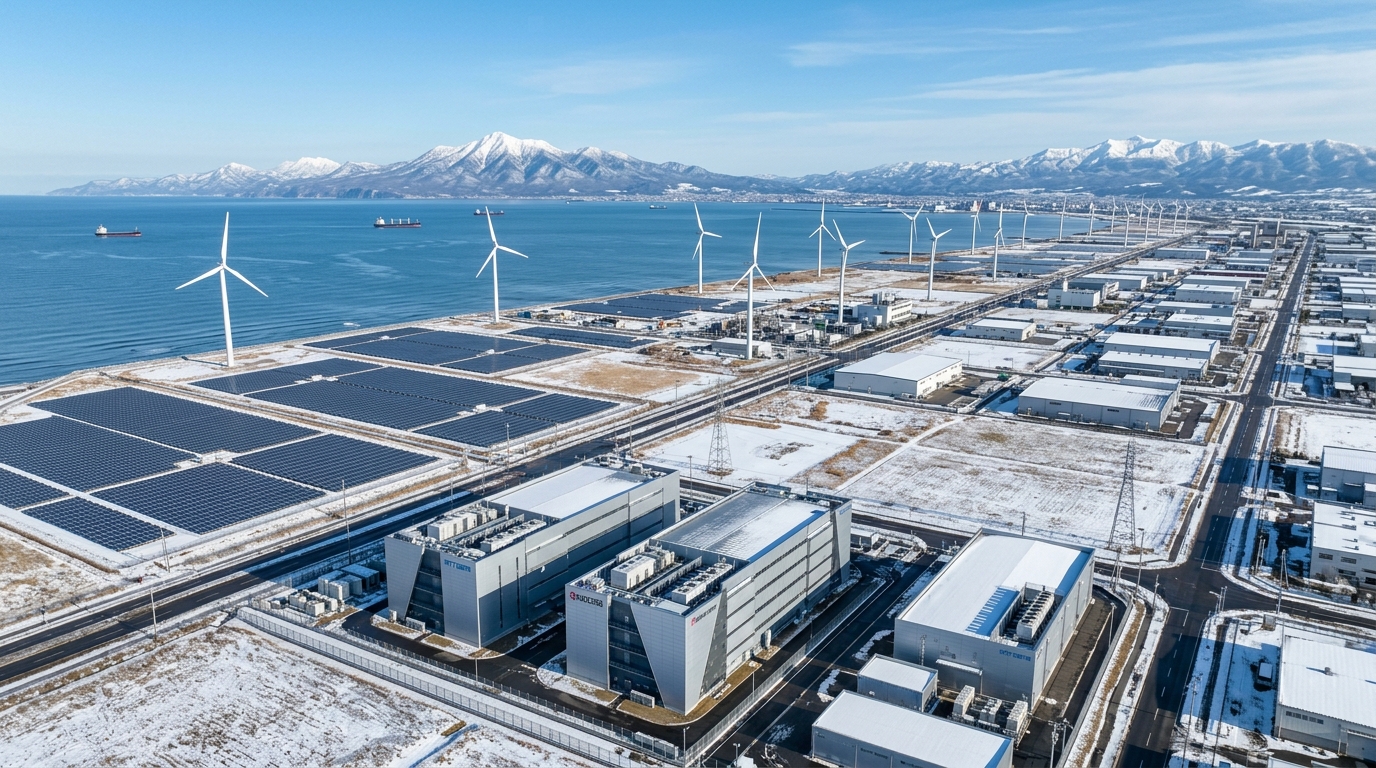
1. Introduction: Ishikari City, Hokkaido, Making Great Strides as a Data Center Hub in 2026
As of 2026, Ishikari City is establishing a massive presence in the real estate market as the new heart of Japan's digital infrastructure. While the area around Ishikari Bay New Port was once characterized by vast expanses of unused land, recent years have seen a flurry of announcements and executions of large-scale DC development projects by domestic and international IT giants and infrastructure companies.
From a real estate investment perspective, data centers are a unique asset class requiring extensive land and enormous amounts of power. Unlike typical logistics facilities or factories, site selection heavily prioritizes "redundancy of communication infrastructure," "stable and green power supply," and "cooling efficiency." Ishikari City meets these conditions at an exceptionally high level, transforming itself from a mere industrial park in a regional city into one of Japan's premier "next-generation industrial hubs."
Note: If you are interested in unlisted property information and detailed area reports for the Ishikari region, be sure to check the latest trends using the Mekiki Research analysis tool so you don't miss out on investment opportunities.
2. Why the Ishikari Bay New Port Area is Chosen: The Strengths of a Cold Climate and 100% Renewable Energy Supply
Why are data centers congregating in the Ishikari area right now? The reasons can be broadly summarized into two main points.
First is the uniquely cold climate of Hokkaido. A significant portion of a data center's running costs comes from server cooling expenses (air conditioning power). In the Ishikari area, "free cooling systems"—which directly draw in cool outside air to chill servers—can operate for much of the year, drastically improving the Power Usage Effectiveness (PUE) metric.
Second is the abundant supply potential of renewable energy. Driven by recent trends in ESG investing, global companies are committing to running their data centers on "100% renewable energy." At Ishikari Bay New Port, one of Japan's largest offshore wind farms is currently operational, and a local production and consumption model for clean energy—combining solar and biomass power generation—is being established. This makes Ishikari an ideal location for foreign cloud vendors and major telecom carriers seeking environmental value.
Note: When looking for suitable development sites for ESG-compliant real estate, a future investment theory will be to prioritize screening areas directly connected to renewable energy supply networks.
3. Recent Trends in Data Center Development and Attraction Projects Around Ishikari City
A chronological timeline of redevelopment and data center concentration in the Ishikari area illustrates the rapid evolution of this region.
[Timeline of the Ishikari Bay New Port Area's Transformation into a Next-Generation Industrial Hub]
- Before 2022: Initial data center establishment in the Ishikari Bay New Port area began. Demonstration experiments utilizing the vast land progressed.
- 2023: The offshore wind farm at Ishikari Bay New Port officially commenced commercial operations, establishing a baseload for renewable energy supply.
- 2024: A succession of major telecom carriers and foreign IT companies began construction and partial operation of "100% renewable energy data centers."
- 2025: Construction progressed on landing stations for new submarine communication cables connecting Honshu (本州) and Hokkaido. Redundancy (backup capabilities) of communication infrastructure was strengthened.
- 2026 (Present): As data center clusters begin operations, the influx of related companies is accelerating. The upward trend in land prices for surrounding industrial and residential areas has become evident.
- 2030 (Projected): Completion of a digital infrastructure vision encompassing all of Hokkaido. Ishikari functions as a critical data hub in the Asia-Pacific region.
As demonstrated, the medium- to long-term asset value of the Ishikari area is being bolstered by comprehensive infrastructure development that integrates power, communications, and real estate, rather than just isolated development projects.
Note: Building an investment exit strategy aligned with the redevelopment timeline is essential. Be sure to continuously monitor future infrastructure operational status using data from Mekiki Research and other sources.
4. Land Price Trends for Industrial Sites: The Price Surge in the Ishikari Bay New Port Area Driven by Soaring Demand
How is the accelerated attraction of data centers impacting local land prices? Let's take a look at actual transaction data (covering 2021 to 2025) for Ishikari City (cityCode: 01235) obtained from the Mekiki Research system.
[Summary of Real Estate Transaction Data in Ishikari City (2021-2025)]
| Item | Value / Data |
|---|---|
| Number of Transaction Samples | 1,521 cases |
| Average Transaction Price | Approx. 17.74 million JPY |
| Median Transaction Price | 11.00 million JPY |
| Highest Transaction Price | 980 million JPY |
| Average Unit Price | Approx. 31,000 JPY/sqm |
The most crucial takeaway from this data is the sheer volume of activity—1,521 transactions during the target period—and the fact that the highest transaction price reached 980 million JPY. This strongly suggests that these are not typical trades for detached homes or small apartments, but rather acquisitions of industrial land by large commercial funds and developers for data centers and related logistics facilities.
On the other hand, extremely inexpensive transactions are occasionally seen, such as 500,000 JPY for 1,900 sqm or 50,000 JPY for 190 sqm in forest areas like Atsuta-ku Mourai (厚田区望来). Investors must note that even within Ishikari City, a severe polarization in real estate values is occurring between the well-equipped New Port area and the distant, undeveloped forest lands.
Note: To accurately assess this price polarization by area, it is essential to analyze zoning and infrastructure development from a micro perspective.
5. Ripple Effects on the Surrounding Real Estate Market from Job Creation and Infrastructure Development
The concentration of data centers not only drives up industrial land prices but also brings undeniable ripple effects to the surrounding housing market. This is because the influx of highly skilled IT personnel responsible for facility operations and maintenance, along with employees of related infrastructure companies, generates new housing demand.
Looking at the actual data, we can confirm active residential land transactions in Ishikari City's urban and residential areas, such as around Tarukawa and Hanakawa-kita. For example, a 530 sqm residential plot in Tarukawa 5-jo sold for 12 million JPY (approx. 23,000 JPY/sqm), a 280 sqm plot in Hanakawa-kita 2-jo for 9 million JPY (approx. 32,000 JPY/sqm), and a 260 sqm plot in Hanakawa-kita 4-jo for 8 million JPY (approx. 31,000 JPY/sqm). These areas are designated as "Category I Exclusively Low-story Residential Zones" (Building Coverage Ratio 40% / Floor Area Ratio 60%, or BCR 50% / FAR 80%) and "Category II Exclusively Low-story Residential Zones," ensuring the preservation of quiet residential environments.
In terms of the living environment, school districts including Hanakawa Elementary School (花川小学校) and Hanakawa Junior High School (花川中学校) are established. Medical institutions, such as the Medical Corporation Shuyu-kai Ishikari Neurosurgical Clinic (医療法人秀友会いしかり脳神経外科クリニック), are also present. However, it should be noted that the number of medical institutions in our acquired data sample is limited to just one.
Moreover, the "lack of railway access" is a critically important factor for investment decisions. As evidenced by the nearest station information (station name, operating company, passenger volume) all showing up as null in public transaction data, the Ishikari area lacks direct railway connections and relies entirely on a car and bus-centric transportation network. Therefore, securing at least two parking spaces per household is an absolute prerequisite when undertaking residential development or apartment investment.
Furthermore, let us touch on hazard information. The location data acquired this time indicates "no risk" for both flood risk (hasRisk: false) and landslide risk (hasRisk: false). Nonetheless, we strongly advise readers to always check the latest hazard maps issued by the local municipality and personally verify the risks of surrounding lowlands and river flooding before purchasing any real estate.
Note: When considering investments in residential real estate, be sure not to neglect parking layouts tailored to a car-dependent society and the verification of the latest hazard maps.
6. Comparative Analysis of the Ishikari Area with Other Data Center Hubs (Inzai, Wakamatsu, etc.)
When it comes to data center hubs in Japan, Inzai City (印西市 - Chiba New Town) in Chiba Prefecture boasts overwhelming name recognition. With excellent access to central Tokyo and solid ground conditions, Inzai City is packed with mega data centers for financial institutions and cloud vendors, which has triggered a surge in land prices.
In western Japan, Wakamatsu Ward (若松区 - around the Kitakyushu Science and Research Park) in Kitakyushu City, Fukuoka Prefecture, is advancing DC attraction efforts armed with renewable energy and industry-academia collaborations.
Compared to these pioneering hubs, the Ishikari area's greatest differentiating factors are undeniably the "drastic reduction in cooling costs due to the overwhelmingly cold climate" and "physical proximity to large-scale offshore wind power generation." Land prices in Inzai City have already peaked, making the barrier to new entry extremely high. In contrast, the Ishikari area still offers a sense of affordability compared to the Tokyo metropolitan area, with an average unit price of approximately 31,000 JPY/sqm (an average that includes residential areas). Although it has a weakness in distance from Honshu (latency), the latency issue is gradually being resolved through the installation of submarine cables, giving Ishikari the potential to be upgraded from a "backup hub" to a "primary hub."
Note: Conducting a relative comparison with other DC hubs allows you to objectively grasp which growth phase the Ishikari area is currently in.
7. Future Outlook: Asset Value as a Next-Generation Industrial Hub and Medium- to Long-Term Investment Risks
Beyond 2026, real estate asset values around Ishikari Bay New Port are projected to remain solid, linked to the operational status of data centers and the associated growth of the renewable energy industry. In particular, industrial land capable of receiving extra-high voltage power—which allows for massive electricity intake—is highly likely to be traded at premium prices in the future.
At the same time, medium- to long-term investment risks must be analyzed objectively. First is the "time lag in infrastructure development." It takes several years of lead time from when a DC plan is announced to when it actually begins operations and employment stabilizes. There is a risk that, despite acquiring land early on, surrounding infrastructure (such as easing traffic congestion or attracting commercial facilities) may not keep pace, resulting in lower-than-expected yields. Second is "interest rate trends." Because large-scale real estate development is highly sensitive to interest rates, one should always bear in mind the concern that rising interest rates following a shift in the Bank of Japan's monetary policy could squeeze developers' financing costs and slow down the pace of development.
Note: Minimizing investment risks requires the research capability to simultaneously track macroeconomic trends and micro-level area infrastructure development.
8. Conclusion: The Future of the Ishikari Real Estate Market Driven by Renewable Energy and Digital Infrastructure
In this article, we have explored the attraction of data centers and land price trends in the Ishikari Bay New Port area of Ishikari City, Hokkaido.
- As evidenced by a track record of 1,521 transactions and large-scale deals reaching up to 980 million JPY, the influx of investment money into Ishikari is genuine.
- The cold climate and 100% renewable energy supply, including offshore wind power, align perfectly with the ESG strategies of global corporations.
- Ripple effects are also visible in surrounding residential areas such as Tarukawa and Hanakawa-kita (unit prices around 20,000 to 30,000 JPY/sqm), creating residential environments with generous floor area and building coverage ratios.
- However, recognizing that it is a car-dependent society with no railway network, and always verifying the latest hazard maps before making a purchase, are absolute prerequisites for sound real estate investment.
The Ishikari area, where renewable energy and digital infrastructure converge, is a unique and highly promising next-generation industrial hub within the Japanese real estate market. Making investment decisions based on accurate data during this period of transformation will likely lead to significant future returns.
For more detailed analysis or data extraction tailored to your own investment strategy, please take advantage of Mekiki Research. By registering for a free membership, you can pull the Ministry of Land, Infrastructure, Transport and Tourism data used in this blog directly from your Claude or ChatGPT (via MCP integration). We invite you to experience a professional research environment where you can seamlessly continue your investigations with your own AI.
Check the latest land price and hazard information for Ishikari City, Hokkaido on Mekiki Research 👉