
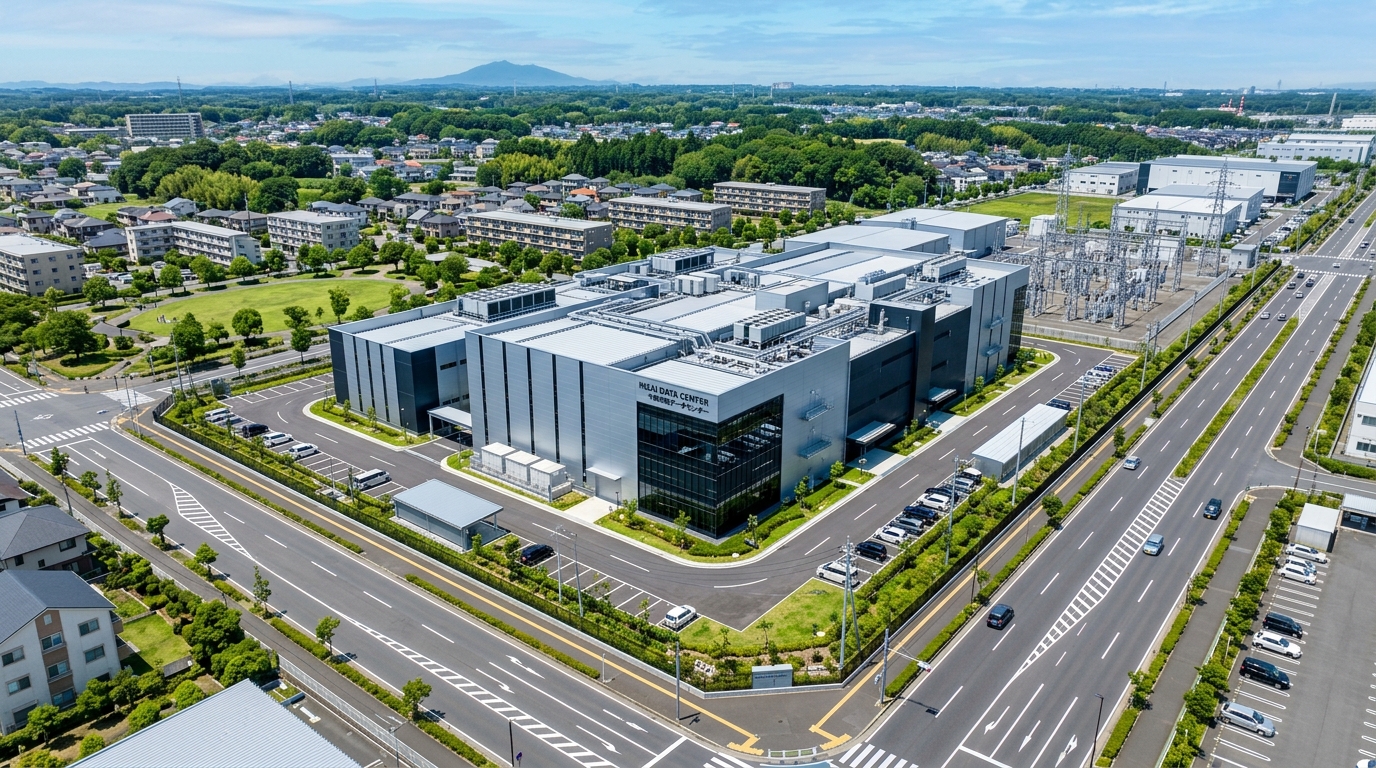
Inzai City, Chiba Prefecture (千葉県印西市). Once known as the sprawling commuter town "Chiba New Town (千葉ニュータウン)," this city is currently undergoing a dramatic transformation into one of the world's leading data center hubs. As of September 2026, major foreign cloud vendors and leading domestic telecom carriers are continuously expanding their massive data centers. The enormous infrastructure investments accompanying this expansion are creating significant ripple effects across the local real estate market.
In this article, we will thoroughly examine the land price trends in Inzai City—a rapidly growing hub for next-generation industries—and the impact on surrounding logistics sites and housing demand. Our analysis is backed by the latest actual transaction records based on public data from the Ministry of Land, Infrastructure, Transport and Tourism (国土交通省, MLIT). Where does the true asset value of this area lie for real estate investors and developers? We will unravel this from the perspective of a professional real estate analyst using objective data.
■ Investment Decision Summary (Conclusion)
- Solid Trading Market and High Liquidity: A robust market has formed, with an impressive 2,725 actual transactions confirmed between 2021 and 2025. The average transaction price stands at approximately 31.74 million yen, with a median of about 26 million yen.
- Solid Ground and Zero Hazards: The exceptionally stable ground, with zero risk of floods or landslides, strongly supports the concentration of data centers and logistics facilities.
- Ripple Effects of Infrastructure Development: Dramatic enhancements in power and telecommunications networks are accelerating the development of next-generation logistics facilities in surrounding industrial zones (60% building coverage ratio, 200% floor area ratio). This has even led to massive commercial land transactions peaking at 4.6 billion yen.
- Polarization of Housing Demand and Solid Actual Demand: While commercial areas lack everyday amenities, existing residential neighborhoods like Uchino (内野), Otsuka (大塚), and Oguradai (小倉台) present solid actual demand from families—driven by an increasing workforce—and prime opportunities for renovation investments.
1. Why Inzai City, Chiba? The Background of a Global Data Center Hub
In recent years, global mega-tech companies such as Amazon Web Services (AWS), Google, and Microsoft have unanimously chosen Inzai City, Chiba Prefecture as their data center base in Japan. The biggest reasons for this are the area's overwhelming "ground stability" and "low disaster risk."
Looking at the latest data for Inzai City (Latitude: 35.7825, Longitude: 140.1456) obtained from the backend system of "Mekiki Research (物件目利きリサーチ)"—which utilizes sources like the Geospatial Information Authority of Japan (国土地理院, GSI) Hazard API—it clearly shows no flood risk (maximum inundation depth rank) and no landslide risk (phenomenon). In real estate investment, being "hazard-free" is an absolute prerequisite, especially for data center developments that require non-stop operation of precision equipment like servers, which are highly sensitive to heat and vibration.
Furthermore, its close physical proximity—within a 40 km radius of central Tokyo—and excellent access to Narita International Airport (成田国際空港) are highly attractive to foreign companies. The geographical advantage of being close to the coastal areas of Chiba Prefecture, where submarine cable landing stations are located, minimizes communication latency and has propelled Inzai City into a global data center hub.
(*You can directly check the latest land price trends and off-market property data, including for Inzai City, through the system linked at the end of this article.)
2. Large-Scale Data Center Expansion Projects and Latest Development Trends as of 2026
Even as of 2026, the data center development rush in Inzai City shows no signs of slowing down. With the explosive spread of generative AI, there is a rapidly growing demand for ultra-high-power data centers to house GPU servers with massive computational capabilities.
Below is a timeline of large-scale redevelopment and infrastructure improvements in and around Inzai City:
- 2022–2023: Full-scale operation of the phase 1 data center clusters by foreign hyperscalers.
- 2024–2025: Construction and completion of large-scale backup hubs by domestic mega-banks and telecom carriers.
- 2026 (Present): An expansion rush of next-generation, high-density data centers accommodating GPU servers for AI.
- 2028 (Scheduled): Planned completion of surrounding arterial road expansions and next-generation smart grids (power transmission networks).
According to the acquired data, the zoning of the central development area is designated as an "Industrial Zone (工業地域)," providing a generous regulatory framework of a 60% building coverage ratio and 200% floor area ratio for large-scale construction. This enables the construction of massive server farms that maximize the use of vast plots of land, indicating a highly flexible investment environment for developers.
(*Investment analysis based on specific zoning data around the development area is constantly updated on Mekiki Research.)
3. Exponential Infrastructure Development Driven by Data Center Concentration
The concentration of data centers does more than just dot the landscape with massive facilities; it dramatically upgrades the infrastructure environment of the surrounding area. It is said that a single giant data center consumes as much electricity as an entire regional city.
Therefore, infrastructure companies like Tokyo Electric Power Company (東京電力, TEPCO) are rapidly constructing new extra-high voltage substations and laying high-capacity transmission lines around Inzai City. Regarding telecommunications infrastructure, the multiplexing of dark fiber (unused optical fiber lines) and the advanced deployment of 5G/6G base stations are underway, building one of the top-tier communication environments in Japan.
The establishment of these "thick pipelines of power and communication" serves as a powerful fundamental factor that fundamentally supports real estate asset values. While the direct benefits to standard residential housing might be limited, the potential as industrial land has grown immeasurably. This is the driving force behind the rising land prices of surrounding plots, which will be discussed later.
(*Detailed area reports forecasting surrounding land price increases driven by infrastructure development will be provided to members.)
4. Ripple Effects of Infrastructure Expansion on Surrounding Logistics and Commercial Sites
The development of robust power and communication infrastructure is also attracting other next-generation industries. The most prominent among these are "high-performance logistics facilities" that support the growing e-commerce (EC) market.
Modern logistics facilities incorporate numerous Automated Guided Vehicles (AGVs) and AI-driven inventory management systems, requiring immense amounts of electricity and stable high-speed communication networks. Inzai City's "Industrial Zone (60% building coverage, 200% floor area ratio)" is perfectly suited for developing these smart logistics hubs. Consequently, a synergistic effect is occurring, with large logistics warehouses being built one after another adjacent to data centers.
In fact, the transaction data (2,725 cases) acquired for the 2021–2025 period includes deals reaching a maximum transaction price of 4.6 billion yen. While extreme figures as low as "1,000 yen" have also been recorded—likely due to special factors like inheritance or private road burdens—the peak figure of 4.6 billion yen strongly suggests bulk transactions by institutional investors and funds for large-scale logistics or data center development sites, rather than ordinary residential trades.
(*The latest transaction examples of logistics and industrial land will be explained in detail in the data analysis section later in this article.)
5. Changes in Housing Demand and the Rental Market in the Chiba New Town Area Due to Workforce Growth
As industries concentrate, the number of commuting workers naturally increases, stimulating housing demand. However, the real estate market structure around the data center areas in Inzai City is showing a somewhat unique polarization.
Looking at the environmental data acquired this time, the "nearest station name" and "station passenger count" near the target location (Latitude: 35.7825, Longitude: 140.1456) are null (no data), and the "number of medical institutions" is also 0. This is not due to missing data; it frankly reflects the reality specific to suburban industrial areas, where large-scale industrial zones are "zoned to specialize in industrial infrastructure rather than residential or lifestyle infrastructure." In other words, the very heart of the development area is a pure business and industrial zone designed around car commuting.
On the other hand, as confirmed by school district data showing "Funaho Elementary School (船穂小学校)" and "Funaho Junior High School (船穂中学校)," mature residential neighborhoods dating back to the Chiba New Town era spread out just a short distance from the industrial zone. With the influx of high-income earners such as engineers and management staff for data centers and logistics facilities, demand for family-oriented condos and single-family homes—assuming car commuting—remains solid in surrounding commuter towns (like Uchino, Otsuka, and Oguradai).
(*Area data regarding school districts and lifestyle amenities are also comprehensively covered in our system as vital indicators for investment decisions.)
6. Latest Land Price Trends and Specific Real Estate Transactions Around Inzai City
Now, let's closely analyze actual transaction data around Inzai City based on public data from the MLIT.
A substantial sample size of 2,725 cases has been confirmed around the target area during the 2021–2025 period. This indicates exceptionally high liquidity for a suburban area, proving that the market is highly active. In terms of the overall market sentiment, the average transaction price is approximately 31.74 million yen, the median is about 26 million yen, and the average unit price is roughly 70,000 yen/sqm.
The chart below visualizes the trend of selected actual transaction prices in Inzai City.
To look more specifically at the characteristics of the housing market by area, we have extracted notable examples from the acquired sample data.
| District Name | Property Type | Year Built | Area | Zoning | Transaction Price | Area Analysis & Investment Perspective |
|---|---|---|---|---|---|---|
| Uchino (内野) | Pre-owned Condo | 1984 | 60–80 sqm | Category 1 Medium-to-High-Rise Residential | 4.3–5.5 million yen | Approaching 40 years old, these RC (reinforced concrete) structures are affordable. Highly promising targets for high-yield investment by renovating and renting out to nearby single or DINKs workers. |
| Otsuka (大塚) | Residential Property (Land & Building) | 2008 | 190 sqm | Category 1 Low-Rise Residential | 32 million yen | Lightweight steel structure, 4LDK. The spacious regulations of a 40% building coverage ratio and 80% floor area ratio ensure a quiet, high-quality living environment. Prominent actual demand purchases by management-level professionals. |
| Oguradai (小倉台) | Pre-owned Condo | 1993 | 125 sqm | Category 1 Medium-to-High-Rise Residential | 17–22 million yen | The vast exclusive area of 125 sqm (3LDK+S, SRC structure)—unimaginable in central Tokyo—is highly attractive. Captures demand from demographics looking to secure telework spaces. |
As such, in Inzai City, while massive commercial land transactions worth billions of yen are taking place, diverse actual demand and investment opportunities coexist in existing residential areas—ranging from affordable pre-owned condos in the 4 million yen range to high-quality single-family homes in the 30 million yen range.
(*The actual transaction data above was obtained from "Mekiki Research." You can conduct your own research on the latest market fluctuations via the link at the end of this article.)
7. How to Utilize "Mekiki Research" to Assess the Asset Value of Next-Generation Industrial Hubs
In areas like Inzai City, where macro perspectives (investments by global corporations) and micro perspectives (localized zoning differences and infrastructure imbalances) intricately intertwine, precise data analysis is indispensable for real estate investment.
In particular, the hazard information mentioned in Chapter 1—"no flood risk" and "no landslide risk"—are paramount factors that must be verified before purchasing. As localized torrential rains increase due to climate change, correctly assessing hazard risks and selecting properties on safe ground directly translates to long-term asset protection, not only for data center operators but also for individual real estate investors.
Furthermore, as pointed out in this article, when data shows "distance from a station or the number of medical institutions is zero," one must not simply view it as a negative factor. Instead, it requires the ability to decipher the local context: "it is a specialized industrial area predicated on a car-centric society." By utilizing "Mekiki Research" and overlaying differences in zoning (Industrial Zone vs. Category 1 Low-Rise Exclusive Residential District), building coverage ratios, and floor area ratios on a map, you can clearly identify the "investment boundary"—determining which areas will grow as industrial land and which will retain their value as residential neighborhoods.
(*Properly assessing hazard risks leads to long-term asset protection.)
8. Conclusion: Future Real Estate Investment Outlook for the Data Center Hub, Inzai City
Armed with its solid ground, Inzai City, Chiba Prefecture has established a firm position as a global data center hub. The large-scale development continuing into 2026 brings exponential improvements in power and telecommunications infrastructure, strongly driving up land prices for surrounding logistics sites. At the same time, industrial development generates employment, stimulating solid actual demand and new rental demand in nearby mature residential areas (such as Uchino, Otsuka, and Oguradai).
It is highly likely that real estate surrounding these next-generation industrial hubs—where massive capital is being injected—will maintain and enhance its high asset value from a long-term perspective.
Success in real estate investment hinges on how well you can connect these macro trends with micro data, such as actual transaction prices and hazard information. By registering for a free membership, you will be able to pull the MLIT data used in this blog directly from your Claude or ChatGPT (via MCP integration). We highly encourage you to utilize this tool to seamlessly continue your research with your own AI and gain deeper investment insights.