
As of 2026, amid the explosive spread of generative AI and the ongoing restructuring of cloud infrastructure, "Data Centers (DCs)" have become one of the most highly anticipated asset classes in the domestic real estate market. While digital infrastructure was previously concentrated in the Tokyo metropolitan area and the Kansai region, regional decentralization is now being promoted as a national policy from the perspectives of economic security and power supply stability.
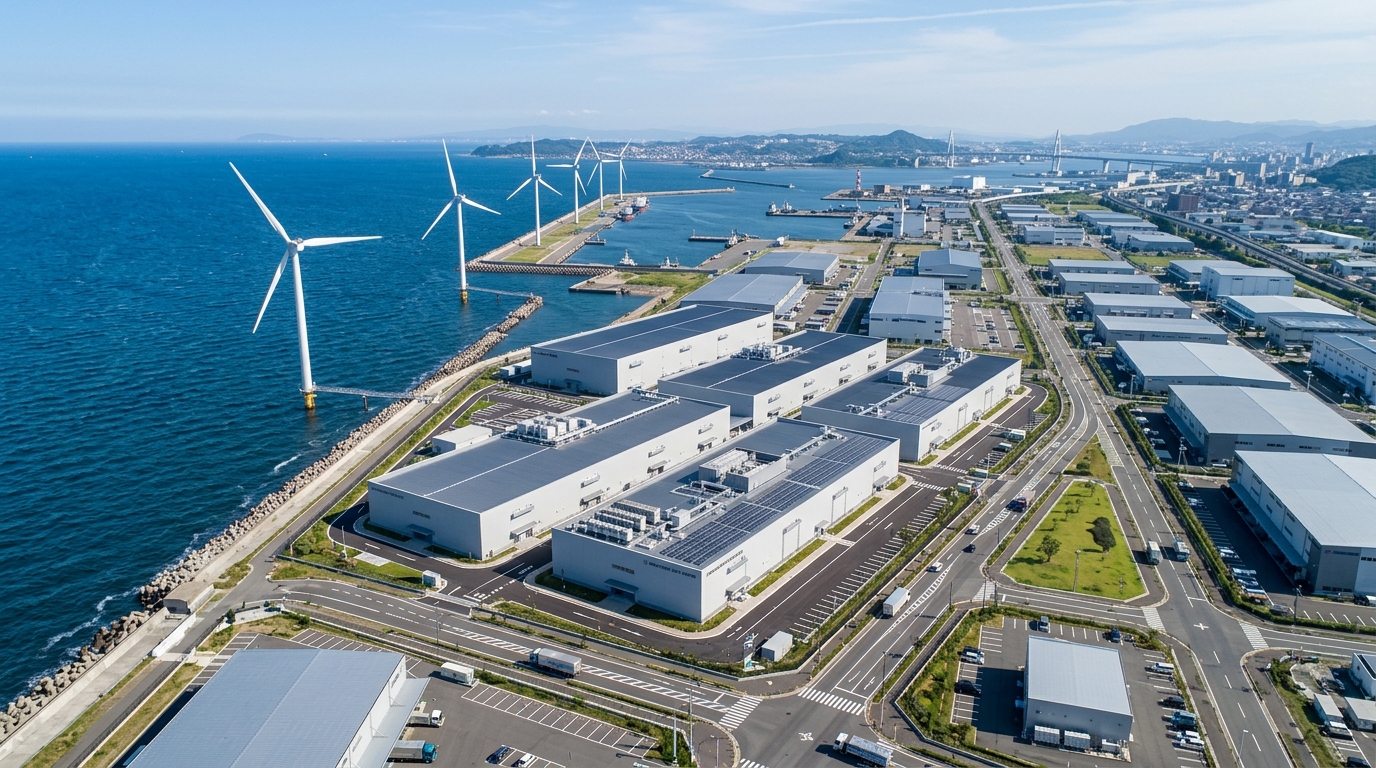
Amid this shift, the Hibikinada (ひびき灘) area in Wakamatsu Ward, Kitakyushu City (北九州市若松区), Fukuoka Prefecture, is undergoing an unprecedented transformation as a next-generation industrial hub. Functioning as a submarine cable landing base while simultaneously attracting large-scale data centers, this area holds exceptionally high potential for future real estate investment.
In this article, based on the latest real-world data (2021–2025) acquired by the B2B SaaS platform "Mekiki Research (物件目利きリサーチ)", we will thoroughly examine the expansion of industrial land in Wakamatsu Ward and its ripple effects on land prices and housing demand from an expert analyst's perspective.
[Summary of Investment Decisions in this Article]
- Synergy between Submarine Cables and Renewable Energy: Offshore wind power and international submarine cable landings in Hibikinada serve as powerful incentives for the concentration of mega DCs.
- Market Dynamism Revealed by Real Data: Transaction data from 2021 to 2025 (1,045 cases) shows robust activity in business land, with a median residential market price of 14 million yen juxtaposed against massive deals reaching up to 2.1 billion yen.
- Overwhelming Disaster Resilience: With both flood and landslide disaster risks rated as "false" (none), the area proves to have optimal ground conditions for DC operators who prioritize BCP (Business Continuity Planning).
- Restructuring of Housing Demand: Due to the increasing working population in related industries, there is growing room for the renovation of older properties and the development of new family-oriented housing.
1. Wakamatsu Ward, Kitakyushu City in 2026: The Current State of the Next-Generation Industrial Hub "Hibikinada"
Wakamatsu Ward, Kitakyushu City once flourished as a coal shipping port that supported Japan's modernization, and later drove Japan's rapid economic growth as a hub for heavy and chemical industries. Today, however, the area is breaking away from its past industrial structure and undergoing a dramatic evolution into a "next-generation technology hub" where green energy and cutting-edge digital infrastructure converge.
Particularly noteworthy is the coastal area of Hibikinada, which features vast tracts of reclaimed land. Here, public-private redevelopment and infrastructure investments are progressing at a rapid pace, unfolding as a national-level priority project that goes far beyond the mere revitalization of an industrial zone.
[Redevelopment Timeline for Wakamatsu Ward and the Hibikinada Area]
- 2023–: Full-scale construction of the Hibikinada offshore wind power generation facility (building a foundation for local production and consumption of green power).
- 2024: Promotion of surrounding infrastructure development based on the Vision for a Digital Garden City Nation (デジタル田園都市国家構想).
- 2025: Expected commencement of operations as a landing point for international submarine cables connecting Asia and Japan.
- As of 2026: Construction and partial operation of large-scale data center (DC) clusters by multiple companies.
- 2028 and beyond: Planned completion of a next-generation technology park and the agglomeration of related supply chains centered around DCs.
By simultaneously bringing two massive infrastructures—energy and communications—to completion during the same period, Wakamatsu Ward is poised to generate an entirely new dimension of asset value.
💡 Mekiki Research Analyst's Perspective: Real-time fluctuations in surrounding land prices accompanying the progress of redevelopment enable early, data-driven investment decisions. You can visually explore the latest area trends on Mekiki Research.
2. The Advantage as a Submarine Cable Landing Base and the Background of Attracting Large-Scale DCs
Why are large-scale data centers concentrating in Wakamatsu Ward, Kitakyushu City? The primary reason is that the area aligns perfectly with two major megatrends: the "decentralization of submarine cables" and the "securing of renewable energy."
Until now, Japan's international submarine cable landing stations have been heavily concentrated on the Pacific side, such as in Chiba Prefecture (Minamiboso / 南房総, etc.) and Mie Prefecture (Shima / 志摩, etc.). However, from the standpoints of natural disaster risks like the Nankai Trough Megaquake (南海トラフ巨大地震) and geopolitical economic security, the government is strongly pushing to diversify routes toward the Sea of Japan side and Northern Kyushu (九州北部). Wakamatsu Ward boasts high geographical superiority as a gateway to the Asian continent, offering an ideal location for low-latency connections to Taiwan, South Korea, and Southeast Asia.
Furthermore, a decisive factor in attracting data centers is electricity. With the rise of generative AI, the power demand required to cool and operate the latest GPU servers has skyrocketed. A large-scale offshore wind power project is underway in the Hibikinada area, providing the ultimate incentive for global hyperscalers (massive cloud providers) aiming for 100% renewable energy (RE100) DC operations.
💡 Mekiki Research Analyst's Perspective: Nodes where communication infrastructure and renewable energy facilities intersect tend to gradually drive up surrounding industrial land prices. You can analyze detailed zoning maps around infrastructure on Mekiki Research.
3. Explosive Increase in Industrial Land Demand Brought by Data Center Agglomeration
Building a data center requires vast land, solid ground, and appropriate zoning designations under the City Planning Act. According to environmental data retrieved from the Mekiki Research system around Wakamatsu Ward (latitude 33.9062, longitude 130.8107), this area is primarily designated as a "Quasi-industrial zone (準工業地域)", with development requirements confirming a Building Coverage Ratio (BCR) of 60% and a Floor Area Ratio (FAR) of 200%.
From a real estate investment perspective, the fact that it is a "Quasi-industrial zone" rather than an exclusively industrial zone is highly significant. This is because it permits the construction of a diverse range of related facilities—not only the data centers themselves, but also IT corporate offices for maintenance and management, R&D facilities, and even commercial stores and support facilities for employees.
The volume allowed by a 60% BCR and 200% FAR holds sufficient potential for constructing medium to large-scale business facilities. Currently, anticipating the arrival of mega DCs, behind-the-scenes moves to proactively acquire industrial land for related logistics facilities and system integrator hubs are becoming active around Hibikinada. It is highly predicted that land supply and demand will tighten significantly over the next few years.
💡 Mekiki Research Analyst's Perspective: When formulating complex development plans that leverage the potential of Quasi-industrial zones, accurately grasping the FAR and BCR is essential. You can instantly retrieve regulatory data for specific areas on Mekiki Research.
4. Land Price Trends Around Wakamatsu Ward and the Direct Impact on the Real Estate Market
How do massive infrastructure investments affect actual real estate transaction prices? Let's examine the actual transaction data for Wakamatsu Ward between 2021 and 2025, retrieved from the Mekiki Research backend system (integrated with the Ministry of Land, Infrastructure, Transport and Tourism (国土交通省) API).
[Real Estate Transaction Statistics for Wakamatsu Ward, Kitakyushu City (2021–2025)]
| Item | Actual Data Values |
|---|---|
| Target Period | 2021–2025 |
| Number of Transaction Samples | 1,045 cases |
| Average Transaction Price | Approx. 32.69 million yen |
| Median Transaction Price | 14 million yen |
| Highest Transaction Price | 2.1 billion yen |
| Lowest Transaction Price | 200 yen |
| Average Unit Price | Approx. 40,000 yen/㎡ |
Market polarization and dynamism can be read from this data. The volume of "1,045 cases" demonstrates the high liquidity of real estate in Wakamatsu Ward. Notably, while the median is 14 million yen, the average price has jumped to approximately 32.69 million yen. This indicates that high-value transactions, such as large-scale business plots and fund-backed projects represented by the highest transaction price of "2.1 billion yen," are pulling the average up significantly.
Additionally, the overall average unit price is "approx. 40,000 yen/㎡," which is overwhelmingly undervalued compared to DC clusters in the Tokyo metropolitan area. This low initial investment cost is a factor that dramatically enhances the ROI (Return on Investment) for mega DC expansions.
Looking at individual data, a residential land transaction in Akasaki-machi (赤崎町) shows a 400㎡ plot sold for 13 million yen (unit price approx. 33,000 yen/㎡). Located in a Neighborhood Commercial Zone (近隣商業地域) (BCR 80% / FAR 200%), it appears this property was traded at a reasonable price for a medium-sized office building or commercial facility site. Furthermore, an office/store property in the Oimatsu (老松) area (land and building, 570㎡, steel frame, built in 1983) was traded for 30 million yen, confirming that demand for renewing commercial real estate is already materializing.
💡 Mekiki Research Analyst's Perspective: The divergence between the average and the median is a powerful signal indicating signs of large-scale investments hidden within the area. You can explore more detailed individual transaction histories and heat maps on Mekiki Research.
5. Creation of New Housing Demand Accompanying the Advance of Related Companies and the Increase in the Working Population
While data centers generate relatively few direct jobs once operational, they bring massive special demand during the construction phase, followed by an influx of highly skilled IT engineers, security staff, and related vendors responsible for maintenance and operations. Consequently, a restructuring of housing demand has begun in the inland areas of Wakamatsu Ward.
Looking at actual transaction samples, a house in Aobadai-nishi (青葉台西) (land and building, built in 1992, 220㎡) was traded for 13 million yen, and a house in Aobadai-higashi (青葉台東) (built in 1999, 360㎡) for 24 million yen. These are located in a "Category I Exclusively Low-Story Residential Zone (第1種低層住居専用地域)" (BCR 40% / FAR 60%), indicating an appreciation for high-quality living environments with spacious lots tailored for families.
Turning to surrounding infrastructure, the nearest station is Wakamatsu Station (若松駅) operated by the Kyushu Railway Company (JR Kyushu / 九州旅客鉄道). However, in the current dataset, the "daily passenger volume" for the station is null (unacquired or insufficient data), and school district information (elementary and junior high schools) is also null. This signifies that it is an area where publicly available infrastructure data is still thin, suggesting that on-site investigations and meticulous comparisons with neighboring market prices are indispensable for investment decisions.
On the other hand, the medical environment is exceptionally well-equipped. Data confirms the presence of 22 medical institutions within the area, including "Yoshino Hospital (芳野病院)," "Imai Clinic (いまい医院)," and "Tsuda Children's Clinic (つだこどもクリニック)." The fact that a reliable living foundation is already in place is a major positive factor for incoming families and workers.
💡 Mekiki Research Analyst's Perspective: Blank zones where data is "null" can sometimes be the source of first-mover advantages overlooked by competing investors. You can supplement and analyze micro-level lifestyle facility data for undisclosed areas on Mekiki Research.
6. Wakamatsu Ward's Uniqueness Seen from a Comparison with Other DC Clusters (Inzai City, etc.)
When speaking of data center clusters in Japan, Inzai City, Chiba Prefecture (千葉県印西市) is the most famous. The primary reason DCs concentrated in Inzai City was the "solid ground of the Shimosa Plateau (下総台地)" and its "low disaster risk." For DC operators entrusted with servers worth hundreds of billions of yen and confidential data, an extremely low risk of floods and landslides is an absolute must-have for investment.
In this regard, Wakamatsu Ward possesses an advantage that rivals or even exceeds that of Inzai City. According to hazard information retrieved from the Geospatial Information Authority of Japan (国土地理院) data by Mekiki Research, the "flood risk (flood.hasRisk)" for this area is false (no risk), and the maximum inundation depth rank is determined as null (not applicable). Furthermore, the "landslide risk (landslide.hasRisk)" is also false, with no alarming phenomena designated whatsoever.
Confirming hazard risks is strictly required before purchasing or developing real estate, and this area in Wakamatsu Ward is a rare location that can "present the absence of risk as powerful evidence." Its topographical characteristic of avoiding flood risks, despite being close to the sea where seawater for cooling and wind energy are easily accessible, can be cited as Wakamatsu Ward's overwhelming uniqueness as a next-generation DC cluster.
💡 Mekiki Research Analyst's Perspective: A low disaster risk serves as a powerful weapon for passing the rigorous due diligence required when funds or institutional investors incorporate properties into their portfolios. You can execute overlays with the latest hazard maps with a single click on Mekiki Research.
7. Future Asset Value Predictions and Investment Strategies Analyzed with "Mekiki Research"
Based on the data analysis so far, what should future real estate investment strategies in Wakamatsu Ward look like? In conclusion, a bifurcated strategy focusing on "large-scale industrial land" and "revitalization of surrounding existing stock" is highly effective.
First is commercial real estate in the Quasi-industrial zones and Neighborhood Commercial Zones along the Hibikinada coast. Like the previously mentioned office/store property in the Oimatsu area (30 million yen), a strategy of acquiring existing commercial buildings and adding value to turn them into satellite offices for DC-related companies or small-scale logistics hubs (last-mile hubs) for equipment maintenance and storage could yield significant capital gains over the next few years.
Second is revitalization investment in existing housing. The data includes instances where a house in the Imamitsu (今光) area (land and building, 350㎡, built in 1961, Category I Exclusively Low-Story Residential Zone) was traded for 3 million yen, and a small house in the Oimatsu area (85㎡, Neighborhood Commercial Zone) for 4 million yen. By acquiring and renovating such low-priced, older vacant properties and supplying them as rental housing or share houses for the increasing number of engineers on solo assignments or young workers, it is possible to secure high yields (income gains).
With the average unit price still hovering at a low of approximately 40,000 yen/㎡, right now—before the infrastructure is completed—can be analyzed as the prime time to accumulate assets.
💡 Mekiki Research Analyst's Perspective: From the revitalization of older properties to the acquisition of large-scale land, data accuracy is the lifeblood of property screening tailored to your investment phase. Please utilize the professional market analysis tools on Mekiki Research.
8. Conclusion: The Future Potential of the Wakamatsu Ward Real Estate Market Driven by Infrastructure Investment
In this article, we examined the real estate market around Hibikinada in Wakamatsu Ward, Kitakyushu City, weaving between the macro perspective of submarine cable landings and data center attraction, and micro real-world data such as 1,045 transaction histories and hazard information.
Wakamatsu Ward is being equipped with green energy via offshore wind power and communication networks directly connected to Asia, all built upon solid ground where flood and landslide risks are "false" (none). The current land price levels—an average transaction price of approximately 32.69 million yen and a median of 14 million yen—must be considered as still in the early stages of an upward trend, looking ahead to full-scale operations a few years from now.
In real estate investment, riding the wave of national-scale infrastructure investment is the royal road to success. We must continue to keep a close eye on the trends in Wakamatsu Ward as it awakens as a next-generation industrial hub.
[To Continue the Research with Your Own AI] By registering as a free member, you will be able to pull the actual transaction data from the Ministry of Land, Infrastructure, Transport and Tourism and the hazard information used in this blog directly from your Claude or ChatGPT (via MCP Integration). There are absolutely no promotional or sales calls. Why not incorporate a professional research environment into your own AI and overwhelmingly enhance the precision of your investment decisions?