
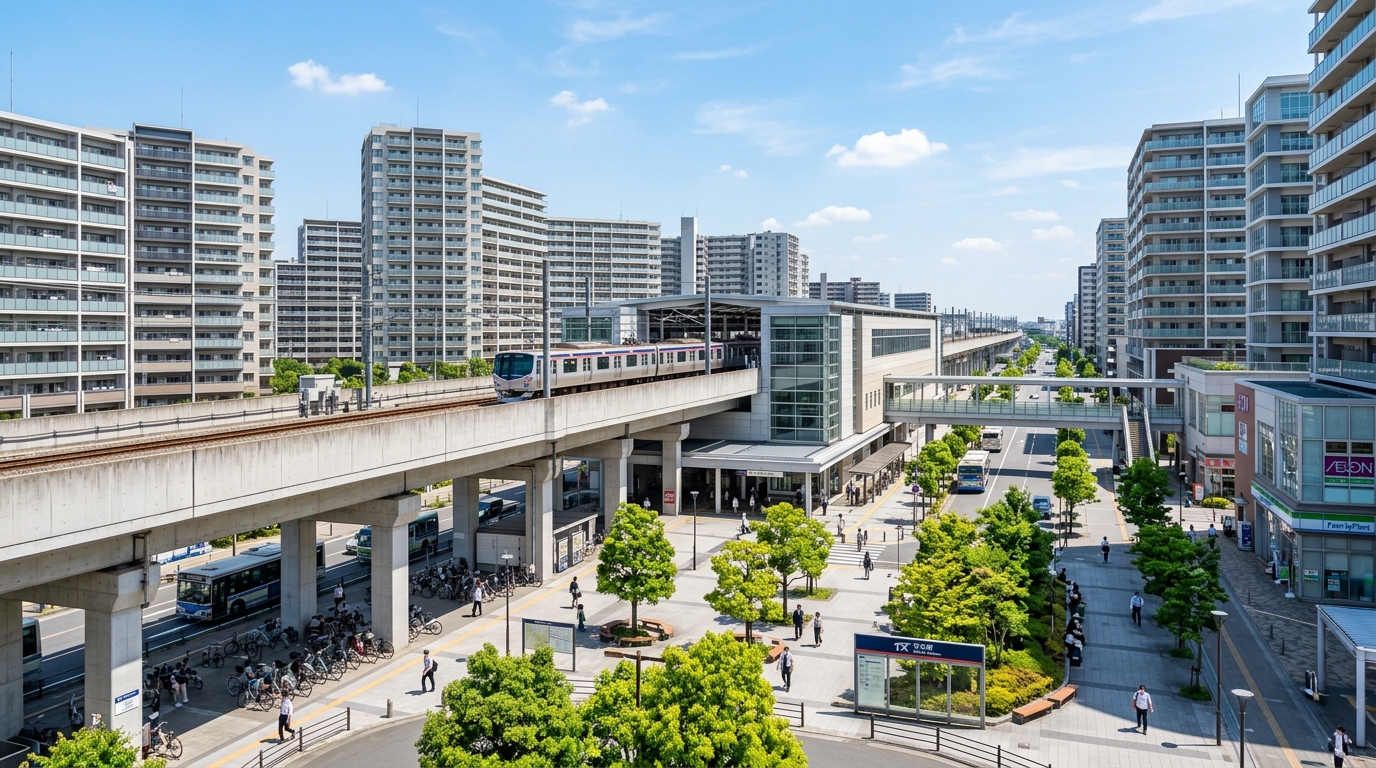
As of 2026, 21 years have passed since the inauguration of the Tsukuba Express (TX) in 2005. Once hindered by its perceived distance from central Tokyo, the southern Ibaraki area (茨城県南エリア) has seen its real estate landscape dramatically transformed by the launch of the TX line. Standing out in this region is Moriya City, Ibaraki Prefecture (茨城県守谷市). Boasting high strategic value as a rapid train stop and offering an unparalleled commute time of just 32 minutes to central Tokyo, Moriya continues to enjoy sustained population growth and stable housing demand.
Based on the latest big data gathered from the front lines of the real estate market, this article analyzes the evolution of Moriya's real estate landscape from the opening of the TX to the present day. We will objectively and logically unpack the "current standing" and "future potential" of the Moriya area for B2B real estate businesses, developers, and those looking toward practical use or investment.
[Investment Insights from This Article]
- Core Price Range: The median real estate transaction price in Moriya City is approximately 28 million yen, maintaining high price competitiveness and affordability compared to other Tokyo suburbs.
- Spacious Lot Sizes: Many transaction samples boast areas ranging from 160 sqm to over 300 sqm, offering a generous living environment that is nearly impossible to achieve in central Tokyo.
- Polarized Land Demand: A stark contrast exists between well-developed new towns—designated as Category I Exclusively Low-Story Residential Zones (第1種低層住居専用地域)—and low-priced land transactions in Urbanization Control Areas (市街化調整区域).
- Hazard Risks to Watch: Certain areas carry a flood risk with potential inundation depths of 3 to 5 meters, making meticulous research essential prior to purchase or development.
💡 [Bring Professional Insights into Your Business] Before reading further, we recommend signing up for a free membership with Mekiki Research, which provides comprehensive, up-to-date land price data and exclusive reports for cities nationwide, including Moriya City. Leverage this objective data to build a winning real estate strategy. Register for a free account here (*placeholder)
1. 21 Years Since the Tsukuba Express Opening: The Development Trajectory of Moriya City, Ibaraki Prefecture
Even before the TX opened, Moriya City was a hub for large-scale residential developments, most notably Joso New Town (常総ニュータウン). However, the 2005 launch of the TX triggered a historic paradigm shift that fundamentally elevated the city's real estate value.
Now in 2026, 21 years post-launch, Moriya City has transcended its role as a mere "commuter town for Tokyo" to firmly establish itself as a core city in southern Ibaraki. The expansive neighborhoods laid out during past new town developments have matured; trees have grown over the decades, creating a highly desirable residential environment.
In particular, areas designated under city planning as "Category I Exclusively Low-Story Residential Zones" (with regulations such as a 40% building coverage ratio and an 80% floor area ratio) have strictly curbed unregulated development. This preserves a high-quality housing stock with excellent sunlight and ventilation. The synergy between this "planned urban legacy" and a "cutting-edge high-speed railway network" forms the robust fundamentals underpinning Moriya's real estate market.
2. Direct Access to Central Tokyo: Moriya Station's Role as a Major Transit Hub
The primary engine driving Moriya City's real estate value is undeniably Moriya Station (守谷駅), operated by the Metropolitan Intercity Railway Company on the Tsukuba Express.
According to the latest data, Moriya Station handles 45,400 passengers daily, making it one of the busiest stations on the line. This massive volume of traffic clearly illustrates that Moriya is not just a pass-through station, but a functional "hub" for wide-area commuting, education, and commerce.
The rapid train ride to Akihabara Station (秋葉原駅) takes just 32 minutes at its fastest. This commute is highly competitive with major commuter towns in Kanagawa and Saitama prefectures, often surpassing them due to the line's low risk of delays and comfortable train cars. Furthermore, because Moriya Station is adjacent to a train depot, it serves as the origin point for "first-out trains." This offers the intangible premium of a guaranteed seat during the morning rush hour to central Tokyo. This exceptional transit connectivity and time-saving value generate robust housing demand among city workers, acting as a strong floor for local land prices.
3. Demographic Trends and Family Housing Demand in Moriya (2005–2026)
Drawn by this expansive connectivity, Moriya City has enjoyed a steady influx of residents over the years, primarily consisting of families. This demographic trend is heavily supported by robust living infrastructure.
Looking at the medical environment, there are 13 medical facilities identified around the target area. Highly specialized clinics, such as Ito Eye Clinic (いとう眼科), Kuroda Dermatology Clinic (くろだ皮膚科), and Takahashi Eye Clinic (たかはし眼科), are deeply rooted in the community, fully satisfying daily healthcare needs. For families raising children, easy access to pediatricians, dermatologists, and ophthalmologists is a critical deciding factor when purchasing a home.
On the other hand, during our recent property data retrieval via Mekiki Research, the school district data (elementary, juniorHigh) returned as null. This simply reflects an API specification in the public real estate transaction data, where school district information is not linked to specific geographic points. When B2B operators or agents conduct business, it is essential not to take these system blind spots at face value. Professionals must always verify the latest information on the ground via Moriya City's official website or the Board of Education before presenting it to clients.
Additionally, the "Category I Residential Zones" (第1種住居地域) around the station operate under relatively relaxed regulations—a 60% building coverage ratio and a 200% floor area ratio—leaving room for mid-sized condominiums and commercial developments. Notably, this provides diverse housing options not only for families who prefer detached homes but also for DINKs (Double Income, No Kids) who prioritize the convenience of living close to the transit hub.
4. Decoding Land Price Trends in Moriya's Residential and Commercial Areas Through Data
Here, we analyze the current state of land prices based on actual real estate transaction data in Moriya City, Ibaraki Prefecture, spanning 2021 to 2025 (Sample size: 1,168 transactions). This data was retrieved from the backend systems of Mekiki Research.
Moriya City Real Estate Transaction Data Summary (2021–2025)
| Metric | Data Value | Analysis & Insights |
|---|---|---|
| Total Transactions | 1,168 | Sufficient liquidity over 5 years indicates an active market. |
| Average Transaction Price | Approx. 32.87 million yen | A few high-priced properties (e.g., commercial land up to 1 billion yen) pull the average up. |
| Median Transaction Price | Approx. 28 million yen | The core price range for end-users. Highly affordable for a Tokyo suburb. |
| Average Unit Price | Approx. 82,000 yen/sqm | Due to generally larger lot sizes, prices feel like a bargain on a per-square-meter basis. |
The chart above and the raw data highlight distinct characteristics of the Moriya real estate market.
First is the trade of pre-owned detached homes in established new town areas. For example, in the Goshogaoka (御所ケ丘) area, a wooden house built in 1982 with a 165 sqm lot and a 3LDK layout sold for approximately 12 million yen. In the Misono (美園) area, a light steel-framed home built in 1997 with a 260 sqm lot and a 4LDK+S layout traded for around 19 million yen, while a wooden home built in 2003 with a 305 sqm lot and a 2DK+S layout sold for about 23 million yen. Remarkably, despite being in "Category I Exclusively Low-Story Residential Zones," these properties feature massive lots ranging from 260 to over 300 sqm—unthinkable in central Tokyo. Even as the buildings age, the intrinsic value of the land itself and the absolute advantage of a spacious living environment create a stable resale value hovering around the 20 million yen mark.
Second is the polarization of transactions in non-urbanized areas. Data for "Urbanization Control Areas" like Akahokke (赤法花) and Itadoi (板戸井) reveals that plots between 110 sqm and 220 sqm are trading at extremely low prices of roughly 190,000 to 930,000 yen (equivalent to approx. 1,200 to 8,500 yen per sqm). This pricing is unique to control zones where building construction is generally prohibited. We can infer that these are transactions for material storage, parking lots, or long-term investments anticipating future deregulation. The data clearly shows that even within the same city, zoning boundaries create a night-and-day difference in land values.
💡 [Need a more detailed area analysis?] If you want to know the exact transaction prices in your coverage area or track the precise price trends of competing properties, take advantage of the professional features offered by Mekiki Research. You can also download detailed CSV data. View feature details (*placeholder)
5. Logistics and Commercial Development Potential Linked to the Yawara IC on the Joban Expressway
Moriya City's advantages extend beyond railway access to central Tokyo via the TX. In terms of vehicular transport, the Yawara Interchange (谷和原インターチェンジ) on the Joban Expressway (常磐自動車道) is located extremely close by, giving the area functional importance as a regional logistics and transport hub.
At first glance, the low-priced land transactions (around 190,000 to 930,000 yen) in Urbanization Control Areas like the aforementioned Akahokke and Itadoi seem to reflect low real estate value. However, from the perspective of B2B operators and developers, they present a different face. With the recent expansion of the e-commerce market, vast tracts of land near expressway interchanges are in exceptionally high demand as development sites for large-scale logistics facilities (such as multi-tenant logistics centers).
Naturally, development in Urbanization Control Areas faces high hurdles, such as securing agricultural land conversion permits and development permits. But if these align with municipal corporate attraction policies or flexible urban planning implementations (like introducing district plans), land priced at a few thousand yen per tsubo holds the "upside potential" to skyrocket in value overnight. The proximity to growing consumer bases along the TX line, coupled with the establishment of a wide-area distribution network originating from the Yawara IC, adds a new pillar of "logistics and industrial land" to Moriya's real estate market.
6. Moriya's Unique Advantages Compared to Competing Stations (Kashiwanoha, Nagareyama, and Tsukuba)
The TX line features several stations that are formidable competitors in the real estate market. These include Nagareyama-otakanomori (流山おおたかの森) and Kashiwanoha-campus (柏の葉キャンパス) on the Chiba Prefecture side, and the terminus Tsukuba (つくば) on the Ibaraki side. How does Moriya City uniquely stand out when compared to these stations?
Nagareyama-otakanomori strongly attracts "urban-minded families" with its concentration of large commercial facilities, while Kashiwanoha-campus is advancing cutting-edge urban development as a smart city driven by public-private-academic partnerships. Tsukuba is an academic city boasting an agglomeration of national research institutes. Recently, land prices in these areas have soared, pushing the cost of new detached houses and condominiums to levels comparable to Tokyo's immediate suburbs (ranging from 50 to 70 million yen).
In stark contrast, the Moriya area's greatest strength lies in the balance between "affordability (median price: approx. 28 million yen)" and "overwhelming lot size (160 sqm to over 300 sqm)." In 2026, where remote work has become entrenched, there remains a solid underlying demand among end-users who think: "If I only commute to Tokyo two or three days a week, I'd rather travel a bit further to live in a spacious home (like a 4LDK or a roomy 3LDK) with a garden and parking for two cars." Rather than flashy commercial hubs or cutting-edge smart city attributes, Moriya has firmly established its position as an incredibly practical and cost-effective commuter town, offering a "quiet, mature residential environment and guaranteed commuting convenience from a starting station" at a fair price.
7. Promising Areas for B2B Real Estate Operators and Risk Factors to Keep in Mind
Moving forward, real estate operators and investors looking to expand their business in the Moriya area should focus on the "revitalization of existing new town housing stock (buy-and-resell renovations)." For properties built in 1982 (Goshogaoka) or 1997 (Misono), as seen in the actual data, the economic value of the buildings themselves is approaching zero due to depreciation. However, the value of their expansive 165 to 260 sqm lots remains fully intact. A business model that acquires this existing stock at a fair price (around 12 to 19 million yen), applies high-value-added renovations tailored to modern lifestyles, and resells the properties in the low 30 million yen range will be highly competitive amidst soaring new construction prices.
However, there is a critical risk factor that must absolutely be considered when purchasing for investment or residential use: "flood risk."
According to the hazard data retrieved from the Geospatial Information Authority of Japan, the target area carries a severe warning of "Flood Risk Present (Max Inundation Depth Rank 3: 3–5 meters)." Conversely, it is assessed to have no "landslide risk." An inundation depth of 3 to 5 meters is an extremely dangerous level where water could submerge the second floor of a standard detached house. Considering the intensifying typhoons and localized torrential rains of recent years, this hazard information can act as a massive discounting factor in pricing.
Under the Building Lots and Buildings Transaction Business Act, real estate brokers and sellers are obligated to accurately present the property's location on flood hazard maps and clearly disclose this risk to clients during the explanation of important matters. Consumers, too, must avoid making decisions based solely on low prices or proximity to the station. A level-headed due diligence (risk assessment) process—accounting for increased fire insurance (water damage coverage) costs and emergency evacuation routes—is essential to protect both lives and assets.
8. Conclusion: Next-Generation Real Estate Strategies for Moriya's Sustainable Growth as a Regional Hub
Twenty-one years have passed since the Tsukuba Express opened. Leveraging its powerful transit infrastructure as a rapid train stop directly connected to central Tokyo, Moriya City has evolved into a mature city offering a rich natural environment and spacious living conditions.
The transaction data metrics—a "median of approx. 28 million yen" and an "average unit price of approx. 82,000 yen/sqm"—are highly attractive even when compared to competing stations along the TX line, validating the persistent demand from families seeking large lot sizes. Furthermore, diverse business opportunities are expanding for B2B operators, from logistics potential driven by the Yawara IC to the revitalization of the existing housing stock.
On the flip side, navigating this market requires meticulous risk assessment backed by data. Failing to account for realities like extremely low-priced transactions in Urbanization Control Areas or severe flood hazard risks with potential inundation depths of 3 to 5 meters could result in unexpected losses.
The most crucial element of future real estate strategies is conducting objective market analysis based on hard data and evidence, rather than being swayed by superficial convenience or image. As it continues to evolve its function as a regional hub, the Moriya City real estate market will undoubtedly continue to deliver solid returns to operators and investors who possess the precise discernment to read the market accurately.