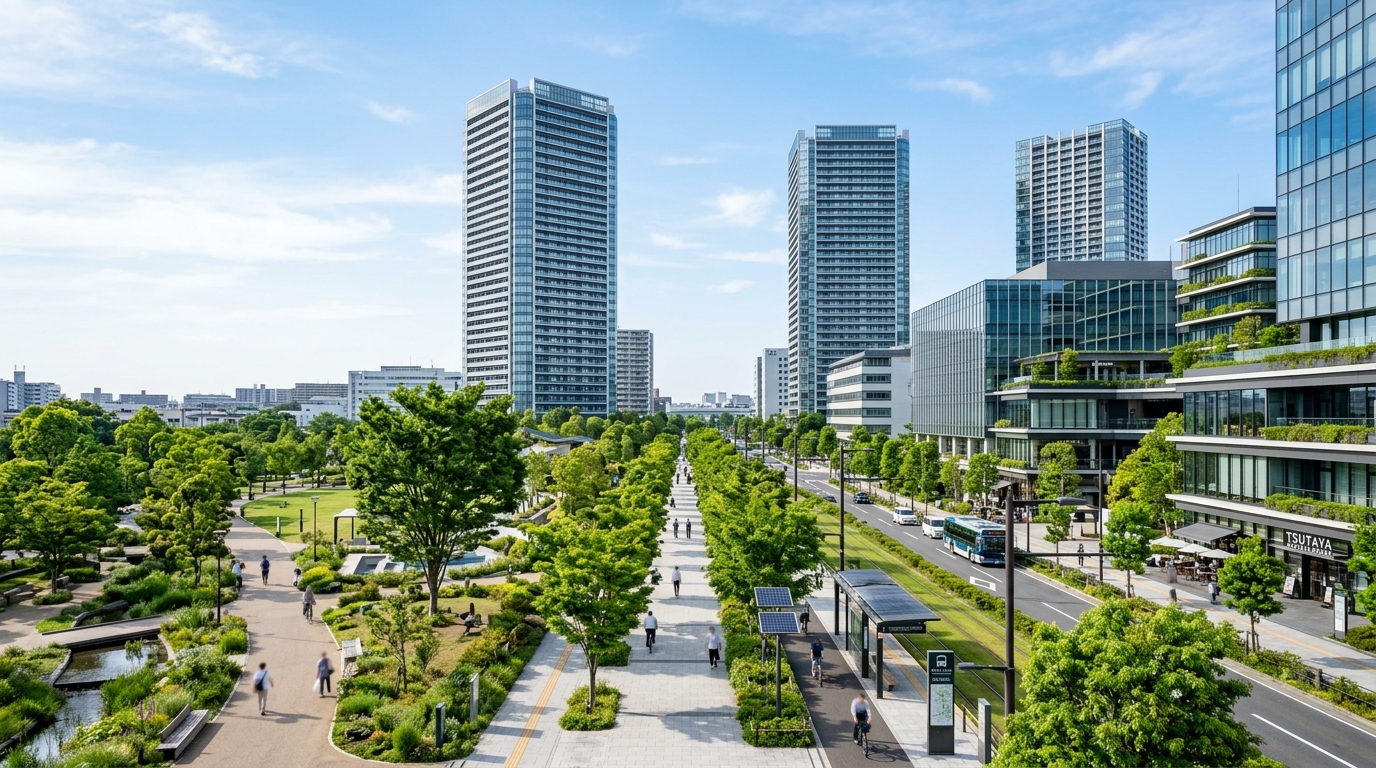
It has been 21 years since the opening of the Tsukuba Express (つくばエクスプレス, TX) in 2005. At that time, the area surrounding Kashiwa-no-ha Campus Station (柏の葉キャンパス駅) in Kashiwa City, Chiba Prefecture (千葉県柏市) was nothing more than an expanse of golf courses and wilderness. Today, it has undergone a dramatic transformation into one of Japan's premier next-generation smart cities.
In this article, we provide an in-depth, professional analysis of the evolution of the real estate market around Kashiwa-no-ha Campus and asset value trends as of 2026. This analysis is backed by the latest actual data from 2021 to 2025, acquired from the backend system of Mekiki Research (物件目利きリサーチ)—which integrates the Ministry of Land, Infrastructure, Transport and Tourism (MLIT) API (国交省API) and Geospatial Information Authority of Japan (GSI) hazard data (国土地理院ハザード連携).
How is the smart city concept, driven by a "public-private-academic" (公・民・学) collaboration, enhancing the area's brand and boosting real estate values? We will unravel the risks and returns that investors and high-net-worth individuals should pay attention to right now, along with land price trends, hazard information, and future forecasts.
💡 Check the Latest Data Driving Investment Decisions If you want immediate access to the latest market prices and risk information for the area covered in this article, you can view our proprietary analytical data via the link below. Check the latest land price and hazard information for Kashiwa City, Chiba Prefecture on Mekiki Research 👉
To kick off this article, we first present a summary of core data and future forecasts regarding the real estate market and living environment of the target area (Kashiwa City, Chiba Prefecture / around latitude 35.8927, longitude 139.9525).
| Analysis Item | Actual Data (2021–2025) |
|---|---|
| Total Transactions | 8,267 |
| Average Transaction Price | Approx. 36 million yen (Median: 28 million yen) |
| Average Unit Price | Approx. 140,000 yen/㎡ |
| Nearest Station / Daily Passengers | Kashiwa-no-ha Campus Station (Metropolitan Intercity Railway Company / 首都圏新都市鉄道) / 24,200 passengers per day |
| Zoning Designations | Planned zoning including Neighborhood Commercial Zones (80% building coverage, 300% floor area ratio) |
| Medical Infrastructure | A cluster of 18 medical institutions, including Tsujinaka Hospital Kashiwanoha (辻仲病院柏の葉) |
| Hazard Risks | Flood risk: None / Landslide risk: None |
1. 21 Years Since the TX Opened! The Current State of Kashiwa-no-ha Campus, Kashiwa City, Chiba Prefecture
The transportation infrastructure revolution brought about by the opening of the TX caused a paradigm shift in the real estate market from northwestern Chiba Prefecture to southern Ibaraki Prefecture. Among these areas, the vicinity of Kashiwa-no-ha Campus Station stands out as a symbol of railway-oriented development.
According to actual data, the daily number of passengers using this station has grown to approximately 24,200. Capitalizing on its exceptional commuting convenience—about 30 minutes to central Tokyo areas like Akihabara (秋葉原)—it has rapidly absorbed demand as a premier commuter town in the Tokyo metropolitan area.
However, a common "current challenge" faced by newly developed residential areas across Japan is the lag in infrastructure and environmental development amidst rapid population growth, along with the future risk of turning into aging "ghost towns" due to a declining birthrate and aging population. Simply developing a commuter town makes it difficult to maintain asset values decades down the line.
To address this challenge, the Kashiwa-no-ha area opted for a completely different approach: aiming to be a "sustainable, next-generation city" rather than "just a place to live." This vision forms the solid foundation that supports its robust asset value today.
2. The Core of the "Kashiwa-no-ha Smart City Concept" Driven by Public-Private-Academic Collaboration
When discussing the full scope of the Kashiwa-no-ha Campus redevelopment, the strong collaboration between the "public, private, and academic" sectors is indispensable. Chiba Prefecture and Kashiwa City (public), private enterprises led by Mitsui Fudosan (三井不動産), and academic institutions such as The University of Tokyo (東京大学) and Chiba University (千葉大学) have united to promote the Kashiwa-no-ha Smart City Concept (柏の葉スマートシティ構想) with a long-term perspective.
The core of this concept lies in three themes: "Environmental Coexistence," "Health and Longevity," and "New Industry Creation," functioning as a testing ground for cutting-edge technologies across the entire city.
For instance, the benefits are clearly visible in the educational environment. Around Toyofuta Elementary School (十余二小学校) and Tanaka Junior High School (田中中学校) within the area's school district, the ripple effects of next-generation education achieved through collaboration with academic institutions are highly anticipated. This has garnered strong support from education-conscious families and affluent households.
Such systematic urban planning, which goes beyond a fleeting boom, curbs real estate volatility (price fluctuation risk) and serves as a source of stable, long-term demand.
3. Realizing a Next-Generation Environmental City and a Dramatic Leap in Living Environment and Brand Power
Among the smart city initiatives, the efforts toward "Environmental Coexistence" and "Health and Longevity" directly enhance residents' quality of life (QOL) and dramatically elevate the area's real estate brand power.
An Area Energy Management System (AEMS) has been implemented, establishing a resilient and low-environmental-impact urban infrastructure that includes power sharing between city blocks. From an urban planning perspective, as shown in the acquired data, the area around the station is designated as a "Neighborhood Commercial Zone (80% building coverage, 300% floor area ratio)," ensuring an efficient and highly harmonized zoning of commercial facilities and residences.
Furthermore, in terms of "Health and Longevity," the comprehensive medical infrastructure is outstanding. According to actual data, the designated area is home to 18 medical institutions, ranging from large hospitals like Koukikai Tsujinaka Hospital Kashiwanoha (医療法人社団康喜会 辻仲病院柏の葉) to community-based clinics such as Miyamoto Family Clinic (みやもとファミリークリニック) and Nise Caps Clinic Kashiwanoha (医療法人社団ナイズ キャップスクリニック柏の葉).
An environment where advanced medical care and health promotion support are readily accessible daily strongly stimulates relocation demand not only from families seeking peace of mind but also from seniors with high purchasing power, robustly underpinning the area's asset value.
💡 Avoid Undisclosed Risks with a Professional's Eye Grasping not just the city's brand power but also the surrounding zoning and micro-level market data is the key to successful real estate investment. Check the latest land price and hazard information for Kashiwa City, Chiba Prefecture on Mekiki Research 👉
4. Land Price Trends from 2005 to 2026 and the Evolution of the Real Estate Market Along the Line
Since its opening in 2005, the real estate market along the TX line has consistently grown on an upward trajectory, weathering several economic shocks along the way.
According to the data acquired for the period between 2021 and 2025, the sample size of real estate transactions in the target area of Kashiwa City reached 8,267, proving it to be a highly liquid and active market.
Looking at the overall market average, the transaction price hovers around 36 million yen, with a median of 28 million yen. Additionally, the average unit price is approximately 140,000 yen/㎡, forming a solid market with room for growth compared to other areas in Chiba Prefecture.
What is particularly noteworthy is the range of transaction prices. An extreme spectrum has been recorded, from a minimum of about 1,000 yen to a maximum of about 4.5 billion yen. This is due to a mix of transactions—from intra-family share transfers and special leasehold land deals at the lower end, to large-scale business sites related to the smart city and massive commercial facility transactions at the upper end. It is a deep market where capital from diverse asset classes flows in.
5. [Mekiki Research] Decoding the Latest Asset Value Trends with Proprietary Data
To dissect the impact (conclusion) of the smart city concept on real estate values from a more micro perspective, we extracted and analyzed six actual transaction samples from the first quarter of 2021. Note that fields where data (such as unit price, building coverage, or floor area ratio) appears as null are areas where public transaction data is sparse or undisclosed, making comparative adjustments with neighborhood market prices essential in practice.
| Property Type | District | Year Built | Area | Layout | Structure | Zoning | Transaction Price |
|---|---|---|---|---|---|---|---|
| Pre-owned Condo, etc. | Kashiwa (柏) | 2010 | 65㎡ | 1LDK+S | RC | Commercial | Approx. 41M yen |
| Pre-owned Condo, etc. | Kashiwa (柏) | 2007 | 80㎡ | 3LDK | RC | Quasi-Residential | Approx. 20M yen |
| Pre-owned Condo, etc. | Kashiwa (柏) | 2007 | 75㎡ | 3LDK | RC | Quasi-Residential | Approx. 18M yen |
| Pre-owned Condo, etc. | Azuma (東) | 1998 | 80㎡ | 3LDK | RC | Category I Residential | Approx. 20M yen |
| Residential Lot (Land & Bldg) | Kashiwa (柏) | 2012 | 135㎡ | 3LDK | Wooden | Category I Residential | Approx. 29M yen |
| Residential Lot (Land & Bldg) | Kaga (加賀) | 1989 | 185㎡ | 3LDK | Wooden | Category I Residential | Approx. 22M yen |
What can be read from this data is a clear price premium based on location and zoning. For instance, a 65㎡ pre-owned condominium (1LDK+S) built in 2010 located in a "Commercial Zone" in the Kashiwa district was traded at a high price of approximately 41 million yen. This is a result of high evaluations of the convenience of a commercial area adjacent to the station and a location that directly enjoys the benefits of the smart city.
On the other hand, family-oriented residential lots (land and buildings) and pre-owned condominiums located in "Category I Residential Zones" or "Quasi-Residential Zones" are traded in a realistic price bracket of 18 million to 29 million yen, indicating strong purchasing intent from end-users. Another positive factor is that a spacious living environment is secured within limits, such as a 60% building coverage and 200% floor area ratio for the residential lot in the Kaga district, or 70% and 200% respectively for the residential lot in the Kashiwa district.
Furthermore, natural disaster risk cannot be overlooked when preserving asset value. In our actual data, both "Flood risk (hasRisk: false)" and "Landslide risk (hasRisk: false / no phenomenon)" in the target area are determined to have no risk. Solid ground and low flood risk are extremely crucial defensive elements in real estate investment.
However, abnormal weather and linear precipitation zones far exceeding expectations have occurred frequently in recent years. Even if data indicates no risk, it is absolutely essential to check the latest hazard maps and visually inspect the surrounding micro-topography and drainage infrastructure before purchasing a property for investment or residential use.
6. Positioning Comparison with Neighboring Rival Areas (Nagareyama Otakanomori, etc.)
Along the TX line lies a formidable rival to Kashiwa-no-ha Campus: the neighboring station of Nagareyama Otakanomori (流山おおたかの森). Promoted as "the closest forest town to the city center," Nagareyama Otakanomori boasts explosive popularity as a commuter town for families, driven by thorough child-rearing support measures and a concentration of large commercial facilities.
In contrast, Kashiwa-no-ha Campus has established a uniquely edgy positioning focusing on "Academia, New Industry, and Smart City." If Nagareyama Otakanomori is a "city specialized in consumption and living," Kashiwa-no-ha Campus can be described as a "city where creation and research fuse."
From a real estate investor's perspective, this difference in character is significant. In a future where the birthrate continues to decline, a city strictly specialized for a specific child-rearing demographic is susceptible to risks from demographic shifts during generational turnovers. On the other hand, Kashiwa-no-ha Campus, with its concentration of university campuses, research facilities, and medical institutions, possesses a structure that sustainably attracts a diverse population, including students, researchers, medical professionals, and seniors. It offers highly attractive characteristics as a diversified destination for a real estate portfolio.
7. Expansion of Functions as a Hub for New Industry Creation and Future Investment Potential
The decisive factor for the future investment potential of Kashiwa-no-ha Campus is the expansion of its functions as a hub for "New Industry Creation." The area is equipped with incubation facilities, notably KOIL (Kashiwa-no-ha Open Innovation Lab, 柏の葉オープンイノベーションラボ), gathering a succession of cutting-edge startup companies in the fields of AI, IoT, and life sciences.
This ecosystem, where the advanced academic insights of The University of Tokyo and Chiba University intersect with private enterprise capital, generates new employment and promotes the influx of high-income knowledge workers. As a result, Kashiwa-no-ha Campus is evolving from a mere suburban commuter town into an independent urban model where "work, residence, academia, and recreation" exist in close proximity.
Such industrial agglomeration directly stimulates demand for offices as well as high-quality rental housing for singles and DINKS (Double Income, No Kids). In the future real estate market, one can fully expect not only demand for family-oriented residential condos but also improved profitability (stabilization of income gains) for investment residences, commercial properties, and office buildings.
8. Conclusion: The Future of Kashiwa-no-ha Campus Spearheaded by the Smart City Concept
As of 2026, 21 years after the opening of the TX, the area around Kashiwa-no-ha Campus in Kashiwa City, Chiba Prefecture, has established a solid real estate brand, propelled by the smart city concept through public-private-academic collaboration.
The abundant transaction data of 8,267 cases, the steady price trend averaging 36 million yen, and the excellent living environment featuring 18 medical institutions eloquently speak to the high asset value of this area. Combining the defensive appeal of low flood and landslide risks with the offensive appeal of expected capital gains through new industry creation, Kashiwa-no-ha Campus is a promising real estate market that demands continued attention.
We hope you will utilize the latest land price trends and future potential forecasts explained in this article to aid in your investment strategies and home selection.
▼ Related Articles