
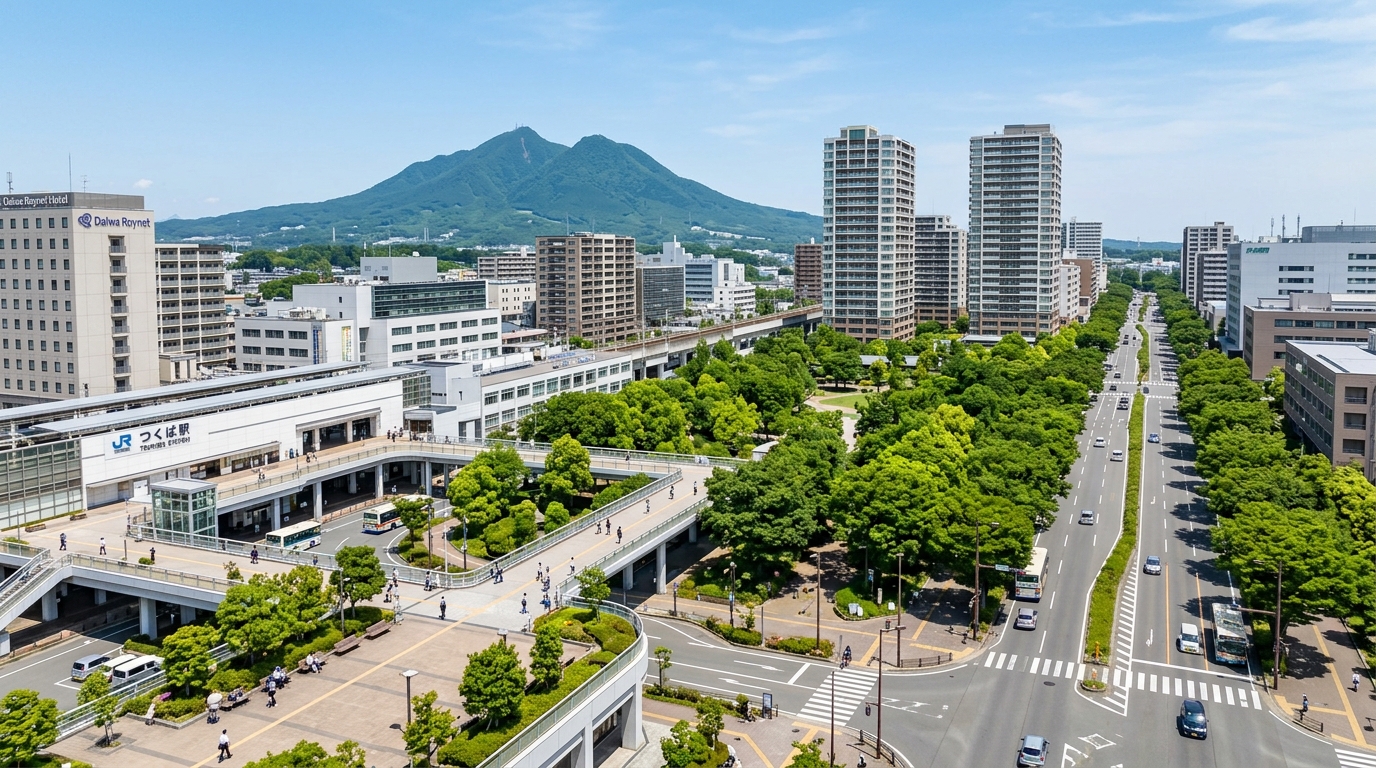
Since commencing operations in August 2005, the Tsukuba Express (つくばエクスプレス, TX) marks a major milestone of nearly 20 years this year in 2026. Connecting Akihabara Station (秋葉原駅) in central Tokyo to Tsukuba City, Ibaraki Prefecture (茨城県つくば市) in as little as 45 minutes, this high-speed railway has grown far beyond a simple piece of transportation infrastructure. It has driven a dramatic paradigm shift in the real estate markets of municipalities along the line. Above all, the area around Tsukuba Station (つくば駅)—the terminus of the line and the focal point of a national project as Japan's largest science city—has achieved a unique development that sets it apart from other suburban cities.
Through years of policies promoting permanent residency and redevelopment projects around the station, Tsukuba City, once strongly perceived as a town for researchers and civil servants, has transformed into a highly coveted residential area for upper-middle-class commuters and families raising children. The condominium market has also matured significantly over the past two decades, with active trading taking place in both new and pre-owned properties.
In this article, from the perspective of a professional real estate analyst, we will thoroughly explore the evolution of real estate values around Tsukuba Station and the future outlook of the condominium market. Our analysis is backed by the latest real estate transaction and environmental data actually extracted from the backend systems (such as the Ministry of Land, Infrastructure, Transport and Tourism [国交省] API and Geospatial Information Authority of Japan [国土地理院] hazard data) of the B2B SaaS "Bukken Mekiki Research" (物件目利きリサーチ).
1. Introduction: Tsukuba City Today, Nearly 20 Years After the Opening of the Tsukuba Express
Tsukuba City (City Code: 08220), located in southern Ibaraki Prefecture, is a unique municipality known as the Tsukuba Science City, hosting a high concentration of advanced research institutions and universities. Before the opening of the TX, the city had to rely on buses and private cars for access to central Tokyo, and its real estate market was highly localized, primarily targeting local residents and workers at research institutions.
However, since the opening of the TX in 2005, the presence of Tsukuba Station, operated by the Metropolitan Intercity Railway Company (首都圏新都市鉄道), has dramatically elevated the city's potential. According to actual data obtained for this analysis, the daily passenger volume at Tsukuba Station is recorded at 31,200. Even now in 2026, well past the COVID-19 pandemic, it maintains remarkably solid transportation demand. This figure of over 30,000 passengers proves its status not merely as a terminal station for a bedroom community, but as a regional hub bustling daily with reverse commuters (workers and students) from central Tokyo, as well as visitors to commercial and research facilities around the station.
Nearly 20 years after the launch of the TX, Tsukuba City is entering its "second growth phase." While the station-front condominiums built in the early days are now due for large-scale repairs, new residential developments and infrastructure improvements targeting the next generation of families are simultaneously underway. This ongoing cycle is arguably the greatest contributor to the long-term stability of the Tsukuba area's real estate market.
2. A 20-Year History of the Condominium Market Around Tsukuba Station: Price Trends and Supply Dynamics
Analyzing macro transaction data is essential to deciphering the real estate market in the Tsukuba area. According to transaction statistics from 2021 to 2025 obtained through Bukken Mekiki Research, there are 4,037 samples in the area, confirming an exceptionally high level of liquidity for a regional city.
What stands out is the distribution of transaction prices. The data shows that the average transaction price is 36,192,317 yen (approx. 36.19 million yen), whereas the median is 25,000,000 yen (25 million yen). This phenomenon, where the average exceeds the median by over 10 million yen, indicates that a small number of ultra-high-priced properties are significantly pulling up the average. In fact, the maximum recorded transaction price is 5.1 billion yen, while the minimum is 1,000 yen. We can infer that the minimum value represents transfers of private road shares or extremely small plots, while the maximum value includes mega-deals for large-scale commercial facilities or development sites in front of the station. This shows that Tsukuba City's real estate market is shaped by a highly diverse range of players, both individuals and corporations. The overall average unit price (avgUnitPrice) is 44,318 yen/sqm (approx. 40,000 yen/sqm), a figure characteristic of an area where vast forests and farmlands coexist with prime commercial districts near the station.
More specifically, the table below summarizes actual transaction samples from the first quarter of 2021 in the Azuma (吾妻) district, the prime area around Tsukuba Station.
| Property Type | Use | Area | Year Built | Zoning (Coverage/FAR) | Transaction Price | Structure |
|---|---|---|---|---|---|---|
| Residential Land (Land & Bldg) | Residential | 200㎡ | 2020 | Category I Mid/High-Rise (60%/200%) | 75 million yen | Wooden |
| Residential Land (Land & Bldg) | Residential | 200㎡ | 2021 | Category II Residential (60%/200%) | 69 million yen | Wooden |
| Residential Land (Land & Bldg) | Residential | 200㎡ | 2021 | Category II Residential (60%/200%) | 69 million yen | Wooden |
| Pre-owned Condo, etc. | Residential | 75㎡ | 2003 | Commercial (80%/400%) | 32 million yen | RC |
| Pre-owned Condo, etc. | (Blank) | 80㎡ | 2017 | Commercial (80%/400%) | 45 million yen | RC |
| Residential Land (Land & Bldg) | Apartment Bldg | 9,999㎡ | 1955 | Category I Mid/High-Rise (60%/200%) | 2.3 billion yen | (Blank) |
As is clear from the table, even among pre-owned condominiums built in the same Commercial Zone (Building Coverage Ratio 80% / Floor Area Ratio [FAR] 400%) in the Azuma district, a unit built in 2003 (75㎡, 3LDK) traded at 32 million yen, while one built in 2017 (80㎡, 3LDK) traded at 45 million yen. There is a distinct price gap between properties built in 2003, prior to the opening of the TX (2005), and those built in 2017, when the city was fully mature. We can see that along with depreciation over time due to building age, recent spikes in construction costs and the scarcity of prime locations are also reflected in the prices.
3. The Unique Strengths of a Science City: High Intellectual Standards Driving the Educational Environment and Residential Demand
What drives Tsukuba City's real estate market is not just convenient transportation. At its core is the overwhelmingly high quality of education, healthcare, and living environment forged under national leadership.
According to the environmental data obtained, the designated school districts around Tsukuba Station are Azuma Elementary School (吾妻小学校) and Azuma Junior High School (吾妻中学校). The Azuma district has long been home to many researchers and university affiliates and is known for boasting extremely high educational standards despite being a public school district. The existence of this "prestigious public school district" serves as a powerful incentive for the influx of education-conscious upper-middle-class families, thereby underpinning the asset values of pre-owned condominiums and single-family homes.
Furthermore, the medical infrastructure, which heavily influences the quality of life (QoL), is exceptionally robust. The data records 24 medical institutions within this area. It is dotted with numerous clinics providing highly specialized medical care, such as the Tsukuba ART Clinic (つくばARTクリニック), Tsujinaka Tsukuba Gastrointestinal & Anorectal Clinic, Koukikai Medical Corporation (医療法人社団康喜会 辻仲つくば胃腸肛門クリニック), and Tsukuba International Breast Clinic (つくば国際ブレストクリニック). This well-equipped medical environment provides great peace of mind not only for families raising children but also for those looking ahead to their senior years, continuously stimulating the demand for permanent residency.
4. The Full Scope of Tsukuba City's Settlement Promotion Policies: Synergies Between Childcare Support and Infrastructure Development
Tsukuba City has consistently pursued planned urban development since the initial launch of the TX. The results are clearly visible in the zoning designations and the state of disaster prevention infrastructure.
Looking at the environmental data, the residential neighborhoods around Tsukuba Station are meticulously zoned into areas such as Category II Mid/High-Rise Oriented Residential Zones and Category II Residential Zones, with generous building standards set at a 60% building coverage ratio and a 200% floor area ratio. This prevents chaotic urban sprawl and preserves a beautiful skyline with wide-open skies and a lush, green living environment.
There is also a notable point regarding "hazard risks," which are heavily weighed in recent real estate transactions. According to hazard data from the Geospatial Information Authority of Japan, the area around Tsukuba Station (around latitude 36.082559, longitude 140.110556) is evaluated as hasRisk: false (No Risk) for flood risk and hasRisk: false (No Risk) for landslide risk. The data substantiates that these blocks were systematically developed on solid inland ground.
However, as a real estate analyst, I strongly want to convey to our readers: "Even if the current data evaluates an area as risk-free, you must always verify the latest hazard maps and municipal disaster prevention information with your own eyes before making a purchase." The risk of natural disasters exceeding predictions, such as localized torrential rains due to climate change, is never zero. Precisely because it is a highly safe area, conducting thorough risk verification is an ironclad rule for asset protection.
5. Market Comparison with Adjacent Areas (Kenkyu-gakuen Station and Bampaku-kinenkoen Station) and the Area's Uniqueness
Along the Tsukuba Express line, large-scale developments are also underway around Tsukuba Station's neighboring stations: Kenkyu-gakuen Station (研究学園駅) and Bampaku-kinenkoen Station (万博記念公園駅). These areas feature sprawling mega-shopping malls and newly developed residential subdivisions, making them popular among demographics seeking more expansive properties.
However, the uniqueness of Tsukuba Station (the Azuma area) at the heart of Tsukuba City lies in its highly refined fusion of convenience and a tranquil living environment. Looking at the aforementioned transaction sample data, "Residential Land (Land and Building)" in the Azuma district—specifically, wooden properties built between 2020 and 2021 on 200㎡ plots—are trading in the high price range of 69 million to 75 million yen. The fact that single-family homes around 70 million yen are consistently bought and sold in a suburban area is proof that the market recognizes the vicinity of Tsukuba Station not just as a bedroom community, but as a premium residential neighborhood with its own economic sphere and brand power.
If the adjacent station areas are "towns of the future," the area around Tsukuba Station can be described as a "mature yet continually evolving town." This clear distinction in character prevents cannibalization (demand overlapping) along the entire rail line and instead generates synergistic effects.
6. Deciphering Rental and Sales Yields in the Tsukuba Area with Bukken Mekiki Research
Analyzing the Tsukuba area from a real estate investment perspective reveals some highly intriguing data. Within the transaction samples for the Azuma district, there is a record of an "Apartment Building" (built in 1955, area 9,999㎡) trading for 2.3 billion yen (Q1 2021, Category I Mid/High-Rise Oriented Residential Zone).
The year 1955 predates the full-scale development of the Tsukuba Science City. We can surmise that this property is likely a case where an extremely large tract of land (roughly 10,000 square meters), such as the site of old public servant housing or company dormitories, was sold to a developer or a fund. The influx of a massive 2.3 billion yen in investment money into central Tsukuba City demonstrates that institutional investors and major developers highly value the area's future prospects (the potential for condo sales or large-scale rental residences through redevelopment).
On the other hand, from a professional standpoint, I must point out a caveat when using this data. In the individual sample data extracted this time, there are scattered items where unitPrice, indicating the price per square meter, is listed as null (no data). Despite being an active market, the Tsukuba area has a tendency where public transaction data regarding individual unit prices is sparse or easily kept confidential. Therefore, it is dangerous to judge yields or fair prices based solely on desktop data. It is essential to conduct careful comparative studies with neighboring market prices while using macro indicators like the overall average of "approx. 40,000 yen/sqm" or the median of "25 million yen" as a baseline.
7. Future Challenges Toward 2030: The 8-Car TX Project and the Direction of the Pre-owned Condominium Market
Having entered its mature phase 20 years after opening, Tsukuba City's real estate market is poised to enter a new phase heading into the 2030s. The biggest topic in this regard is the project to expand the Tsukuba Express to 8-car trains.
Currently operating with 6-car trains, the TX has long faced challenges with congestion during morning and evening rush hours. If the 8-car expansion, which involves extending station facilities, is realized, transport capacity will be significantly boosted, and commuting comfort to central Tokyo will dramatically improve. This increases the likelihood that high-income power couples, who previously considered condominiums closer to central Tokyo, will flow into the Tsukuba area for its superior living environment.
At the same time, revitalization of the pre-owned condominium market is expected. Properties over 20 years old, like the "built in 2003, 32 million yen" example in the sample data, will become the main players in the renovation market going forward. As new construction prices remain high due to soaring material costs, purchasing a well-managed, station-front pre-owned condominium and remodeling it to one's taste will likely become a standard style in Tsukuba City as well.
8. Conclusion: Future Prospects and Investment Strategies for Real Estate Along the Tsukuba Express Line
In this article, we have examined the real estate evolution around Tsukuba Station in Tsukuba City, Ibaraki Prefecture—nearly 20 years after the opening of the Tsukuba Express—using actual data from Bukken Mekiki Research.
A rich track record of up to 4,037 transactions, solid station passenger volume (31,200 people), high educational standards led by Azuma Elementary and Junior High Schools, and a living environment supported by as many as 24 medical institutions. Furthermore, all the data—including the low hazard risk and the influx of investment money symbolized by large-scale land transactions on the scale of 2.3 billion yen—corroborates the resilience of Tsukuba City's real estate market.
With the upcoming catalyst of the TX 8-car expansion, real estate around Tsukuba Station is arguably an extremely promising choice not only as residential assets but also as medium- to long-term wealth preservation and investment destinations. For those considering buying a condominium or investing in real estate, why not calmly assess macro data alongside the micro characteristics of individual properties, and formulate a strategy to capitalize on this city's growth?