
October 4th is designated as "Investment Day" in Japan. In today's real estate market, assessing asset value through a mid- to long-term lens—rather than focusing solely on immediate yields—has become increasingly essential. Amid rising urban prices in major metropolitan areas, "core regional cities" experiencing forward-looking redevelopment are capturing widespread attention from institutional investors to end-user home buyers (both families and single professionals).
Among these, Takamatsu City in Kagawa Prefecture stands out. Centered around the "Sunport Takamatsu" waterfront area north of JR Takamatsu Station, large-scale redevelopment projects targeting the 2028–2030 timeframe are coming to fruition one after another, dramatically reshaping both the cityscape and local property values.
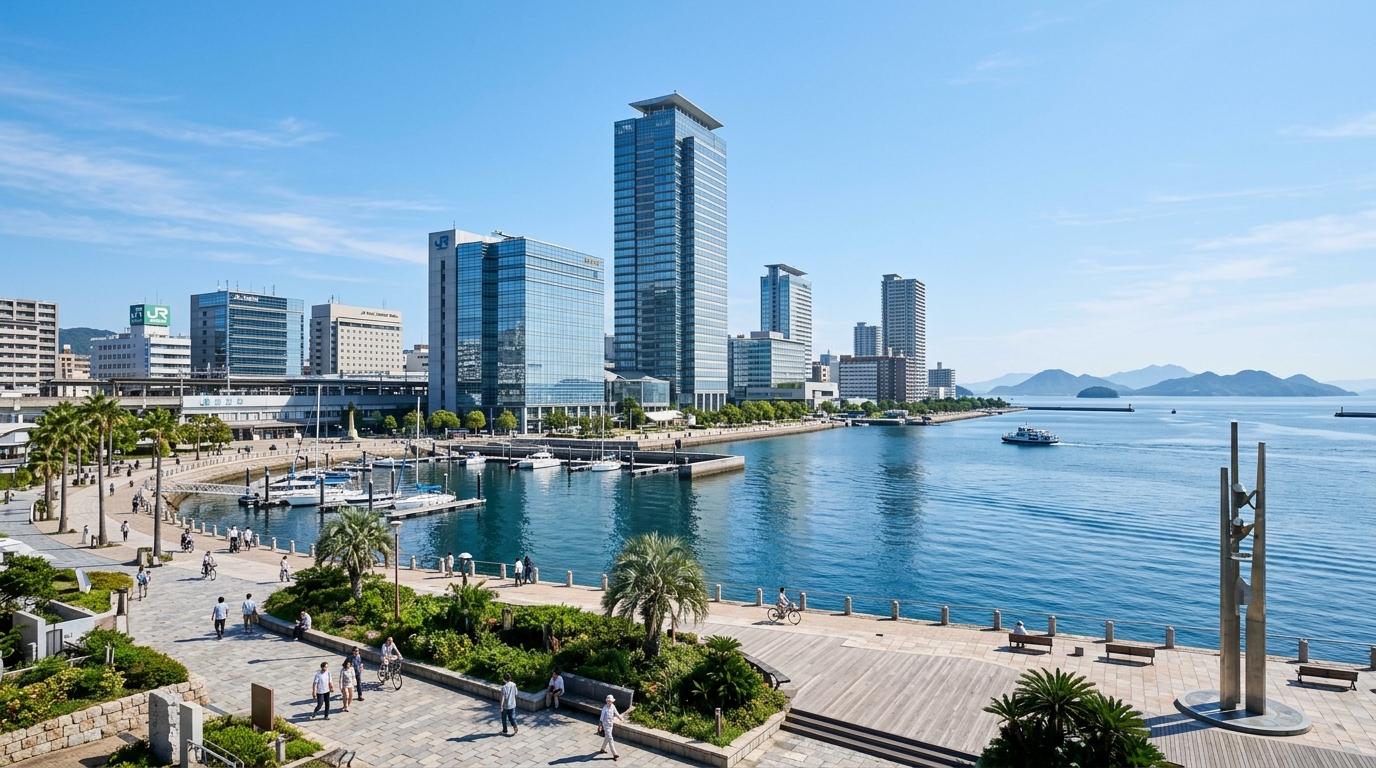
This article thoroughly analyzes land price trends and livability insights surrounding Takamatsu Station, leveraging the latest 2026 transaction data from the Ministry of Land, Infrastructure, Transport and Tourism (MLIT) along with on-the-ground updates.
1. Real Estate Value in Core Regional Cities on Investment Day: Why Takamatsu is Drawing Attention
3 Key Investment Takeaways
- City growth scenario targeting 2030 driven by Sunport Takamatsu redevelopment
- Land price trends and forecasts for pre-owned condos and detached homes based on 2026 real transaction data
- Living environment supporting end-user families and singles, plus hazard risks to check before purchasing
When investing in real estate or purchasing a home in a core regional city, "growth potential" is the most critical metric. Even in a shrinking population environment, areas that serve as major transportation hubs and where local governments actively promote compact city policies tend to maintain resilient long-term demand.
Takamatsu City, Kagawa Prefecture—the Gateway to Shikoku—fits this description perfectly. Historically serving as the center of Shikoku's transit network since the days of the Udaka Ferry (宇高連絡船), Takamatsu is now evolving through the Sunport Takamatsu redevelopment into a next-generation compact city that combines "walkable streets" with "advanced urban functions." Beyond the macro economic ripple effect valued by institutional investors, its primary strength lies in providing a convenient, close-to-work lifestyle for resident families and singles alike.
2. Sunport Takamatsu Redevelopment Progress and the Transformation of Takamatsu Station Area
To accurately gauge a city's future potential, understanding the redevelopment timeline is essential. Around Takamatsu Station, several symbolic projects have rolled out or are scheduled in rapid succession:
| Completion / Target | Facility / Project Name | Overview & Expected Impact |
|---|---|---|
| Spring 2024 | TAKAMATSU ORNE | A new commercial complex directly connected to JR Takamatsu Station, significantly enhancing daily shopping convenience around the station. |
| Completed Nov 2024 | Anabuki Arena Kagawa (New Kagawa Prefectural Gymnasium / あなぶきアリーナ香川) | Opening Feb–Mar 2025. One of the largest arenas in the Chugoku-Shikoku region with a capacity of up to 10,000. Expected to drive sports and concert demand. |
| April 2025 | Tokushima Bunri University Takamatsu Station Campus | An urban campus adjacent to the Sunport area, boosting youth inflow and single-renter housing demand. |
| Expected Summer 2027 | Mandarin Oriental, Setouchi | Opening of a world-class luxury hotel, enhancing the city's brand value as a base for high-net-worth travelers and inbound tourists. |
Particularly noteworthy is Anabuki Arena Kagawa, designed by the world-renowned architectural firm SANAA. Featuring a distinctive gently curving roof that blends into the Seto Inland Sea landscape, it is one of the largest arenas in the Chugoku and Shikoku regions, capable of hosting up to 10,000 spectators. It is expected to attract international sports competitions and top-tier concert tours.
Furthermore, the opening of Tokushima Bunri University's Takamatsu Station Campus in spring 2025 has injected youthful energy into the district, providing strong support for local single-tenant rental apartments and dining establishments. With the luxury hotel "Mandarin Oriental, Setouchi" slated for summer 2027, the completion of this redevelopment cycle between 2028 and 2030 is projected to elevate real estate values around Takamatsu Station into an entirely new phase.
3. Latest Land Price Trends and Transaction Unit Price Trajectory in Takamatsu City
The momentum of redevelopment is clearly reflected in actual real estate transaction data. Here, we analyze Takamatsu's land price trends using objective quarterly metrics aggregated from MLIT's Real Estate Information Library.
According to our data compilation, Takamatsu City recorded 5,843 transactions between 2021 and 2025, with an average transaction price of approximately 20.19 million yen, a median of 11.0 million yen, and an average unit price of about 48,000 yen/m². While these overall citywide averages appear moderate due to including suburban zones, delving into quarterly trends by property type reveals distinct patterns.
Looking at the recent Q1 2026 data, the median price per m² for "residential land (land and building)"—meaning single-family homes—stood at approximately 58,000 yen/m², reflecting a steady year-over-year increase of +7.5%. On the other hand, "residential land (vacant land)" was slightly softer in Q1 2026 at approximately 36,000 yen/m² (-5.3% YoY). However, this slight softness is far outweighed by a sharp surge in the condominium market.
The median price per m² for "pre-owned condominiums" reached approximately 210,000 yen/m² in Q1 2026. Compared to approximately 143,000 yen/m² in the same period of the previous year (Q1 2025), this represents a dramatic surge of +48.8%. In addition to rising new-construction costs driven by elevated building expenses, heightened future expectations surrounding the Sunport Takamatsu redevelopment appear to be driving a robust shift in demand toward pre-owned condominiums.
Examining high-volume districts, "Hamanomachi" (浜ノ町)—adjacent to the Sunport area—recorded 33 pre-owned condo transactions with a high median price of approximately 238,000 yen/m². Slightly to the east in "Kitacho" (木太町), active trading occurred across all sectors: 31 condo transactions (median ~136,000 yen/m²), 25 detached home transactions (median ~65,000 yen/m²), and 27 land transactions (median ~45,000 yen/m²), demonstrating that it serves as an active hub for both investors and actual home buyers.
4. Livability Insights for Families and Singles in the Takamatsu Area
Ultimately, underlying real estate asset values depend on the daily livability for those who reside there. The Takamatsu Station area boasts not only excellent transit convenience with 24,308 daily passengers, but also highly robust infrastructure supporting daily life.
The zoning near the surveyed location (adjacent to Takamatsu Station) is classified as a "Commercial Zone," featuring high development potential with an 80% building-to-land ratio and a 600% floor-area ratio. Despite being a high-density urban district, there are 41 medical facilities scattered nearby. From comprehensive care centers like Yoshimine Orthopedic Hospital (整形外科吉峰病院) and Kuwaya Hospital (医療法人社団雙和会クワヤ病院) to community primary care clinics like Kitajima Ophthalmology Clinic (北島眼科), the medical infrastructure offers peace of mind for families and seniors. Furthermore, the local school catchment includes Takamatsu Daiichi Elementary School (高松第一小学校) and Takamatsu Daiichi Junior High School (高松第一中学校), earning strong support from education-minded households.
Municipal homeownership incentives are another key highlight. To encourage residential settlement in designated urban areas, Takamatsu City operates the "Takamatsu City Housing Acquisition Support Project" (高松市住宅取得支援事業). Starting in fiscal year 2026 (Reiwa 8), this program has been expanded: eligible buyers can now receive a 200,000 yen subsidy for pre-owned home purchases as well as new builds. When combined with national programs like the "Mirai Eco Housing 2026 Project" (みらいエコ住宅2026事業, offering up to 1.1 million yen in subsidies for GX-oriented homes), buyers can smartly minimize upfront costs when purchasing a home.
5. Compact City Policies and Waterfront Living Convenience
At the heart of Takamatsu's "Multi-Node Compact Eco-City" strategy is the delivery of high-quality housing within urban development zones. Combining waterfront openness with downtown convenience, this area sees dynamic real estate transactions across various lifestyle needs.
Let's look at several actual transaction samples: In "Kankocho" (観光町), close to downtown, a pre-owned 65 m² 3LDK condominium built in 1988 sold for approximately 7.9 million yen (Neighborhood Commercial Zone; 80% building ratio, 300% floor-area ratio). While older, it offers an accessible price point for single users, small families planning renovations, or rental investors.
Meanwhile, in "Kagawacho Ono" (香川町大野), located further into the suburban zone, a 175 m² detached house built in 2021 (land and building) sold for approximately 20.0 million yen (Category 1 Residential Zone; 60% building ratio, 200% floor-area ratio). Another transaction saw a 120 m² house and lot sell for around 1.0 million yen (Category 2 Medium-and-High-Rise Exclusive Residential Zone). Land-only transactions include a 210 m² plot selling for ~6.5 million yen (~31,000 yen/m²) and a 160 m² plot for ~4.0 million yen (~25,000 yen/m²), accommodating buyers seeking spacious suburban living.
6. Long-Term Asset Value Evaluation from an End-User Homebuyer Perspective
When purchasing real estate in the Takamatsu area, verifying "disaster risk and hazard profiles" is essential to protecting long-term asset value.
According to real hazard data, while the surveyed site carries no sediment disaster risk, it is designated as having "flood risk," with some portions falling under Maximum Depth Level 4 (estimated inundation depth of 5 to 10 meters). This is a characteristic feature of waterfront locations with low elevation near the sea. Before purchasing, it is critical to review Takamatsu City's hazard map, map out emergency evacuation routes, and implement flood mitigation measures.
For those planning to build or buy a detached home, mitigation techniques such as raising building foundations or placing living areas on the second floor above ground-floor garaging are highly recommended. Registered subscribers to our site's Pro plan gain access to our "AI Architectural Simulator." By entering real local data and custom preferences, users can generate 2D floor plans, 3D models, sunlight simulations, exterior visualizations, and estimated total project budgets for detached homes (note: apartment building planning and yield calculations are not supported). Use this tool to visualize your ideal home and assess detailed architectural plans including disaster resilience.
7. How to Avoid Mistakes in Property Selection and Site Inspections in Takamatsu
Working backward from 2030 predictions, what investment actions should you take today?
Once the Sunport Takamatsu redevelopment completes its major milestones with the luxury hotel opening in 2027, the district's convenience and brand prestige will be firmly established. Station-adjacent areas like "Hamanomachi," which directly benefit from redevelopment, are expected to see even higher property scarcity. Given the current trend of surging condo prices, securing high-quality pre-owned properties in areas with solid baseline demand—before excessive price appreciation takes hold—is key to capturing capital gains and securing long-term residential value heading into 2030.
During site inspections, avoid relying solely on yield numbers or asking prices. The single most important factor in making a successful purchase is evaluating livability through the eyes of an end-user resident: checking whether supermarkets and hospitals lie along daily walking routes from the station, and verifying how buildings are constructed to withstand flood hazards.
8. Conclusion
In honor of "Investment Day," we examined the real estate potential of central Takamatsu City, Kagawa Prefecture, where the Sunport Takamatsu redevelopment is energizing the region. With major milestones like Anabuki Arena Kagawa, Tokushima Bunri University, and Mandarin Oriental, Setouchi, the city's growth trajectory toward 2028–2030 is clearly reflected in objective land price data. Rapidly climbing condo prices and steady single-family home demand demonstrate that Takamatsu is highly regarded by institutional investors and primary home buyers alike.
Achieving success in real estate investment or home purchasing requires level-headed analysis backed by real data like the metrics presented here. By signing up for a free membership, you can connect Ministry of Land, Infrastructure, Transport and Tourism data directly into your own Claude or ChatGPT assistant via MCP integration. Set up a seamless environment to continue researching with your personal AI, and make confident, data-driven property choices.