
Takamatsu City in Kagawa Prefecture, the gateway to Shikoku, enjoys a mild Seto Inland Sea climate and rich natural surroundings while maintaining its firm position as a regional core city with a high concentration of urban functions. In recent years, large-scale redevelopment projects around Takamatsu Station—the city's central hub—have been dynamically reshaping the urban landscape, driving a surge of interest in its real estate market. A succession of mega-projects has transformed the face of the city: the large commercial complex TAKAMATSU ORNE opened in spring 2024, followed by the completion of Anabuki Arena Kagawa in 2025, which continues to generate tremendous excitement here in 2026.
To state the conclusion upfront, the area stretching from Takamatsu Station to the residential zones along the railway lines—direct beneficiaries of this redevelopment—holds exceptional potential for property value appreciation heading toward 2030. According to the latest real estate transaction data, prices for pre-owned condominiums in the city center have surged by approximately 48% year-on-year, reflecting robust investor demand. Meanwhile, looking slightly further into the suburbs reveals an abundance of high-quality residential land for single-family homes with stable pricing, presenting an outstanding opportunity for end-user buyers (both families and single residents). Drawing on actual transaction and environmental data from the Ministry of Land, Infrastructure, Transport and Tourism (MLIT) as evidence, this article delivers an in-depth analysis of Takamatsu's livability and future land price trends to provide insights for making a confident, regret-free home purchase.
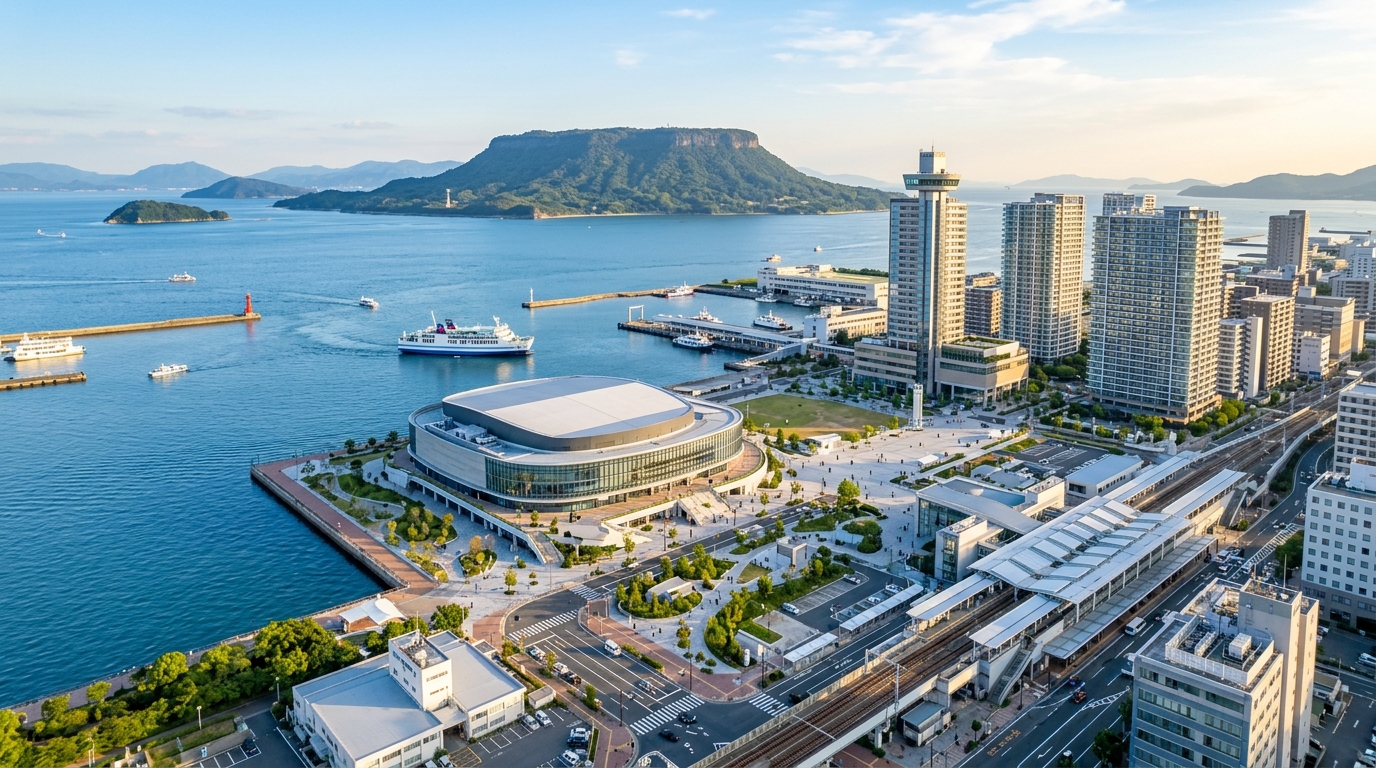
1. The Full Scope of Large-Scale Redevelopment at Takamatsu Station: Gateway to Shikoku
In the area surrounding Takamatsu Station, known as Sunport Takamatsu, long-planned redevelopment projects are reaching fruition one after another. At the heart of this transformation is TAKAMATSU ORNE, a commercial complex directly connected to JR Takamatsu Station that celebrated its grand opening in March 2024. Developed under the concept of "a place to enjoy time and experiences, serving as both a destination and a point of departure," the facility houses around 50 stores, including Shikoku's first-ever locations of major brands and "shikoku meguru," a select shop and food court specializing in Shikoku cuisine. Far more than a typical station building, it has established an overwhelming presence as both a daily shopping hub for local residents and a vibrant nexus for tourists and business travelers from outside the prefecture.
Infrastructure developments around the station are also progressing at a rapid pace. The opening of Tokushima Bunri University's Takamatsu Campus near the station brings thousands of students and young adults into the area daily, infusing the district with youthful energy. Furthermore, plans for the luxury hotel Mandarin Oriental, Setouchi (Takamatsu) are underway (with the opening timeline currently being adjusted as of 2026), steadily preparing the city to capture high-net-worth inbound travel demand from both domestic and international markets.
Urban planning data underscores the immense potential of this area. The zoning around Takamatsu Station is designated as a "Commercial District," allowing high-density land use with a building coverage ratio of 80% and a floor area ratio (FAR) of 600%. This enables the development of mid-to-high-rise mixed-use buildings and high-rise residential towers, with further capital inflows anticipated through 2030. As a textbook case of regional urban redevelopment, the Takamatsu Station area is entering its golden era.
2. Transforming City Vibrancy and Living Environment: The Impact of Anabuki Arena Kagawa
Another massive catalyst in the Sunport Takamatsu redevelopment is the Kagawa Prefectural Arena, officially named Anabuki Arena Kagawa, which opened in February 2025. Boasting a main arena with a maximum capacity of 10,000 people alongside a sub-arena and martial arts facilities, it ranks among the largest venues in the Chugoku and Shikoku regions. The arena has earned high praise for its sleek architectural design, garnering international attention including architectural honors affiliated with UNESCO organizations.
As of 2026, the operation of this arena has dramatically energized Takamatsu. Arena-scale nationwide concert tours by top Japanese artists and large music festivals—events previously difficult to host in Shikoku—are now held regularly, drawing tens of thousands of visitors from outside the prefecture every weekend. It has also taken root as a major sports and entertainment hub, hosting home games for the local professional basketball team, the Kagawa Five Arrows.
The emergence of this landmark venue has brought positive effects extending beyond event-driven economic activity to the surrounding living environment. In tandem with the arena's opening, pedestrian walkways and promenades were constructed, and attractive nighttime illumination was introduced, significantly improving public safety and streetscape aesthetics. This has created a safe, appealing residential setting where local families and single residents can enjoy evening walks and weekend strolls. As sports, music, and arts seamlessly integrate into daily life, residential demand in central Takamatsu has risen to unprecedented heights.
3. Recent Land Price Trends and 2030 Forecasts for Takamatsu Station and Nearby Residential Areas
How is the real estate market reacting to the city's dramatic rise in appeal? An analysis of actual transaction data obtained from the Real Estate Information Library of the Ministry of Land, Infrastructure, Transport and Tourism (MLIT) (5,716 samples between 2021 and 2026) reveals robust momentum in Takamatsu's real estate sector. Over this period, the average transaction price across Takamatsu City stood at approximately 20.15 million yen, with a median of 11 million yen and an average price per square meter of roughly 48,000 yen/sqm, demonstrating a resilient market typical of a regional core city.
Particularly noteworthy is the steep rise in the condominium market shown in our latest quarterly aggregated data, Market Trends (2026 Q1). The transaction volume for pre-owned condominiums in Q1 2026 reached 72 deals, with a median price per square meter of approximately 213,000 yen/sqm. This represents a staggering year-on-year (YoY) increase of +48.8%. Looking back, the unit price rose from 175,000 yen/sqm in 2024 Q2 to 237,000 yen/sqm in 2025 Q3, moving in direct lockstep with redevelopment progress. Examining individual transaction records, a pre-owned 85 sqm 3LDK condo built in 1990 in Akane-cho (designated as a Semi-Industrial Zone) sold for approximately 9.5 million yen, while a 70 sqm 2LDK in the same neighborhood fetched around 14 million yen, demonstrating that even older properties maintain and appreciate in value.
Meanwhile, what about the single-family housing market popular among end-user buyers? The graph below shows the quarterly trend in median price per square meter for "Residential Land (Land and Building)" in Takamatsu City.
As the graph illustrates, while the single-family home market has not seen the extreme spikes observed in the condo segment, it displays steady strength. In 2026 Q1, transaction volume was 56 cases, with a median price per square meter of approximately 58,000 yen/sqm (+7.5% YoY). Although prices briefly reached around 86,000 yen/sqm in 2025 Q2, they have generally stabilized in the 50,000 to 60,000 yen range. Looking at specific sales examples, a newly constructed single-family home (land and building, 200 sqm) built in 2026 in Iida-cho closed at approximately 36 million yen, while a 1988 property (195 sqm) in Ikushima-cho sold for around 12 million yen.
Furthermore, looking solely at "Residential Land (Vacant Land)" transactions, the median price per square meter in 2026 Q1 stood at roughly 36,000 yen/sqm, reflecting a slight dip of -5.3% YoY. This gentle settling from approximately 42,000 yen/sqm in 2024 Q2 presents an advantageous buying window for end-users seeking land to build a custom home at reasonable prices. Considering that spillover effects from downtown redevelopment will continue spreading into surrounding districts through 2030, securing prime land now is a highly strategic choice.
4. Livability and Transit Advantages of Central Takamatsu: A Family and Single-Resident Perspective
Central Takamatsu shines not only as an investment prospect, but also as an exceptionally comfortable place to live for end-user residents, including families and single professionals. Takamatsu Station, operated by Shikoku Railway Company (JR Shikoku), serves as a major terminal for limited express trains connecting directly across Shikoku and to the mainland (Okayama direction), delivering unparalleled transit convenience for frequent business travelers and relocated staff.
Everyday living infrastructure is equally robust. In terms of education, public schools such as Takamatsu Daiichi Elementary School and Takamatsu Daiichi Junior High School serve the central area and enjoy strong reputations among education-minded parents. Medical infrastructure is another major asset of Takamatsu City. Our surrounding environment dataset highlights a dense concentration of 41 medical facilities in the district. From general medical institutions like Orthopedic Yoshimine Hospital and Kuwaya Hospital (Medical Corporation Sowakai) to specialized practices like Kitajima Eye Clinic, residents have access to comprehensive healthcare within walking distance—offering peace of mind to young families, seniors, and single residents alike.
This compact integration of advanced urban services and daily convenience represents Takamatsu's ultimate appeal. Even within regional Japan, where car dependency is common, Takamatsu stands out as a highly functioning compact city where a rich, comfortable lifestyle can be fully enjoyed by bicycle, walking, or public transit alone—providing a solid backbone for property values leading into 2030.
5. Land Price Spillover along the Kotoden Lines and Suburbs: Key Residential Neighborhoods
The land price momentum initiated around Takamatsu Station has extended beyond the city center, spreading along the Takamatsu-Kotohira Electric Railroad (commonly known as Kotoden) lines and into suburban residential neighborhoods. As central condo prices climb, families seeking larger living spaces, quiet environments, or easy parking are expanding their search into suburban districts.
The table below summarizes recent transaction activity across top-performing neighborhoods (Cho-chome) in Takamatsu City based on our aggregated data:
| Neighborhood (Cho-chome) | Property Type | Transaction Volume | Median Price / sqm |
|---|---|---|---|
| Hamanomachi | Pre-owned Condominiums | 33 deals | Approx. 238,000 yen/sqm |
| Kita-cho | Pre-owned Condominiums | 31 deals | Approx. 136,000 yen/sqm |
| Yashima Nishi-machi | Pre-owned Condominiums | 26 deals | Approx. 107,000 yen/sqm |
| Kita-cho | Residential Land (Land & Building) | 25 deals | Approx. 65,000 yen/sqm |
| Kita-cho | Residential Land (Vacant Land) | 27 deals | Approx. 45,000 yen/sqm |
This data reveals clear market trends. First, Hamanomachi, a waterfront district adjacent to Takamatsu Station, commands the highest popularity in the pre-owned condominium market, commanding a premium median price of approximately 238,000 yen/sqm.
Meanwhile, the remarkable transaction volume in Kita-cho, a suburban bedroom community, demands attention. Kita-cho records high activity across all property categories: pre-owned condos (31 deals), single-family homes with land (25 deals), and vacant land (27 deals). With abundant commercial facilities, schools, and convenient access to Kotoden stations, it stands as a top destination for home-buying end users. Condominium prices here average around 136,000 yen/sqm, making them far more accessible than central properties.
Additionally, Yashima Nishi-machi, renowned for its scenic views, exhibits steady condo demand (26 deals, ~107,000 yen/sqm). Suburbs like Ichinomiya-cho show active land trading (280 sqm land transaction at ~8.7 million yen, or ~31,000 yen/sqm), while Imazato-cho features versatile housing options (105 sqm land and building at ~13 million yen in Category 2 Mid/High-Rise Residential Zone). This breadth of options tailored to diverse budgets and lifestyles underscores the depth of Takamatsu's real estate market.
6. Neighborhood Checkpoints for End-User Buyers to Avoid Home-Buying Pitfalls
When purchasing a home for personal residence, evaluating municipal support programs and future lifestyle compatibility is just as vital as reviewing land price trends and transit convenience.
Takamatsu City is well known for offering generous support programs for relocators and child-rearing households. In 2026, the Takamatsu City Trial Relocation Promotion Subsidy continues to operate, allowing prospective relocators from outside Kagawa to stay at designated guesthouses with a subsidy of 2,000 yen per night (up to 7 nights) to experience local life firsthand. Furthermore, home buyers can take advantage of national subsidy initiatives such as the Housing Energy Efficiency 2026 Campaign and the Mirai Eco-Housing 2026 Project, yielding significant financial benefits when building high-insulation new homes or retrofitting existing homes with energy-saving upgrades.
Prospective buyers can easily research market values and neighborhood environments with a free Mekiki Research account. For those considering single-family construction, the AI Architectural Simulator available on the Pro plan leverages real local data and custom preferences to automatically generate 2D floor plans, 3D models, sunlight simulations, exterior visualizations, and estimated budgets (*Note: This feature is exclusively designed for single-family homes and does not support yield or cash-flow calculations for apartment buildings). Leveraging data and technology right from the site selection stage to visualize what kind of home can be built and what lifestyle it will offer—while ensuring no applicable subsidies are missed—is essential to making an informed home purchase.
7. Waterfront Development Considerations: Natural Hazards and Disaster Preparedness
Coastal waterfront areas like Sunport Takamatsu offer daily views of the breathtaking Seto Inland Sea alongside strong asset value, making them highly sought-after. However, there is a critical aspect that every homebuyer or investor must review before purchasing: natural hazard information.
An analysis of empirical data for central Takamatsu (around lat=34.3508, lng=134.0469) indicates "No Risk" regarding landslide phenomena, meaning mountain collapse risks are negligible. However, flood risk is explicitly classified as "At Risk," with a maximum inundation depth rank of 4 (5 to 10 meters). Given Takamatsu's coastal geography facing the Seto Inland Sea and flat plain intersected by major rivers such as the Koto River, storm surges from typhoons and severe localized downpours represent real risks that cannot be overlooked. An inundation depth of 5 to 10 meters means floodwaters could potentially reach the second or third stories of standard buildings.
Consequently, buyers seeking a home or investment property in this area must take hazard data seriously. When building a single-family home, measures such as elevating the foundation or locating primary living spaces and critical equipment (such as power distribution boards) on upper floors are strongly recommended. When selecting a condominium, verifying disaster preparedness—such as whether backup generators are installed on higher floors and whether clear emergency evacuation routes are established—is essential. Objective, data-driven risk assessment is the single best shield for protecting both family safety and long-term asset value.
8. Conclusion: Smart Home Selection and Wealth Building in Rapidly Redeveloping Takamatsu
Following the 2024 opening of TAKAMATSU ORNE and the 2025 launch of Anabuki Arena Kagawa, central Takamatsu around Takamatsu Station has powerfully transformed into a modern urban core as of 2026. As evidenced by a remarkable ~48% year-on-year increase in pre-owned condo prices, the city's asset value is experiencing rapid real-time growth. At the same time, suburban areas like Kita-cho and neighborhoods along the Kotoden lines offer a stable single-family market at accessible prices, providing a broad market that benefits both investors and end-user buyers.
Looking ahead to 2030, Takamatsu City is poised for further urban infrastructure enhancements and an influx of visitors from other prefectures and overseas. At this opportune moment, evaluating locations based on objective data rather than subjective impressions or speculation is key to finding a home you love while building reliable real estate wealth.
By registering for a free account, you can access the MLIT real estate data used in this article directly through your own Claude or ChatGPT assistant via MCP integration. Take advantage of this cutting-edge experience to power your personalized area research and home search.