
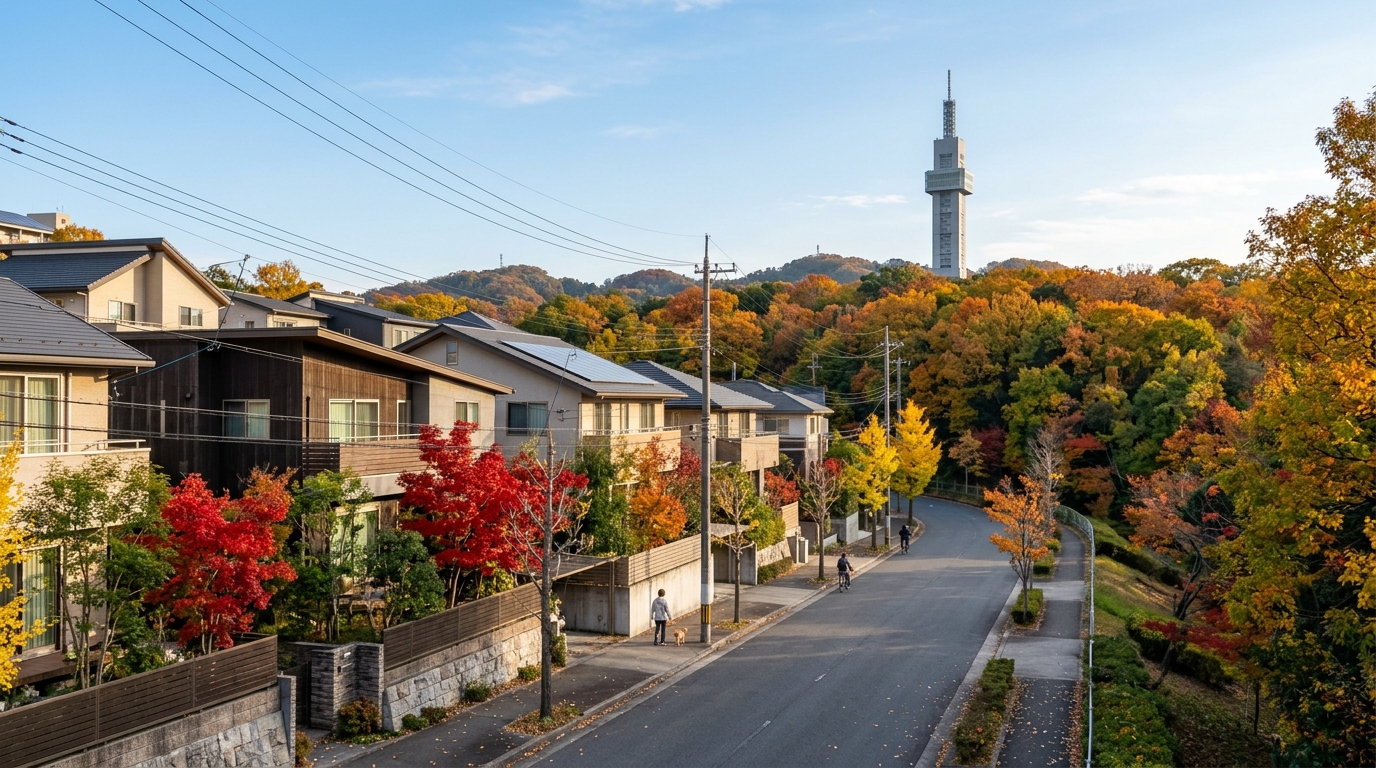
As autumn foliage reaches its peak and trees burst into vibrant colors, many people find themselves visiting large neighborhood parks on weekends. When choosing a place to live, having access to large-scale urban green spaces where you can experience all four seasons is not only key to daily satisfaction, but also an important factor in evaluating the long-term value of a residential area.
Looking at the latest transaction data for Chikusa Ward, Nagoya City, Aichi Prefecture (愛知県名古屋市千種区)—including the Higashiyama Park (東山公園), Hoshigaoka (星ヶ丘), Kakuozan (覚王山), and Imaike (今池) areas—as of Q1 2026, the median price per square meter for detached houses (land and building) stood at approximately ¥480,000/㎡ (+26.7% YoY), while residential land alone reached ¥400,000/㎡ (+29.0% YoY), showing steady strength. Combining expansive natural surroundings with convenient transit access to the city center and ongoing station-area redevelopments, this ward continues to attract solid support from both homebuyers and real estate investors.
In this article, we objectively organize the appeal of living near large-scale green spaces and key points for selecting a property, based on real estate transaction data and hazard information from the Ministry of Land, Infrastructure, Transport and Tourism (MLIT), as well as the latest 2026 development trends and childcare/housing support programs.
1. The Appeal of Higashiyama Park and Chikusa Ward in Autumn
When discussing the living environment of Chikusa Ward, Nagoya, one cannot overlook "Nagoya Higashiyama Forest (なごや東山の森)," a roughly 400-hectare green belt stretching across the urban area. At its core are Higashiyama Park, which includes the 60-hectare Higashiyama Zoo and Botanical Gardens (東山動植物園), and Heiwa Park (平和公園) to the north, which covers a planned urban area of approximately 146.53 hectares. Preserving such vast natural forests, ponds, and walking trails within an urban setting is rare nationwide, bringing rich scenery to the eastern hills stretching from Chikusa Ward into Meito Ward (名東区) and Tempaku Ward (天白区).
From November 14 to December 6, 2026, the "Higashiyama Zoo and Botanical Gardens Autumn Foliage Festival" is being held, with over 500 autumn trees—including Japanese maples and fullmoon maples—reaching peak color around Yayu-en (也有園), the Gassho-zukuri farmhouse, and Okuike Pond inside the botanical gardens. Evening illuminations are also held, making it one of Nagoya's premier autumn foliage spots that draws visitors from afar. For local residents, however, the greatest appeal is being able to enjoy these seasonal changes within their daily walking routine rather than as a special trip.
Moreover, Higashiyama Zoo and Botanical Gardens is not just a static facility; it is undergoing continuous updates under the long-term "Higashiyama Zoo and Botanical Gardens Revitalization Plan" ahead of its 100th anniversary in FY2036. Starting in FY2025, the fourth phase of the project is underway, with staged developments including the "Asian Highlands Area" (featuring snow leopard and Pallas's cat habitats), the "Komodo Dragon and Malayan Tapir House," the "Rear Conservatory" in the botanical gardens, and improvements to the Africa Zone and Savanna Area. Having an environment where children can continuously interact with animals and plants in newly updated facilities is one reason families want to settle here long-term.
2. Why Large Urban Green Spaces Steadily Support Residential Property Values
In the real estate market, there are clear reasons why residential areas adjacent to large green spaces like Higashiyama Park and Heiwa Park tend to be resilient to economic fluctuations and maintain stable valuations.
First is "irreplaceability in an urban setting." Commercial facilities and office buildings in front of stations can be newly built or redeveloped over time, but a 400-hectare forest and expansive parklands nurtured over decades cannot be artificially recreated later. Furthermore, much of the area surrounding the parks is designated as a "Category 1 Low-Rise Exclusive Residential Zone (第1種低層住居専用地域)," which strictly limits building heights, building coverage ratios, and floor-area ratios. In fact, looking at residential land data for Akasaka-cho (赤坂町) included in Chikusa Ward's transaction samples, it is zoned as Category 1 Low-Rise Exclusive Residential (50% building coverage / 150% floor-area ratio), demonstrating how sunlight, ventilation, and quiet streetscapes are protected by urban planning rules.
Second is "deep demand from end-users." Detached houses and family-oriented condominiums near green spaces tend to see steady demand from owner-occupiers, including child-rearing households and seniors seeking a calm lifestyle. For investors and buyers considering a future move, having a deep pool of end-user buyers when selling or renting out provides reassuring liquidity.
Third is "steady redevelopment of surrounding hubs." Across Chikusa Ward, efforts are underway to update urban functions without compromising the rich natural environment. On the eastern side around Hoshigaoka Station (星ヶ丘駅), the "(Tentative) Hoshigaoka Bowl Site Project" is progressing on the roughly 18,510㎡ former site of Hoshigaoka Bowl, which closed in 2023. As of autumn 2026, structural work on the buildings is underway, with "Hoshigaoka Tsutaya Books (tentative)" scheduled to open in spring 2027 as an expansion of Hoshigaoka Terrace (星が丘テラス), followed by the new theater "Hoshigaoka Playhouse" in July 2027. In spring 2028, the city-operated "Hoshigaoka Library (tentative)," a new building for Sugiyama Jogakuen University (椙山女学園大学), and "Branz Hoshigaoka Terrace," a condominium jointly developed by Tokyu Land Corporation and Meitetsu City Design, are scheduled for full opening.
Additionally, in front of Higashiyama Zoo and Botanical Gardens, a 22-story condominium is under construction on the former site of the aging Higashiyama Building. At Chikusa Station (千種駅), the western gateway to the ward, demolition work and environmental assessment procedures are underway for Sekisui House's 48-story, approximately 190-meter mixed-use tower condominium, "(Tentative) Chikusa Station Front Development (Grand Maison Chikusa The Tower Plan)." These developments at both the eastern and western hubs are raising the overall livability and profile of Chikusa Ward.
3. Price Trends and Market Conditions in Higashiyama Park, Hoshigaoka, and Kakuozan
Let's examine Chikusa Ward's price levels and recent movements using actual transaction data. According to statistics compiled by the real estate research service "Mekiki Research (物件目利きリサーチ)" from MLIT's Real Estate Information Library for Chikusa Ward, Nagoya City (2021–2026, 3,982 transactions):
- Average transaction price: Approx. ¥54.8 million (ranging from ¥1.1 million to ¥2.4 billion, including whole buildings and commercial land)
- Median transaction price: ¥38.0 million
- Average price per ㎡: Approx. ¥350,000/㎡
To understand the overall trend in greater detail, let's look at the quarterly breakdown by property type (pre-owned condominiums, residential land, and detached houses) from Q2 2024 to Q1 2026, compiled by Mekiki Research.
Source: Quarterly aggregation of MLIT Real Estate Information Library transaction data by Mekiki Research
The latest quarterly figures (Q1 2026) and recent comparisons by property type are summarized below:
| Property Type | Q1 2026 Transactions | Q1 2026 Median Price/㎡ | Q1 2026 Median Price | YoY Change in Price/㎡ (vs. Q1 2025) | Recent Trends & Characteristics |
|---|---|---|---|---|---|
| Pre-owned Condominiums | 130 | Approx. ¥440,000/㎡ | ¥33.0 million | -5.2% | Settled after a temporary rise in Q1 2025 (approx. ¥460,000/㎡), moving stably in the ¥400,000–440,000/㎡ range |
| Residential Land | 8 | ¥400,000/㎡ | ¥80.0 million | +29.0% | Moved in the ¥300,000–330,000/㎡ range in 2025; Q1 2026 reflects high-end transactions amid a small sample size |
| Detached Houses (Land & Building) | 42 | Approx. ¥480,000/㎡ | ¥54.0 million | +26.7% | Stepped up from ¥370,000–390,000/㎡ in 2024 to ¥440,000–490,000/㎡ from Q2 2025 onward, remaining firm |
A key takeaway from this data is that while pre-owned condominium prices have moved sideways to calmly in the low ¥400,000/㎡ range, the median price per square meter for detached houses (land and building) has clearly stepped up since the second half of 2025. In addition to rising construction material and labor costs, persistent demand for spacious detached homes near green spaces and educational districts is supporting prices. Note that because residential land had only 8 transactions in Q1 2026, individual locations (such as large plots or popular neighborhoods) can heavily influence the median.
Looking at transaction volume by neighborhood (top neighborhoods for pre-owned condominiums), regional differences within Chikusa Ward are also clear:
- Uchiyama (内山): 34 transactions (median price/㎡: ¥580,000/㎡)
- Shinike-cho (新池町) (toward Higashiyama Park–Hoshigaoka): 26 transactions (median: approx. ¥530,000/㎡)
- Fujimidai (富士見台) (north of Heiwa Park / northern Higashiyama Park): 21 transactions (median: ¥360,000/㎡)
- Imaike (今池): 21 transactions (median: approx. ¥470,000/㎡)
- Chikusa (千種): 19 transactions (median: approx. ¥530,000/㎡)
Looking at individual Q1 2026 transaction samples, properties within Chikusa Ward trade across a wide price range depending on location, building age, and zoning:
- Akasaka-cho (Residential Land): 440㎡, approx. ¥110 million (¥260,000/㎡), Category 1 Low-Rise Exclusive Residential Zone (50% coverage / 150% floor-area ratio)
- Asaoka-cho (朝岡町) (Pre-owned Condo): 3LDK, 70㎡, built 2000, SRC structure, ¥33.0 million (Commercial Zone, 80% coverage / 400% floor-area ratio)
- Ageha-cho (揚羽町) (Pre-owned Condo): A 3LDK, 80㎡, built 2005, RC structure traded at ¥31.0 million, while a 4LDK, 90㎡ built in 1985 traded at ¥20.0 million, and a 3LDK, 70㎡ built in 1986 traded at ¥19.0 million
- Ikegami-cho (池上町) (Pre-owned Condo): 3LDK, 70㎡, built 1987, RC structure, ¥4.5 million (cases exist where price/㎡ falls well below the surrounding median due to age or individual circumstances)
Thus, market prices in Chikusa Ward vary significantly by distance from the station, zoning, and building age. To understand recent transaction prices, living environments, and hazard risks around a specific address you are considering, using Mekiki Research's free area research tool to compare objective data at a pinpoint level is highly effective.
4. Livability and Daily Convenience for Families in Chikusa Ward
The reason Chikusa Ward is chosen by a wide range of residents, from singles to child-rearing families, is that the expansive green spaces in the east and the urban convenience in the west are directly connected by the Higashiyama Subway Line (地下鉄東山線).
For example, the Imaike Station area used as the search hub for this data (Commercial Zone, 80% coverage / 400% floor-area ratio) is a major transit hub where the Higashiyama Line and Sakura-dori Line (桜通線) intersect (while passenger counts are not listed in the public API data, it functions as a key transfer station in eastern Nagoya). Within this search area alone, there are 57 medical facilities, including Chikusa Hospital (ちくさ病院), Kato Clinic (かとう医院), and Goto Surgery & Dermatology (ごとう外科・皮フ科), offering a wide range of specialties nearby. The local school district is Chikusa Elementary School (千種小学校) and Imaike Junior High School (今池中学校), providing high convenience for daily life, medical care, and commuting despite being in an urban area. From here, riding the Higashiyama Line takes you to Kakuozan, Motoyama (本山), Higashiyama Park, and Hoshigaoka in just a few to ten-plus minutes, making it easy to balance weekday work and shopping convenience with nature-filled weekends.
Furthermore, childcare and housing support programs from Nagoya City and the national government are well-established as of 2026. Key programs that families considering moving or buying a home should know include:
- Child Medical Expense Subsidy: No out-of-pocket costs for both outpatient and inpatient care up to high school age (end of the fiscal year turning 18), with no income restrictions.
- Child Allowance and Birth/Childcare Support: In addition to the child allowance (now without income caps), Nagoya City offers its own "Nagoya Wakuwaku Present Project (BABY YELL!)" providing a ¥50,000-equivalent catalog gift, free childcare for the third child and beyond under age 3, and over 100 community childcare support centers across the city.
- Kodomo Anshin Sumairu Subsidy: Subsidizes safety renovation costs—such as fall-prevention measures for openings on the second floor or higher—for Nagoya households with elementary-school-age children or younger, or pregnant women (continuing in FY2026, with applications open until February 28, 2027).
- Energy-Efficient Housing & Decarbonization Support: Under the national "Mirai Eco Housing 2026 Project," child-rearing and young-couple households building new ZEH-standard or Long-Term Quality Housing, as well as any household building or renovating GX-oriented housing, are eligible for subsidies. Nagoya City also supports solar power and ZEH adoption through its "FY2026 Residential Decarbonization Promotion Subsidy" (note that as of November 11, 2026, the "storage battery system" and "insulated window renovation" categories have reached their budget caps and closed, so checking the latest budget status is necessary).
Having this administrative safety net and support for housing performance is another factor encouraging detached-home purchases in Chikusa Ward.
5. Topography, Hazards, and Sunlight Conditions to Check for Detached Homes
When considering an ideal home or investment property, land "safety" and "sunlight" are just as important as price and distance from the station.
Looking at the pinpoint data obtained around Imaike, the estimated flood inundation risk is "None," and the landslide disaster risk is also "None." Because Chikusa Ward consists largely of plateaus and hills at higher elevations than the lowlands of western Nagoya, it features broad areas with relatively low risk of large-scale river flooding.
However, because the eastern area around Higashiyama Park, Hoshigaoka, and Heiwa Park lies in the "Nagoya Eastern Hills Region," it is important to look at the topography of each individual plot rather than treating the entire area as uniform. Specifically, there are scattered plots with elevation differences, slopes, and retaining walls, so checking the following points will provide peace of mind:
- Localized hazard checks: Even without a major river nearby, the risk of inland flooding in low-lying depressions or designation as a landslide warning zone near slopes varies by parcel.
- Condition of retaining walls and construction costs: When building or rebuilding a detached house on land with elevation differences, needing to reinforce or rebuild an old retaining wall can lead to unexpected expenses.
- Surrounding elevation differences and sunlight: While the Higashiyama Park area has many Category 1 Low-Rise Exclusive Residential Zones, if the road or neighboring lot on the south side is elevated, the property may fall into shadow during seasons with low sun angles, such as the winter solstice.
Especially for detached homes, rather than assuming "a south-facing road means good sunlight," checking summer and winter solstice sunlight simulations that account for surrounding building heights and terrain undulations will determine post-move comfort and winter heating efficiency.
6. Property Selection and Maintenance Tips for Areas Near Green Spaces
While living near large urban green spaces offers many benefits, there are also practical lifestyle and maintenance points to keep in mind precisely because nature is so close.
First is "seasonal maintenance and exterior planning." While the autumn-to-winter foliage season offers beautiful scenery, homes near parks and tree-lined streets tend to accumulate wind-blown fallen leaves on their grounds. When considering a detached house, installing leaf-guard nets on rain gutters or choosing easy-to-sweep paving materials rather than gravel for the exterior can significantly reduce daily maintenance. Additionally, choosing high-insulation, airtight window sashes and a floor plan that considers cross-ventilation helps manage summer humidity and insects.
Second is "traffic conditions during tourist seasons." On weekends during the Higashiyama Zoo and Botanical Gardens autumn festival/foliage events or spring cherry blossom season, Prefectural Route 60, roads around the park, and parking areas tend to become congested. Households that frequently drive should check weekend daytime traffic on back roads to main thoroughfares and neighborhood streets in person to avoid surprises after moving in.
Third, for investors and buyers thinking about future resale, "evaluating zoning and land shape" is crucial. Low-rise exclusive residential zones preserve a quiet living environment, but floor-area and building coverage caps limit building volume. Conversely, commercial zones and Category 1 Residential Zones near stations offer high convenience and asset liquidity, but carry the possibility of mid-to-high-rise condominiums being built next door in the future. It is essential to choose an area that balances your lifestyle priorities with your future exit strategy.
7. Future Outlook for Chikusa Ward Detached Homes Compared to Surrounding Areas
In eastern Nagoya, popular residential areas naast Chikusa Ward include Meito Ward to the east and Showa Ward (昭和区) and Tempaku Ward to the south. Compared to these neighboring wards, Chikusa Ward's standout strengths are "proximity to the city center combined with large-scale green spaces" and "the wide variety of living environments within the ward."
For example, while Meito Ward offers highway interchange access and spacious land-readjustment districts, transit times to downtown areas like Sakae (栄) and Nagoya Station (名駅) are slightly longer than from Chikusa Ward. In contrast, Chikusa Ward stretches continuously along the Higashiyama Line from the urban convenience of Chikusa and Imaike to the lush, academic, and upscale residential neighborhoods of Kakuozan, Motoyama, Higashiyama Park, and Hoshigaoka. As a result, residents can easily adapt their housing to their life stage within the same ward and living sphere—enjoying the convenience of a condominium around Imaike or Chikusa when young, and moving to a detached house near Higashiyama Park or Heiwa Park when raising children.
Looking ahead, the phased opening of commercial facilities, a library, and a theater under the Hoshigaoka Bowl Site Project (2027–2028) and the large-scale redevelopment in front of Chikusa Station are drawing attention as factors that will further boost the area's appeal and convenience. Of course, transaction volumes and price movements may fluctuate depending on construction cost trends and interest rate environments, but as shown by the steady median price per square meter for detached houses in public data, end-user demand remains firm. Calmly comparing local transaction prices with future area plans is key to making a satisfying property choice.
8. Summary
The Higashiyama Park area of Chikusa Ward, Nagoya—whose appeal shines especially during the autumn foliage season—combines the 400-hectare urban green belt of "Nagoya Higashiyama Forest" with high transit convenience along the Higashiyama Subway Line and a well-developed child-rearing environment. In Q1 2026 market trends compiled from MLIT transaction data, the median price per square meter for detached houses (land and building) remained firm at approximately ¥480,000/㎡ (+26.7% YoY). Coupled with redevelopments in Hoshigaoka and in front of Chikusa Station, the area enjoys stable evaluations for both livability and asset value.
For those considering building or buying a detached house as their own home, it is reassuring to check not only the market price and hazard information of the land, but also "what kind of floor plan fits on the plot and how sunlight will look at the summer and winter solstices." With a free membership on Mekiki Research, you can check transaction price trends, living environments, and hazards by address. Furthermore, with the Pro plan's "AI Architecture Simulator," you can specifically verify 2D floor plans, 3D models, summer/winter solstice sunlight simulations, and estimated total budgets for detached houses based on actual area data and conditions (note that income/yield simulations and multi-family apartment plans are not supported).
Additionally, by registering for a free account, you can pull the MLIT data used in this blog directly from your Claude or ChatGPT (via MCP integration). Why not connect it with your everyday AI tools to continue comparing neighborhood market prices and exploring living environments?