
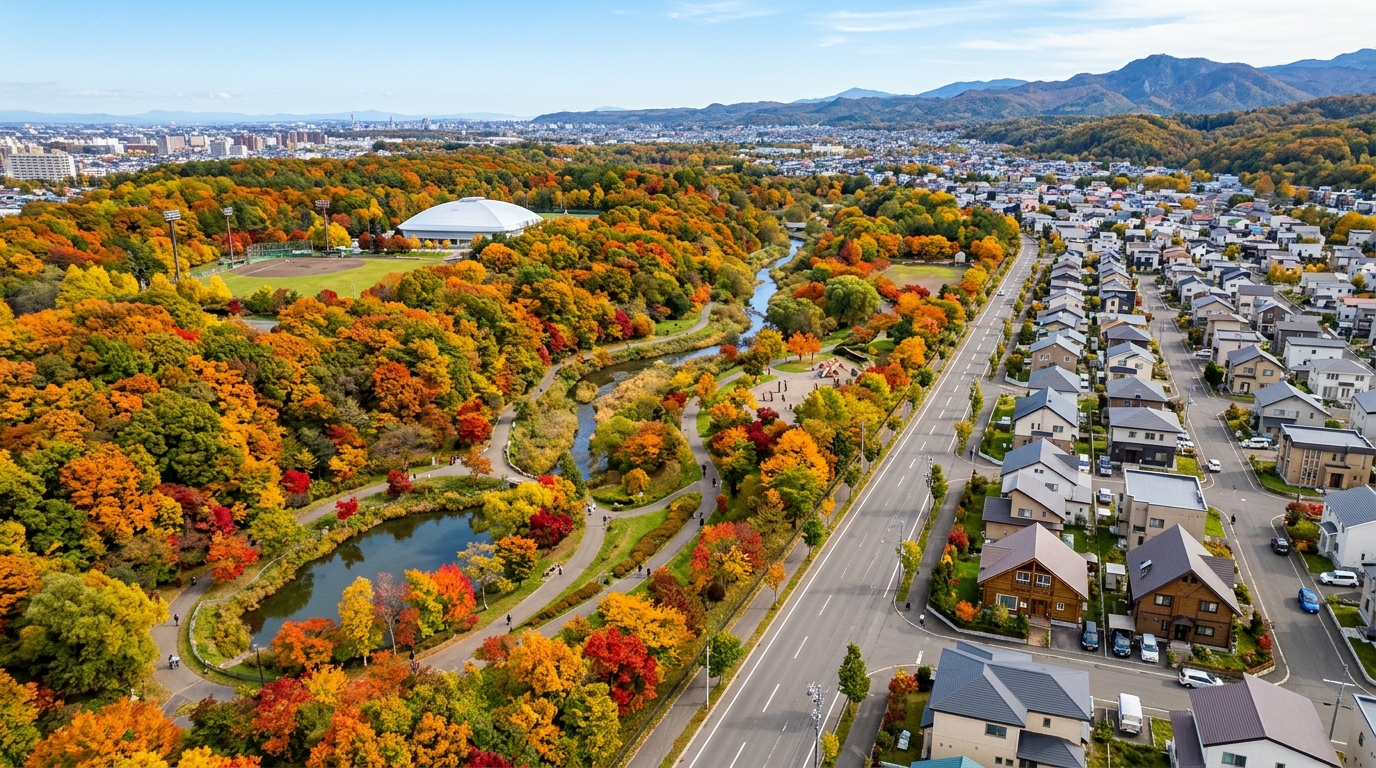
In November, as autumn foliage deepens and news of the first snowfall arrives in Toyohira Ward (豊平区), Sapporo, Hokkaido, the street trees and park greenery vividly reflect the changing seasons. Balancing easy access to the city center with a calm residential atmosphere, Toyohira Ward is anchored by Tsukisamu Park (月寒公園), an iconic urban oasis spanning approximately 22 hectares.
To summarize our conclusion upfront: the area surrounding Tsukisamu Park combines direct subway access to central Sapporo via the Toho Line (東豊線) with the exceptional livability of a large-scale green space. According to the 2026 Official Land Price Publication (地価公示), residential land across Toyohira Ward continues to show steady, resilient growth. Furthermore, a wave of major commercial facility openings through 2026 has significantly enhanced everyday shopping convenience.
In this article, we objectively examine how large urban green spaces impact residential property values and living environments, review the latest land price and transaction trends around Tsukisamu Park, and outline key lifestyle and site-selection considerations for both homebuyers and real estate investors.
1. How Large Urban Green Spaces Impact Residential Property Values
In urban areas, residential neighborhoods adjacent to or within walking distance of comprehensive parks spanning several to dozens of hectares tend to demonstrate unique long-term price resilience. The primary reason is that large-scale green spaces are scarce environmental resources that are extremely difficult to create artificially after an area has been developed.
For owner-occupiers, living near a major park directly enhances quality of life—offering spaces for daily walks, jogging, and children's play. Additionally, properties bordering a park face a lower risk of high-rise buildings being constructed right next door, helping preserve open views, natural ventilation, and cooler summer breezes over the long term.
From a real estate investment perspective, this superior living environment underpins both rental demand and resale appeal. Beyond basic metrics like distance to the station or building age, the added value of a "quiet residential environment near greenery" attracts a steady stream of families and single professionals. Because the neighborhood's overall appeal is easily maintained regardless of short-term market fluctuations, this factor draws strong attention from both homebuyers and investors.
2. Area Characteristics of Toyohira Ward and Tsukisamu Park
Toyohira Ward borders central Chuo Ward (中央区) and enjoys high transit convenience, with two Sapporo Municipal Subway lines—the Toho Line and the Namboku Line (南北線)—running north to south through the ward. Near its center, straddling Misono 10–12-jo (美園10〜12条) and Tsukisamu-Nishi 2–3-jo (月寒西2〜3条), lies Tsukisamu Park.
History and Facilities of Tsukisamu Park
Opened in 1961, Tsukisamu Park covers approximately 21.7 hectares (about 22 hectares) and has been selected as one of Japan's "Top 100 Urban Parks." Between 2012 and 2018, it underwent a major renewal, resulting in well-maintained facilities including the Park Life Center (management and rest hub), two baseball fields (upper and lower), artificial turf tennis courts, a park golf course, a boating pond popular in summer, and the "Mori no Asobiba" (Forest Playground) equipped with large play structures.
The park offers excellent public transit access: it is about a 5-minute walk from Misono Station (美園駅) on the Toho Line to the lower parking lot entrance, and about a 9-minute walk from Tsukisamu-Chuo Station (月寒中央駅) to the children's plaza. Administrative facilities such as the Toyohira Ward Office and the Health Center are also within walking distance, creating a rare blend of urban convenience and abundant nature.
Latest Commercial Facilities and Local Developments (2026)
Over the past one to two years, Toyohira Ward and the Tsukisamu Park area have seen several commercial and urban hub developments that further boost daily convenience:
- Sports Depo Flagship Store Sapporo Tsukisamu & Alpen Outdoors Sapporo Tsukisamu (Opened March 2026): Located in Tsukisamu-Chuo-dori 2-chome (月寒中央通2丁目), this experiential mega-store boasts roughly 1,500 tsubo (approx. 4,950 sq m) of sales floor space—one of the largest in Hokkaido. Close to both Tsukisamu Park and Tsukisamu-Chuo Station, it makes shopping for sports and outdoor gear effortless.
- Nitori Nakanoshima & Lopia Nakanoshima (Opened January 2026): Built on the former site of Hokkaido University of Science High School in Nakanoshima 2-jo 6-chome (中の島2条6丁目), this commercial hub pairs furniture and interior giant Nitori with popular grocery supermarket Lopia. Easily accessible by car from the Tsukisamu Park area, it expands local options for daily necessities and fresh food.
- Sapporo Industrial Exhibition Hall (Scheduled to open Autumn 2027): On the former Tsukisamu Green Dome site in Tsukisamu-Higashi 3-jo 11-chome (月寒東3条11丁目)—adjacent to the BRANCH Sapporo Tsukisamu commercial complex—construction is underway on a new large-scale exhibition hall to succeed Access Sapporo. Planned as the first city-owned facility to achieve Nearly-ZEB (Net Zero Energy Building) certification, it is expected to serve as a future hub for community and business exchange in the Tsukisamu-Higashi area.
These updates to everyday retail and regional urban functions, layered onto an established, tranquil residential neighborhood, demonstrate the ongoing vitality of Toyohira Ward.
3. Transaction Unit Price Trends and Land Value Movements
Next, let's examine land price levels and trends in Toyohira Ward and around Tsukisamu Park using official statistics. According to the Ministry of Land, Infrastructure, Transport and Tourism's (MLIT) 2026 Official Land Price Publication and the July 2026 Hokkaido Prefectural Land Price Survey, residential land in Toyohira Ward continues to post steady gains, supported by rising land prices in central Sapporo.
In the 2026 Official Land Price Publication, the average residential land price in Toyohira Ward sits in the low 500,000 yen per tsubo range (up around 2% year-on-year), and the Hokkaido Land Price Survey also maintains positive year-on-year growth. The ability to keep land acquisition costs lower than in Chuo Ward while keeping commute times to the city center short continues to drive stable demand from both homebuyers and renters.
Based on standard land data from the 2026 Official Land Price Publication around Tsukisamu Park, the trends by location type are summarized below:
| Area / Location Type | Typical Zoning | Distance to Nearest Station | Indicative Official Land Price (2026 Trend) | Streetscape & Land Use Characteristics |
|---|---|---|---|---|
| Near Stations & Arterial Roads (Walking distance to Tsukisamu-Chuo / Misono) | Neighborhood Commercial / Category 2 Residential / Category 1 Medium-to-High-Rise Exclusive Residential | Approx. 3–10 min walk | Around ¥190,000–¥220,000 / sq m | Mix of condominiums, commercial facilities, and detached houses; high transit and shopping convenience |
| Park-Adjacent & Quiet Residential (Between Misono & Tsukisamu-Nishi) | Category 1 Medium-to-High-Rise Exclusive Residential / Category 1 Low-Rise Exclusive Residential | Approx. 8–15 min walk | Centered around ¥140,000–¥180,000 / sq m | Well-balanced access to greenery and quiet living; strong demand for detached homes |
| Further from Stations / Suburban-Leaning (Inner Tsukisamu-Higashi / Toward Nishioka) | Category 1 Low-Rise Exclusive Residential, etc. | Over 15 min walk / Bus access | Around ¥100,000–¥130,000 / sq m | Easier to secure larger lots; suited for spacious detached homes and car-oriented lifestyles |
Note: The figures above are organized based on trends in the 2026 Official Land Price Publication standard sites. Actual transaction prices vary depending on individual factors such as road frontage, lot width, elevation differences, and building age.
Even within Toyohira Ward, unit prices vary clearly depending on walking distance to subway stations and zoning regulations (which govern building height and type). How you balance budget and lot size will significantly shape which pocket around Tsukisamu Park best fits your needs.
If you want to investigate historical real estate transaction prices, price-per-square-meter trends, and local living environment data for a specific address or district, using the free-member area research feature on Mekiki Research (物件目利きリサーチ) is a helpful way to gain an objective grasp of market values.
4. Appeal for Detached-House Living: Four-Season Nature, Child-Rearing, and Convenience
Beyond numbers and market prices, let's look at the living environment around Tsukisamu Park through three lenses—nature, child-rearing, and convenience—to picture daily life in the area.
Experiencing the Four Seasons in Everyday Life
In November, the ginkgo trees around the park's clock tower and the maples near the shrine and forest areas turn vibrant shades of yellow and red; depending on the year, you can even enjoy the contrast between early snow and autumn leaves. Spring brings cherry blossoms and fresh greenery, summer offers water play and shaded strolls, autumn invites leaf-peeping, and winter transforms the park into a snowfield for sledding and cross-country skiing.
Having nature on a scale that a private backyard simply cannot match within walking distance is a major draw—whether for a midday break during remote work, a daily walking routine, or walking the dog. Even for singles or couples without children, it offers a breathing space amid urban convenience.
A Compact Living Sphere for Medical Care, Shopping, and Administration
Around Tsukisamu Park, you will find the Toyohira Ward Office, Toyohira Police Station, libraries, children's hall facilities, and numerous clinics and supermarkets. Easy access to major arterial roads such as Kanjo-dori (環状通) and National Route 36 (Tsukisamu-Chuo-dori) allows residents to flexibly switch between driving and taking the subway—a reassuring advantage in a snowy region.
With the opening of the Sports Depo Flagship Store Sapporo Tsukisamu and the new Nitori and Lopia stores in Nakanoshima, everything from daily groceries to hobby and outdoor gear is now within a 10-to-15-minute drive or bike ride.
5. Child-Rearing Support and Housing Subsidies in Sapporo (FY2026)
For families and younger households considering buying or building a detached home, municipal support programs and national housing subsidies are essential components of financial planning. Below is a summary of key programs as of FY2026:
| Program Type | Program Name (Administrator) | Main Features as of FY2026 | Key Points to Check |
|---|---|---|---|
| Childcare Fee Support | Free Preschool & Childcare (National / Sapporo City) | Free for ages 3–5; additionally, under Sapporo's own policy, free for second and subsequent children aged 0–2 regardless of household income | Treatment of non-certified facilities and side-dish meal fees varies by facility and household |
| School Meals & Medical Care | School Lunch Support & Child Medical Expense Subsidy (Sapporo City) | Elementary school lunch fees effectively free for parents in FY2026; burden-reduction measures for junior high. Medical subsidies cover up to age 18 (high school age) | Partial co-payments and income limits apply to medical expense subsidies |
| New Home / Renovation Subsidy | Mirai Eco Housing 2026 Program (MLIT) | Supports high-energy-efficiency new homes (GX-oriented, Long-Life Quality Housing, ZEH-level, etc.) and energy-saving renovations | Budget caps and application deadlines (varying by housing type) require early confirmation |
| City-Specific Housing Subsidy | Sapporo Next-Generation Housing Subsidy System (Sapporo City) | Subsidizes construction costs for new homes meeting Sapporo's own insulation and energy-efficiency standards (Platinum and Gold tiers in FY2026) | Registration periods and lottery quotas apply; coordination with construction schedules is crucial |
Note: Program requirements, application status, and details may change mid-fiscal year. Always confirm the latest official announcements from Sapporo City and MLIT.
In cold regions like Sapporo (classified under the coldest Climate Zones 1 and 2 for energy-efficiency standards), high-insulation, high-airtightness homes are becoming the standard—further accelerated by the mandatory energy-efficiency compliance introduced in April 2025. National and municipal subsidies not only reduce initial construction costs but also lower winter heating bills after moving in, supporting long-term comfort and asset value.
6. Key Precautions When Considering a Detached Home Near Green Spaces
While the Tsukisamu Park area offers an attractive living environment, it is important to objectively check potential risks and practical constraints before purchasing land or a home.
Pinpoint Checks for Elevation Differences and Flood Hazards
Tsukisamu Park encompasses both elevated hills and low-lying areas, and the surrounding neighborhoods feature gentle undulations. Several rivers flow through Toyohira Ward, including the Toyohira River (豊平川), Mochisappu River (望月寒川), and Tsukisamu River (月寒川). According to Sapporo City's Flood Hazard Map (Toyohira Ward edition, updated July 2026), while many elevated areas lie outside expected inundation zones, certain low-lying pockets near rivers and parts of Misono are designated as potential flood or inland-water inundation areas.
Even within the same district name—such as "Misono" or "Tsukisamu"—elevation and drainage conditions can change within just a few blocks. Always check hazard information for the exact, pinpoint address of any property you are considering.
Winter Road Widths, Snow Removal, and Weekend Traffic
A must-check item when choosing a detached house in Sapporo is winter road conditions. Some perimeter roads around Tsukisamu Park and nearby residential streets (such as parts of the Misono-Nakanoshima Line) are relatively narrow. When snow is piled along the roadside in winter, passing oncoming cars can become tight. Additionally, on weekends or during park events, queues of cars heading to the park's parking lots can affect surrounding streets.
When viewing properties, try visiting at different times—such as a snowy weekday morning and a sunny weekend afternoon—to see firsthand how well the front road is cleared of snow and how traffic flows. Furthermore, because rich nature remains around Tsukisamu Park, the park management office conducts ecological surveys on foxes and issues advisories regarding crows and hornets, reflecting local rules for coexisting with wildlife.
7. Winter Solstice Sunlight and Floor Plan Design
When building a detached house near a large green space, an often-overlooked factor is seasonal sun angles and sunlight conditions.
In summer, the park's trees provide pleasant shade. However, at high latitudes like Sapporo, the sun's altitude around the winter solstice (late December) is very low. Consequently, lots located on the north or west side of the park—or plots shaded by tall trees or neighboring houses—may receive less indoor sunlight during winter afternoons than expected.
Winter sunlight affects not only indoor brightness but also natural passive solar heating and how easily snow melts on your front walkway and parking space. Even on a south-facing road, factors like the height of buildings across the street, lot proportions (frontage vs. depth), and window placement can dramatically change winter livability. Simulating in 3D how shadows fall at the summer and winter solstices—and when sunlight enters the living room—before purchasing land will help prevent regrets later.
8. Summary
The area around Tsukisamu Park in Toyohira Ward, Sapporo, brings together four-season nature across roughly 22 hectares of urban greenery, convenient subway access to central Sapporo via the Toho Line, and growing everyday convenience highlighted by new 2026 commercial openings. Land price trends in the 2026 Official Land Price Publication show steady performance across Toyohira Ward's residential districts—offering medium-to-long-term rental stability for investors and an appealing child-rearing and living environment for homebuyers.
At the same time, careful site-by-site evaluation remains essential, including checking flood hazards across hilly and low-lying terrain, assessing winter road and snow-removal conditions, and securing winter solstice sunlight in a snowy, cold climate.
If you would like to conduct deeper research on the Tsukisamu Park area or another neighborhood of interest, consider using Mekiki Research (物件目利きリサーチ). With the Pro Plan's AI Architecture Simulator, you can generate detached-house floor plans, 3D models, summer/winter solstice sunlight simulations, and rough total budget estimates based on real area data and your preferences (note: multi-family apartment planning and yield/cash-flow calculations are not covered). Additionally, by registering as a free member, you can look up historical transaction prices, hazard data, and living environment metrics by specifying an address, and even pull the MLIT data used in this blog directly into your Claude or ChatGPT via MCP integration. Why not start by checking objective data for your locations of interest on the map?
Check the latest land prices and hazard information for Toyohira Ward, Sapporo on Mekiki Research 👉