
Bottom Line: Shirakawa City, Fukushima Prefecture (福島県白河市), long recognized as the gateway to the Tohoku region, has gained significant attention in recent years as an emerging hub for large-scale data centers (DCs). Leveraging its excellent accessibility from the Greater Tokyo area, cool climate, and resilient power infrastructure, the city is establishing its position as a major new industrial base. This article analyzes the ripple effects that job creation and infrastructure expansion—driven by data center investments—will have on residential land prices and living environments for families in Shirakawa City leading up to 2030. Ultimately, sustained demand for living close to work (proximity of residence to workplace) combined with ongoing urban redevelopment is expected to keep residential land prices firm, with asset values anticipated to remain steady or appreciate, particularly in highly convenient stationfront areas and well-established residential districts.
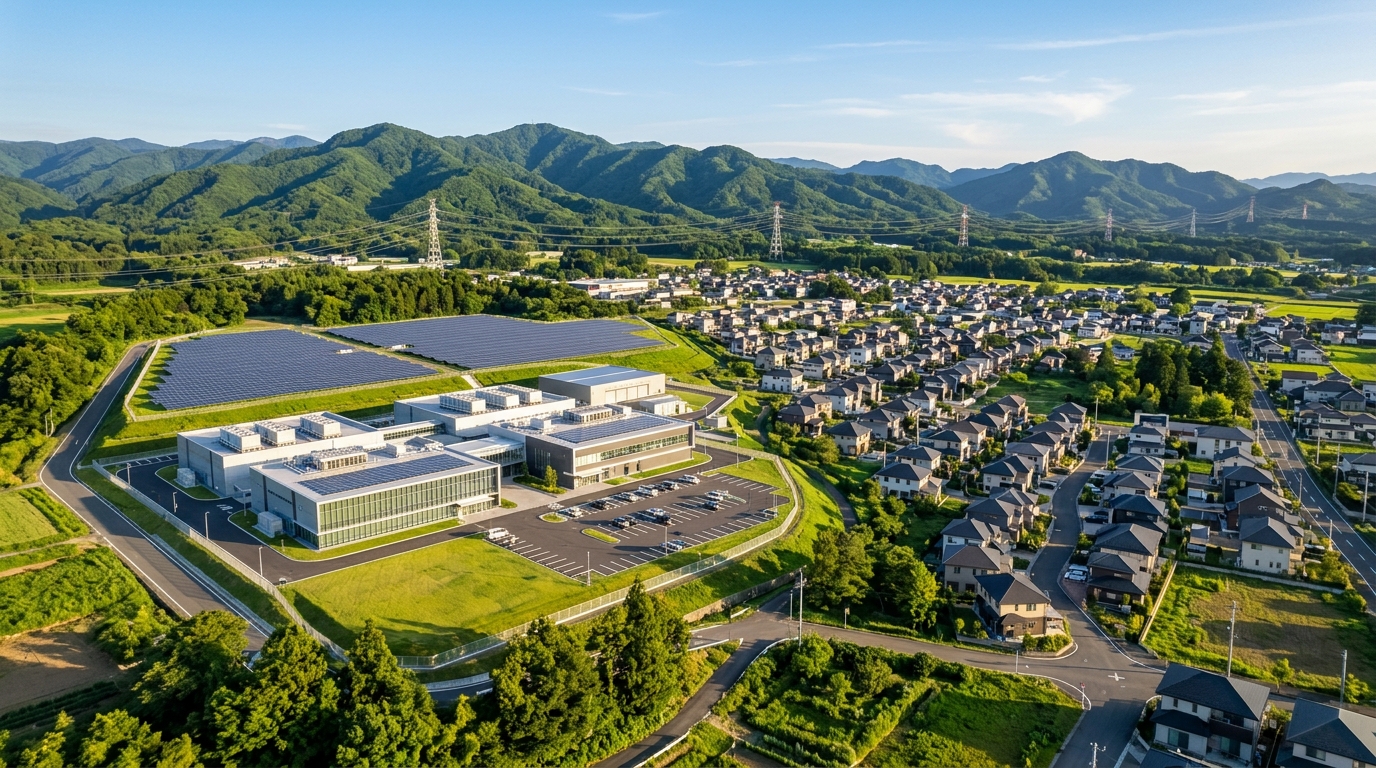
1. Background Behind the Data Center Concentration in Shirakawa City, Fukushima: Gateway to Tohoku
Located in the southern region of Fukushima Prefecture, Shirakawa City has historically served as a strategic transportation hub and the southern entry point to Tohoku. In recent years, a major concentration of large-scale data centers has rapidly emerged as a new defining feature of the city. Driven by the rise of generative AI and expanding cloud services, Japan's domestic data processing demands are surging exponentially. To alleviate power grid bottlenecks in the Tokyo metropolitan area and mitigate disaster risks through Business Continuity Planning (BCP), the national government strongly encourages decentralizing digital infrastructure across regional areas.
Among candidate locations, Shirakawa City stands out primarily due to its cool climate and relatively low risk of natural disasters. Data centers consume immense amounts of electricity to cool their servers; however, Shirakawa enables facilities to easily implement free-cooling systems using ambient outside air, significantly boosting energy efficiency. For example, the "Fukushima Shirakawa Data Center," operated by SoftBank (formerly IDC Frontier), is a state-of-the-art, eco-friendly facility that combines cool ambient air with water cooling systems to meet most of its annual cooling needs with outside air alone. Furthermore, modular expansions aligned with growing demand continue to transform the facility into a symbolic regional IT infrastructure hub.
2. Industrial Strengths Powered by Strategic Transportation and a Stable Power Supply Network
When selecting data center locations, network latency and a stable power supply are just as critical as climate conditions. Shirakawa City lies within approximately 150 km of central Tokyo as the crow flies. Taking the Tohoku Shinkansen from Shin-Shirakawa Station connects the city to central Tokyo in about 90 minutes. This physical proximity directly translates to low-latency network response speeds, enabling ultra-low latency data transmission with the metropolitan area. Consequently, the region satisfies the rigorous operational requirements for primary data centers and disaster recovery backup facilities operated by financial institutions and cloud service providers.
Simultaneously, the city is strengthening its power infrastructure by integrating renewable energy sources. For instance, real estate developer Hulic Co., Ltd. is progressing with the development of the "(Tentative Name) Hatajuku Renewable Energy Park," a solar power plant paired with large-scale battery storage targeting operation by March 2028. This facility will serve as a vital new pillar supporting the local power grid. Such initiatives toward decarbonization, backed by a resilient electrical grid, make Shirakawa an exceptionally attractive destination for power-intensive tech enterprises.
3. Impact of Data Center Attraction on the Local Economy and Job Market
The concentration of data centers extends far beyond the construction of physical facilities; it delivers long-term economic benefits to the local community. It generates new employment opportunities—including high-income positions for IT engineers, facility managers, and specialized technicians—which is expected to spur an influx of new residents from outside the city.
In anticipation of these demographic shifts, local infrastructure in Shirakawa is undergoing rapid redevelopment. Scheduled to open around the summer of 2027 on the site of the former Civic Hall is a new multipurpose community complex named "Shirafull" (しらふる), themed around health promotion, childcare support, and lifelong learning. Culture Convenience Club Co., Ltd. (CCC) will participate in its operation as the designated manager, transforming the site into a vibrant new local gathering hub. Additionally, everyday retail environments are expanding rapidly: the new "York Benimaru Shirakawa Showamachi Store" is slated to open in November 2026, dramatically enhancing convenience for families. The dual drivers of new job opportunities and upgraded urban amenities are increasingly attracting homebuyers seeking a convenient work-life balance near their places of employment.
4. Residential Land Price Trends in Shirakawa City and Forecast Toward 2030
This economic revitalization is clearly reflected in real estate market data. According to quarterly transaction data compiled by our team from the Real Estate Information Library of the Ministry of Land, Infrastructure, Transport and Tourism (MLIT), the Shirakawa real estate market demonstrates strong resilience.
The table below outlines recent transaction performance in Shirakawa City (2021–2026, total sample size: 767 transactions) alongside key district trends:
| Indicator / District | Transaction Count | Average & Median Overview | Median Price per m² | Notes |
|---|---|---|---|---|
| Shirakawa City Overall (2021–2026) | 767 cases | Avg. Transaction Price: ~¥9.53M<br>Median: ¥5.00M | ~¥21,000 / m² | Baseline benchmark for overall market trends |
| Misaka (みさか) | 7 cases | Property Type: Residential (Land & Building) | ~¥43,000 / m² | Premium residential district within the city |
| Shirasaka (白坂) | 5 cases | Property Type: Residential (Land & Building) | ~¥11,000 / m² | Relatively spacious plots at affordable price points |
| Oo (大) | 4 cases | Property Type: Residential (Land & Building) | ~¥16,000 / m² | Stable residential demand |
| Ishikiriba (石切場) | 3 cases | Property Type: Residential (Land & Building) | ¥180,000 / m² | Higher unit prices driven by specific property conditions |
Additionally, quarterly trends for residential plots (land and building) indicate sustained, consistent housing demand despite seasonal fluctuations.
According to the latest data for Q1 2026, land-only residential transactions totaled 12 cases, with the median price per square meter rising sharply by 12.5% year-over-year to approximately ¥27,000/m². Meanwhile, residential transactions involving land and building recorded 22 cases with a median price of approximately ¥19,000/m² (-3.2% YoY), suggesting that demand for new single-family home lots is currently leading market momentum. Looking ahead to 2030, the establishment of data center-related industries combined with maturing public infrastructure is expected to mitigate downside risks, resulting in solid and steady land price appreciation.
5. Rising Demand for Proximity to Work and Features of Family-Friendly Residential Areas
For engineers and corporate personnel working at local data centers, avoiding long commutes by living close to work is a top priority when choosing a home. Real estate transaction data reveals distinct neighborhood characteristics catering to diverse lifestyle needs.
For example, in the popular "Shin-Shirakawa" area—highly sought after by families prioritizing convenience—a 230 m² land-only residential plot recently sold for approximately ¥15 million (~¥64,000/m²). Designated as a Category II Residential Zone with a 60% building coverage ratio and a 200% floor area ratio, it provides ideal parameters for constructing a spacious single-family home. Conversely, buyers seeking a relaxed lifestyle in a greener setting often select the "Shirasaka" area. Outside urban promotion areas, a 250 m² residential plot sold for ¥2 million (¥8,000/m²), offering abundant budget-friendly options to build a custom home. In commercial-adjacent districts like "Otemachi," a 230 m² mixed-use commercial property located in a Commercial Zone (80% building coverage / 400% floor area ratio) transacted for approximately ¥19 million, demonstrating active trading across diverse property types. In "Asahicho," a 240 m² residential lot in a Category I Residential Zone (60%/200%) traded at ¥7 million (¥29,000/m²), drawing interest as a well-balanced neighborhood offering both comfort and affordability.
For homebuyers searching for residential lots or seeking in-depth insights into market trends and local living environments, we recommend using the free neighborhood research features available to registered members on Mekiki Research. By registering for a free account, you can access MLIT transaction datasets used in this article directly through your own Claude or ChatGPT models via Model Context Protocol (MCP) integration. Continuing your research with your custom AI tools makes it seamless to evaluate properties and track localized historical transaction pricing.
6. Expanding Regional Living Sphere via Shinkansen and Expressways
Another major pillar supporting real estate values in Shirakawa City is its exceptional regional connectivity. The city is anchored by JR Shirakawa Station in the central urban core. Furthermore, adjacent Shin-Shirakawa Station provides direct access to the Tohoku Shinkansen, making business trips to Tokyo or Sendai and weekend leisure getaways effortlessly convenient. The nearby Shirakawa Interchange on the Tohoku Expressway ensures seamless highway travel in all directions, a key advantage for motor-dependent households and families establishing roots in regional cities.
From a lifestyle standpoint, data underlines the area's livability and peace of mind. The surrounding community features 19 healthcare facilities—including Nakatsuka ENT Clinic (なかつか耳鼻科), Otaka Internal Medicine and Gastroenterology Clinic (医療法人 大高内科胃腸科), and Ichibakukai Watanabe Clinic (医療法人一麦会渡辺医院)—ensuring prompt medical care for sudden illnesses or pediatric visits. On the educational front, established institutions such as Shirakawa Third Elementary School and Shirakawa Chuo Junior High School form a solid foundation that supports long-term settlement for growing families.
7. Green Living Environments and Key Checkpoints for Family Homebuyers
When purchasing a home, safety is just as critical as convenience and pricing. While Shirakawa City broadly offers quiet, scenic Category I Residential Zones, prospective buyers should carefully review local flood and hazard maps prior to acquisition.
According to Geospatial Information Authority of Japan (GSI) hazard data for target locations, certain low-lying zones carry an estimated flood inundation depth of 0.5 to 3.0 meters. Additionally, specific areas carry designated debris flow hazard risks. These factors should not discourage homebuyers, but rather serve as crucial information for proper risk mitigation: verifying terrain elevations, raising foundation designs, and confirming emergency evacuation routes in advance are essential steps to protect your family's safety and preserve asset value.
Furthermore, Shirakawa City actively encourages long-term residential settlement by offering municipal housing support schemes. For instance, the "Come to Shirakawa Housing Acquisition Support Subsidy" (来て『しらかわ』住宅取得支援事業補助金) provides generous housing subsidies for households relocating from outside the prefecture, alongside various childcare support benefits. When creating financial plans, homebuyers are encouraged to verify the latest policies through municipal consultation windows or official city websites to maximize available financial incentives.
8. Conclusion: Selecting a Home and Future Asset Value Outlook in Shirakawa City
This article explored recent structural developments in Shirakawa City, Fukushima Prefecture—driven by the rapid concentration of data centers—alongside residential land price forecasts toward 2030 and living environments for families. As a vital transportation and energy node in Tohoku, Shirakawa is leveraging industrial investments alongside major community developments like "Shirafull" to cultivate a highly attractive residential market optimized for living near work. With land prices showing strong upward momentum, gathering early, objective data-driven insights will be key to securing your ideal home while safeguarding long-term asset value.
Upgrading to the Mekiki Research Pro Plan (paid tier) grants access to detailed AI-powered neighborhood analysis reports as well as the "AI Architectural Simulator." This tool automatically generates 2D floor plans, 3D home models, summer/winter solstice sunlight simulations, exterior visual renderings, and preliminary total budget estimates tailored to real-world regional data and your specific preferences. Users can also convert uploaded floor plan images into 3D models or export data directly to PowerPoint and 3D formats, providing comprehensive support to bring your dream home project to life.