
In short, Sanda City, Hyogo Prefecture (兵庫県三田市)—which is seeing rapid expansion of its power and telecommunications infrastructure as one of the Kansai region's premier data center (DC) hubs—is an exceptionally promising area for both end-user homebuyers and real estate investors. The city is positioned to maintain strong asset values while undergoing dramatic enhancements to its residential environment heading toward 2030.
In recent years, Japan has experienced a continuous construction boom in data centers, driven by accelerating digital transformation and the widespread adoption of generative AI. Crucially, the benefits extend far beyond mere industrial growth: they directly spur urban redevelopment, enhancing neighboring residential neighborhoods and elevating overall livability. From the perspective of a real estate analyst, this article provides an in-depth analysis of Sanda City's latest infrastructure expansion trends and their spillover effects on residential living environments and future land values.
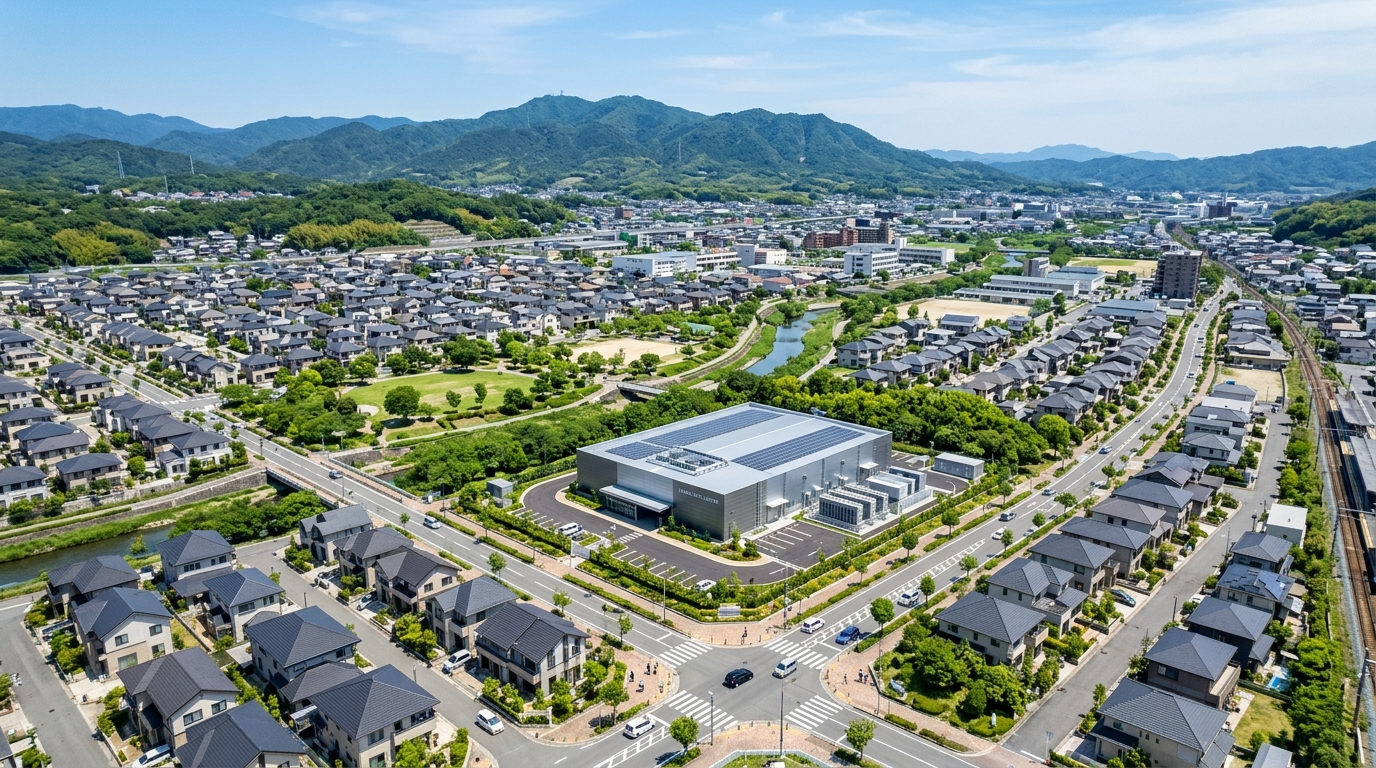
1. Why Sanda City, Hyogo Prefecture Is Drawing Attention as a Major Kansai Data Center Hub
In recent years, Sanda City in Hyogo Prefecture has attracted intense interest from IT enterprises and real estate investors as a crucial data center cluster in the Kansai region. Behind this momentum lies its overwhelming geographical advantage, characterized by solid bedrock ground and ideal conditions for Business Continuity Planning (BCP)—two non-negotiable prerequisites for data center location selection.
A prime example is SCSK Corporation's "netXDC Sanda Center" (netXDC三田センター) and the "netXDC Sanda Center No. 2" (netXDC三田第2センター), completed in 2018. These large-scale facilities boast some of the highest reliability standards in Japan and are situated in inland hilly areas well-distanced from active fault lines and major river systems. This topography minimizes the risk of natural disasters such as earthquakes, tsunamis, and major floods—a factor highly valued by corporations entrusting their critical data to these centers.
Furthermore, in 2025, Sanda City conducted a "Sounding-based Market Investigation for New Industrial Park Planning" (新たな産業団地検討に関するサウンディング型市場調査), initiating steps to develop a new industrial park spanning approximately 27 hectares designed to accommodate manufacturing, logistics, and data centers. These municipal-led initiatives to attract data centers and reinforce the local industrial base serve as a powerful engine driving Sanda's economic potential toward 2030.
2. Infrastructure Expansion Driven by DC Attraction and Transforming Urban Development
For a high concentration of data centers to function, advanced infrastructure is mandatory—including robust power grids for stable, large-scale electricity supply and optical fiber networks capable of ultra-low-latency, high-capacity data transmission. In Sanda City, the expansion of industrial-grade power and telecommunications infrastructure is progressing rapidly, and the benefits are being reinvested directly into the community through upgraded living environments and station-front redevelopments.
Particularly noteworthy is the ongoing "Sanda Station Front C-Block District Category 1 Urban Redevelopment Project" (三田駅前Cブロック地区第一種市街地再開発事業) near JR and Kobe Electric Railway (Shintetsu) Sanda Station (三田駅). Considered the capstone of the station-area redevelopment, the new commercial complex "Kippy Terrace" (キッピーテラス) is scheduled to open in stages starting in the spring of 2027. This commercial and office building will house "San-no-wa" (さんのわ)—a municipal facility for learning, interaction, and co-creation—alongside a medical clinic mall, establishing a vibrant new hub directly connected to the station. On the same site, "Geo Sanda" (ジオ三田), a 20-story, 541-unit high-rise tower condominium, is currently under construction and is poised to become a new landmark for station-front living.
Significant developments are also underway around Flower Town Station (フラワータウン駅). On the former site of the long-beloved commercial facility "Flora 88" (フローラ88, formerly Ion Sanda), AEON Retail is developing "(Tentative Name) Soyora Sanda Sunflower" ((仮称)そよら三田・サンフラワー), an urban shopping center featuring a new format targeted for opening in autumn 2027 (with some plans pointing to April). Designed around the concept of a "place to visit, gather, and connect," this facility will enhance daily shopping convenience while providing community spaces for children, contributing significantly to the revitalization and appeal of the new town area. Infrastructure investment has acted as a catalyst, creating a virtuous cycle of urban development across Sanda today.
3. Excellent Residential Environment and Natural Foundation: Sanda's Appeal for Families
While infrastructure expansion and urban redevelopment progress, Sanda City's long-standing popularity among prospective homebuyers—especially young families—stems from its harmonious balance between a rich natural environment and robust living infrastructure.
Examining the neighborhood through empirical data reveals a strong educational foundation, with public institutions such as Miwa Elementary School (三輪小学校) and Hakkei Junior High School (八景中学校) delivering deeply rooted community education. Healthcare infrastructure is equally well-established: within the area surrounding Sanda Station alone, there are 32 medical facilities, including Shojinkai Hirashima Hospital (医療法人社団 尚仁会 平島病院), Ito Mental Clinic (いとうメンタルクリニック), and Inazumi Internal Medicine and Cardiology Clinic (いなずみ内科・循環器科). Having numerous trustworthy hospitals and clinics nearby provides invaluable peace of mind for both child-rearing families and seniors.
In addition, Sanda City offers strong administrative support for young households. Under its recent "Newlywed Housing Support Program" (結婚新生活支援事業), the city provides subsidies of up to 600,000 yen to newly married couples for home purchases, renovations, rent, and moving expenses, actively encouraging young generations to settle permanently. Residents enjoy the benefits of cutting-edge infrastructure brought by data center aggregation, while spending weekends refreshing in nature and benefiting from generous local government support. This ideal balance of work, residence, and leisure ("職・住・遊") represents Sanda's greatest strength as a residential location.
4. Economic Spillover: How DC Aggregation Drives Employment, Population Inflow, and Land Values
The concentration of data centers and related IT infrastructure industries delivers direct positive spillover effects to the local economy. As engineers responsible for facility operation and maintenance move in and corporate offices expand, jobs for highly skilled, well-compensated professionals are created. This mechanism encourages an inflow of residents seeking proximity between work and home, structurally lifting local housing demand.
From a real estate investment perspective, stable employment and population growth directly translate into resilient rental demand. Demand for high-quality condominiums and detached homes remains consistently strong, particularly in commercial zones with high transit convenience like Sanda Station and in master-planned new towns with well-developed amenities like Flower Town.
Furthermore, as Sanda solidifies its brand image as an infrastructure-rich, disaster-resilient city, demand from end-user homebuyers making targeted property searches continues to grow. The fact that the ground is safe enough to host high-tech data centers functions as an "invisible shield" protecting residential property value, making it a highly favorable factor for mid-to-long-term land value stability and growth.
5. Area-by-Area Land Value Trends and Housing Price Forecasts Toward 2030
To project price trends toward 2030, let us analyze current real estate market conditions in Sanda City using actual transaction data. According to quarterly data compiled by Mekiki Research from the Ministry of Land, Infrastructure, Transport and Tourism (MLIT) Real Estate Information Library, real estate transactions in Sanda City between 2021 and Q1 2026 totaled 2,052 cases, reflecting a highly active market. During this period, the overall average transaction price was approximately 25 million yen, with a median price of 18 million yen and an overall average unit price of roughly 72,000 yen per square meter.
The table below summarizes recent quarterly transaction trends by property type:
| Property Type | 2026 Q1 Transaction Volume | Median Price per m² | Year-over-Year (YoY) | Median Transaction Price |
|---|---|---|---|---|
| Existing Condominiums, etc. | 38 transactions | Approx. ¥189,000/m² | +12.5% | ¥15.0 million |
| Residential Land (Land with Building) | 53 transactions | Approx. ¥86,000/m² | -32.5% | ¥20.0 million |
| Residential Land (Land Only) | 2 transactions | Approx. ¥23,000/m² | -67.6% | ¥7.3 million |
| (Source: Compiled quarterly by Mekiki Research based on transaction data from the MLIT Real Estate Information Library) |
Notably, the price per square meter for existing condominiums posted a strong increase of +12.5% year-over-year. Driven by station-front redevelopment progress and a growing buyer preference for convenience, condominium demand has proven firmly resilient. Meanwhile, detached homes (land with building) experienced a price adjustment of -32.5% year-over-year. This shift primarily reflects changes in the proportion of suburban transactions and the turnover of older properties—which, conversely, presents an excellent entry opportunity for end-users seeking spacious single-family homes at accessible price points.
Looking at specific transaction examples, in quiet residential neighborhoods like Akashiadai (あかしあ台—Category 1 Exclusive Low-Rise Residential Zone; building coverage ratio 50%, floor area ratio 100%), a 38-year-old (built in 1988), 200 m² wooden house transacted at approximately 21 million yen. In contrast, a 9-year-old (built in 2017), 165 m² property in a Category 2 Residential Zone closed at around 41 million yen, demonstrating clear price graduation based on building age and micro-location. Meanwhile, in Ekimae-cho (駅前町—Commercial Zone; building coverage ratio 80%, floor area ratio 400%), which is experiencing redevelopment momentum, a 9-year-old (built in 2017), 55 m² reinforced concrete (RC) pre-owned condo traded for approximately 22 million yen.
Examining top areas by transaction volume reveals high liquidity across master-planned residential districts: Hazamagaoka (狭間が丘, condo-focused, 32 transactions), Yurinokidai (ゆりのき台, detached-focused, 28 transactions), Mukogaoka (武庫が丘, condo-focused, 25 transactions), Fujimigaoka (富士が丘, detached-focused, 19 transactions), and Akashiadai (あかしあ台, detached-focused, 19 transactions). As redevelopment projects become fully operational and DC-related employment takes firm root toward 2030, asset values in these popular residential neighborhoods are expected to appreciate further.
6. Essential Checklist for Homebuyers: Navigating Zoning and Hazard Risks
While Sanda City offers strong growth potential, purchasing a home requires an objective, data-driven risk assessment. When selecting real estate, verifying "zoning designations" (用途地域) and "hazard information" (ハザード情報) is essential.
As noted above, Sanda City encompasses a diverse mix of land-use zones—ranging from highly convenient commercial areas like Ekimae-cho to strictly protected Category 1 Low-Rise Residential Zones like Akashiadai, and even Urbanization Control Areas with development restrictions like Aimoto (藍本). Identifying the zone that best aligns with your long-term lifestyle is the first step.
From an asset protection standpoint, reviewing hazard maps is a step that should never be compromised. Empirical data shows that certain locations in Sanda City are designated with flood risks reaching "Maximum Inundation Depth Rank 4 (5–10 meters)," while others carry risks of sediment-related disasters such as steep slope collapses, landslides, or debris flows. Just as data center operators carefully select safe, elevated ground for their facilities, individual homebuyers must evaluate flood and landslide risks in advance to choose structurally safe ground, protecting both family safety and financial equity.
7. How to Research Neighborhood Data and Property Prices for Your Ideal Home in Sanda
Conducting detailed area analyses and tracking price trends used to be privilege reserved for professional investors. Today, modern technology enables anyone to perform high-level research easily.
Using the free area lookup features on our site, Mekiki Research, you can instantly review historical transaction price trends, up-to-date hazard risks, school districts, and medical infrastructure for any specific address or point of interest. Furthermore, registering for a free account allows you to connect MLIT transaction data directly to your own AI assistant—such as Claude or ChatGPT—via Model Context Protocol (MCP). Being able to dig deep into your current or prospective neighborhood at your own pace using your preferred AI tool provides a clear advantage in making a well-informed real estate purchase.
8. Conclusion: Securing Asset Value and Quality of Life in an Evolving Infrastructure Hub
Sanda City's emergence as a key data center hub in Kansai—accompanied by major power and telecom infrastructure upgrades—is elevating the municipality to its next phase of growth. The redevelopment surrounding Sanda Station and the introduction of new commercial centers boost urban convenience while maintaining harmony with the area's rich natural surroundings, creating an exceptional living environment for families. Heading toward 2030, this intersection of job creation and population inflow makes Sanda an appealing choice—not only as a primary residence for end-users, but also as an asset for long-term wealth preservation and growth.
To achieve both your ideal lifestyle and long-term asset security, a great first step is to explore the data for the areas you are considering.