
Ishikari City, Hokkaido (北海道石狩市, Hokkaido Ishikari-shi), is currently drawing nationwide attention as a next-generation IT infrastructure hub. Once largely viewed as a quiet bedroom community adjacent to the north side of Sapporo City (札幌市), or as a town centered around fishing and port logistics, Ishikari has undergone a rapid transformation in recent years. Leveraging its cool climate and abundant renewable energy resources as its primary advantages, the city is experiencing a rapid concentration of large-scale data centers. Centered around the Ishikari Bay New Port Area (石狩湾新港地域, Ishikari-wan Shinko Chiki), facilities powered by 100% renewable energy are opening one after another. The ripple effects of this wave of massive IT investment and infrastructure development on the regional economy and surrounding real estate markets are immeasurable.
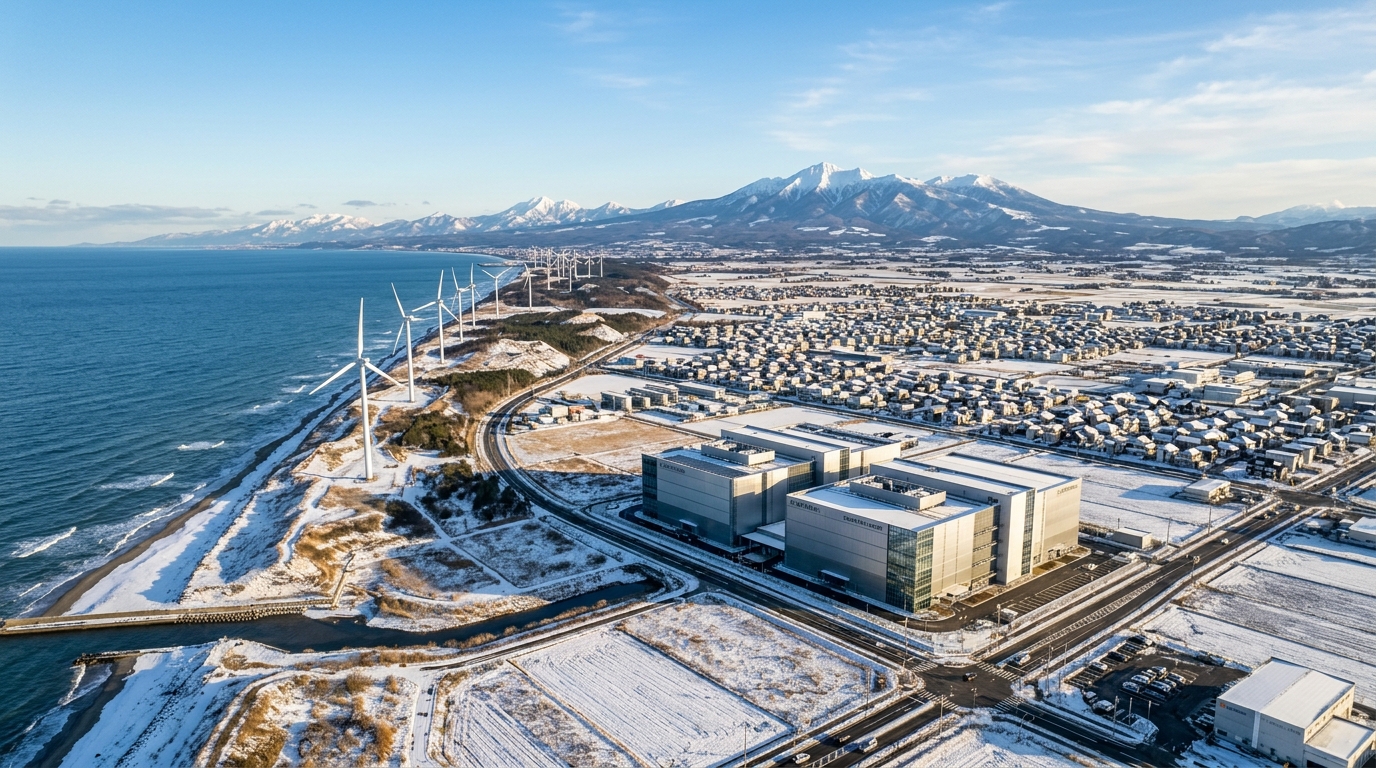
This article provides an in-depth analysis of land price trends and shifts in housing demand in and around Ishikari City leading up to 2030, focusing on the economic impact of data center recruitment. In short, job creation driven by the expansion of IT companies, combined with dramatic upgrades to next-generation telecommunications networks and convenient access to Sapporo, is expected to bolster residential housing demand—primarily among end-user families—and drive a gradual increase in land prices. Whether you are an investor evaluating the region’s long-term potential or a homebuyer looking to purchase a property in a nature-rich environment, this guide breaks down the latest developments in the Ishikari area using actual real estate transaction data, living environment metrics, and local hazard data.
1. Why Ishikari is Chosen: The Strength of a Cold Climate and Renewable Energy
Driven by the rapid adoption of generative AI and the growth of cloud services, national demand for data centers—which consume massive amounts of electricity and generate substantial heat—has skyrocketed across Japan. Because data centers operate 24 hours a day, 365 days a year, cooling them requires tremendous electrical power. In this context, Ishikari City’s key competitive advantage is its cold climate, which enables the use of direct outside-air cooling to significantly lower electricity costs associated with server cooling. Furthermore, the expansive area around the Ishikari Bay New Port Area boasts exceptionally high potential for renewable energy generation, including offshore wind and biomass power, making it an ideal location for IT enterprises striving for carbon neutrality.
Recognizing these geographical and environmental strengths, the Ministry of Economy, Trade and Industry (METI) designated the Ishikari Bay New Port Area as a priority location for forming gigawatt-class data center clusters under its Green Transformation (GX) Strategic Region Policy (GX(グリーントランスフォーメーション)戦略地域制度). In recent developments, the "Ishikari Renewable Energy Data Center No. 1" (石狩再エネデータセンター第1号)—a project involving Tokyu Land Corporation (東急不動産) and Broadband Tower (ブロードバンドタワー)—was completed in March 2026, beginning full-scale operations in August of the same year. Operating on 100% locally generated renewable energy, this facility has attracted international and domestic attention as a pioneering model for sustainable social infrastructure. Ishikari City plays a crucial role in national initiatives to expand the computing foundation supporting AI development in Japan, and as such cutting-edge facilities continue to open, the city is undergoing a dramatic evolution into a core hub powering Japan’s next-generation digital infrastructure.
2. The Impact of Data Center Aggregation on the Local Economy and Infrastructure
The influx of data centers represents far more than the physical construction of server facilities; it serves as a powerful catalyst upgrading the local economy and regional infrastructure. Highlighting this trend, on July 28, 2026, Ishikari City, several local data center operators, and power/telecom infrastructure providers partnered to establish the Ishikari Data Center Consortium (Ishikari DCC / 石狩データセンターコンソーシアム). Moving beyond viewing data centers strictly as corporate property, this innovative framework treats them as shared "regional computing resources" and "social infrastructure." By integrating these facilities into the community, the consortium aims to boost the local economy, enhance disaster preparedness, and create new jobs, actively promoting Ishikari's appeal as a premier data center hub across Japan.
From a real estate market perspective, the dramatic advance in telecommunications infrastructure is equally noteworthy. Through the deployment of NTT East’s next-generation IOWN (Innovative Optical and Wireless Network / アイオン) initiative and its All-Photonics Network (APN) technology, network latency between Ishikari and Otemachi, Tokyo (東京・大手町) has been drastically reduced. By overcoming physical distance, this advanced infrastructure does more than attract business operations; it enables entirely new lifestyles. It encourages Tokyo-based IT firms and AI startups to set up satellite offices, while enticing highly skilled IT professionals who work remotely to relocate to the area. Consequently, this fuels demand for high-quality family housing, providing strong structural support for the local property market.
3. Land Price Trends and Real Estate Market Outlook Around Ishikari Toward 2030
How is Ishikari’s real estate market responding to expanding IT investment and infrastructure upgrades? The chart below shows our proprietary quarterly aggregation of median transaction prices per square meter for residential properties (land and buildings) in Ishikari City, based on transaction data from the Ministry of Land, Infrastructure, Transport and Tourism (MLIT) Real Estate Information Library.
Looking at data for Q1 2026, 20 transactions were recorded for residential property (land and buildings, including existing single-family homes). The median price stood at approximately ¥93,000 per m² with a median transaction price around ¥19 million—representing a remarkable year-on-year increase of +39%. Surging from the ¥60,000/m² range in the same period last year to over ¥90,000/m², this climb highlights heightened activity among end-user buyers. By contrast, transactions for vacant residential land during the same quarter totaled just 4 cases, with a median price of ¥36,000 per m² (median price approx. ¥14 million), representing a modest YoY decline of -2.7%. Meanwhile, pre-owned condominiums accounted for only 3 transactions in Q1 2026 at a median price of roughly ¥69,000 per m² (approx. ¥11 million total), reflecting a relatively thin market for multi-family apartment complexes in Ishikari.
A clear takeaway from this objective data is that high material costs and rising construction expenses are inflating total budgets for building new homes from scratch on vacant land. As a result, demand is shifting strongly toward turnkey pre-owned single-family homes (land and building). Looking ahead to 2030, as employment generated by data centers and related service sectors takes root, mature residential neighborhoods such as Hanakawa Minami (花川南) and Hanakawa Kita (花川北) are likely to see sustained demand for pre-owned houses suitable for renovation, as well as reasonably priced new spec homes, continuing to drive local land and transaction prices.
4. The Ishikari Area as a Sapporo Commuter Zone: Living Environment and Access Favored by Families
Ishikari City borders Sapporo’s Kita-ku (北区) and Teine-ku (手稲区), placing central Sapporo within a smooth 30- to 40-minute drive. Although there are no train stations within Ishikari itself, a well-developed bus network serves the region, providing ample convenience for daily life in a car-oriented community. This balance between urban accessibility and abundant natural surroundings makes the area exceptionally appealing to families seeking spacious homes.
The target area surveyed (around latitude 43.1706, longitude 141.3486) is designated as a "Category 2 Residential Zone" (第2種住居地域). With a building coverage ratio of 60% and a floor area ratio of 200%, zoning regulations allow homeowners to build spacious houses with multiple parking spots, space for winter snow removal, and private gardens, all while retaining ample sunlight and privacy.
Actual transaction samples illustrate the broad range of choices available for home buyers:
| District | Property Type | Year Built | Land Area | Transaction Price | Structure |
|---|---|---|---|---|---|
| Hanakawa Kita 2-jo | Residential (Land & Building) | 2024 | 290 m² | Approx. ¥34 million | Wooden (4LDK) |
| Hanakawa Kita 2-jo | Residential (Land & Building) | 1986 | 260 m² | Approx. ¥6.3 million | Wooden (4LDK) |
| Hanakawa Kita 1-jo | Residential (Land & Building) | 1980 | 240 m² | Approx. ¥3.5 million | Reinforced Concrete (RC) |
| Hachiman-cho | Forest Land | - | 4,500 m² | Approx. ¥230,000 | - |
Source: Selected from Q1 2026 transaction samples.
As shown above, while a newer, spacious 4LDK single-family home transacts for around ¥34 million, properties nearly 40 years old can be acquired for under ¥10 million. Compared to the soaring condo prices within Sapporo City, Ishikari offers superior cost performance for spacious living quarters—a major reason it appeals to real-demand buyers. Additionally, in suburban areas such as Hachiman-cho (八幡町), large parcels of forest land sell at low prices, reflecting a diverse real estate market unique to Ishikari, where urban residential zones sit right next to natural landscapes.
5. Commercial Facilities and Child-Rearing Support: Evaluating Living Convenience and Quality of Life
Beyond serving as a commuter town, Ishikari’s popularity as a permanent residence for families stems from generous municipal child-rearing support policies and robust local life infrastructure.
Under local government initiatives, the "Child Medical Expense Subsidy" (子ども医療費助成) covers outpatient and inpatient medical fees until the end of the fiscal year a child turns 18 (with minor out-of-pocket costs such as ¥580 for initial visits). Free daycare for second and subsequent children further eases the financial burden on raising families. The city also offers robust after-school care programs, providing peace of mind for dual-income households. To encourage younger residents to settle permanently, the "Ishikari City New Marriage Life Support Project" (石狩市結婚新生活支援事業) provides qualifying newlyweds with up to ¥600,000 toward rent, home purchases, or moving costs. For those relocating from outside the region, the "Relocation Support Grant" (移住支援金—targeting movers from the Tokyo metro area) offers up to ¥1 million, plus an additional ¥1 million per child under 18.
Local living environment data around the survey point indicates designated school zones for Oyafuru Elementary School (生振小学校, Oyafuru Shogakko) and Ishikari Junior High School (石狩中学校, Ishikari Chugakko). Local healthcare facilities include Keiaikai Oyafuru Hospital (医療法人社団恵愛会茨戸病院) and Wakaba Dental Clinic (わかば歯科クリニック), providing dependable healthcare access for routine checkups and unexpected illnesses. Over time, increased tax revenue and corporate activity driven by the data center hub are expected to further attract commercial facilities and enhance local public services.
6. Trends and Selection Tips for Residential Land Buyers
Analyzing overall transaction data in Ishikari City from 2021 to 2026 (sample size: 1,483 cases), the average transaction price is approximately ¥17.94 million, with a median of ¥11 million and an average price of around ¥32,000 per m². Recent high-volume districts include planned residential developments in the Hanakawa area, such as Hanakawa Minami 7-jo (花川南7条) (13 cases, median unit price approx. ¥91,000/m²), Hanakawa Kita 1-jo (花川北1条) (11 cases, approx. ¥48,000/m²), Hanakawa Kita 2-jo (花川北2条) (10 cases, approx. ¥35,000/m²), Hanakawa Minami 1-jo (花川南1条) (10 cases, approx. ¥51,000/m²), and Hanakawa Kita 6-jo (花川北6条) (9 cases, approx. ¥57,000/m²). These areas offer convenient access to supermarkets, drugstores, and everyday commercial amenities.
When searching for a home in Ishikari, key success factors include accurately evaluating price variations across sub-districts and designing custom home layouts that make full use of spacious land parcels. For instance, using the "AI Construction Simulator" (available via our Pro Plan), you can generate visual 2D floor plans, 3D models, summer/winter solstice sunlight simulations, and total budget estimates based on local transaction data and your specific preferences (Note: financial return calculations and multi-family housing plans are not supported). These AI-generated 3D models and sunlight simulations serve as powerful visual tools when planning a home with your family.
Furthermore, registering for a free account allows you to connect MLIT property data used in this article directly to your Claude or ChatGPT tools via Model Context Protocol (MCP) integration. This seamless connection lets you run real-time market analyses and local environment checks using your preferred AI assistant, streamlining your property search.
7. Real Estate Risks vs. Future Potential: Investor and End-User Perspectives
When purchasing real estate to build long-term asset value, thorough risk management is just as crucial as assessing growth potential. Given the increasing frequency of extreme weather events in recent years, reviewing hazard information in advance is essential. Checking hazard maps to understand specific flood depths and color-coded risk zones is the first step toward protecting your family and assets.
According to hazard data for the target location (near Hanakawa Kita and Oyafuru in Ishikari City), there is no sediment disaster risk (unassigned). However, flood risk is explicitly listed as present, categorized as "Rank 3: Maximum flood depth 3 to 5 meters." Given the area’s proximity to major waterways such as the Ishikari River (石狩川), flood risk must be carefully evaluated prior to purchase.
For end-users purchasing or building a home, structural measures—such as raising the foundation or avoiding placing critical equipment on the ground floor—can minimize flood damage during the design phase. Comprehensive fire insurance that includes flood coverage is essential. For real estate investors, potential repair expenses and ongoing insurance costs associated with flood risk must be factored into yield calculations beforehand. While the data center cluster provides a powerful growth engine, assessing local natural hazard risks objectively through reliable data is vital for long-term real estate success.
8. Summary: Evaluating Housing Choices and Asset Value in Ishikari Toward 2030
By leveraging its cold climate and abundant renewable energy potential, Ishikari City in Hokkaido is solidifying its position as one of Japan's premier decarbonized data center hubs. Leading up to 2030, the rollout of next-generation infrastructure such as the IOWN initiative and the inflow of high-tech talent are set to elevate the local economy, maintaining solid housing demand within this Sapporo commuter zone.
As actual transaction data reveals, rising construction costs are driving strong demand for new and recently built single-family homes (land and building), a trend reflected in recent price increases. Buyers and investors should balance a positive long-term view of the region's potential with a careful assessment of property-specific risks, including flood hazards. Making sound real estate decisions requires precise local data analysis. Data-backed evaluation remains your strongest asset for selecting the right property and protecting your wealth.
If you are considering buying property or investing in the Ishikari area, explore the latest land price trends and hazard maps for your target location firsthand.
Check the latest land prices and hazard data for Ishikari City, Hokkaido on Mekiki Research 👉