
As one of Asia's largest hubs for data centers, Inzai City in Chiba Prefecture (千葉県印西市) is currently attracting intense global attention. The influx of international IT giants has generated massive tax revenues and significant economic ripple effects, which are being passed back to local residents through upgraded road networks, improved public infrastructure, and expanded child-rearing support programs—dramatically enhancing the surrounding living environment. At the same time, community reactions to station-front redevelopments and massive data center construction, alongside land price trends heading toward 2030, represent vital considerations for home-seeking buyers and real estate investors alike. This article provides an expert yet accessible analysis of land price trends, daily livability, and long-term asset value in Inzai City, focused on the Chiba New Town (千葉ニュータウン) area, drawing on the latest real estate transaction data and hazard risk assessments.
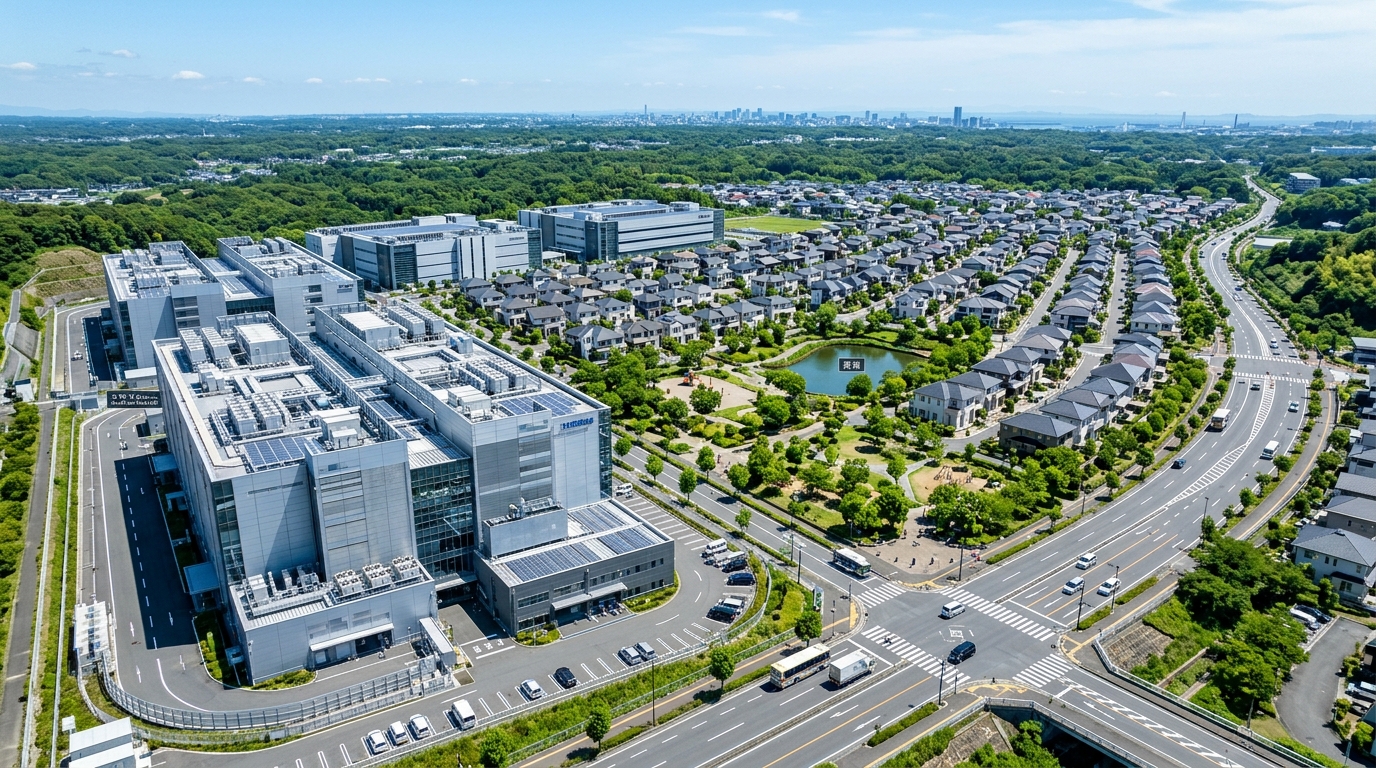
1. Why Are Data Centers Concentrating in Inzai City, Chiba Prefecture? Solid Ground and Transport Access
Inzai City has solidified its standing as one of Japan's leading and Asia's largest data center hubs, earning the nickname "Data Center Ginza" within the real estate and technology sectors. Why have such massive facilities concentrated in this particular city? The primary reasons center on the region's exceptionally firm geology alongside the availability of expansive development sites and high-capacity infrastructure.
The Shimosa Plateau (下総台地), where Inzai City is situated, sits on extremely stable ground and carries a relatively low risk of natural disasters such as major earthquakes. Data centers—serving as the core physical infrastructure for cloud computing and generative AI—require 24/7/365 uninterrupted operational uptime. Consequently, disaster-resilient site conditions rank as the single highest priority for global tech companies.
Furthermore, vast land parcels pre-developed during the original "Chiba New Town" project, paired with pre-existing high-capacity power grids and telecommunications networks, provided a powerful catalyst. Located roughly 40 km from central Tokyo and midway to Narita International Airport, Inzai offers an ideal balance of convenience and physical security. As of 2026, this construction surge shows no signs of slowing down. For example, at BIGHOP Garden Mall Inzai (BIGHOPガーデンモール印西), a major retail center in front of Inzai-Makinohara Station (印西牧の原駅), US-based CloudHQ is spearheading a large-scale redevelopment project looking ahead to the mid-2030s. The plan envisions two data center towers integrated with commercial facilities and public park space. This concentration of cutting-edge technology infrastructure is not only reshaping the cityscape but also driving sustained economic momentum across the region.
2. Enhanced Quality of Life in Inzai City Driven by Tax Revenue Surge and Infrastructure Development
The consecutive arrival of data centers has delivered extraordinary fiscal prosperity to Inzai City. According to municipal disclosures, property tax revenues surged from approximately 9.1 billion yen in the initial FY2018 budget to roughly 20.9 billion yen in FY2026—a 2.3-fold increase in just eight years. Fixed asset taxes now account for over 60% of total municipal tax revenues, establishing an exceptionally sound fiscal base rarely seen among Japanese local governments.
These substantial tax receipts directly fund public infrastructure upgrades and enhanced municipal services aimed at enriching residents' daily lives. The most notable policy is the full waiver of school lunch fees for municipal elementary and junior high schools, implemented in September 2024. Significantly reducing household expenses for families with children, this program exemplifies the tangible returns enabled by the city's expanding tax base.
Environmental data retrieved by our system around central Inzai City (Latitude: 35.8016, Longitude: 140.1118) highlights the area's development potential. Designated as a "Commercial Zone" under the City Planning Act, the location features a maximum building coverage ratio of 80% and a floor area ratio of 600%, permitting high-density land utilization. Daily living amenities are robust: the area falls within the school districts for Mikari Elementary School (木刈小学校) and Mikari Junior High School (木刈中学校), and the vicinity around the nearest station—Chiba-Newtown-Chuo Station (千葉ニュータウン中央駅) on the Hokuso Railway (北総鉄道)—hosts nine healthcare facilities. The close proximity of diverse medical services, including Urban Ekimae Clinic (ラーバン駅前クリニック), Toyoda Eye Clinic (豊田眼科), and Chiba New Town Ladies Clinic (千葉ニュータウンレディースクリニック), makes the area an exceptionally attractive residential setting for both families and single professionals.
3. Livability Along the Chiba New Town Line: Why Child-Rearing Families Choose Inzai
Inzai City consistently ranks near the top of private research institutions' "Livability Rankings" (住みよさランキング), enjoying particularly strong favor among child-rearing families. Beyond financial incentives like free school lunches, the city's popularity is driven by the rapid expansion of practical childcare infrastructure designed to support dual-income households.
In terms of childcare facilities, a new transit childcare station (送迎保育ステーション) opened in front of Chiba-Newtown-Chuo Station in April 2026. A second transit childcare facility is scheduled to open at neighboring Inzai-Makinohara Station in April 2027. This system allows parents to drop off their children at the station in the morning, where dedicated shuttle buses transport them to their respective nursery schools—a high-efficiency solution that saves valuable time for parents commuting to central Tokyo.
From a disaster preparedness and safety standpoint—a critical consideration when purchasing real estate—Inzai City boasts impressive metrics. Our site analysis based on data from the Ministry of Land, Infrastructure, Transport and Tourism (MLIT / 国土交通省) and the Geospatial Information Authority of Japan (GSI / 国土地理院) indicates "No Flood Risk" and "No Landslide Risk" for the target area, reflecting the natural advantages of its location on the elevated Shimosa Plateau. Nevertheless, as real estate analysts, we strongly advise prospective buyers to independently examine up-to-date hazard maps prior to closing, confirming emergency evacuation routes and shelter locations. Comprehensive preparation for natural disasters is essential regardless of baseline risk ratings.
4. Correlation Between the Data Center Construction Boom and Residential Land Prices
Substantial corporate investments and ongoing infrastructure improvements have exerted steady upward pressure on surrounding residential land values. The following analysis examines land price dynamics in Inzai City using transaction data. (Note: By registering for a free membership, you can connect MLIT transaction data directly to your Claude or ChatGPT workflows via MCP integration, enabling AI-assisted research into local transaction price trends.)
The chart below illustrates the quarterly median price per square meter for pre-owned condominiums and residential units in Inzai City.
Based on our quarterly aggregation of transaction data from MLIT's Real Estate Information Library (covering 2021 to 2026, sample size: 2,655 cases), the citywide average transaction price in Inzai stands at approximately 31.76 million yen, with a median price of around 27.00 million yen and an average unit price of roughly 75,000 yen/sqm. Recent trends broken down by property type are summarized in the table below:
| Property Type | Recent Quarter | Transaction Volume | Median Price / Sqm | Median Transaction Price | Year-over-Year (YoY) |
|---|---|---|---|---|---|
| Pre-owned Condos, etc. | 2026Q1 | 46 cases | Approx. ¥290,000/sqm | Approx. ¥25.00 million | +8.9% |
| Residential Land (Land Only) | 2025Q4 | 9 cases | Approx. ¥120,000/sqm | Approx. ¥27.00 million | +166.7% |
| Residential Land (Land & Building) | 2026Q1 | 37 cases | Approx. ¥190,000/sqm | Approx. ¥37.00 million | +3.0% |
As shown in the table, the median unit price for "Pre-owned Condos, etc." reached approximately ¥290,000/sqm in 2026Q1, marking an 8.9% year-over-year gain. The single-family housing market ("Residential Land: Land & Building") also exhibited solid performance, recording a median unit price of roughly ¥190,000/sqm and a median transaction price of around ¥37.00 million (+3.0% YoY). Particularly remarkable was the performance of vacant land ("Residential Land: Land Only"), where the median unit price climbed to approximately ¥120,000/sqm in 2025Q4—an explosive 166.7% YoY increase. This spike underscores how intense demand for data center facilities, supporting infrastructure, and residential site preparation for new incoming residents is actively driving up land valuations.
5. Land and Real Estate Price Forecast for Key Inzai Areas Heading Toward 2030
Between 2028 and 2030, multiple ongoing data center construction projects and related road and retail infrastructure redevelopments are scheduled for completion. These completions are expected to further reinforce asset valuations around Chiba-Newtown-Chuo Station and Inzai-Makinohara Station.
A breakdown of market metrics across top-performing sub-districts (chome) in our database reveals clear localized trends:
- Makinohara (牧の原): Land & Building: 38 transactions; median unit price: approx. ¥285,000/sqm
- Oguradai (小倉台): Pre-owned Condos: 36 transactions; median unit price: approx. ¥225,000/sqm
- Hara (原): Pre-owned Condos: 35 transactions; median unit price: approx. ¥321,000/sqm
- Uchino (内野): Pre-owned Condos: 26 transactions; median unit price: approx. ¥121,000/sqm
- Nishinohara (西の原): Pre-owned Condos: 24 transactions; median unit price: approx. ¥213,000/sqm
Districts situated near train stations and major shopping centers—such as Hara, Oguradai, and Makinohara—command high unit prices ranging from the upper ¥200,000s to over ¥300,000/sqm. These sub-markets represent premium zones where strong end-user homebuyer demand aligns closely with investor interest.
Conversely, prospective buyers searching for value may find opportunities in established residential pockets situated slightly farther from station cores. For example, sample data from 2026Q1 for the Uchino district shows pre-owned reinforced concrete (RC) apartments constructed between 1984 and 1988 (70–90+ sqm, 3LDK to 3DK+S layouts) within Category 1 Mid/High-Rise Exclusive Residential Zones trading between ¥4.6 million and ¥14.0 million. Purchasing an older unit with a plan to renovate allows buyers to access Inzai City's high level of family support and public services at a highly competitive entry cost.
6. Key Property Selection Factors for Home-Seeking Buyers
While Inzai City offers strong fundamentals, buyers looking for a primary residence should evaluate potential purchases beyond upfront pricing and floor plans. Two critical factors requiring careful review are "Zoning Designations" and "Surrounding Redevelopment Plans."
As highlighted above, central portions of the city are zoned as "Commercial Areas" with high density potential (80% building coverage, 600% floor area ratio). While commercial zoning provides exceptional everyday convenience, it carries the risk that large-scale structures or industrial facilities could be built on adjacent parcels in the future. For example, on land adjacent to Aeon Mall near Chiba-Newtown-Chuo Station, plans are underway to construct a large data center—tentatively named "Inzai 5"—with over 30,000 sqm of floor area and a height exceeding 50 meters. As of 2026, lawsuits to void building permits and community opposition campaigns regarding sunlight access and neighborhood aesthetics remain ongoing among neighboring condominium owners.
In response to these friction points, Inzai City has been moving to update its "District Plans" (地区計画) to regulate data center development near station hubs. However, proposed developments can still emerge prior to the formal enactment of revised district guidelines. A notable example is the proposed redevelopment of BIGHOP near Inzai-Makinohara Station, which drew approximately 600 residents to a public briefing session in October 2026. When buying a home, thoroughly reviewing current city planning designations and district plan regulations to understand potential future uses for adjacent vacant lots or aging commercial sites is essential to securing long-term residential quality.
7. Future Prospects and Key Considerations for Inzai Real Estate: Investment vs. Residential Perspectives
To conclude, Inzai City's real estate market presents distinct dynamics when evaluated through investment and residential lenses.
From an investment perspective, the clustering of data centers—backed by expanding global cloud workloads and AI infrastructure development—provides strong medium- to long-term support for land values. As long as a positive feedback loop of population growth and infrastructure expansion continues in key sub-markets like Hara and Makinohara, downside risk for real estate asset values remains limited, supporting steady underlying demand.
From a residential perspective, robust family support policies financed by growing tax revenues—including free school lunches and expanded transit childcare stations—provide clear advantages over competing suburban municipalities. The planned neighborhood layouts of Chiba New Town, featuring wide streets, spacious parks, and major retail malls, offer an attractive environment for families.
However, certain trade-offs should be monitored. While data centers generate substantial municipal property tax revenue, their daily operations are automated, employing relatively few onsite workers. Consequently, their direct job-creation impact is modest. The placement of large, windowless facilities on prime station-front parcels has sparked debates over urban vitality and neighborhood aesthetics, creating occasional friction with surrounding residential communities. Balancing strong tax revenues with the preservation of neighborhood character and livability will remain Inzai City's central urban planning challenge leading up to 2030.
8. Summary
Inzai City in Chiba Prefecture continues to evolve as one of Asia's primary data center hubs. The ongoing wave of infrastructure investment and commercial redevelopment heading toward 2030 is simultaneously supporting real estate values and enhancing local living standards for families. As recent transaction data demonstrates, property values remain firm, establishing Inzai as a compelling market for both homebuyers and real estate investors. Nevertheless, buyers should carefully evaluate adjacent zoning rules and potential surrounding developments before entering into transactions.
Through Mekiki Research's free membership tools, you can easily examine historical transaction prices and detailed hazard data for your target neighborhoods. We encourage you to utilize these tools to conduct thorough due diligence for your real estate decisions.