
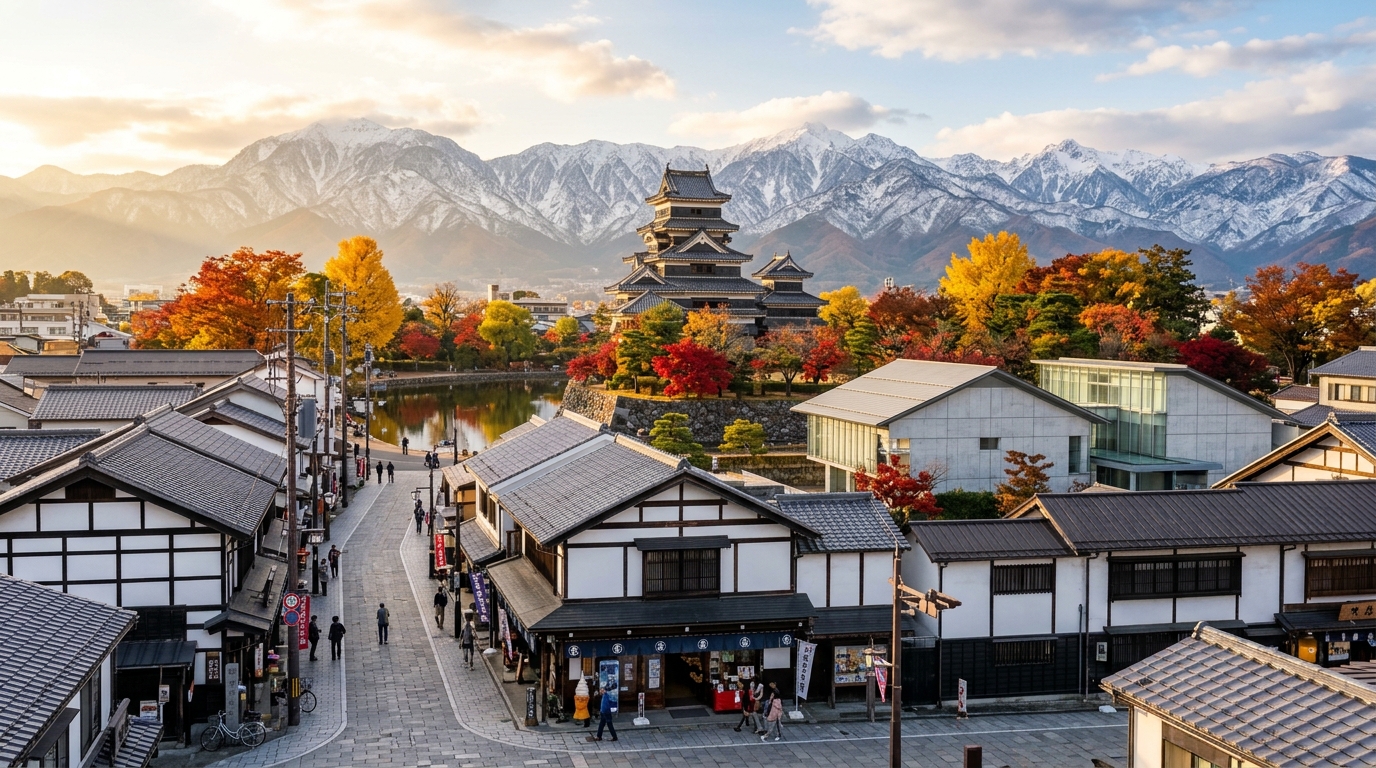
Today, November 3, is Culture Day (Bunka no Hi / 文化の日). Established as a national holiday to honor freedom, peace, and cultural progress, this occasion provides an ideal backdrop to examine how historical heritage and cultural facilities influence local real estate values. Our focus is Matsumoto City, Nagano Prefecture (長野県松本市), a former castle town built around National Treasure Matsumoto Castle (Matsumoto-jo / 松本城). Matsumoto is currently undergoing a major structural transformation in its living environment, simultaneously advancing historical landscape preservation, developing modern cultural hubs, and redeveloping its central urban core.
To state the conclusion up front: preserving historical streetscapes around Matsumoto Castle and updating central cultural and commercial facilities serve as strong medium- to long-term tailwinds supporting the area's residential appeal and asset value. At the same time, the latest 2026 real estate transaction data reveals that land and residential property prices in Matsumoto are currently in a temporary adjustment phase (a downward trend). This means that despite the city's rising future potential, buyers can currently acquire high-quality properties at relatively modest prices—creating an exceptionally advantageous market environment for families, single buyers, and medium- to long-term real estate investors.
This article combines objective evidence from 2026 Ministry of Land, Infrastructure, Transport and Tourism (MLIT) transaction data, hazard mapping, and neighborhood environment metrics to provide a logical analysis of the practical liveability and future land value potential of Matsumoto’s historical castle town.
1. Reevaluating the Asset Value of "Cultural Heritage x Living Environment" on Culture Day
In the real estate market, cultural heritage such as national treasures and historic streetscapes does more than attract tourists—it forms the core brand identity of a region. As seen in historic European cities, districts with strictly preserved streetscapes rarely deteriorate in value over time; instead, they tend to appreciate as classic, vintage assets.
In Matsumoto, the historic castle town landscape surrounding Matsumoto Castle is both a point of civic pride and a foundation for maintaining a high-quality residential environment. While building height and color restrictions under local landscape ordinances might initially appear to hinder development, end-user homebuyers view them as a strong guarantee that future chaotic development will be prevented, preserving scenic views and natural sunlight for years to come. Looking around the city on Culture Day highlights how thoughtful urban planning attuned to history directly enhances our Quality of Life (QOL).
2. Historic Landscape Preservation Initiatives and 2026 Urban Development in Matsumoto Castle Town
Matsumoto City is actively enhancing pedestrian mobility and urban space through its "Ekimae Area Vision" (Ekimae Area Vision / えきまえエリアビジョン), designating the corridor from Matsumoto Station to Matsumoto Castle as the "Ekishiro Space" (Ekishiro Kukan / えきしろ空間). Redevelopment plans are also under way for Agata-no-Mori Street (Agata-no-Mori Dori / あがたの森通り), which connects Matsumoto Station to Agata-no-Mori Park (Agata-no-Mori Koen / あがたの森公園), transforming it into a safer, more welcoming avenue featuring tree canopies and dedicated bicycle lanes.
Furthermore, the commercial landscape of the central city reached a major turning point between 2025 and 2026. Following the bittersweet closure of Matsumoto PARCO (Matsumoto Paruko / 松本パルコ) in February 2025, the new commercial complex "Matsumoto Scena" (Matsumoto Scena / 松本シェーナ) celebrated its grand opening on June 30, 2026. Anchor-tenanted by Don Quijote (Don Quijote / ドン・キホーテ) and housing approximately 40 outlets—including an indoor amusement park and medical clinics—the complex significantly boosts daily shopping convenience. Meanwhile, the former main branch of Inoue Department Store (Inoue Hyakkaten / 井上百貨店本店), which closed in March 2025, is undergoing adaptive reuse renovation without demolition, converting the existing structure into an international hotel scheduled to open in 2027.
Rather than merely preserving the old, Matsumoto is flexibly updating its commercial and tourism infrastructure to meet next-generation needs. As these redevelopment projects and infrastructure enhancements mature between 2028 and 2030, the balance between work, living, recreation, and education ("work-live-play-learn") in the central city will reach a much higher standard.
3. Daily Convenience Delivered by Surrounding Cultural Facilities Like the Matsumoto City Museum
Along with historical landscape preservation, the modernization of local cultural hubs deserves equal attention. The primary symbol of this effort is the Matsumoto City Museum (Matsumoto Shiritsu Hakubutsukan / 松本市立博物館), which relocated and opened in a newly constructed facility along Daimyo-cho Street (Daimyo-cho Dori / 大名町通り) south of Matsumoto Castle in October 2023. Located in the historic Sannomaru area (Sannomaru / 三の丸), this modern facility features an open glass entrance, with a café, museum shop, and kids' area on the first floor.
By shifting its concept from a traditional "quiet exhibition viewing space" to an "open civic hub for daily gathering and interaction," the museum has become a vibrant "third place" where local families and singles can enjoy fulfilling weekends. Having high-quality cultural amenities and recreational spaces within walking distance represents a significant "invisible asset value" when choosing a primary home.
4. Latest 2026 Trends: Land Prices and Transaction Patterns in Matsumoto (Data Analysis)
How are these community enhancements reflecting in actual property values? We analyzed recent 2026 transaction data retrieved via MLIT APIs by the Mekiki Research system (Matsumoto City, City Code 20202).
According to 3,224 transaction records published between 2021 and 2026, the overall average transaction price in Matsumoto City stands at approximately 24.73 million JPY, with a median price of 15.50 million JPY and an average unit price of roughly 48,000 JPY/㎡.
To examine short-term market dynamics in detail, the table below highlights quarterly trends aggregated from the MLIT Real Estate Information Library (Fudosan Joho Library):
| Property Type | Latest Quarter (2026Q1) Median Price/㎡ | Year-over-Year (YoY) |
|---|---|---|
| Residential Land (Land only) | 45,000 JPY/㎡ | -11.8% |
| Pre-owned Condominiums, etc. | 333,000 JPY/㎡ | -3.2% |
| Residential Land with Building (Single-Family Houses) | 84,000 JPY/㎡ | -15.8% |
As the data demonstrates, real estate prices across all categories—land, condominiums, and detached houses—entered an adjustment phase in Q1 2026 compared to the previous year. Price drops in single-family houses (-15.8%) and land (-11.8%) are particularly prominent.
Looking at specific transaction examples highlights clear regional variations. For instance, in the Igawajo (Igawajo / 井川城) district south of Matsumoto Station, a 120㎡ lot sold for 11 million JPY (approx. 87,000 JPY/㎡; 60% building coverage ratio / 200% floor area ratio), reflecting high station-proximity convenience. Conversely, in the quiet residential area of Arigasaki (Arigasaki / 蟻ケ崎) northwest of the castle, a spacious 480㎡ lot transacted for 9 million JPY (approx. 19,000 JPY/㎡; 60% BCR / 200% FAR), while a 5LDK pre-owned house built in 1987 on a 320㎡ plot (50% BCR / 80% FAR) in the same area was traded at 37 million JPY.
In the condominium sector, a 3LDK unit (65㎡; built in 2000; 60% BCR / 200% FAR) in Degawa-machi (Degawa-machi / 出川町) sold for 26 million JPY. With overall price levels currently subdued, buyers seeking primary residences in Matsumoto are presented with a prime buying opportunity to secure better locations or larger floor plans within budget.
By registering for a free account on Mekiki Research, you can access the MLIT dataset used in this article directly via Claude or ChatGPT (via MCP integration), empowering you to conduct personalized, AI-assisted neighborhood research tailored to your specific search criteria.
5. How Landscape Guidelines Impact Home Building: Key Points for Detached Houses
Many central areas in Matsumoto Castle Town are designated as "Neighborhood Commercial Zones" (e.g., 80% BCR / 300% FAR). While high floor area ratios allow for efficient land utilization, local landscape plans and guidelines in Matsumoto may require specific considerations regarding exterior wall colors and roof design.
Technology can significantly streamline the planning process when designing a single-family house that harmonizes with historic surroundings. Using the "AI Architectural Simulator" included in our Pro Plan, users can simply input local market data and custom design requirements to instantly generate 2D floor plans, 3D models, exterior renderings, and estimated total project budgets. The tool also performs solar position simulations for the summer and winter solstices, making it invaluable for visualizing sunlight exposure and privacy relative to adjacent structures during urban infill planning.
6. Liveability and Hazard Risks in Matsumoto Castle Town for Families and Single Residents
Data analysis highlights a robust living environment in Matsumoto. The neighborhood evaluated (within the school districts of Asahi-machi Elementary School [Asahi-machi Shogakko / 旭町小学校] and Asahi-machi Junior High School [Asahi-machi Chugakko / 旭町中学校]) features 27 medical facilities, including Takashima Pediatric Clinic (Takashima Shonika Iin / 高島小児科医院), Kurashina Clinic (Kurashina Iin / 倉科医院), and Hata Clinic (Hata Kurinikku / はたクリニック), providing exceptional healthcare infrastructure for families and single adults.
Matsumoto is also renowned for generous homebuyer and relocation support programs. As of 2026, the "Matsumoto City New Life Support Grant for Newlyweds" (Matsumoto-shi Kekkon Shinseikatsu Shien Jigyo Hojokin / 松本市結婚新生活支援事業補助金) provides up to 700,000 JPY (subject to conditions) to eligible newlyweds and registered civil partners for home purchases or renovation expenses. Programs supporting eco-friendly housing, such as the "Zero Carbon Housing Promotion Grant" (Sumai no Zero Carbon Suishin Hojokin / 住まいのゼロカーボン推進補助金), also help significantly offset initial upfront costs.
However, reviewing natural hazard risks remains imperative prior to purchasing property. Geospatial Information Authority of Japan (GSI) data indicates zero risk for landslides in the surveyed area; however, the flood hazard map specifies a high-risk classification of "Depth Rank 5" (maximum inundation depth of 10 to 20 meters). Because Matsumoto lies on an alluvial fan traversed by multiple rivers—including the Metoba River (Metoba-gawa / 女鳥羽川) and Susuki River (Susuki-gawa / 薄川)—checking official flood maps for your candidate location is essential. Incorporating risk-mitigating architectural layouts (such as second-floor living rooms), flood-resistant foundations, and adequate flood hazard insurance coverage should be standard practice when finalizing your financial plan.
7. Selecting Properties for Asset Value and Liveability Towards 2028–2030
To anticipate Matsumoto's future real estate market trends, monitoring districts with high transaction volumes is key. According to our Q1 2026 quarterly summary, top-performing neighborhoods by transaction volume include:
- Oaza Satoyamabe (Oaza Satoyamabe / 大字里山辺): Detached homes (24 transactions, median ~87,000 JPY/㎡), Land (19 transactions, median ~57,000 JPY/㎡). Blending rich natural surroundings in eastern Matsumoto with convenient access to the city center, this area leads family demand for single-family housing.
- Futaba (Futaba / 双葉): Pre-owned condominiums, etc. (15 transactions, median ~438,000 JPY/㎡). High daily convenience near Minami-Matsumoto Station drives concentrated condominium demand here.
- Oaza Shimauchi (Oaza Shimauchi / 大字島内): Detached homes (14 transactions, median ~121,000 JPY/㎡).
- Hata (Hata / 波田): Detached homes (14 transactions, median ~30,000 JPY/㎡).
As central redevelopment projects—such as the full-scale operation of Matsumoto Scena and the opening of converted international boutique hotels—take firm root between 2028 and 2030, the convenience and brand prestige around Matsumoto Station will solidify further. While land prices are currently adjusting, home buyers can effectively target value-priced homes and plots in established residential communities like Oaza Satoyamabe and Arigasaki. Meanwhile, investors seeking long-term growth should focus on city-center condominiums that benefit directly from downtown renewal, or secure rare land parcels within historical preservation districts.
8. Summary
Revisiting Matsumoto Castle Town on Culture Day underscores how effectively the city balances strict historic preservation with modern commercial and cultural developments. The relocation of the Matsumoto City Museum and the opening of Matsumoto Scena have dramatically elevated local quality of life.
While Matsumoto's land prices are experiencing a temporary downward adjustment in 2026, this does not reflect a decline in urban appeal. On the contrary, with long-term potential expanding, the current market presents buyers with favorable conditions for price negotiations and securing ideal homes. Nevertheless, given severe flood risks in select locations, objective data analysis and sound risk management remain crucial.
To explore precise price trends and hazard risks for your prospective area and make confident real estate decisions, take advantage of our free neighborhood research tools today.