
1. Reevaluating the Appeal of Kanazawa City on Culture Day: A Living Environment Woven from Historical Landscapes and Cultural Facilities
As November 3, "Culture Day" (文化の日, Bunka no Hi), approaches each year, opportunities to engage with art and history expand across Japan, inviting us to reflect on the cultural value of the cities we inhabit. Kanazawa City in Ishikawa Prefecture (石川県金沢市) stands out as one of Japan's premier cities, boasting a rich heritage as a flourishing castle town under the Kaga Clan—historically celebrated for its "Kaga Hyakumangoku" (加賀百万石) wealth—where traditional streetscapes and modern art seamlessly merge. From a real estate perspective, this unique cultural bedrock serves as an enduring foundation of asset value that remains resilient against transient market trends.
Central to any discussion of Kanazawa’s real estate potential is the dynamic urban redevelopment currently underway. Along the "Downtown Axis" stretching from Kanazawa Station to Korinbo, new projects are continually being set into motion. A key recent catalyst (a positive market driver) is the "Musashigatsuji A District Type 1 Urban Redevelopment Project" (武蔵ヶ辻A地区第一種市街地再開発事業), which received urban planning approval in September 2026. Encompassing the area around the Kanazawa Sky Building—home to the Kanazawa M'ZA department store—the project plans to construct three mixed-use towers with a total floor area of approximately 95,000 m² and heights reaching 60 meters, creating a major new hub integrating retail, hospitality, and residential facilities.
Furthermore, in front of Kanazawa Station, on the long-vacant former site of the Kanazawa Miyako Hotel (金沢都ホテル跡地), Kintetsu Real Estate and partners have unveiled a concept for a public-private mixed-use building standing roughly 160 meters tall—making it one of the largest developments on the Sea of Japan coast. Lower levels are expected to house commercial and public cultural facilities, while mid-to-upper floors will feature residential condominiums and a hotel, generating high expectations for a new Kanazawa landmark.
As dynamic updates to urban functionality progress alongside historical landscape preservation, this article analyzes central Kanazawa’s livability and land price trends from a professional real estate analyst's perspective, drawing on official data from the Ministry of Land, Infrastructure, Transport and Tourism (MLIT) for end-user home buyers (families and singles) as well as property investors.
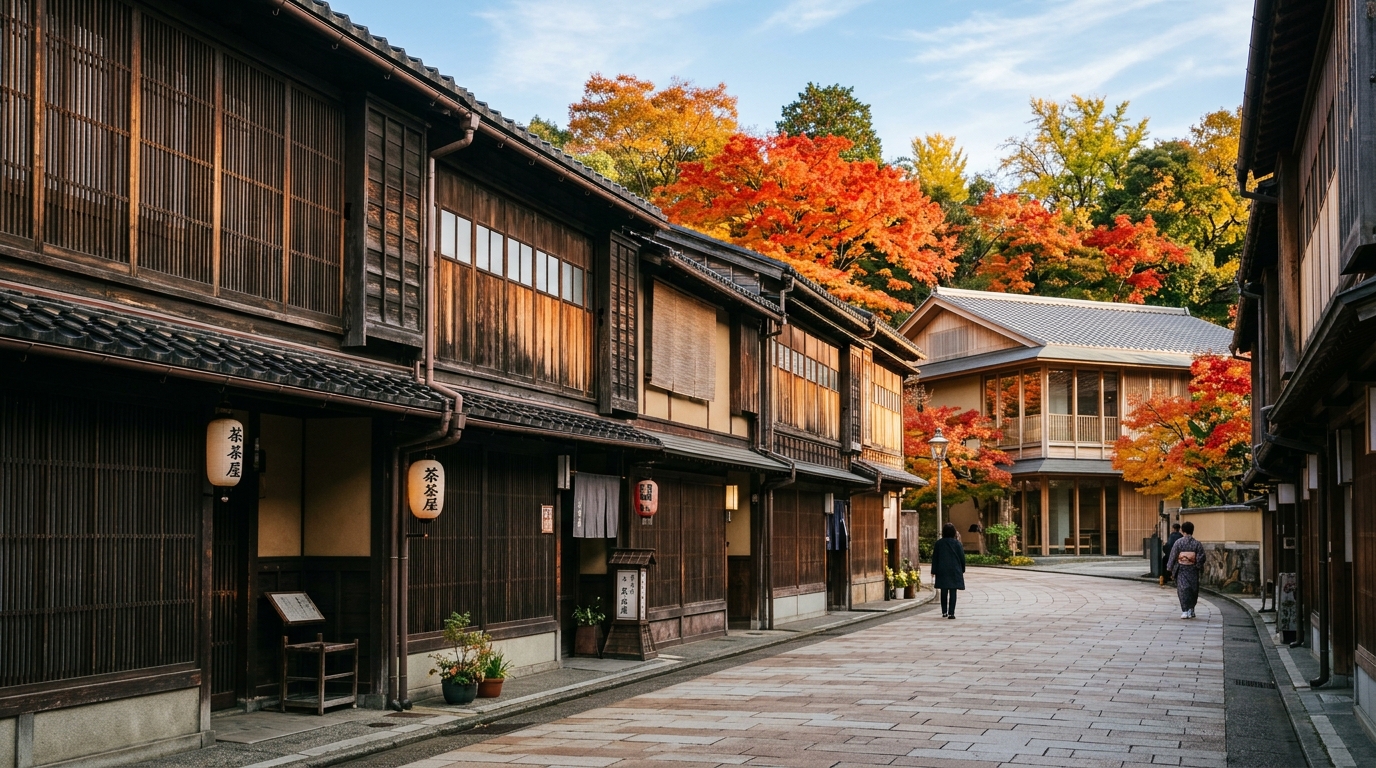
2. Insights into Living in Beautiful Streetscapes Protected by Preservation Districts for Groups of Traditional Buildings
Strolling through Kanazawa, one is instantly captivated by the beauty of its Important Preservation Districts for Groups of Traditional Buildings, including the famous Higashi Chaya District (ひがし茶屋街) and Kazuemachi Chaya District (主計町茶屋街). In these areas, the local government enforces strict landscape regulations covering everything from building heights and exterior architectural design to color palettes.
From the perspective of property buyers and developers, such restrictions might initially appear to be obstacles limiting freedom of design. However, taking a mid- to long-term view reveals that these landscape rules serve as a powerful bulwark for maintaining and enhancing the overall brand value of the neighborhood. By curbing chaotic development, a pleasant living environment is guaranteed for the future, resulting in the significant advantage of sustained asset value retention.
Additionally, Kanazawa City offers robust support schemes to preserve its historical streetscapes for future generations. For example, under the "Historic Building Restoration Project" (歴史的建築物修復事業), property owners undertaking restoration work on buildings in designated preservation areas can receive subsidies of up to 1 million yen to cover a portion of exterior renovation costs. By taking advantage of such programs, an increasing number of buyers are modernizing charming kominka (traditional Japanese houses) to suit contemporary lifestyles, achieving a refined standard of living.
For families seeking a tranquil environment to raise children, or single professionals wanting to draw cultural inspiration while working remotely, Kanazawa's traditional streetscapes offer a unique "lifestyle insight"—fulfilling deep-seated desires for character and quality that few other cities can match.
3. The Positive Impact of Revitalized Cultural Hubs Around the 21st Century Museum of Contemporary Art
Another key strength of Kanazawa City is the exquisite harmony between traditional culture, modern art, and fresh commercial development. Globally acclaimed cultural and tourist destinations such as the 21st Century Museum of Contemporary Art, Kanazawa (金沢21世紀美術館) and Kenroku-en Garden (兼六園) are concentrated in the city center, driving consistently strong residential demand in surrounding areas.
In recent years, a wave of new facility openings has further enhanced convenience around these cultural hubs. In March 2025, the former Korinbo Tokyu Square in the heart of the Korinbo area reopened as "Curaso Place Korinbo" (クラソ・プレイス香林坊). Housing a diverse range of tenants from fashion to everyday household goods, it has dramatically elevated daily shopping convenience for local residents.
Moreover, in May 2026, the experiential complex "Mitz Kanazawa" (Mitz 金沢) celebrated its grand opening in the area west of Kanazawa Station. Centered around the themes of "Food, Fun, and Travel," this facility serves as a vibrant new community hub for locals and tourists alike, boosting pedestrian circulation across the entire station-west district.
Having cultural institutions and modern retail spaces within walking distance elevates Kanazawa's reputation as a walkable city. Dropping by a special museum exhibition on the weekend, relaxing at a favorite café, and picking up fresh ingredients on the way home—the ability to picture such a rich daily routine strongly drives real estate demand in central Kanazawa from both end-users and investors.
4. Thorough Analysis of Land Price Trends and Livability Balance in Central and Suburban Kanazawa
Now, let us objectively analyze Kanazawa's land price trends using actual transaction data. Using our proprietary system, we extracted transaction data published by MLIT from 2021 to 2026 for central Kanazawa (around latitude 36.5613, longitude 136.6562).
The dataset comprises a robust sample size of 7,404 transactions over the target period. The overall average transaction price stood at approximately 24.9 million yen, with a median of 18.0 million yen and an average unit price of roughly 80,000 yen per m².
The following chart illustrates the quarterly trend in median price per m² for residential land (land and building combined).
To gain a more detailed picture of market dynamics, the table below summarizes property trends by category for the most recent quarter (2026 Q1), compiled from MLIT's Real Estate Information Library.
| Property Type | 2026 Q1 Transaction Volume | Median Price per m² | YoY Change (Price per m²) |
|---|---|---|---|
| Pre-owned Condominiums, etc. | 84 transactions | Approx. ¥246,000/m² | +5.5% |
| Residential Land (Land Only) | 55 transactions | Approx. ¥85,000/m² | +11.8% |
| Residential Land (Land & Building) | 170 transactions | Approx. ¥126,000/m² | ±0.0% |
What the data reveals is resilient demand for pre-owned condominiums and land. Unit prices for pre-owned condos grew +5.5% year-over-year, indicating that well-located condominiums remain popular among both end-users and investors. Even more striking is the sharp +11.8% increase in "Residential Land (Land Only)," suggesting competitive demand for custom home plots in prime locations.
Meanwhile, unit prices for "Residential Land (Land & Building)"—i.e., pre-owned single-family homes—remained flat at ±0.0% YoY. However, at 170 transactions, this category recorded the highest volume, reflecting strong, persistent demand for single-family living among local buyers. Looking at the top sub-districts (chome) by transaction volume: Yokokawa (横川, 25 cases), Kita-Yasue (北安江, 24 cases), Kodatsuno (小立野, 23 cases), Hisayasu (久安, 20 cases), and Awagasaki-machi (粟崎町, 19 cases) led the market, showing active trading in residential areas with convenient central access.
Here are a few representative transaction examples from 2026 Q1:
- Pre-owned Condominium (Asahi-machi / 旭町): Approx. ¥9.0 million; 2LDK layout; 60 m² area; built in 1992; reinforced concrete (RC) structure; Category 1 Medium-to-High-Rise Exclusive Residential Zone.
- Residential Land & Building (Asahi-machi / 旭町): Approx. ¥23.0 million; 4LDK layout; 135 m² area; built in 1990; wooden frame; Category 1 Medium-to-High-Rise Exclusive Residential Zone.
- Residential Land Only (Asano-honmachi / 浅野本町): Approx. ¥4.1 million (unit price approx. ¥40,000/m²); 100 m² area; Quasi-Industrial Zone.
As these examples show, older properties built over 30 years ago remain at accessible price points—under ¥10 million for condos and in the lower-to-mid ¥20 million range for detached homes—making Kanazawa a highly attractive market for buyers planning renovation projects.
5. Daily Convenience and Educational Environment in Kanazawa for Families and Single Residents
Next, let us examine surrounding environment data directly impacting daily life. The target search area (central Kanazawa) is designated as a "Commercial Zone," permitting high-density land use with a building-to-land ratio of 80% and a floor area ratio (FAR) of 400%.
For child-rearing families, school districts are a key factor; the area falls under the attendance zones for Saio Elementary School (犀桜小学校) and Jonan Junior High School (城南中学校). Regarding healthcare infrastructure, 24 medical facilities were identified near the query point, including Ito Hospital (伊藤病院) and Kawakita Eye Clinic (かわきた眼科クリニック), providing reliable healthcare access for singles and seniors alike.
Note that in the official transaction data, fields for "Nearest Station" and "Station Passenger Volume" frequently appear as null (missing data). This reflects local transit characteristics—where travel in Kanazawa relies heavily on local buses and personal automobiles—as well as sparse public data in specific micro-locations. Consequently, when evaluating property, buyers should look beyond railway station proximity and consider bus stop accessibility, highway access, and multi-faceted comparisons with surrounding market values.
Furthermore, Kanazawa City offers exceptionally generous subsidies to support child-rearing and encourage permanent settlement. For instance, under the "Downtown & Residential Attraction Area Housing Acquisition Incentive Scheme" (まちなか・居住誘導区域住宅取得奨励金), home buyers purchasing within designated urban attraction zones can receive up to 2 million yen in subsidies. Additionally, taking advantage of the national government's "Mirai Eco Housing 2026 Project" (みらいエコ住宅2026事業) allows buyers building or retrofitting GX-oriented (Green Transformation) homes with high thermal insulation and energy efficiency to claim up to 1.1 million yen. Complemented by Kanazawa’s local "Childcare Support Allowance for Inflation Relief" (物価高対応子育て応援手当) of 30,000 yen per child, these financial backstops offer compelling incentives for end-user buyers.
6. Regulations and Architectural Design Points for Detached Homes in Preservation Zones
Building or renovating a detached home in historic Kanazawa requires thoughtful exterior architectural choices aligned with the local landscape rules mentioned earlier. Incorporating traditional lattice windows (koshi) or choosing grounded earth tones for exterior walls makes the design process an engaging opportunity to harmonize with the historic surroundings.
However, even more critical than design before purchasing is reviewing localized hazard data. According to the transaction dataset collected for this survey point, the surrounding area contains the following natural hazard risks:
- Flood Risk: Present (Maximum assumed inundation depth rank 3: 3 to 5 meters)
- Landslide Risk: Present (Warning category: Debris flow)
No matter how beautiful or convenient a neighborhood is, flood and landslide risks are a reality in Japanese cities. In areas with anticipated flood depths of 3 to 5 meters, extreme flood events could submerge structural space up to second-floor underfloors. When planning or purchasing a single-family home here, building in disaster-mitigation measures from the design phase—such as raising building foundations, locating primary living areas and bedrooms on the second floor or higher, and installing watertight entrance doors—is essential.
7. Choosing a Home Without Regrets in a Historic City: Sunlight and Floor Plan Strategies
In urban centers with high designated capacity (80% building coverage and 400% FAR), distances between neighboring buildings are often tight. Consequently, designing a floor plan that maximizes natural light, ventilation, and privacy within a compact plot becomes crucial. At the same time, builders must navigate roof height restrictions imposed by landscape codes alongside elevation plans for hazard mitigation.
To navigate these overlapping constraints when evaluating a single-family home project, end-user buyers will find Mekiki Research’s Pro Plan feature—the "AI Architecture Simulator"—an invaluable tool.
By simply inputting localized zoning parameters (such as coverage and FAR ratios) alongside your specific lifestyle preferences, the AI automatically generates 2D floor plans and interactive 3D models for single-family homes. Furthermore, it instantaneously outputs summer/winter solstice sunlight simulations to check shadowing from neighboring structures, exterior renderings tailored to visual landscape guidelines, and estimated construction budget breakdowns.
You can also upload a rough floor plan sketch to convert it into a 3D visualization. The generated 3D models (.glb format) and PowerPoint summaries can be easily shared among family members. By visualizing whether your desired natural light and aesthetic vision can truly be achieved on a specific plot before engaging architects or homebuilders, you can make informed decisions and choose your ideal home without regret. (Note: This simulation feature is specialized for single-family home construction and does not support multi-family residential developments, rental yield calculations, or financial return modeling.)
8. Summary
Reevaluating Kanazawa City on Culture Day highlights a high-potential urban market where historical streetscape preservation lives side by side with dynamic redevelopment projects in Musashigatsuji and around Kanazawa Station. With pre-owned condo and land prices demonstrating steady growth, buyers who leverage generous municipal housing subsidies while accurately evaluating hazard risks can achieve highly rewarding outcomes for both homeownership and investment.
By registering for a free account, you can connect the Ministry of Land, Infrastructure, Transport and Tourism data used in this article directly to your Claude or ChatGPT models via MCP (Model Context Protocol). This enables you to conduct interactive, deep-dive investigations into your areas of interest using your own AI, making your property search more efficient and reliable.
Kanazawa is a city where history meets the future. Why not explore its true value for yourself?