
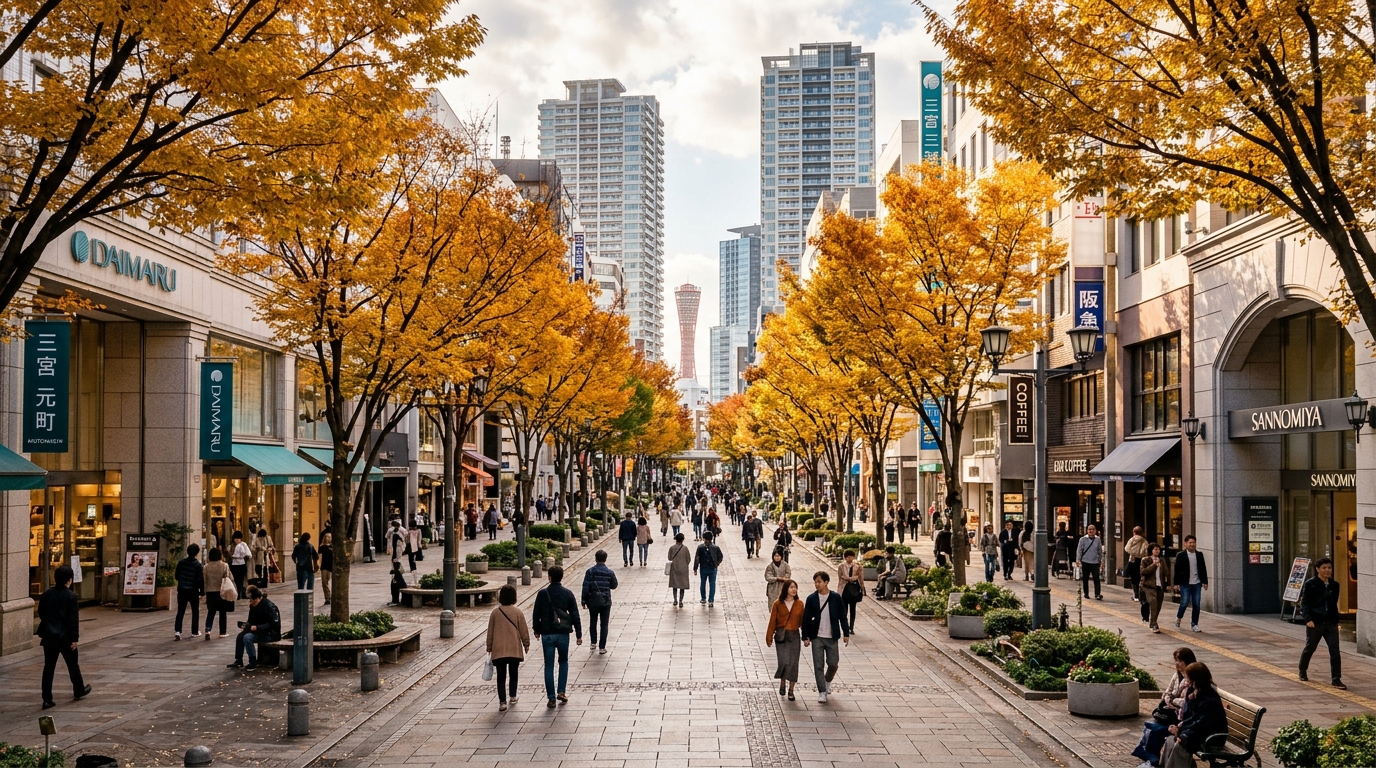
As Halloween season arrives and parades and events take place across the country, the value of urban "pedestrian spaces" and "event plazas" is once again coming into the spotlight. In urban planning, transitioning toward a "walkable city"—where pedestrians can safely and comfortably stroll and spend time—is far more than a simple aesthetic improvement; it is a vital factor directly tied to the asset value of surrounding residential and commercial properties. Transforming vehicle-centric streets into human-centered spaces generates vibrant local activity, creating a virtuous cycle that pushes up land prices and residential demand.
In the Kansai region, this dynamic transformation is most prominently unfolding in the Sannomiya and Motomachi areas of Chuo Ward, Kobe City, Hyogo Prefecture (兵庫県神戸市中央区). Kobe City is currently executing a large-scale downtown urban redevelopment aimed at creating "spaces prioritized for people and public transportation." This bold project, virtually unprecedented in scale nationwide, includes converting arterial roads in front of major stations into pedestrian-only zones.
In this article, we draw upon actual real estate transaction data from the Ministry of Land, Infrastructure, Transport and Tourism (MLIT) to provide an in-depth analysis of the appeal of walkable cities fostered by event spaces and pedestrianized zones, as well as the impact of the Sannomiya-Motomachi redevelopment on the surrounding living environment. Whether you are a family or single resident considering downtown living, or an investor tracking future land price movements, this guide offers practical insights into assessing the area's potential from both real-use and investment perspectives.
1. Halloween & Walkable Cities: The Connection to Residential Asset Value
Events like Halloween, Christmas, and local farmers' markets serve as effective barometers for evaluating how effectively urban public spaces are being utilized. Cities that implement pedestrianized streets, set up temporary stages, or open outdoor cafes around station plazas demonstrate that they have built an environment where residents and visitors can gather safely.
In the real estate market, a neighborhood's walkability is increasingly recognized as a key metric influencing property values. Areas with robust pedestrian infrastructure benefit from reduced traffic noise and exhaust emissions, preserving a high-quality residential environment. Furthermore, enhanced pedestrian connectivity activates street-level retail and local community ties, contributing to better public safety and elevating the neighborhood's overall brand image. Consequently, residential properties located around walkable urban cores maintain resilient demand in both rental and sales markets, characterized by strong value retention. An environment where residents can enjoy city life through local events serves as a powerful draw for buyers seeking a primary residence.
2. The Current State of Walkable Urban Redevelopment in Kobe's Sannomiya and Motomachi
The Sannomiya and Motomachi districts—the heart of Kobe—are currently undergoing a once-in-a-generation urban transformation. Between 2026 and 2029, several mega-projects are scheduled to fundamentally reshape the streetscape and pedestrian flow.
At the center of this initiative is the "Kumoidori 5-Chome District Redevelopment" (雲井通5丁目地区再開発), with Phase 1 completion targeted for December 2027. This project will house "Busta Kobe Sannomiya (Kobe Sannomiya Twin Gate)" (バスタ神戸三宮(神戸三宮ツインゲート)), one of Western Japan’s largest medium- and long-distance bus terminals, significantly upgrading the city’s major transit hub. In spring 2028, the building will welcome the "New Sannomiya Library," the "New Kobe Cultural Hall," and a luxury hotel (EVOL HOTEL KOBE), giving rise to a new center for culture and community exchange. Furthermore, major corporations such as ASICS and Sysmex have decided to relocate their corporate headquarters back to the city center.
Looking ahead to FY2029, the completion of the "(Tentative Name) JR Sannomiya New Station Building" ((仮称)JR三ノ宮新駅ビル) will feature a sprawling elevated pedestrian deck above the station plaza. Connecting these developments via an elevated network known as the "Sannomiya Deck" (三宮デッキ) will establish a multi-layered walkable space seamlessly integrating ground, underground, and elevated levels.
3. Enhanced Convenience and Walkability Driven by Pedestrian Zones and Event Spaces
Expanding pedestrian areas significantly enhances daily convenience for city-center residents. According to localized real estate data analyzed by Mekiki Research around Chuo Ward, Kobe City (near lat=34.6947, lng=135.196), the area is designated as a "Commercial Zone" with a high land-use efficiency featuring an 80% building coverage ratio and a 600% floor area ratio (FAR). In a high-density urban core, dedicated pedestrian walkways and public plazas play a crucial role in relieving spatial congestion and providing breathing room for daily living.
The primary transit hub serving the area is JR West's "Sannomiya" Station (三ノ宮駅). While official public data points for daily passenger counts at this specific location show "null" in recent open transaction datasets, conducting local market surveys and comparing neighboring benchmarks remains essential to accurately gauge the area's vitality.
In terms of living infrastructure, the abundance of healthcare facilities is particularly noteworthy. Within the search radius, there are 209 medical facilities, including "Sansei Hospital" (三聖病院), "AGA Skin Clinic Kobe Branch" (AGAスキンクリニック神戸院), and "KKC Wellness Kobe Health Screening Clinic" (KKCウエルネス神戸健診クリニック). Having immediate walking access to everything from general hospitals to specialized clinics provides a reliable foundation for long-term residency across all demographics—from singles and young families to seniors.
4. Living Environment Benefits and Livability for Families and Singles in the City Center
While city-center living offers undeniable convenience, families raising children often express concerns regarding urban living environments. However, in Kobe's Chuo Ward, where pedestrian-first urban design is advancing, these perceptions are shifting. Local school district data indicates that the area is served by "Wadamisaki Elementary School" (和田岬小学校) and "Yoshida Junior High School" (吉田中学校), maintaining a well-rooted local educational network.
In addition, municipal support for child-rearing households in Kobe has expanded substantially. As of FY2026, home buyers can leverage national ZEH+ renovation grants offering subsidies up to 4 million JPY, along with local initiatives like the "Child-Rearing Support Apartment Promotion Project (Renovation Type)" (子育て支援型共同住宅推進事業(改修型)) to lower the cost of acquiring high-quality housing and upgrading home safety.
On the soft services front, Kobe provides practical family assistance such as the "Kobekko Welcome Express Delivery" (こべっこウェルカム定期便), which delivers essential infant supplies directly to post-natal households, alongside financial incentives for intergenerational living (grant programs supporting parents and adult children moving close to or in with one another). The combination of widened sidewalks—making stroller travel effortless—and generous administrative support offers a compelling living environment for families evaluating a urban home purchase.
5. Residential Land Price Trends and Future Asset Value Predictions for Chuo Ward, Kobe
Let us examine land price trends and future asset values in Chuo Ward based on actual transaction records. Between 2021 and the first quarter of 2026, the dataset recorded 5,451 real estate transactions in the surrounding area. Across this period, the average transaction price stood at approximately 45.89 million JPY, with a median price of 30.0 million JPY and an average price per square meter of roughly 590,000 JPY/m².
Examining specific historical transactions highlights how age and layout impact pricing, even within the same commercial zoning in "Aioicho" (相生町) for reinforced concrete (RC) pre-owned condominiums:
- A 65 m² unit (1LDK+S) built in 2019 traded at approximately 76.0 million JPY.
- A 65 m² unit (3DK) built in 1979 traded at approximately 17.0 million JPY.
- A 105 m² unit (5LDK+S) built in 1979 traded at approximately 23.0 million JPY.
Conversely, a 2013-built 85 m² unit (3LDK) in "Asahidori" (旭通) commanded approximately 110.0 million JPY, reflecting a substantial premium for modern, high-end residential properties located in the urban core.
Below is a quarterly summary of pre-owned condominium market trends aggregated from the official transaction database of the MLIT Real Estate Information Library:
| Period (Quarter) | Pre-Owned Condominium Median Price per m² | Median Transaction Price | Transaction Count |
|---|---|---|---|
| 2025 Q1 | Approx. 720,000 JPY/m² | 30.0 million JPY | 275 transactions |
| 2025 Q2 | Approx. 660,000 JPY/m² | 26.0 million JPY | 243 transactions |
| 2025 Q3 | Approx. 710,000 JPY/m² | 25.0 million JPY | 274 transactions |
| 2025 Q4 | Approx. 680,000 JPY/m² | 27.0 million JPY | 284 transactions |
| 2026 Q1 | Approx. 710,000 JPY/m² | 37.0 million JPY | 220 transactions |
In the latest quarter (2026 Q1), the median unit price for pre-owned condominiums settled at approximately 710,000 JPY/m², showing a stable trajectory (-0.8% year-over-year). However, the single-family housing market ("residential land with building") presents a notable trend: in 2026 Q1, the median price per square meter for single-family properties reached approximately 630,000 JPY/m², posting a sharp +11.1% increase year-over-year. This surge highlights robust buyer demand for landed residential living within the central city.
The top neighborhoods by overall transaction volume are as follows:
- Minatojima Nakamachi (港島中町) (84 transactions, median unit price approx. 220,000 JPY/m²)
- Shimoyamate-dori (下山手通) (64 transactions, median unit price approx. 770,000 JPY/m²)
- Nakayamate-dori (中山手通) (58 transactions, median unit price approx. 720,000 JPY/m²)
- Sakaemachi-dori (栄町通) (38 transactions, median unit price approx. 840,000 JPY/m²)
- Kaigan-dori (海岸通) (36 transactions, median unit price approx. 910,000 JPY/m²)
Sub-districts along the waterfront or featuring preserved historic streetscapes, such as Kaigan-dori and Sakaemachi-dori, command higher per-meter valuations, clearly demonstrating how neighborhood brand equity translates into residential demand.
6. Key Considerations When Purchasing a Home or Single-Family House in Sannomiya/Motomachi
While the redevelopment in Sannomiya and Motomachi offers undeniable lifestyle appeal, evaluating natural hazard risks is critical when buying residential or investment property in dense urban settings. According to official hazard mapping data, the target search area is subject to flood risk, categorized at maximum flood depth rank "2" (0.5 to 3.0 meters). This depth indicates potential inundation of ground-floor structures during major storm events, making second-floor evacuation strategies a prudent design consideration.
Additionally, due to Kobe’s distinctive geography backed by the Mount Rokko range, properties in proximity to slopes carry sediment disaster risks, specifically "steep slope collapse" (急傾斜地の崩壊). Prior to closing a transaction, buyers should consult updated hazard maps, consider raised foundation construction, and verify clear evacuation routes.
Detailed historical pricing data and location-specific hazard profiles can be accessed anytime by registering for a free account at Mekiki Research. With a free registration, you can directly query MLIT transaction datasets using your own ChatGPT or Claude interface via Model Context Protocol (MCP) integration. This empowers buyers to evaluate properties objectively using familiar AI tools without relying solely on real estate sales pitches.
7. Property Inspection Essentials: Evaluating Walkability, Sunlight, and Lot Conditions
As shown in the data, the transaction unit price for single-family residential properties in Chuo Ward, Kobe City rose +11.1% year-over-year, indicating growing interest among end-user buyers. However, building or purchasing a single-family home in commercial zoning characterized by an 80% coverage ratio and 600% FAR presents unique design challenges—most notably shade cast by adjacent mid-to-high-rise buildings and privacy constraints.
To address these challenges, our "AI Architectural Simulator"—available under the Mekiki Research Pro Plan—serves as a powerful planning tool. By inputting local property data alongside your personal layout preferences, the tool instantaneously generates 2D floor plans, 3D architectural models, summer and winter solstice sunlight simulations, exterior renderings, and estimated total construction budgets. You can also upload existing 2D floor plans to convert them into interactive 3D visualizations.
Even on narrow urban lots where daylighting is restricted, visualizing solar angles and spatial volume before committing to a purchase helps prevent costly surprises, such as unexpectedly dim living spaces. Generated plans can be exported as PowerPoint decks or 3D files (.glb), and shared via web link with family members or architects to streamline the design process.
8. Conclusion: How Expanding Pedestrian Spaces Are Transforming Kobe’s Downtown Living
The value of "walkable cities," highlighted during community events like Halloween, will remain a vital metric across real estate markets. The major transportation upgrades and interconnected pedestrian networks underway across Sannomiya and Motomachi represent far more than routine transit enhancements—they act as a long-term catalyst driving downtown livability and overall quality of life.
As real estate metrics show, Chuo Ward offers a compelling mix of complete healthcare infrastructure, expanding municipal family support, and rising demand for urban single-family housing (+11.1% YoY). By carefully balancing site-specific conditions like hazard risks and daylighting against these structural urban improvements, buyers can leverage modern AI tools to discover property ideally suited to their long-term lifestyle goals.