
In the autumn of 2026, as the fall foliage deepens, Aso City, Kumamoto Prefecture (熊本県阿蘇市)—home to one of the world's largest calderas—is capturing renewed attention in the real estate market. Historically, the Aso area has been widely recognized as one of Japan's premier tourist destinations, famed for its majestic natural scenery and hot springs. In recent years, however, its value as a residential location and a hub for dual-location living (dual residency) has surged. The shift toward remote work and evolving lifestyles seeking harmony with nature are strongly driving relocation and home purchases in the area.
This article provides a detailed analysis of local landscape preservation initiatives in the Aso Caldera and the ripple effects of recent tourism infrastructure redevelopment on nearby residential land prices, based on the latest actual transaction data from the Ministry of Land, Infrastructure, Transport and Tourism (MLIT / 国土交通省). Designed for families and single individuals considering buying a home, as well as real estate seekers looking to build a base near a mountain resort, this piece unpacks both the practical realities and future potential of living in Aso City.
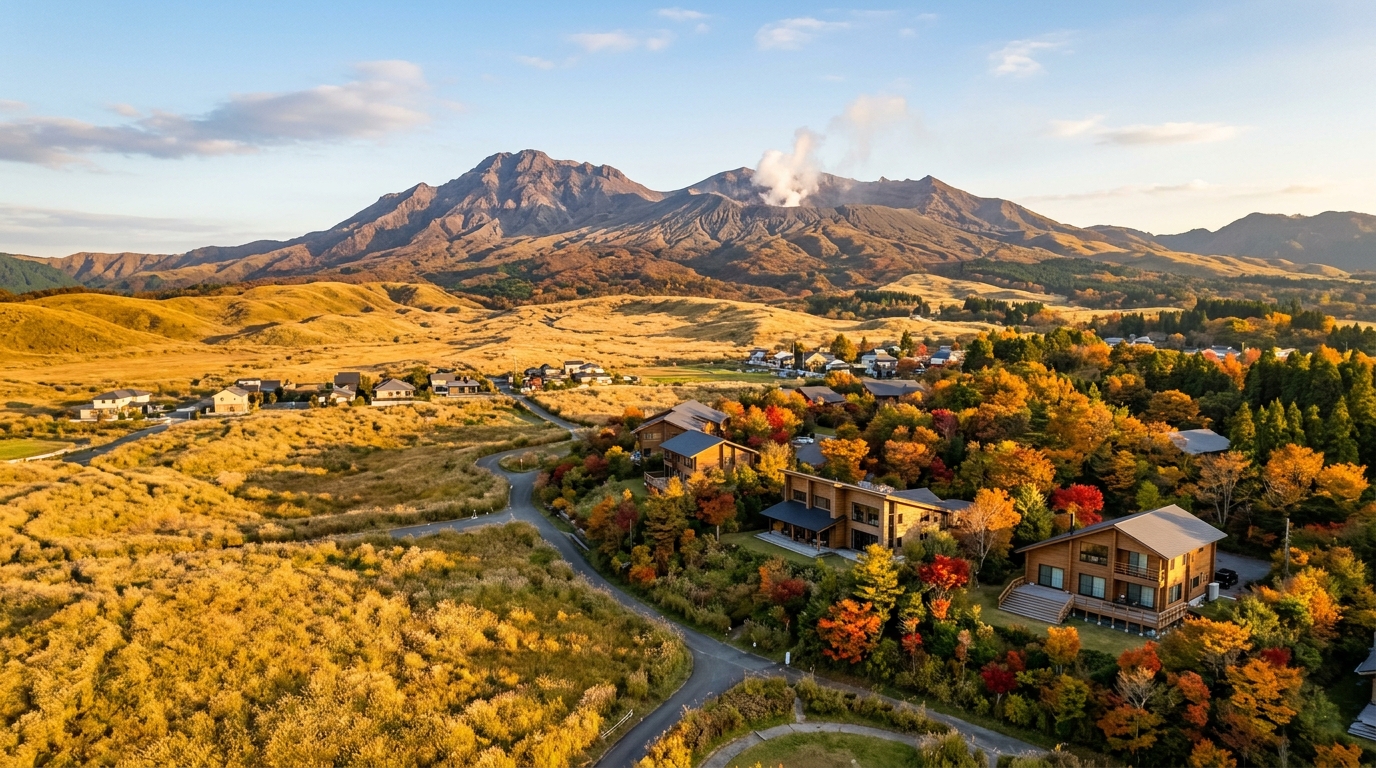
1. The Aso Caldera Amid Autumn Foliage and an Overview of the 2026 Real Estate Market
As of 2026, the real estate market in Aso City exhibits unique momentum and diversity. The vast Aso Caldera (阿蘇カルデラ) presents a rare living environment where approximately 70,000 residents reside within a caldera. Designated as a UNESCO Global Geopark and a Globally Important Agricultural Heritage System (GIAHS), its rich environment fuels solid residential demand from relocators and dual-location dwellers.
An analysis of transaction data for Aso City from 2021 through 2026 (a sample of 446 transactions) retrieved from the MLIT Real Estate Information Library reveals an overall average transaction price of approximately 4.71 million yen and a median price of 1.3 million yen. Transaction prices span a wide range—from a low of just 1,000 yen to a high of 130 million yen—with an overall average unit price recording approximately 10,000 yen/m² (9,737 yen/m²).
This broad price spectrum underscores the diverse property needs within Aso City. While extensive agricultural and forest lands are traded at low prices, residential land in highly convenient urban areas and prime resort sites offering sweeping views of the Aso Five Peaks (Aso Gogaku / 阿蘇五岳) command prices in the tens of millions of yen. The data clearly shows that Aso is far from a depopulated rural area; it actively attracts buyers and investors seeking land for well-defined, real-demand purposes.
2. Benefits to Living Environments and Asset Value from Aso City's Landscape Ordinance
The single largest factor supporting real estate value in the Aso area is the community-wide effort dedicated to landscape preservation. Seven municipalities in the Aso region, including Aso City, adopted the "Declaration to Protect the Landscape of 'Aso'" in their pursuit of UNESCO World Cultural Heritage designation.
Under this declaration and the "Aso City Landscape Ordinance" (阿蘇市景観条例), development activities exceeding a certain scale require prior notification, and strict landscape guidelines govern major installations such as solar farms. From a real estate investment or residential construction standpoint, such regulations might initially appear to raise the barrier to development. However, for buyers purchasing homes for primary living, they deliver immense long-term benefits.
Strict landscape preservation effectively means the local government guarantees the maintenance of a high-quality residential environment into the future. For instance, a major utility pole removal project around Aso Station moved overhead wires underground, clearing unobstructed views of the Aso Five Peaks' ridges and dramatically enhancing the visual appeal of the entire town.
Because risks such as sudden solar panel installations on neighboring vacant lots or high-rise developments spoiling scenic views are exceptionally low, families building primary residences and buyers constructing vacation homes highly rate Aso City as an area where they can safely invest long-term in both asset value and natural scenery.
3. Tourism Redevelopment and Improved Accessibility via Major Roads and Infrastructure
While landscapes are strictly protected, tourism infrastructure redevelopment has evolved dramatically leading into 2026. Surrounding JR Aso Station (阿蘇駅), which achieved a full recovery from the Kumamoto Earthquake, the station area has transformed from a transit stop into a "mega-hub for experiential tourism."
The station plaza features a statue of Luffy from the popular manga ONE PIECE—a symbol of earthquake recovery—alongside next-generation attractions like AR-based digital photo experiences that entice domestic and international travelers alike. Furthermore, secondary transit networks from the Aso Station bus terminal have been meticulously upgraded, including eco-friendly electric buses (EV buses) operating direct routes to the scenic Kusasenrigahama (草千里ヶ浜) plain and the dynamic Nakadake Crater (中岳火口). This substantially improves mobility between residential zones and sightseeing destinations, even for relocators and single residents who do not own personal vehicles.
Private investment is equally dynamic. In October 2026, "Aso Otohime Onsen Yura Yura" (阿蘇乙姫温泉 湯ら癒ら), located within a resort complex in Otohime, Aso City (阿蘇市乙姫), completed a major renovation featuring new pet-friendly guest rooms and an online booking system. Meanwhile, developments of high-value stay bases are accelerating, such as "COCO VILLA Mt. Aso" (COCO VILLA 阿蘇山), a newly built shared villa offering rooftop saunas overlooking the volcanic landscape and a design that blends seamlessly into nature. This enhanced tourism infrastructure and improved access generate a powerful spillover effect, pushing up surrounding residential and resort land prices.
4. Land Price Trends around Aso Station and Miyaji Area: Appeal as Residential Zones
Let us examine the specific land price trends and transaction activity in Aso City using objective data. The chart below illustrates quarterly trends in median prices per square meter for "residential land (land and building)" in Aso City, independently aggregated by our team based on real transaction data from the MLIT Real Estate Information Library. ("Quarterly aggregation of transaction data from the MLIT Real Estate Information Library by Mekiki Research")
According to our compiled data, market trends in the most recent quarter (2026 Q1) demonstrate strong momentum. The median price per square meter for "residential land (land only)" reached 11,000 yen/m² (median transaction price: 5.3 million yen across 5 transactions), marking a sharp year-over-year increase of +155.8%. For "residential land (land and building)," the median price per square meter in 2026 Q1 stood at approximately 4,700 yen/m² (median transaction price: 4.2 million yen across 4 transactions), up +52.9% year-over-year. Although quarterly transaction counts are relatively small—leading to temporary volatility—an overall upward trend is clearly observable.
| Use Category | Target Period | Transaction Volume | Median Price per m² | Median Transaction Price | YoY Change |
|---|---|---|---|---|---|
| Residential Land (Land only) | 2026 Q1 | 5 transactions | 11,000 yen/m² | 5.3 million yen | +155.8% |
| Residential Land (Land and Building) | 2026 Q1 | 4 transactions | Approx. 4,700 yen/m² | 4.2 million yen | +52.9% |
Looking at individual transactions around JR Hohi Main Line (JR豊肥本線) Miyaji Station (宮地駅)—specifically the Ichinomiya-machi Miyaji area (一の宮町宮地), a popular residential hub—housing diversity stands out. For example, a wooden home built in 1963 on an 890 m² lot sold for 4.2 million yen, while a modern light-gauge steel home built in 2013 on an 1,800 m² lot fetched 40 million yen. Notably, both properties are located outside designated city planning areas, offering the advantage of spacious home setups on expansive plots.
On the other hand, the highest transaction volumes are recorded in forest and agricultural land: Nishikozono (西小園; forest land: 9 transactions, unit price 1,014 yen/m²), Kurokawa (黒川; forest land: 8 transactions, unit price 5 yen/m² / agricultural land: 8 transactions, unit price 524 yen/m²), Namino Oaza Namino (波野大字波野; forest land: 7 transactions, unit price 114 yen/m²), and Namino Oaza Kojino (波野大字小地野; forest land: 6 transactions, unit price 327 yen/m²). Furthermore, low-cost parcels circulate widely for individuals pursuing new farming ventures or private campsite developments—such as agricultural plots in Ichinomiya-machi Nakadori (一の宮町中通; 1,500 m² for 610,000 yen; 2,400 m² for 710,000 yen), Akamizu (赤水; 155 m² for 240,000 yen), and a sprawling plot in Ichinomiya-machi Sakanashi (一の宮町坂梨; 8,888 m² for 1.5 million yen). This depth reflects the multifaceted nature of Aso City's real estate landscape.
5. Everyday Convenience and Child-Rearing Environments for Families and Relocators
Beyond its reputation as a scenic resort, Aso City earns high marks from residential buyers due to its well-developed living infrastructure and robust child-rearing support programs.
For education, community-anchored school districts serve the area, including Ichinomiya Elementary School (一の宮小学校) and Ichinomiya Junior High School (一の宮中学校). Transportation is convenient via Miyaji Station operated by Kyushu Railway Company (JR Kyushu / 九州旅客鉄道). In terms of medical care, key facilities such as Matsumi Internal Medicine Clinic (松見内科クリニック), Kumamoto Prefecture Aso Public Health Center (熊本県阿蘇保健所), and Uji Dental Clinic (宇治歯科医院) are clustered nearby, offering everyday peace of mind for families and senior residents.
Additionally, attractive subsidy systems supporting home acquisition and parenting are active through 2025 and 2026. Leveraging joint national programs like the "Child-Rearing Green Housing Support Project 2025" (子育てグリーン住宅支援事業2025) and the "Housing Energy-Saving 2025 Campaign" (住宅省エネ2025キャンペーン) grants significant financial aid for constructing highly energy-efficient new homes or undertaking thermal insulation renovations on existing houses. Furthermore, Aso City offers unique local initiatives, such as the "Aso City Scholarship Repayment Support Grant" (阿蘇市奨学金返済支援補助金) encouraging young adults to settle locally, alongside the "Aso City Housing and Building Seismic Diagnosis Project" (阿蘇市住宅・建築物耐震診断事業), which subsidies seismic retrofitting for wooden homes built prior to 1981.
For families seeking to raise children freely amid nature, Aso City represents a compelling relocation option that balances economic assistance with reliable healthcare and educational infrastructure.
6. Key Considerations when Building Custom Homes or Dual-Location Residences Near Mountain Resorts
When planning an ideal primary home or getaway residence near the Aso Caldera, buyers should keep several practical technical considerations in mind.
First, as real data indicates, most of Aso City (including the Ichinomiya-machi Miyaji area) lies outside designated city planning areas. In these non-city planning zones, strict land-use zones under the City Planning Act do not apply, offering substantial freedom regarding building coverage and floor area ratios. However, utility access—such as water supply, sewage connections, and road paving conditions—varies considerably by location, making detailed on-site surveys essential prior to purchase.
Second, buyers should note the prevalence of agricultural and forest land among high-volume listings. Converting these properties for residential use requires official land-use conversion permits under the Agricultural Land Act, as well as additional expenses for land development, clearing, and tree stump removal separate from the land purchase price. Moreover, in areas subject to the Landscape Ordinance, building designs and color schemes (such as incorporating earth tones that blend with the surrounding natural environment) must be carefully planned in advance.
For buyers exploring single-family home construction in these resort-adjacent zones, we strongly recommend using the "AI Building Simulator" available through our website's Pro Plan. By inputting real Aso City land data alongside your preferred parameters, this tool instantly generates 2D floor plans, 3D structural models, sunlight exposure simulations for the summer and winter solstices, and exterior previews. It supports uploading existing floor plan images for 3D conversion, exporting to PowerPoint (.pptx) or 3D formats (.glb), and generating shareable links for family members. Because it also estimates total project budgets—including land preparation costs—you can build concrete financial plans before consulting architectural firms. (*Note: The AI Building Simulator is designed specifically for single-family custom home layouts, 3D modeling, sunlight analysis, exterior design, and rough budget estimation. It does not support real estate investment cash flow calculations, yield projections, or multi-family housing projects such as apartment complexes.)
7. Preparing for Natural Hazards: Land Selection Checklist
Living alongside magnificent nature makes checking hazard information an indispensable step in selecting land.
According to hazard data retrieved for a specific location in Aso City (lat=32.9382, lng=131.1167 / near the Miyaji area), both flood risk (hasRisk: false) and landslide risk (hasRisk: false) showed zero identified hazard, confirming high safety against water damage and mudslides at that specific point.
However, safety levels vary across Aso City. Heavy rainfalls in the past have triggered landslides in surrounding mountainous regions, making it essential to verify whether hilly or slope-adjacent properties fall within designated Landslide Warning Areas. Furthermore, because Mt. Aso is an active volcano, prospective residents should consider entry restrictions near the Nakadake Crater and potential ash fall depending on wind direction. Smartly leveraging municipal seismic retrofitting grants and building resilient structures are essential prerequisites for enjoying long-term peace of mind in this scenic caldera.
8. Conclusion
As the autumn leaves peak, Aso City is rediscovering its spotlight through breathtaking scenery and natural energy. Strict landscape conservation ordinances combined with modern tourism redevelopment—such as next-generation mobility and upgraded hot spring facilities—have transformed the region from a classic sightseeing stop into an increasingly chosen residential and resort destination.
As land price data reflects, convenient residential sites maintain a firm upward trajectory, while extensive land parcels suitable for diverse uses remain widely available. By capitalizing on comprehensive child-rearing support and housing subsidies, a rich life in harmony with nature or an enviable dual-location lifestyle can easily become reality.
For those wishing to deepen their real estate research independently, registering for a free account allows you to query the Ministry of Land, Infrastructure, Transport and Tourism data used in this article directly through your own Claude or ChatGPT assistant. Utilizing our Model Context Protocol (MCP) external AI integration, you can seamlessly analyze your target areas using your own AI—get started today!