
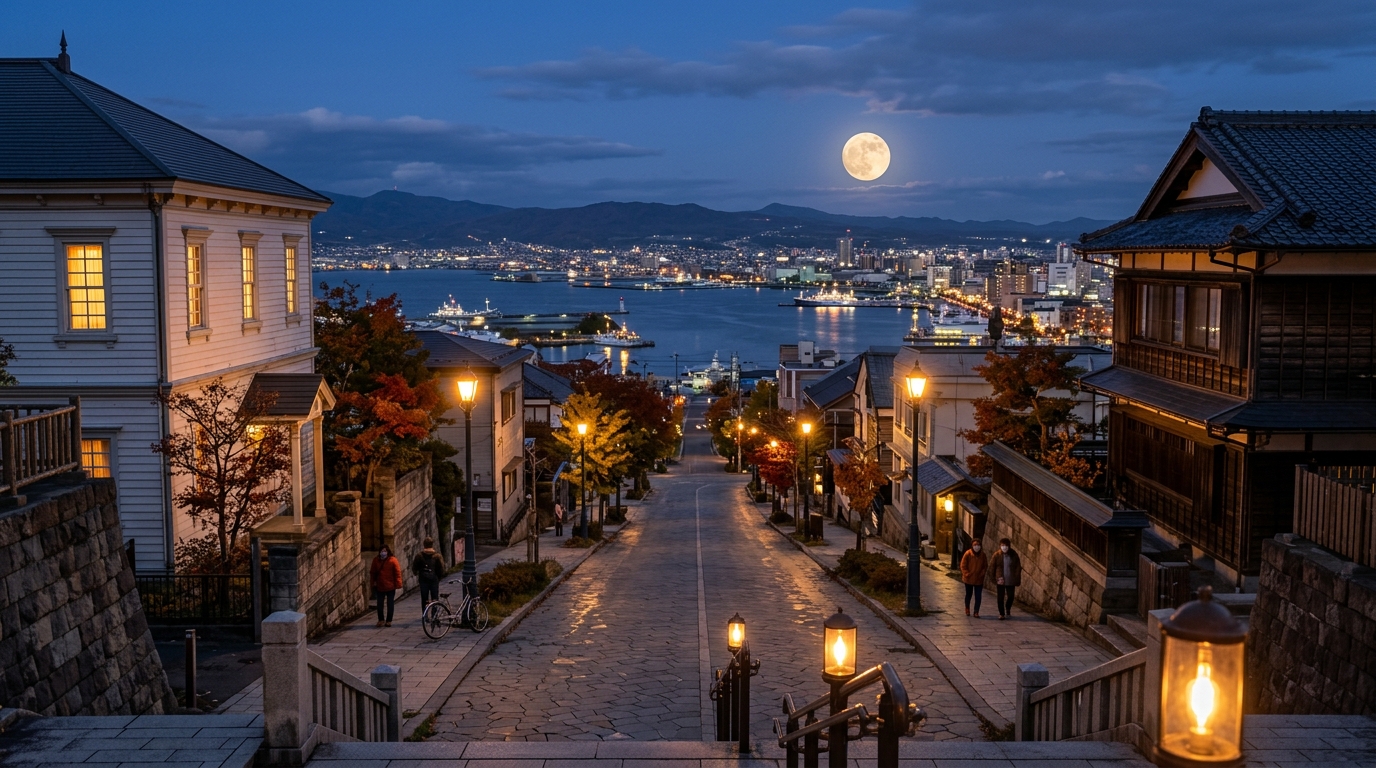
As the season arrives when the luminous Harvest Moon (Jūgoya) illuminates the calm waters of Hakodate Port (Hakodate-kō), the long autumn nights offer a breathtaking spectacle. The crisp night air amplifies the contrast between the glowing moon above and the jewel-box city lights below—a serene moment unique to those who live in this harbor town. While Hakodate is world-famous for the panoramic night view from Mount Hakodate (Hakodate-yama), residents living on the elevated slopes at its base—specifically in the historic Seibu District (西部地区, Western District, encompassing neighborhoods like Motomachi and Suehiro-cho)—enjoy this world-class vista as an everyday luxury.
Based on the latest market data and trends as of 2026, this article analyzes the living comfort and real estate asset value of elevated hillside residential areas overlooking Hakodate Port. Whether you are seeking a primary home or evaluating investment opportunities, here is a detailed look into what makes this market compelling.
Executive Summary: Key Highlights
[Conclusion: Hakodate’s elevated residential districts offer strong potential for both owner-occupiers and real estate investors.]
- Accessible Pricing with Low Entry Barriers: Recent transaction data from Hakodate City (2021–2025, 3,188 records) shows an average real estate transaction price of approximately ¥17.31 million ($115,000 USD equivalent) and a median price of ¥9 million. Compared to major metropolitan areas like Tokyo, acquiring a home with prime panoramic views is exceptionally affordable.
- "Immutable Value" Protected by Landscape Regulations: Strict municipal hillside landscape regulations and low-density zoning (such as 50–60% building coverage ratios) safeguard sunlight and view corridors, mitigating the risk of asset depreciation caused by chaotic surrounding development.
- Peace of Mind from Low Hazard Risks: Official hazard mapping for these elevated areas indicates "No Flood Risk" and "No Landslide Risk," providing long-term structural safety and stability.
- Clear Future Growth Drivers: Major local developments—including the Hakodate Station East District Urban Redevelopment Project scheduled for completion in 2029, the Hokkaido University of Education Hakodate Campus Complex opening in spring 2027, and the targeted extension of the Hokkaido Shinkansen to Sapporo by the end of FY2030—are set to boost regional asset values.
1. Rediscovering Hillside Living: Harvest Moons and Harbor Vistas
Floating in the clear autumn sky, the Harvest Moon over Hakodate Port is more than just scenery; it brings deep comfort to daily life. Enclosed by the sea on three sides, Hakodate features a unique topography where gentle slopes descend from Mount Hakodate toward the harbor. Residential streets built along these slopes resemble a natural amphitheater, thoughtfully positioned so that homes can take full advantage of sweeping harbor and cityscape views.
For owner-occupiers—particularly families and remote workers—having an inspiring view right outside the window significantly lowers daily stress and elevates Quality of Life (QOL). Waking up to ship horns echoing softly across the bay, watching the water turn amber at sunset, and relaxing under the moonlight at night are experiences often associated with luxury high-rise penthouses in Tokyo. On Hakodate's hillsides, however, this lifestyle is achievable in grounded single-family homes or low-rise condominiums.
From an investment perspective, an irreplaceable asset like an unobstructed view serves as a strong hedge against rent depreciation and vacancy risks. Hakodate’s historic streetscapes continue to attract domestic migrants, lifestyle seekers, and tourists alike, supporting steady long-term housing demand.
2. Landscape Regulations in Hakodate’s Seibu District
The stunning visual harmony of Hakodate’s hillside neighborhoods is no coincidence. Hakodate was one of the earliest municipalities in Japan to enact urban landscape preservation measures. In the historic Seibu District (including Motomachi and Suehiro-cho), strict guidelines under the Hakodate Urban Landscape Ordinance preserve the area's distinct architectural heritage.
| Key Municipal Landscape Initiatives | Overview & Objectives |
|---|---|
| Urban Landscape Preservation Districts (都市景観形成地域) | Centered on historic streetscapes in the Seibu District. Sets guidelines for building height, design, materials, and color palettes to harmonize with the surroundings. |
| Protection of Sloped Landscapes (斜面地景観の保護) | Capitalizes on the hillside slope running from Mt. Hakodate to the port. Regulates building heights and setbacks to protect view corridors toward the sea. |
| Outdoor Advertising Controls (屋外広告物の規制) | Limits loud neon signage and oversized billboards, maintaining a tranquil and elegant urban ambiance. |
While building regulations might initially sound like restrictive design constraints, for buyers and investors, they represent a significant legal safeguard. They prevent common real estate drawbacks—such as a sudden high-rise development blocking sunlight or obscuring views.
Preserving regional beauty enhances the long-term brand equity of the neighborhood. Living in Hakodate’s Seibu District carries a recognized prestige, providing a solid foundation for property value retention.
💡 Note for Investors and Buyers: Accessing Off-Market Information Due to strict landscape protections, high-quality properties on Hakodate’s slopes often sell quickly before reaching public listing sites. Register for a free membership at Mekiki Research to download market reports and localized transaction trends. Use the link at the end of this article to sign up.
3. Protecting Sunlight and View Rights Through Zoning Controls
In addition to landscape ordinances, urban zoning designations under the City Planning Act play a crucial role in safeguarding residential environments in Hakodate.
While central areas near Hakodate Station and the Daimon commercial district (大門地区) are designated as "Commercial Zones" (商業地域) with building coverage ratios (BCR) of 80% and floor area ratios (FAR) of 400%—enabling high-density redevelopment and residential towers—residential sectors operate under much quieter parameters.
A look at recent market transaction samples illustrates this balance:
- Kashiwagi-cho (柏木町): A residential plot (¥12 million, 190 m²) located in a Category 2 Medium-and-High-Rise Exclusive Residential Zone (第2種中高層住居専用地域) features a 60% BCR and 200% FAR.
- Kaji (鍛治): A newer single-family home built in 2016 (¥27 million, 185 m² lot) and a spacious residential plot (¥8.5 million, 240 m²) are designated as Category 1 Low-Rise Exclusive Residential Zones (第1種低層住居専用地域), capped at a restrictive 50% BCR and 100% FAR.
A "50% BCR / 100% FAR" requirement means at least half of the plot must remain open space (gardens, parking, or setbacks), effectively limiting building heights to two stories. On hillside terrain, this prevents foreground homes from blocking the light or coastal views of properties behind them, legally preserving light exposure and scenic integrity.
4. Daily Convenience and Amenities on the Slopes
While scenic views are attractive, functional daily infrastructure is essential for comfortable long-term living.
Local data shows that central Hakodate is well-equipped with educational institutions such as Asahi Elementary School (あさひ小学校) and Aoyagi Junior High School (青柳中学校). Healthcare infrastructure is equally well-developed, with nine medical clinics and centers nearby, including the Hakodate City Hall Clinic, Advance Clinic Hakodate, and Hakodate Otemachi Clinic.
For public transportation, the Hakodate City Tram serves as an accessible local option. The Matsukaze-cho stop (松風町停留場), which handles roughly 782 daily passengers, offers a charming and dependable route for daily commutes.
Commercial convenience has also advanced significantly across the city:
- GRANDIR ICHII: Opened at the end of 2024 on the former Ito-Yokado site, this commercial complex added local retail options, including Southern Hokkaido’s first Saizeriya location in January 2025.
- Hokkaido University of Education Hakodate Campus Complex: A multi-use development project that broke ground in July 2026 on underutilized university land. Set to open in spring 2027, it will house a Co-op Sapporo supermarket, 2nd Street retail, and a Tsuruha Drug store, expanding shopping options for nearby residents.
This combination of quiet hillside living and quick access to neighborhood shopping, schools, and transit makes Hakodate's elevated districts practical for everyday life.
5. Market Trends and Resale Value Insights
Below is an overview of recent real estate transaction data in Hakodate City.
[Hakodate Real Estate Transaction Statistics (Period: 2021–2025, Sample Size: 3,188)]
| Indicator | Figure |
|---|---|
| Average Transaction Price | Approx. ¥17.31 million (¥17,308,644) |
| Median Transaction Price | ¥9.00 million |
| Average Price per m² | Approx. ¥35,000/m² (¥34,988/m²) |
Hakodate's housing market remains accessible, with half of recorded transactions priced at or below ¥9 million.
Examples from the dataset highlight market diversity:
- Condominium Investment / Second Home: A 20 m² 1K unit in Ugaura-cho (宇賀浦町, built in 1990) traded for ¥1.5 million. For buyers interested in renovation or DIY updates, such entry points allow for high-yield, low-cost capital outlay.
- Single-Family Residential Plots: In Kaji (鍛治), a 165 m² lot with an older house traded at ¥9.6 million. In contrast, a well-maintained single-family home in the same area built in 2016 (185 m²) sold for ¥27 million, demonstrating that updated or newer inventory retains resale value effectively.
- Commercial/Office Land: A 260 m² commercial plot in a neighborhood commercial zone traded for ¥15 million, reflecting stable demand for small business premises.
In areas protected by architectural preservation rules, underlying land value and scenic appeal help support long-term property values over time.
6. Real Estate Outlook and Local Infrastructure Pipeline
Timing is a critical element in property investment. As of 2026, Hakodate is advancing several notable urban infrastructure projects.
[Key Infrastructure & Development Timeline (2026–2030)]
- July 2026: Construction begins on the Hokkaido University of Education Hakodate Campus Complex.
- October 2026: Construction Starts on Hakodate Station East District First-Class Urban Redevelopment Project.
- A major 1-hectare redevelopment centered on the site of the former Boni Moriya (棒二森屋) department store.
- Spring 2027: Expected opening of the Hokkaido University of Education Hakodate Campus Complex.
- May 2029: Target Grand Opening of the Hakodate Station East Redevelopment Complex.
- A multi-use landmark featuring a 25-story residential tower, an 11-story hotel tower, retail, and public community areas, alongside an all-weather civic plaza designed to increase pedestrian activity near the station.
- End of FY2030 (Target): Hokkaido Shinkansen Extension to Sapporo.
- Extending high-speed rail connectivity from Shin-Hakodate-Hokuto Station toward Sapporo will improve regional transit connections, further strengthening Hakodate's role as a regional hub.
These redevelopment initiatives are reshaping Hakodate's urban center. Increased investment near Hakodate Station provides broader economic support to adjacent residential neighborhoods, including the Seibu and hillside districts.
7. Practical Considerations for Hillside Buyers
When evaluating hillside real estate in Hakodate, consider the following practical factors:
1. Natural Hazard Profiles
Geographic safety is a key priority when purchasing real estate. Based on municipal hazard mapping, elevated hillside plots in these districts show "No Risk for Flooding" and "No Risk for Landslides." Being located at a higher elevation provides natural protection against coastal storm surges and tsunamis, while firm ground structures mitigate landslide concerns.
2. Winter Access and Parking
Living on a slope requires preparation for Hokkaido’s winter conditions. When viewing properties, check whether adjacent streets are served by municipal snowplow routes or equipped with road-heating systems (融雪設備). Additionally, off-street parking adds practical value for personal use and rental appeal.
3. Local Subsidies and Family Support Programs
Hakodate City offers several municipal grant programs to support home buyers and new residents as of 2026:
- Vacant House Renovation Support Subsidy (空家等改修支援補助金): Up to ¥2 million in funding when purchasing and renovating an unoccupied home in designated zones like the Seibu District—ideal for restoring traditional historic structures.
- Young Family Housing Support Program (ヤングファミリー住まいりんぐ支援事業): Rental subsidies of up to ¥15,000 per month for up to 16 years for eligible child-rearing families living in designated rental housing.
- Downtown Housing Construction/Acquisition Subsidy (まちなか住宅建築取得費補助金): Grants of up to ¥2 million for building or buying a new home in designated central urban zones near Hakodate Station or Daimon.
Combining local incentives with Hokkaido Prefecture's Relocation Support Grant (移住支援金, up to ¥1 million) can significantly reduce initial acquisition costs.
8. Conclusion
Hakodate's elevated residential areas offer an appealing combination of panoramic views, municipal architectural protections, and reliable natural hazard safety profiles.
With average local transaction prices floating around ¥17 million and major city infrastructure projects underway through 2030, Hakodate presents a practical market for both owner-occupier families and long-term real estate investors.
[Run Professional Property Research in Your Own AI Environment] Verifying transaction histories and precise hazard mapping is crucial when evaluating real estate. By registering for a free Mekiki Research account, you can connect real-time land data and hazard maps from the Ministry of Land, Infrastructure, Transport and Tourism (MLIT) directly to your own Claude or ChatGPT setup via MCP integration. No sales calls, no promotional spam—just data to assist your property evaluation.
Check the latest land prices and hazard information for Hakodate, Hokkaido on Mekiki Research 👉