
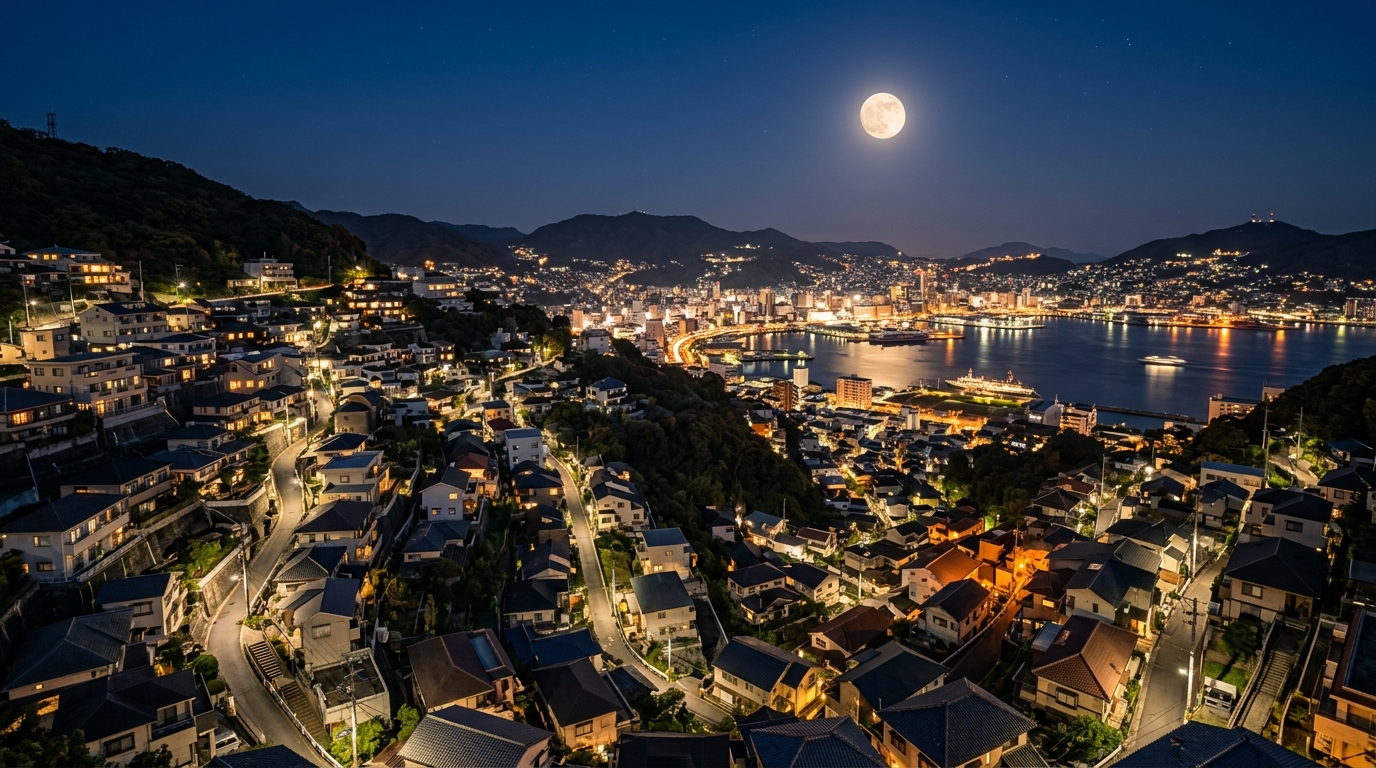
The harvest moon (Jugoya) floats in the crisp autumn air. The contrast between the moonlight reflecting on the ocean surface and the city lights viewed from the hilltops of Nagasaki City (長崎市)—recognized as one of the New World's Top Three Night Views—is truly breathtaking. In the real estate market, factors like "scenic views" and "nightscapes" are not just matters of mood; they are clear sources of asset value. Particularly in areas with unique topography and strict landscape regulations like Nagasaki City, this value tends to be preserved over the long term.
Today, in honor of the 2026 harvest moon, we will unpack the appeal of Nagasaki City's hilltop residential areas, as well as the "residential comfort" and "asset preservation effects" brought about by landscape regulations, from the perspective of a professional real estate analyst. Whether you are a real estate investor, a family, or a single professional considering purchasing a primary residence, we will provide you with plenty of insights to help you balance livability with future asset value.
1. Reflections on the Harvest Moon: The Richness of Life and Investment Potential Brought by Beautiful Views
| Overview of Transaction Statistics in Nagasaki City (Around Target Area) | Figures / Indicators |
|---|---|
| Target Period | 2021–2025 |
| Total Transaction Samples | 4,053 |
| Average Transaction Price | Approx. 27.35 million yen |
| Median Transaction Price | 15 million yen |
| Average Unit Price | Approx. 85,000 yen/sqm |
When choosing a property, the "view"—which heavily influences the richness of daily life—is a factor that should never be underestimated. The Port of Nagasaki (長崎港) sparkling in the morning sun, the gradient hues of dusk, and the harvest moon shining in the night sky alongside the city's neon lights. A life where you can enjoy these sights daily from your own windows brings an irreplaceable sense of mental well-being.
So, what kind of potential do the hilltop areas of Nagasaki City hold from the perspective of real estate investment or purchasing a home? To get straight to the point, Nagasaki City's hilltop residential areas can be described as "excellent investment targets that combine medium- to long-term asset value stability with a unique living environment premium." The data supporting this conclusion is summarized below:
- Affordable price range and strong resilience: According to transaction statistics from 2021 to 2025 based on data from the Ministry of Land, Infrastructure, Transport and Tourism (国土交通省) (sample size: 4,053), the average transaction price is approximately 27.35 million yen, with a median of 15 million yen. While these are overwhelmingly accessible prices compared to central metropolitan areas, liquidity is well-secured by a robust number of transactions throughout the year.
- Limited supply due to landscape regulations: The strict landscape regulations discussed later prevent the chaotic overdevelopment of high-rise condos. This maintains the scarcity of existing properties with good views and mitigates the risk of future price declines.
- Spillover effects from large-scale redevelopment: The redevelopment of the city center, spearheaded by Nagasaki Stadium City (長崎スタジアムシティ)—which opened in 2024 and is currently thriving as it celebrates its 2nd anniversary in 2026—directly translates to improved access and a higher baseline of convenience for the surrounding hilltop residential areas.
In this way, Nagasaki City's hilltop areas are not just "places with good views"; they harbor solid investment potential backed by data.
2. The Unique Asset of "Night Views" in Nagasaki City's Hilltop Residential Areas
| Area / Zoning | Property Type | Layout / Area | Year Built | Transaction Price |
|---|---|---|---|---|
| Ozonemachi (大園町) (Category I Mid/High-Rise) | Pre-owned Condo | 3LDK / 75 sqm | 2005 | 19 million yen |
| Bunkyomachi (文教町) (Semi-Residential) | Pre-owned Condo | 2LDK / 75 sqm | 1979 | 19 million yen |
| Ote (大手) (Category I Low-Rise) | Residential (Land & Building) | 4DK / 200 sqm | 1975 | 6 million yen |
| Aburagimachi (油木町) (Category I Low-Rise) | Residential (Land & Building) | - / 185 sqm | 1989 | 5 million yen |
| Ienomachi (家野町) (Commercial) | Pre-owned Condo | 3LDK / 75 sqm | 2003 | 27 million yen |
| Izumi (泉) (Category I Mid/High-Rise) | Land (Multi-family Housing) | - / 270 sqm | 2021 | 50 million yen |
It is often said that in real estate, "location is everything," but in Nagasaki City, "elevation and unobstructed views" are factors just as important as—if not more important than—location itself. Nagasaki's "night view" is a three-dimensional art of light created by houses lining its bowl-shaped terrain, and hilltop properties that offer this scenery inherently possess a unique asset value.
Let's take a look at actual transaction data. For example, a 3LDK pre-owned condo in Ozonemachi, built in 2005 with an area of 75 sqm, was traded for 19 million yen. Similarly, a 2LDK pre-owned condo in Bunkyomachi, built in 1979 with 75 sqm, also sold for 19 million yen. Despite differences in building age, both fall into a highly realistic price bracket of under 20 million yen, making them very attractive options for families and DINKS (Double Income, No Kids).
On the other hand, looking at detached houses (residential land), there are transaction records of a 200-sqm 4DK home in Ote (built in 1975) for 6 million yen, and a 185-sqm property in Aburagimachi (built in 1989) for 5 million yen. While these prices reflect the physical aging of the buildings, they offer immense potential as a base for acquiring "spacious land and a hilltop living environment" at a bargain price, ready to be renovated or rebuilt to your liking.
Furthermore, in the Izumi area, a 270-sqm residential plot for multi-family housing (such as apartments) built in 2021 was traded for 50 million yen. This indicates that investment money targeting rental demand in hilltop areas is steadily flowing in. From affordable family homes to income-producing properties, Nagasaki City's hilltop residential areas have the capacity to accommodate a wide variety of needs.
3. What Are the "Landscape Regulations" That Protect These Stunning Views? (A Beginner's Guide)
| BCR and FAR by Zoning (Examples from Nagasaki City Data) | Building Coverage Ratio (BCR) | Floor Area Ratio (FAR) | General Idea of Main Restrictions |
|---|---|---|---|
| Category I Exclusively Low-Rise Residential Zone (Ote, Aburagimachi, etc.) | 50% | 100% | Primarily spacious detached houses up to about two stories. Tall buildings are prohibited. |
| Category I Exclusively Mid/High-Rise Residential Zone (Ozonemachi, Izumi, etc.) | 60% | 200% | Mid-rise condos and apartments can be built. Subject to sunlight regulations. |
| Commercial Zone (Ienomachi, City Center, etc.) | 80% | 400–600% | Densely packed with office buildings and high-rise condos. Mixed with commercial facilities. |
The greatest contributors to preserving Nagasaki City's beautiful night views and excellent living environments are the "landscape regulations" and "zoning restrictions" enforced by the local government. Though it might seem complicated with all the technical jargon, these are essentially rules stating, "You cannot construct buildings beyond a certain height or size in this area."
For instance, Ote and Aburagimachi from our actual data examples are designated as "Category I Exclusively Low-Rise Residential Zones," where the building coverage ratio (the percentage of the building footprint relative to the lot size) is limited to 50%, and the floor area ratio (the ratio of total floor area to lot size) is capped at 100%. This means that "half of the lot must be left as a yard or open space, and you can only build a house of about two stories at most." Thanks to these strict limitations, the risk of a massive condo suddenly being built next door and stealing your sunlight and view is extremely low.
On the other hand, in a "Category I Exclusively Mid/High-Rise Residential Zone" like Izumi (BCR 60%, FAR 200%), the construction of mid-rise apartments and condos is permitted, but designs that are considerate of the surrounding environment are still required.
What would happen if everywhere had rules like a "Commercial Zone" (BCR 80%, FAR 400–600%), where tall buildings could be constructed freely? Nagasaki's beautiful sloping terrain would be overrun with sterile high-rise buildings, ruining both the night views and the natural scenery. Landscape regulations might initially seem like an obstacle to development, but they are actually "a powerful shield that protects the existing beautiful views and living environments for eternity."
4. Why Landscape Regulations Prolong the "Livability" of Your Home
| Hazard Risks in Nagasaki City (Alerts Based on Actual Data) | Risk Assessment | Details & Points of Caution |
|---|---|---|
| Flood Risk | Present | Max inundation depth Rank 4 (5–10m). Caution required in lowlands and along rivers. |
| Landslide Risk | Present | Phenomena such as debris flows. Steep slopes and hilltops with retaining walls require confirmation. |
The benefits brought by landscape regulations go far beyond just "having a good view." Rules that prevent building congestion and ensure open spaces guarantee abundant sunlight and ventilation. Because houses situated on slopes can take in light and wind over the roofs of the buildings in front of them—much like terraced fields—they are less prone to trapping moisture, which helps prolong a healthy and comfortable living space.
However, when choosing a home on a hilltop or slope, checking the hazard (disaster) risks is something that, as a professional analyst, I must emphasize cannot be ignored.
As clearly shown in the actual data, the central and lowland areas of Nagasaki City have a very high flood risk, categorized as "Max inundation depth Rank 4 (5–10m)." In this regard, hilltop areas offer a viable option for protecting life and property from water damage. On the flip side, however, there are quite a few locations identified as having risks unique to hilltops, such as "landslides (e.g., debris flows)."
Do not jump at a property simply because "the view is great." Always make sure to check the latest hazard map before purchasing. Carefully inspecting whether the property is designated as a Landslide Warning Area (Yellow Zone or Red Zone) and checking retaining walls (the concrete walls supporting the slope) for cracks or deterioration alongside an expert is an absolute prerequisite for a long, worry-free life there.
[To Those Seeking Real Estate Information (Free Offer)] Here is a quick announcement for those who are about to seriously begin their search for a home or consider real estate investments. On our site, Bukken Mekiki Research (物件目利きリサーチ), we provide off-market, unlisted property information that is not available on general portal sites, as well as the latest market reports (2026 edition) for regional core cities like Nagasaki City—completely free of charge. Please feel free to use these resources to gather the optimal information tailored to your investment phase or purchase plans.
5. Great for Families! The Positive Impact of Hilltop Environments on Nature and Education
| Residential Environment Data (Nagasaki City Center & Hilltop Periphery) | Details |
|---|---|
| Major Public Transit | Shinchi Chinatown Station (新地中華街駅) (Nagasaki Electric Tramway (長崎電気軌道)) / Daily passengers: 13,430 |
| Educational Environment (School District Examples) | Oura Elementary School (大浦小学校), Umegasaki Junior High School (梅香崎中学校), etc. |
| Medical Facilities | 134 facilities in the vicinity (e.g., Nagasaki Jin Hospital (長崎腎病院), Dejima Hospital (出島病院), Kobayashi Hospital (小林病院)) |
When families choose a home, they place just as much importance on the "child-rearing environment" as they do on views and prices. Nagasaki City's hilltop areas offer a well-balanced fusion of nature and urban functions, providing an extremely attractive environment for the child-rearing generation.
For instance, the surrounding target area is home to historic schools such as Oura Elementary School and Umegasaki Junior High School, where a calm and stable educational environment can be expected. Furthermore, medical facilities are highly abundant; there are 134 medical institutions in the vicinity alone, including Nagasaki Jin Hospital, Dejima Hospital, and Kobayashi Hospital. The peace of mind that comes with knowing you can immediately access proper medical care in the event of an injury or sudden illness is a huge plus for families raising children.
Regarding transportation access, Shinchi Chinatown Station on the streetcar line (Nagasaki Electric Tramway) boasts 13,430 daily passengers and serves as a central hub for commuting to major spots within the city. The route from the hilltops to the stations at the base (navigating the sloped terrain) has been a longstanding challenge, but in recent years, convenience has improved dramatically due to the expansion of community buses supporting the hillside areas and the widespread use of electric-assist bicycles.
Moreover, as of 2026, Nagasaki City has rolled out generous subsidy programs aimed at encouraging the child-rearing generation to settle down. A prime example is the Nagasaki City Child-rearing Housing Support Subsidy (長崎市子育て住まいづくり支援費補助金). When households with multiple children or child-rearing families renovate an existing home, or purchase and renovate one, they can receive up to 400,000 to 500,000 yen in subsidies, with an additional 100,000 yen awarded for utilizing a vacant house. Additionally, by taking advantage of national partnerships like the Mirai Eco Housing 2026 Project (みらいエコ住宅2026事業), it is possible to acquire a comfortable home with high insulation performance at a great value. The ability to fully leverage these systems to realize your ideal living environment while keeping initial costs low is a major strength of the current real estate market in Nagasaki City.
6. Asset Preservation Effect: A Beautiful View Acts as a Shield Against Future Price Declines
In real estate investment, the most fearsome risk is a future "price decline (depreciation of asset value)." However, properties with excellent views in the hilltop areas of Nagasaki City possess strong resistance against this downside risk.
The biggest reason for this is their "irreplaceability." In a flat, newly developed town, if a similar subdivision is developed next door, existing properties are dragged into price competition simply because they are older. In contrast, the "beautiful night view from a specific angle" seen from the slopes of Nagasaki exists solely on that particular plot of land. Furthermore, because the aforementioned "landscape regulations" restrict new developments that would block those views, the supply remains extremely limited.
While the average transaction unit price is an affordable 85,000 yen/sqm, the 4,053 transaction samples show that market liquidity is more than adequately secured. This is evidence of a constantly thick layer of primary residence demand from buyers who think, "I can't afford a brand-new build, but I'm looking for a pre-owned property with a great view that's worth renovating." Even if the physical building's value depreciates to zero, a beautiful view elevates the underlying appeal of the land, functioning as a powerful "shield" to prevent price declines during future sales or rental operations.
7. 2026 Edition: Choosing an Area in Nagasaki City That Balances Great Views and Livability
| Major Projects and Redevelopment Timeline in Nagasaki City | Overview and Impact on the Real Estate Market |
|---|---|
| October 2024 | Opening of Nagasaki Stadium City. A new complex integrating sports, retail, and offices. |
| October 2026 | Nagasaki Stadium City 2nd Anniversary. Established as a new everyday space, enhancing walkability in the surrounding area. |
| Around 2028–2030 | Full-scale implementation of the "Nagasaki City Center Urban Development Concept" (長崎都心まちづくり構想). Establishment of walkable zones and infrastructure prioritizing pedestrian flow. |
| FY 2032 (Planned) | Widening of arterial roads from National Route 202 (国道202号) to city roads. Drastic improvement in access around Nagasaki Station (長崎駅). |
When forecasting future asset values, you cannot overlook the timeline of the large-scale redevelopment currently underway in central Nagasaki City—often referred to as a "once-in-a-century" undertaking.
Nagasaki Stadium City, spearheaded by the Japanet Group (ジャパネットグループ) and opened in the fall of 2024, functions not merely as a sports facility but as a massive city-within-a-city encompassing an arena, hotel, retail spaces, and offices. A grand 2nd-anniversary festival is scheduled for October 2026, and it has already completely established itself as an "everyday oasis" for the citizens of Nagasaki.
How to spread this downtown vibrancy to the surrounding areas is the current overarching theme for Nagasaki City. Looking ahead to 2028–2030, the establishment of "walkable zones" emphasizing pedestrian flow will advance based on the Nagasaki City Center Urban Development Concept. Furthermore, plans are in place to widen the arterial roads alongside Nagasaki Station, aiming for completion in FY 2032.
The implications of these developments for the real estate market are profound. As the city center's infrastructure is upgraded and walkability improves, the convenience of the "hilltop residential areas" located just a short distance from the center will skyrocket. Areas that were previously shunned because "the views are nice but access to downtown is a bit inconvenient" are now transforming into the ultimate hybrid locations: places where you can easily pop out to Stadium City or the commercial facilities in front of the station, and then return to a quiet hilltop home with a stunning night view. The timing for this transformation is right now.
8. Conclusion: How to Choose a Hilltop Residential Area for Breathtaking Views and a Secure Living Environment
What are your thoughts? Nagasaki City's hilltop residential areas, symbolized by the beautiful harvest moon and stunning night views, are not just objects of romantic yearning; they serve as highly rational choices for both primary residence and investment purposes.
- Solid demand backed by affordable prices (median of 15 million yen) and abundant transaction track records
- Prevention of chaotic overdevelopment through landscape regulations, providing resistance against future asset value depreciation
- Robust medical and educational environments, along with generous child-rearing and housing subsidies (latest as of 2026)
- Dramatic improvements in convenience driven by redevelopment, starting from the opening of Stadium City and heading into the 2030s
When searching for a property that meets these criteria, please never forget to check the "hazard maps (especially debris flow risks)" and the "safety of retaining walls." If you can manage these risks appropriately, you are sure to find an exceptional home or investment property that balances everyday livability with future asset preservation.
[Would You Like to Research Deeper on Your Own Using AI?] By registering for a free membership, you will be able to pull the actual transaction data from the Ministry of Land, Infrastructure, Transport and Tourism, as well as hazard information used in this blog, directly into your Claude or ChatGPT (via MCP integration). This offers the groundbreaking advantage of being able to continue specialized research alongside your own AI assistant, so please take advantage of it for your information gathering.