
As we approach Respect for the Aged Day (敬老の日) in September 2026, the ideal living environment for the "100-year life era" is once again drawing attention. For seniors who are beginning to feel uneasy about driving, an environment where all daily needs can be met within walking distance is essential. Consequently, the "Compact City Strategy" heavily promoted by Kanazawa City, Ishikawa Prefecture (石川県金沢市), and the accompanying push for "machinaka" (downtown) living, are currently taking the real estate market by storm.
Following the extension of the Hokuriku Shinkansen to Tsuruga (敦賀), Kanazawa City has been rapidly upgrading its urban functions. The "urban axis" area stretching from around Kanazawa Station to Katamachi (片町) has been designated by the national government as an Urban Renaissance Urgent Redevelopment Area. Here, the rebuilding of aging structures and large-scale redevelopment projects are taking place simultaneously. By concentrating medical facilities and commercial centers in the heart of the city, the area is transforming into a highly attractive district—not only as a final home for seniors but also for child-rearing families and singles who prioritize convenience.
In this article, from the perspective of a professional real estate analyst, we will thoroughly explore the true value of downtown living in central Kanazawa and the future asset value potential brought about by redevelopment. We will base our analysis on public transaction data from the Ministry of Land, Infrastructure, Transport and Tourism, as well as the latest municipal trends. Whether you are a prospective homebuyer looking for a place to live or a forward-thinking real estate investor, we will reveal exactly why you should be paying attention to central Kanazawa right now and share the secrets to choosing the perfect property without regrets.
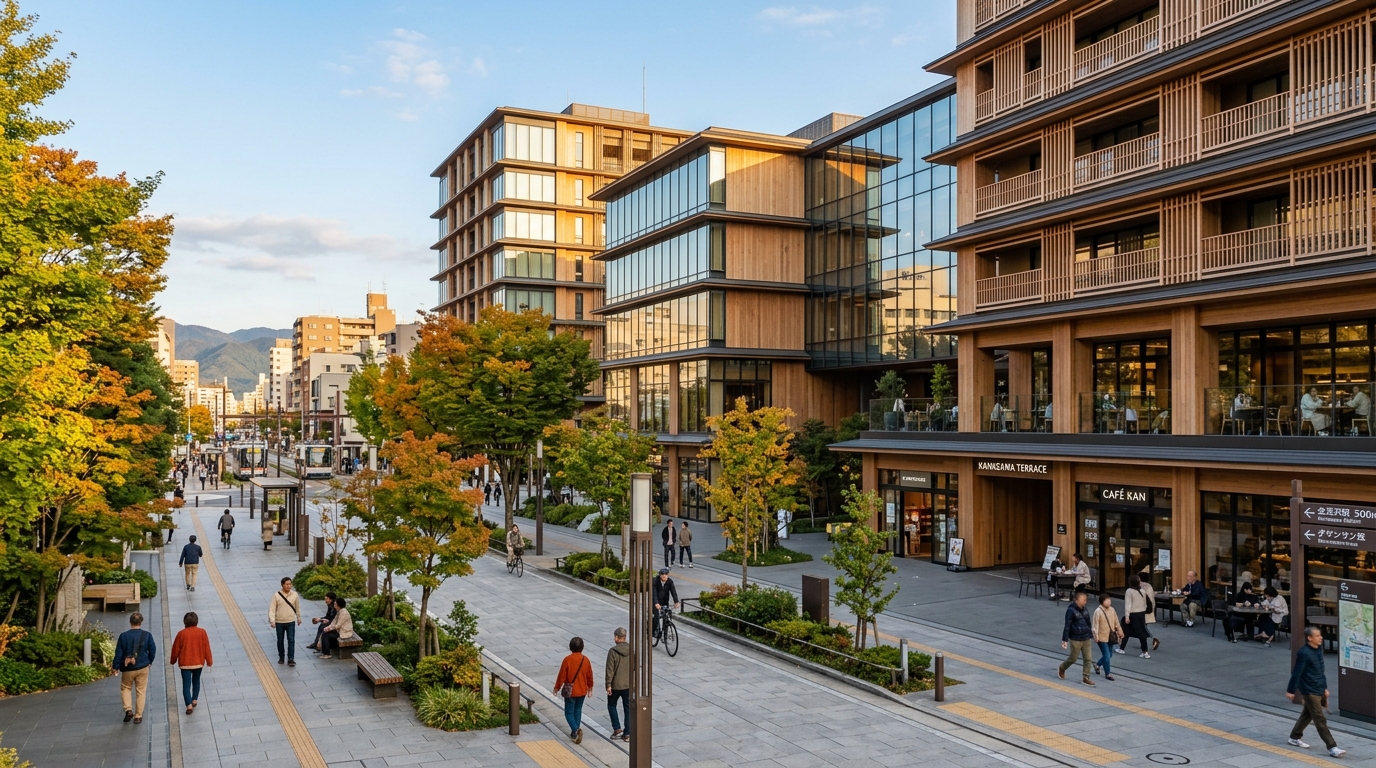
1. Rethinking "Future Living" and Shifting Senior Demand on Respect for the Aged Day 2026
| Conclusion and Rationale for Investment & Practical Demand Potential |
|---|
| Overall Rating: "Extremely high potential" both as a final home for personal use and as an investment for future asset appreciation. |
| Reason 1: Redevelopment: Full-scale construction of large multipurpose buildings in front of Kanazawa Station and Musashigatsuji (武蔵ヶ辻) is slated for 2028–2030. |
| Reason 2: Support Measures: Kanazawa City offers a robust subsidy program, providing up to 2 million yen for acquiring housing in the city center. |
| Reason 3: Infrastructure: A dense concentration of 24 medical institutions within walking distance creates a safe, car-free environment for seniors. |
Let's start with the conclusion: As of 2026, the central downtown area (the urban axis) of Kanazawa is a highly promising market where we can strongly expect long-term asset value retention and appreciation. The primary reason is the perfect alignment between the "relocation demand" among seniors and the local government's aggressive "residential attraction policies."
As the population ages, the trend of seniors downsizing from spacious suburban houses to convenient downtown condominiums will only accelerate. The downtown environment—where you can escape the burden of yard work and winter snow shoveling, give up your driver's license, and still easily access hospitals, supermarkets, and cultural facilities on foot or via public transport—offers irreplaceable value.
The solidity of this practical demand (demand for actual living) is also crucial for real estate investors. It guarantees stable rental demand and future resale opportunities, thereby minimizing the risks of vacancies and price drops. Supported by senior demand, the value of central Kanazawa is projected to become even more premium as we head into the 2030s.
2. The Current State of Kanazawa's Compact City Strategy and Downtown Living
| Real Data Overview of Central Kanazawa (Target Period: 2021–2025) |
|---|
| Survey Area: Kanazawa City, Ishikawa Prefecture (around latitude 36.561325, longitude 136.656205) |
| Data Sample Size: 7,434 transactions |
| Urban Planning (Zoning): Commercial zones (80% building coverage ratio, 400% floor area ratio), etc. |
| Average Transaction Price: Approx. 24.85 million yen (Median: 17 million yen) |
Kanazawa City has adopted "harmony between preservation and development" as its core urban planning philosophy, designating the arterial route from Kanazawa Port, through Kanazawa Station, down to Katamachi as the "urban axis." The compact city strategy of concentrating commercial, business, and residential functions along this axis is currently bearing significant fruit.
What deserves special attention is the generous residential support program uniquely deployed by Kanazawa City. Its flagship initiative, the "Kanazawa City Downtown/Residential Attraction Area Housing Acquisition Incentive," subsidizes a certain percentage of mortgage loans—up to 2 million yen when factoring in bonuses for child-rearing families and new migrants—when purchasing or building a house or condo in the downtown area. Furthermore, an additional subsidy of up to 500,000 yen is available under the "Kanazawa City District Plan Area Housing Acquisition Incentive," proving that the local government is absolutely serious about driving population flow back to the city center.
Looking at the actual data acquired this time through Mekiki Research, this area is zoned for "commercial use," allowing for high-density utilization with an 80% building coverage ratio and a 400% floor area ratio. Because developers can efficiently use limited land to construct mid-to-high-rise condominiums and mixed-use buildings, it is a highly attractive area for real estate development. As a result, an ideal virtuous cycle has emerged, making it easier to supply the high-quality, barrier-free housing stock that seniors demand.
3. A Hub of Medical and Commercial Facilities! The Unmatched Livability Brought by Downtown Redevelopment
| Medical and Redevelopment Data Supporting Livability |
|---|
| Nearby Medical Institutions: 24 locations (including Ito Hospital (伊藤病院), Kawakita Ophthalmology Clinic (かわきた眼科クリニック), Saburi Clinic (さぶりクリニック), etc.) |
| May 2026: Construction begins on "Zepp Kanazawa (Zepp金沢)" (tentative name) at the west exit of Kanazawa Station, the first live music hall of its kind on the Sea of Japan coast. |
| August 2026: The City Planning Council approves a redevelopment project for three 60-meter-tall buildings in the Musashigatsuji area. |
| Around 2028–2030: A plan for a 160-meter-tall public-private mixed-use building at the former Kanazawa Miyako Hotel (旧金沢都ホテル) site at the east exit of Kanazawa Station is set to move into full swing. |
As the most critical index of "livability" for seniors, robust medical facilities are absolutely indispensable. According to the data we obtained, there are no fewer than 24 medical institutions in the vicinity of the target area. The dense concentration of everything from large-scale facilities like Ito Hospital to specialized clinics like Kawakita Ophthalmology Clinic and Saburi Clinic within walking distance provides an overwhelming sense of security for both routine health management and sudden emergencies.
Furthermore, in Kanazawa's urban axis area, large-scale redevelopments—including commercial facilities for daily shopping—are progressing simultaneously. Since the area stretching from Kanazawa Station to Katamachi was designated as an Urban Renaissance Urgent Redevelopment Area by the national government in July 2024, tax incentives such as subsidies for demolishing aging buildings have kicked in, rapidly accelerating the city's rejuvenation.
In August 2026, the City Planning Council approved a construction project for three 60-meter-tall buildings in the Musashigatsuji area near Omicho Market (近江町市場), surrounding the Kanazawa Sky Building (金沢スカイビル). These buildings will feature commercial spaces on the lower floors and hotels or condos on the upper levels. Additionally, at the site of the former Kanazawa Miyako Hotel at the east exit of Kanazawa Station—which had sat vacant for years—Kintetsu Real Estate (近鉄不動産) has announced a concept for a 160-meter-tall mixed-use building. It will be the finest of its kind on the Sea of Japan coast, equipped with MICE (Meetings, Incentives, Conferences, and Exhibitions) facilities, a luxury hotel, and residential spaces.
As these redevelopments are sequentially completed between 2028 and 2030, everyday convenience will take a massive leap forward. From the perspective of real estate investment theory, right now—while the redevelopment blueprints are drawn and projects are just moving toward construction—is the best time to invest before property prices peak entirely.
💡 [A Professional's Perspective] Catch the Latest on Kanazawa's Redevelopment Trends and Off-Market Properties Early! Prime used condominiums and new building lots in the downtown area are increasingly being traded behind closed doors before they ever hit the open market. By registering as a free member on our site, you can regularly receive off-market property information around redevelopment zones and more detailed market reports tailored for investors. To ensure you don't miss out on future relocation or investment opportunities, set up your information-gathering pipeline right now.
4. Not Just for Seniors: Why Downtown is Also Popular Among Convenience-Seeking Families and Singles
| Central Kanazawa Education and Child-Rearing Support Data (2026 Latest) |
|---|
| Designated School Zones: Saio Elementary School (犀桜小学校), Jonan Junior High School (城南中学校) |
| Child-Rearing Support Allowance: 30,000 yen paid per child (20,000 yen from the national government + 10,000 yen unique city addition) |
| Childcare Fee Reduction: Free childcare for the second child under 3 years old (implemented from FY2025) |
When people hear "downtown living," they often think of it as a privilege for seniors. However, in recent years, its popularity has been skyrocketing among child-rearing families in their 20s to 40s and single business professionals. The biggest reason for this is Kanazawa City's generous child-rearing support systems and exceptional educational environment.
As a new development in 2026, to combat rising prices, Kanazawa City is distributing an "Inflation Relief Child-Rearing Support Allowance" of 30,000 yen per child (adding an independent 10,000 yen to the national government's 20,000 yen). Furthermore, financial support is incredibly robust, featuring free childcare for second children under age 3 and comprehensive support programs for expectant and nursing mothers.
On the educational front, the target area falls within the school zones for Saio Elementary School and Jonan Junior High School. Ishikawa Prefecture is known for having some of the highest academic standards in the country, and schools in the center of Kanazawa tend to attract families deeply invested in education. Because of this, a growing number of families are deliberately purchasing downtown condos to secure a better educational environment.
For singles as well, a city center that allows them to live close to work is highly appealing. In a modern lifestyle that prioritizes "quality" (time and experiences) over "quantity" (floor space), central Kanazawa serves as a powerful magnet attracting multiple generations.
5. A Transport Network That Makes Car-Free Living Comfortable and the Appeal of Walkability
| Quality of Transport Infrastructure and Entertainment Facilities |
|---|
| Nearest Station Data: "Null" in public transaction data (characterized by a uniquely developed bus and road network independent of train stations) |
| Public Transportation: An extensive route bus network originating from Kanazawa Station, plus abundant bike-sharing options |
| New Entertainment Hub: "Zepp Kanazawa" (tentative name, approx. 1,200 capacity) scheduled for completion at the west exit of Kanazawa Station in October 2027 |
The biggest challenge for regional cities is "breaking away from a car-dependent society." However, in Kanazawa's urban axis area, you can live a perfectly comfortable life without owning a car.
In the public transaction data obtained from the Ministry of Land, Infrastructure, Transport and Tourism, information regarding the nearest station (station name and passenger numbers) for the target area is listed as "null." This is not a lack of data; rather, it vividly illustrates that central Kanazawa is a city that has developed around a uniquely advanced bus network, which cannot be measured by the nationwide standard of "walking distance to a train station." With Kanazawa Station as a hub, buses circulate to Korinbo (香林坊), Katamachi, and Musashigatsuji every few minutes. The flat terrain makes bike-sharing highly practical, meaning that "distance from a major bus stop" dictates asset value far more than distance from a train station.
Even after growing older and surrendering your driver's license, you can still walk to Omicho Market to buy fresh groceries and visit your regular doctor. The realization of this "walkable city" is the very essence of the compact city strategy. Furthermore, with Zepp Kanazawa slated for completion at the west exit of Kanazawa Station in the fall of 2027, younger generations and singles will be able to enjoy cutting-edge music entertainment without traveling far.
Eliminating the cost of owning and maintaining two cars (hundreds of thousands of yen annually) and redirecting those funds toward a mortgage, investments, or educational expenses is a highly logical choice for practical homebuyers.
6. Tracking Real Estate Prices and Asset Value Trends in Central Kanazawa Through Actual Data
Now, let's take a closer look at real estate price trends in central Kanazawa based on actual data from 2021 to 2025 obtained by Mekiki Research. The overall average transaction price is approximately 24.85 million yen, with an average unit price of about 80,000 yen per square meter.
| District | Property Type (Structure) | Year Built | Area | Zoning | Transaction Price |
|---|---|---|---|---|---|
| Katamachi (片町) | Pre-owned Condo, etc. (RC) | 2016 | 90㎡ | Commercial Zone | 56 million yen |
| Kodatsuno (小立野) | Residential Lot (Land & Bldg, Wooden, etc.) | 2020 | 145㎡ | Category I Mid/High-Rise Exclusive Residential District | 30 million yen |
| Kanaiwa-Honmachi (金石本町) | Residential Lot (Land & Bldg, Wooden) | 2020 | 145㎡ | Semi-Industrial Zone | 24 million yen |
| Izumi-Honmachi (泉本町) | Pre-owned Condo, etc. | 2008 | 75㎡ | Semi-Industrial Zone | 24 million yen |
| Takayanagi-machi (高柳町) | Pre-owned Condo, etc. (SRC) | 1999 | 95㎡ | Semi-Industrial Zone | 16 million yen |
| Kodatsuno (小立野) | Pre-owned Condo, etc. | 1989 | 60㎡ | Category II Mid/High-Rise Exclusive Residential District | 3 million yen |
The insights gleaned from this data are incredibly clear. First, a relatively new RC (reinforced concrete) condo (90㎡) in Katamachi, a bustling commercial district directly benefiting from redevelopment, traded for a premium price of 56 million yen. This is proof that the demand for high-quality condos in the highly convenient urban axis area is exceptionally strong, smoothly absorbing the downsizing demand from affluent individuals and seniors.
On the other hand, an older condo (built in 1989, 60㎡) in the Kodatsuno area, slightly removed from the city center, sold for just 3 million yen, showing a massive price gap. (*A new detached house in the same area traded for 30 million yen, indicating that building aging directly impacts the price.)
Even within Kanazawa City, it is evident that a clear polarization in asset value is occurring based on location, age of the building, and "accessibility to urban functions." From an investment perspective, the rule of thumb for preserving future asset value is not simply buying cheap properties, but rather targeting commercial zones like Katamachi, Musashigatsuji, and the area around Kanazawa Station, which directly benefit from redevelopment.
7. Key Points for Identifying Prime Properties Where You Can "Live Safely for a Long Time" (For Homebuyers & Investors)
| Hazard Risks in Central Kanazawa (Must Check Before Purchase) |
|---|
| Flood Risk: Present (Max expected inundation depth rank 3: 3 to 5 meters) |
| Landslide Risk: Present (Some areas noted for potential debris flows) |
While downtown living in Kanazawa is undeniably attractive, there is one point you must never compromise on when choosing a property: "preparedness for natural disaster risks."
According to the hazard information we obtained, the target area carries both flood risks (with an expected maximum inundation of 3 to 5 meters) and landslide (debris flow) risks. Kanazawa boasts two beautiful rivers, the Sai River (犀川) and the Asano River (浅野川), which offer excellent scenery but also mean the city is not immune to flood risks during heavy rains. In areas where 3 to 5 meters of flooding is projected, detached houses (especially single-story homes or layouts with living spaces on the ground floor) come with a significant risk of losing your foundation for daily life.
Therefore, the ironclad rules for identifying a prime property where you can live safely for a long time are as follows:
- For condominiums, choose units on the 2nd floor or higher (preferably 3rd floor or higher): In the unlikely event of flooding, you can protect your living space and valuable belongings.
- Check the location of the building's electrical equipment (power receiving and transforming facilities): Condos with electrical equipment in the basement risk total power and water outages during a flood. Choose properties where these facilities are located slightly elevated on the first floor or on upper floors.
- Avoid debris flow warning zones: Always check the hazard map. Exercise caution when considering properties near mountain slopes or cliffs, even if the price seems like a bargain.
Properly understanding hazard information and adopting the stance of "smartly choosing a property with a structure that avoids or mitigates risk"—rather than giving up and thinking, "I won't buy because there's a risk"—is the fundamental key to successful homebuying and real estate investment.
8. Conclusion: The Future of Kanazawa Where Multiple Generations Thrive, and Smart Housing Choices
In honor of Respect for the Aged Day 2026, we have explored Kanazawa City's compact city strategy and the potential of downtown living.
For seniors, it serves as a "final home" where 24 medical institutions and commercial facilities are within walking distance, allowing for an independent, rich lifestyle without relying on driving. For child-rearing families and singles, it acts as an "exciting and convenient city" where they can take advantage of up to 2 million yen in housing acquisition incentives, an excellent educational environment, and cutting-edge entertainment like Zepp Kanazawa. Central Kanazawa is truly continuing its evolution into an ideal city where multiple generations intersect.
When the 60-meter-class building complex in Musashigatsuji and the 160-meter-class mixed-use building at the former Miyako Hotel site are completed between 2028 and 2030, the convenience and asset value of this area will undoubtedly be elevated to the next level. That is exactly why it is crucial to calmly analyze the trend of real estate price polarization and hazard risks, and to identify prime properties now while you can still reap the benefits of the redevelopment.
For those who read this article and thought, "I want to analyze this deeper myself," or "I want to look up data from other areas and compare," we have great news. By registering as a free member, you can pull the Ministry of Land, Infrastructure, Transport and Tourism transaction data and hazard information used in this blog directly from your Claude or ChatGPT (via MCP integration). Utilizing the latest AI, you can continue your property research at your own pace until you are completely satisfied. Be sure to check out the latest data for Kanazawa City from the link below!