
[2026 Latest / Respect for the Aged Day] Learning from Toyama City's Compact City Policy: Land Price Trends, 2030 Investment Potential, and How Medical & Transport Convenience Boosts Senior Livability and Real Estate Value
Today, September 21, 2026, is Respect for the Aged Day (敬老の日). In Japan's super-aging society, finding a city where seniors can live long, fulfilling, and secure lives is a top priority—not only for prospective homebuyers looking for a primary residence but also for real estate investors aiming for mid- to long-term returns. As an ideal model attracting nationwide attention, Toyama City (富山市) in Toyama Prefecture stands out.
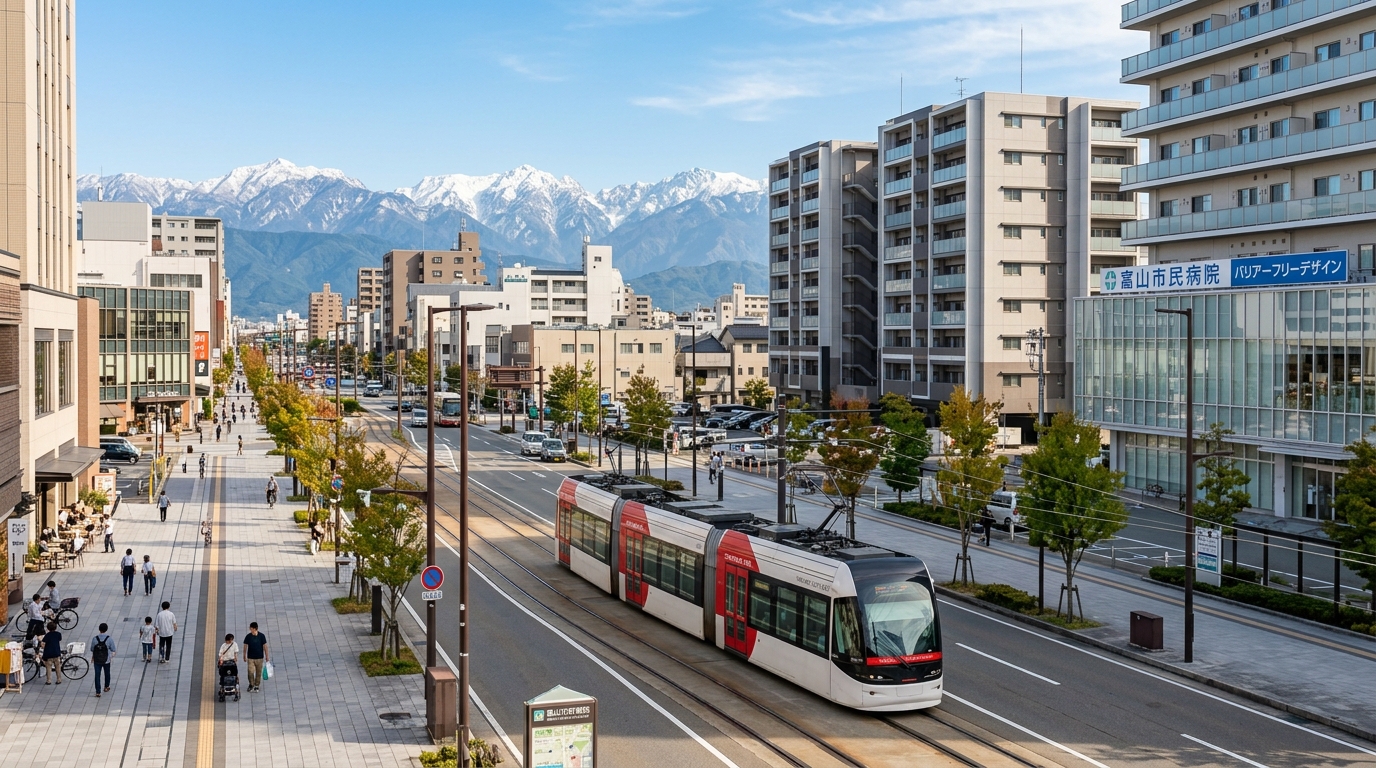
Toyama City has long promoted a "Compact City" policy, famously compared to "dumplings and skewers" (お団子と串) — concentrating city functions (the dumplings) along public transport routes (the skewers). By centralizing medical, commercial, and administrative facilities along a Light Rail Transit (LRT) network, the city has created an environment where residents can live comfortably without relying on cars. In this article, we will thoroughly analyze how senior-friendly livability impacts real estate asset values by examining actual transaction data around Toyama Station (富山駅), the latest redevelopment news, and updated 2026 subsidy programs. Read on for insights into assessing investment potential leading up to 2030.
[Real Estate & Environmental Data Summary for Toyama City (Toyama Station Area)]
| Item | Data / Indicator |
|---|---|
| Target Period | 2021–2025 |
| Transaction Data Samples | 5,979 cases |
| Average Transaction Price | Approx. 20.95 million JPY |
| Median Price | 13 million JPY |
| Average Unit Price | Approx. 40,000 JPY/sqm |
| Nearest Station / Daily Passengers | Toyama Station (Ainokaze Toyama Railway / あいの風とやま鉄道) / 31,492 passengers/day |
| Medical Facilities Near Station | 21 locations |
1. Rethinking Housing in a Super-Aging Society on Respect for the Aged Day 2026
As Japan's aging rate continues to rise, deciding "where to live" goes beyond mere convenience—it has become a critical issue that dictates future Quality of Life (QOL). Especially for seniors, there is a rapidly growing demand for "walkable cities" where they can seamlessly shop and visit clinics even after surrendering their driver's licenses.
From a real estate market perspective, these "locations that support prolonged independent living" share a clear characteristic: their asset value rarely depreciates. Instead of sprawling suburban houses, compact condos and homes located near stations or transit stops with daily infrastructure within walking distance are being reevaluated and highly prized.
Toyama City anticipated this trend early on and has actively concentrated urban functions in its center. Taking Respect for the Aged Day as an opportunity to consider the optimal environment for our own future homes—or a relocation destination for our parents—is highly beneficial for increasing the certainty of real estate investments. Let's develop the ability to assess a city's potential based on objective, data-driven perspectives.
2. Why "Compact City" Now? The Reason Toyama City Commands Nationwide Attention
The core of Toyama City's Compact City policy is to maintain efficient administrative services and uphold residents' living standards despite population decline and an aging demographic. By preventing urban sprawl and encouraging population concentration in designated residence promotion zones, the city can provide high-quality public services while curbing infrastructure maintenance and renewal costs.
A particularly noteworthy trend for 2026 is the revision of Toyama City's "City Center and Public Transport Corridor Residence Promotion Project" (まちなか・公共交通沿線居住推進事業). Starting this April, the policy shifted significantly from supporting new housing construction to subsidizing the acquisition and utilization of "used housing (existing stock)." As a result, generous subsidies are now available to households that purchase and renovate eligible pre-owned homes in central areas. This measure, which prevents the increase of vacant homes and effectively circulates existing housing stock, is also highly praised from a Sustainable Development Goals (SDGs) perspective.
According to data obtained by this site, Mekiki Research (物件目利きリサーチ), the area around Toyama Station is designated as a "Commercial Zone," permitting intensive land use with a building coverage ratio of 80% and a floor area ratio of 500%. This combination of deregulation and subsidy systems acts as a powerful driving force, attracting people and capital to Toyama City's urban core.
3. A Life Connected by LRT: Comfortable Transport Convenience Without a Car
When discussing Toyama City's Compact City, one cannot overlook the LRT (Light Rail Transit) system that runs north-south and covers the entire city. In regional cities that were once the epitome of car-centric societies, there is no other example of such a successful return to public transportation.
Toyama Station, served by conventional lines like the Ainokaze Toyama Railway and the Hokuriku Shinkansen (北陸新幹線), is a massive transport hub handling 31,492 passengers daily. The LRT runs directly under the elevated tracks of Toyama Station, seamlessly connecting the north and south exits and dramatically improving mobility within the city.
For the elderly, the low-floor LRT vehicles—which have no steps and are easy to board—act almost like moving walkways. Having a transport network that allows safe, weather-independent access to major city facilities even after giving up a driver's license strongly supports the independent living of seniors. This overwhelming transport convenience is undoubtedly the biggest factor underpinning the solid real estate demand in central Toyama City and along the LRT corridors.
👉 Research transport access and surrounding property prices around Toyama Station with Mekiki Research
4. Hospitals and Supermarkets Right Nearby! A Secure Living Environment for Seniors and Families
When measuring livability, the abundance of medical and commercial facilities is indispensable. According to our acquired actual data, there is a dense cluster of 21 medical institutions in the Toyama Station area alone, including Toyama Ekimae Himawari Hospital (富山駅前ひまわり病院), Masutani Gastroenterology and Internal Medicine Clinic (桝谷胃腸科内科クリニック), and the National Health Insurance Society for Civil Engineering and Construction, Chubu Health Management Center Toyama Clinic (全国土木建築国民健康保険組合 中部健康管理センター 富山医務室). Having everything from specialists to general hospitals within immediate walking or LRT distance is the ultimate peace of mind for seniors prone to health concerns.
Furthermore, the expansion of commercial facilities that enrich daily life has been remarkable. Most recently, on September 18, 2026, a multi-commercial complex called Across Plaza Toyama Kakeo (アクロスプラザ富山掛尾) began opening sequentially on the grounds of the Toyama City Public Local Wholesale Market (富山市公設地方卸売市場). Featuring the first Toyama Prefecture store of Al Plaza Foods Market (アルプラフーズマーケット) operated by Shiga Prefecture's (滋賀県) Heiwado (平和堂), alongside Yamada Denki Tecc LIFE SELECT (ヤマダデンキ Tecc LIFE SELECT) and Super Sports Xebio (スーパースポーツゼビオ), it has become a bustling new shopping hub offering everything from market-direct fresh food to daily necessities and home appliances in one stop.
The concentration of medical institutions and the birth of the latest large-scale commercial facilities—this seamlessly connected environment in Toyama City forms an extremely attractive living foundation not only for seniors but also for families raising children who want to manage chores and childcare efficiently.
👉 Check the map of nearby medical institutions and convenience facilities right now on Mekiki Research
5. A Practical Buyer's Perspective: Toyama City's Appeal for Prospective Homeowners
For those considering buying a home for their own use, Toyama City offers a major advantage through its robust subsidy programs. By utilizing the aforementioned "City Center and Public Transport Corridor Residence Promotion Project," buyers can receive partial grants for the acquisition and renovation costs of pre-owned condos and houses in the city center, making it possible to significantly reduce initial expenses.
On the other hand, one aspect that must never be ignored when purchasing real estate is disaster risk. According to hazard data from the Geospatial Information Authority of Japan (国土地理院) and other sources obtained for this report, while there is no "landslide" risk in central Toyama City, there is a very high risk for "flooding," rated at a maximum depth rank of 5 (estimated inundation of 10 to 20 meters). Given the geographical characteristics of hosting multiple rivers including the Jinzu River (神通川), preparing for flood risks is essential. When choosing a property, we strongly urge buyers to take measures such as selecting higher floors in condominiums or elevating foundations for detached houses, and to always check the latest hazard maps before purchasing.
Additionally, educational environments require careful attention. In our public transaction data, school district information for specific elementary and junior high schools was listed as "null (unassigned/missing data)." Because school districts in central urban areas are often reorganized, it is absolutely vital for families buying property to individually verify the designated school zones with the Toyama City Board of Education (富山市教育委員会) using the latest information.
👉 A must-check before buying! Visualize detailed hazard risks in Toyama City with Mekiki Research
6. A Must-Read for Investors! Real Estate Value and Future Potential in Infrastructure-Concentrated Areas
From here, we will analyze Toyama City's real estate market from an investor's perspective. We present data-driven benchmarks for investment decisions across three sections: "Redevelopment Overview," "Impact on Land Prices," and "Future Investment Potential."
[Past 5 Years of Actual Transaction Data and Impact on Land Prices] Analyzing 5,979 actual transactions from 2021 to 2025, the overall average transaction price is approximately 20.95 million JPY, the median is 13 million JPY, and the average unit price is about 40,000 JPY/sqm. However, price disparities are prominent depending on the area and the property's age. For instance, a relatively new pre-owned condo (built in 2018, 3LDK, 80 sqm) in a commercial zone within the central Sakuramachi (桜町) area traded for approximately 36 million JPY, and even a 2014-built condo (2LDK, 65 sqm) in the same area went for 28 million JPY, indicating extremely strong demand for highly convenient downtown condos. Conversely, a residential plot in the Oeboshi (大江干) area (Category 1 Residential Zone, 60% coverage, 200% floor area, 200 sqm) sold for 23 million JPY, a pre-owned condo in Kakeomachi (掛尾町) (Commercial Zone, built in 1990) for 8.5 million JPY, and a pre-owned condo in Kuboshinmachi (窪新町) (Quasi-Industrial Zone, built in 1992) for 13 million JPY, showing that appropriate market prices have formed based on zoning and building age.
[Redevelopment Overview] Multiple large-scale redevelopments are currently proceeding simultaneously in Toyama City. A major redevelopment project in the Sakuragicho (桜木町) area, the prefecture's largest entertainment district, has kicked into high gear. Additionally, in the Chuo-dori D-Kita District (中央通りD北地区), a Category 1 Urban Redevelopment Project is underway for "Premist Tower Toyama Chuo-dori" (プレミストタワー富山中央通り), a 24-story residential tower set to become a new local landmark.
[Future Investment Potential (Timeline Forecast)]
- 2026 (Present): The opening of Across Plaza Toyama Kakeo and the shift toward pre-owned housing in the city center residence promotion project are revitalizing the existing housing stock market. The Sakuragicho redevelopment is also fully underway.
- 2028: Redevelopment facilities, including those in Chuo-dori, are scheduled for sequential completion. The integration of commercial and residential functions will advance, accelerating population influx into infrastructure-concentrated areas.
- 2030: The Compact City policy will reach maturity, solidifying the settlement not only of seniors but also of younger generations and families seeking convenience. Land prices and rental rates along the LRT lines and in the central city area will see a baseline increase, offering strong expectations for a balance of stable income gains and capital gains.
As a benchmark for investment decisions, properties within a 5-minute walk from Toyama Station or LRT stops have an extremely low future vacancy risk. It is no exaggeration to call them "ironclad areas" where long-term asset value preservation can be expected.
7. The Well-being Brought by a "Walkable City" for All Generations
The goal of a Compact City is not merely to optimize urban functions. The ultimate objective is to realize the "well-being" (a state of physical and mental fulfillment) of its residents.
Seniors taking the LRT to dine out with friends in the city center. Families enjoying weekend shopping at new commercial facilities. A daily life completely free from the stress of accessing hospitals and government offices. All of these represent the richness brought by a "walkable city." Ultimately, real estate value is determined by "how many people want to live there." The overwhelming living convenience and sense of security provided by Toyama City attract numerous people across all generations, which directly translates into robust real estate demand.
For both investors and prospective owner-occupiers, choosing an area where the city's growth factors are clear and resident satisfaction is high is an absolute requirement for successful real estate selection.
👉 Compare and verify the conditions of "livable cities" proven by data on Mekiki Research
8. Conclusion: How to Choose a City for Long-Term, Secure Living Supported by Medical and Transport Convenience
Today, in honor of Respect for the Aged Day, we explored the asset value of a Compact City driven by senior demand, using Toyama City as a prime example. The overwhelming transport convenience provided by the LRT, the peace of mind from having 21 clustered medical institutions, and the birth of new commercial facilities like Across Plaza Toyama Kakeo. As these elements merge, Toyama City will continue to evolve into an even more attractive urban center leading up to 2030.
As actual data shows, properties in highly convenient areas are trading at bullish prices, and there are ample expectations for the maintenance and appreciation of future asset values. On the other hand, there are many critical points you must verify with your own eyes before purchasing, such as flood risk hazard information and detailed school district boundaries. In real estate, making calm decisions based on objective data is more important than anything else.
For those who want to deepen their real estate research: By registering for a free account, you can pull the Ministry of Land, Infrastructure, Transport and Tourism's actual transaction data and hazard information used in this blog directly through your Claude or ChatGPT (via MCP integration / MCP連携). Why not leverage AI to continue your research at your own pace until you are completely satisfied?